Nixed
For those who don’t want to look at the nuts and bolts of writing, here’s a funny and informative look at an acquisitions meeting (I LOVE this blog entry): http://cba-ramblings.blogspot.com/2010/09/behind-scenes.html
Also, here’s a random picture of a bird on a train:

There are some very mild spoilers in the following (spoilers on theme and on the first few chapters only).
I just started reading “Sabriel” by Garth Nix for the second time this week, analysing it like crazy to understand how a master of storytelling weaves his spell. It’s a little odd to be studying “Sabriel” (400 pages for young adults) while editing “The Princess and the Pirate” (40 pages for kids) but some principles do transfer.
I’ll ignore the prologue in this analysis, having talked about it two days ago. It’s interesting to note, however, that the first paragraph of the prologue isn’t action – it’s setting. It’s a “slow burn” opening, which is the right choice because (a) having used a prologue, the chapter one opening must be involving from the first sentence, which means a “slow burn” opening will no longer be an option, (b) the setting is quite difficult to grasp – two completely distinct lands exist side by side – one magical, and one more like 1920s England. So it needs to be mentioned up front, and re-mentioned several times in the next few chapters. (And of course, that one paragraph of description sets the mood for that scene.) And even though Sabriel is barely born in that scene, she is still the centre of it – she even manages to be an active character.
And on with the first chapters.
The very first paragraph is a truly eerie image of a white pet rabbit, freshly bathed – and freshly killed. The dichotomy of innocence and horror is a constant throughout the book (Sabriel is 18 – literally a schoolgirl). Sabriel raises the rabbit from the dead before its young owner arrives. TV tropes has a section on “pat the dog” – establishing a hero’s goodness by their kindness to an animal. This scene is a fantastically macabre (and frightening) “pat the dog” – with a twist. The twist is that Sabriel’s calling is to make sure the dead (including this rabbit) stay dead – her compassion is a flaw.
This ties in to the main plot, not only because the school (and its innocence) becomes important later, but because Sabriel faces a similar temptation at the climax.
It also makes us love her instantly – that is the primary function of the scene (the character hook is her compassion, plus her own fear of her frighteningly creepy job, plus the unique pain of compassion being a flaw). And it shows us a little more of the mechanics of her job (which are important many times in the book – the realm of Death has its own rules and challenges).
After that there are 3 pages of quite straightforward exposition – by now we care enough to find it all interesting.
Then a literal incursion of horror into a dorm filled with 11-year old girls (girls Sabriel is responsible for). A dead thing enters, and Sabriel runs to fight it (we see she’s brave, but also see her authority over the dead – even the Magistrix of the school clearly sees Sabriel as the most competent person to deal with it). It is a terrifying scene – but that’s not the primary purpose. The primary purpose is to deliver a message from Sabriel’s father (aka Mr Macguffin) – effectively saying a garbled, “Help!” It’s a brilliantly dramatic way to deliver a message, and also shows more about Death that is important later.
And the plot is set: Sabriel must find her father (who may or may not be beyond help). The plot later builds to become, “Sabriel must find her father and save the kingdom” but the emotional heart is exactly the same.
Now that the plot and character are established, chapter two and three are relatively action-free (except for a brief misunderstanding – that, admittedly, could have gotten Sabriel killed if it had gone the wrong way). There’s a lot of setting detail, more info on the stakes (including a 14-day ticking clock for tension), and more on Sabriel (mainly: she shows humanity as she struggles to carry a load of skis and stocks and backpack, she shows off cheekily to an annoying beaurocrat, and a father figure is deeply concerned for her dangerous voyage, but respects her enough to help her on her way).
Chapters 4-7 are an epic and terrifying journey, with quite a bit of setting detail (journeys are handy for that, particularly since Sabriel hasn’t travelled that path since she was 4), some bad news on the big bad (via a pile of corpses), and a brief moment of joy when Sabriel meets her dead mother’s spirit (which just makes us more sympathetic, since her mother is dead and rarely reachable – even this meeting is cut short). Sabriel kills a dead thing, but flees from another – which shows her competence, while also showing that This Is Serious Now.
And then there’s a period of physical and mental recuperation before she continues on her way – this time, with a Mysterious Companion (who is sort of evil, but also extremely helpful, and a great source of humour throughout the book).
Here’s the way Garth Nix deals with the challenges of opening a novel:
1. Instant hook: The image of the rabbit is compelling.
2. Setting: He describes Sabriel’s school uniform (including her prefect’s badge), and the iron school gate, which says “established in 1652 for Young Ladies of Quality”. That tells us everything we need to know about her boarding school, and thus all necessay setting for the first two scenes. (The dichotomy of this “country” with the magical one 40 miles away is also mentioned – not for the first or last time. Chapter two and three are set entirely in the area between the two locations.)
3. Characterisation: The fast hook is her compassion, magic, and that her compassion is a flaw. We then quickly see her courage and intelligence – reinforced by the way both children and adults come to her for help.
4: Instant action: Within a page, we have a problem (the Bunny’s young owner is fast approaching), and Sabriel goes into the risky world of Death to do something about it.
5: Plot hooks: It’s not until the dorm room scene that we know the main plot.
a. Finding her father, who may or may not be dead.
b. Sabriel needs to get better at her job (keeping the dead dead). Will she turn evil?
c. In chapter two, it becomes clear that more lives are at stake because of her father’s helplessness.
d. After the big action sequence, Sabriel keeps a wary eye on her companion (and soon gets another, who is also mysterious – and has several private conversations with the first). Each companion is utterly vital at the climax, and their secrets are relevant.
6: What characters look like: Since it’s in third person, everything is described in a fairly straightforward manner.
7. How the magic system works: As in “The Princess and the Pirate”, the basics are shown by immediate action, and more is revealed as it becomes relevent (again, through action).
8: Link to prologue: We all know Sabriel is the infant of the prologue – and the plot soon makes it very clear that a character we love (Sabriel’s dad) is in mortal danger. (And, since he’s not the main character, we know he really could die – causing pain to Sabriel, who has suffered enough.)
So that’s how it’s done: Exciting stories within the greater, more exciting story.
I’ll be sending off “The Princess and the Pirate” in the next few days (unless CJ spots a fatal flaw when he reads it tonight). I recently met three people from Publisher D (two of them the most relevant two people I could have hoped for). Publisher J specifically recommended Publisher D, so this is my shining new hope. Sadly, I’m only sending the first three chapters, so I won’t have a final answer for 6-12 months (and that’s assuming they’re prompter than the silent Publisher B).
The main lessons I’ve learnt from Nix this week are:
1. A Mr Macguffin needs a prologue – but your chapter one opening has to be a killer.
2. Some character-establishing exposition is fine, once you’ve earned it.
3. Repeat, repeat, repeat your main plot – all the way through the book (and the other plots/motivations too).
#40: Steal Flowers
If there’s anything this blog has taught me, it’s that crime is awesome*. Technically, this item on my pre-existing list read “pick flowers” but since I own exactly 0 flowers at present (some of my plants are dead, and some. . . sleeping), I chose theft once more.
I’m still recovering from schmoozing in Melbourne and Brisbane, and I’m still physically recovering from Indonesia in January (and a vitamin D deficiency). It’s reasonably difficult to get up in the morning, or be enthusiastic about. . . well, anything.
And this is where crime comes in. I stole these flowers from five different locations (my friend Ann may find the daffodils eerily familiar, but the other victims of my crime spree were all neighbours and/or strangers), generally leaving my car running to assist in the fastest possible getaway. I inadvertently collected several ants (both large and small) in my guilty haste, but since none bit me and the fuzz hasn’t come a-knocking, I feel I can confidently declare that crime pays.
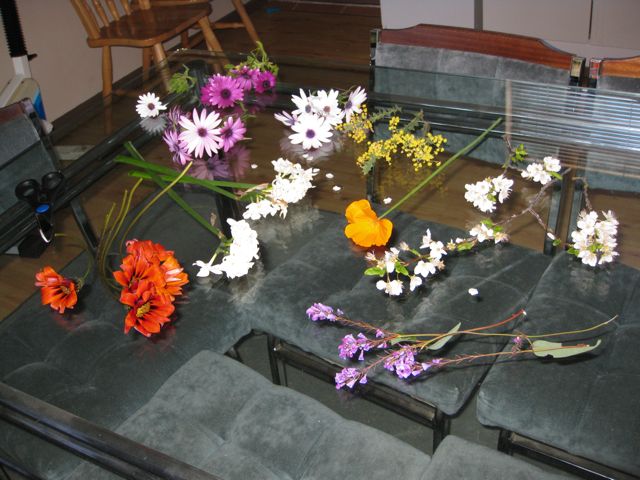

And, it’s fun.
My heart rate is up, my house is all pretty (I put some in every single room), and a smile is tugging at my lips.
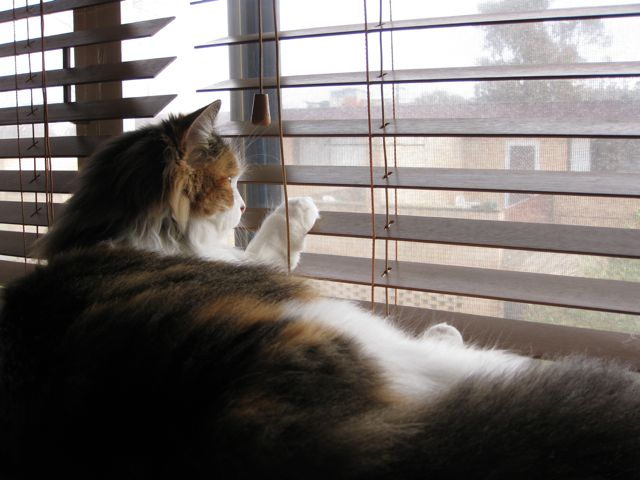
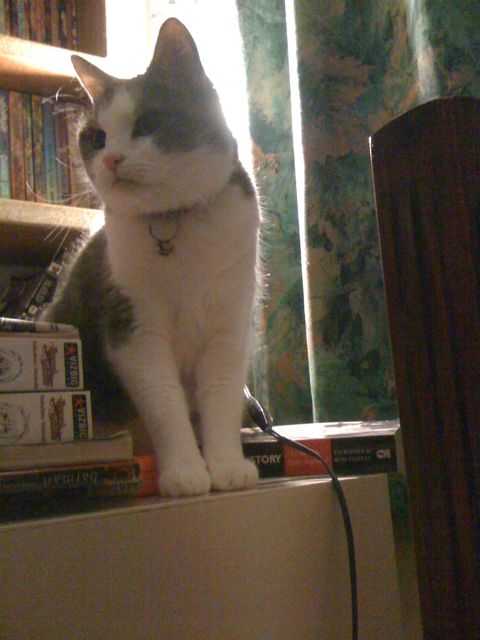
In other news, I took these two photos of my cat Ana spying on our neighbours (neither was posed, and the look in the second picture was a response to my picture-taking – after which she went back to work. . . watching. . .). I also had a nightmare about a killer robot last night. That was odd.
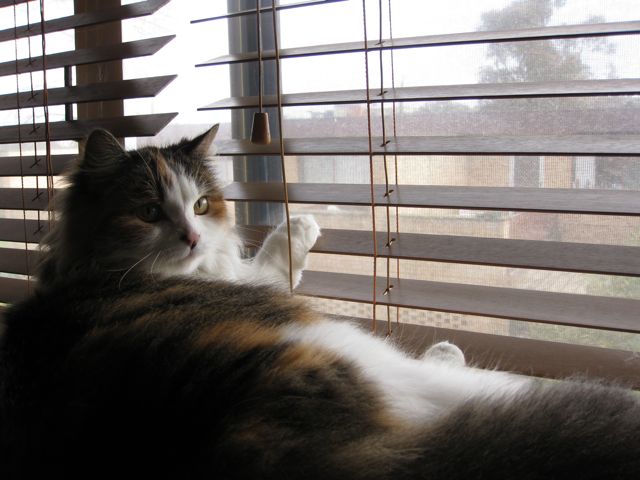
I call this second one, “Here’s looking at you, meatwad.”
*There’s been fountain frolicking, herb hustling, and guerrilla gardening thus far.
S#40 and #82 – Silly hats for the deaf
s#40 is to learn sign language.
#82 is to wear a silly hat.
There are a lot of different sign languages, so I learnt the Australian sign alphabet. The vowels are the easiest – you just touch your right index finger to each finger of your left hand – “A” is the thumb, “E” is the index finger, and so on.
Play along at home: If your name is Ioueueoa, you already know how to say your name! Great work!
You’ve seen this silly hat before, but I think this is the last time I’ll wear it this year. I was invited to a picnic by an optimist (you can tell they’re an optimist, because they invited me to a picnic in Canberra in September). The weather was like this:
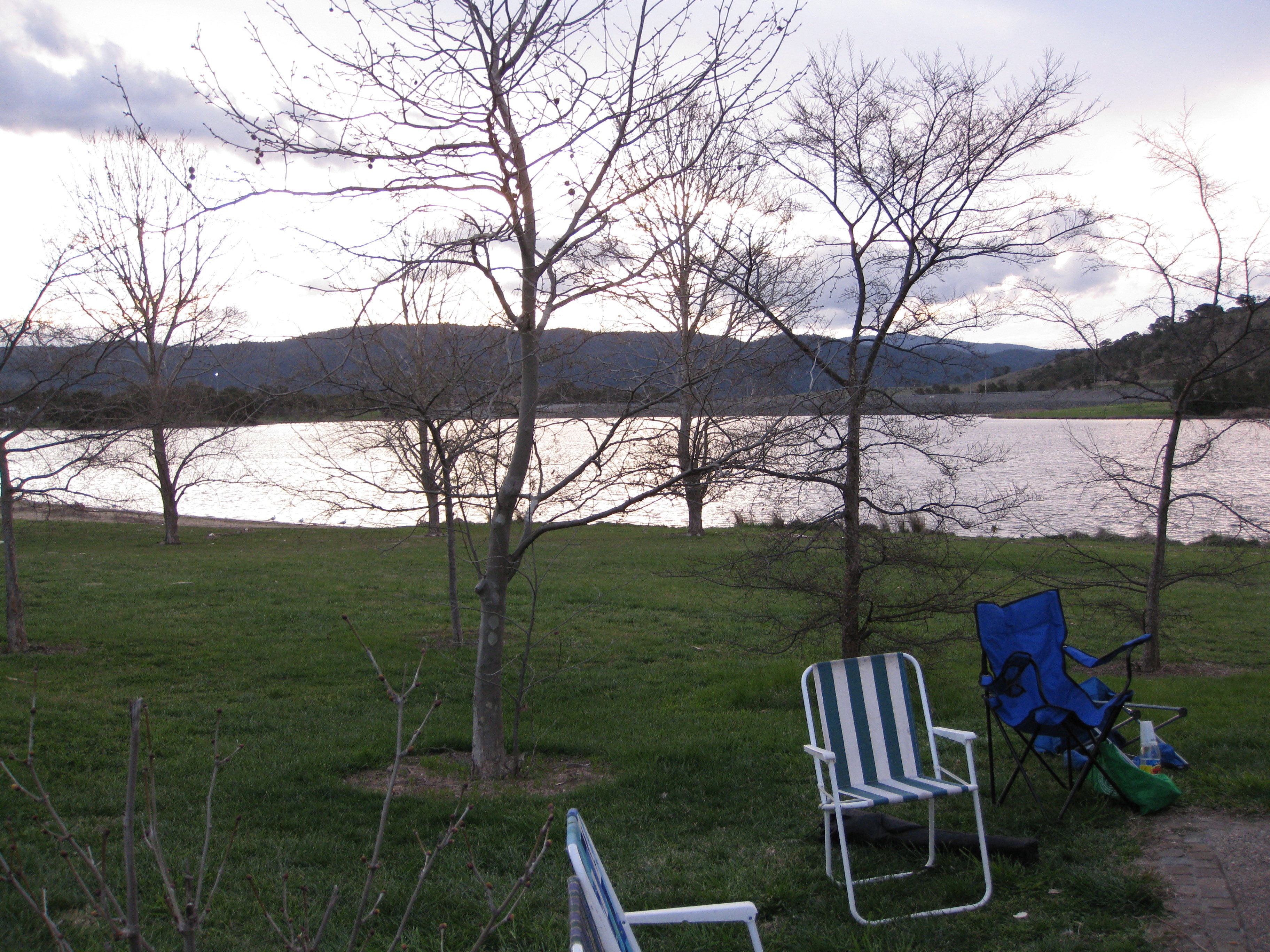
There was also an icy wind.
Now, my beanie is famous on three continents, but on this particular day I was outdone by a sheep/monkey suit, as you can see:
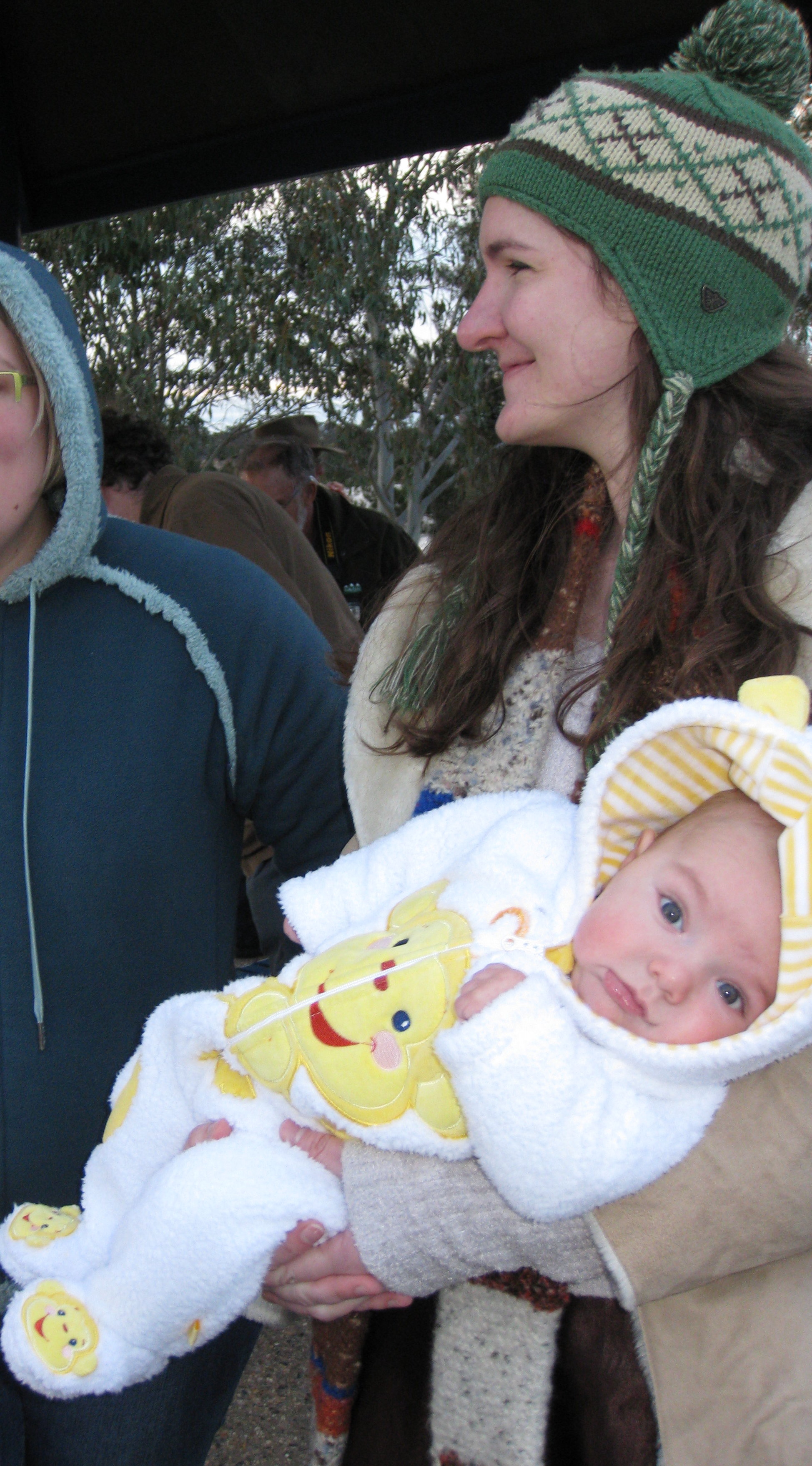
Kids these days.
And here’s today’s killer robot, from (I think) geekologie:

There’s more writing stuff today and tomorrow at https://felicitybloomfield.wordpress.com.
Topping Mr Macguffin
The bad thing about having a fabulous prologue is that you need to re-grab your readers from the very beginning of chapter one – while also (along with the usual difficulties of setting, characterisation, action, plot hooks, and finding a new way to say what your characters look like and how the magic of the world works) making the link between prologue and actual story perfectly clear.
Here’s my tips on all of these (since I think better when instructing someone else) – keeping in mind it’s vital to SHOW the various details rather than boring a reader by simply explaining the salient points.
1. Instant hook: I used magic (which has coolness factor), and a need to escape. Instant goals = good. Here’s the very beginning:
I smiled prettily at my usual pack of guards and eyed the outermost wall of Ratu Castle one last time. It hadn’t been easy to get them so close to the open air. They’d all seen me walk through walls before.
It’s the challenge that makes it fun, I thought. Escaping Mum’s clutches.
2. Setting: My fantasy world is tropical, with many islands (and many cultures), and brown-skinned people. It’s rare to go hungry and almost impossible to be cold. People trade stories or art for food (or, more likely, other art). About one-third of the population has some kind of magic, and it’s considered quite ordinary (even lower-class in some places). The technology is fairly medieval, as is the population (ie villages and towns and farmers and sailors, rather than high-rise buildings and businessmen). Ratu island has a population of a few thousand, ruled by a troubled monarchy (the previous two kings were both murdered by the pirate at different times) and currently experiencing plague.
We’ve already seen pirates in the prologue, which implies 1700s Europe. The hints of “this is like Earth, but a while ago” is reinforced by the mention of the castle/monarchy. In the first two chapters, only the castle is described – that’s enough setting for now. The narrator’s magic and the fact that she’s a princess are both mentioned in the third paragraph – the two things combined are a quick character hook to keep people interested as I draw a more detailed picture of who she is. She’s about 13, a couple of years older than the target readership (her age is never mentioned, but it’s clear from the way people talk about her and how she relates to them).
3. Characterisation: The first paragraph above shows the princess is cheeky and a little melodramatic – and accustomed to a “pack of guards” (slightly ominous). It also shows there’s trouble with her mum (who may even be evil). There’s more in the next little while about her dad’s recent death, her mum’s emotional withdrawal (not evil, but not making good decisions), and the fact she’s not allowed out of the castle (which I hope kids will relate to on a metaphorical level – certainly they’ll relate to an over-protective parent). She also shows kindness by making sure the guards aren’t punished, and shows more spirit by eavesdropping on an adult conversation. My favourite thing about her is her goodness and innocence/optimism – it’s her innocence that is at risk in the book (people think the most exciting books are the ones in which the character nearly dies – but losing one’s identity is a lot more frightening).
4: Instant action: Magically escaping guards in order to eavesdrop. It’s exotic but also relates to escaping schoolteachers, so it’s not TOO exotic (I’ve been comparing “Sabriel” by Garth Nix with his “Seventh Tower” series, and one of the reasons “Sabriel” is better is that the “Seventh Tower” series has a lot of stuff on class structure – which isn’t very emotionally powerful to modern Australian kids).
5: Plot hooks: In chapter one, we find out she is leaving the island (quite shocking and exciting – I think kids will like the idea of going away to sea). In chapter two, she is given a goal – to find the pirate Sol (who we already know is Bad News). So there’s adventure and danger. I think kids need to relate to the emotional heart (“I need to help my mum”) but the physical plot (going away to sea) should be outside their experience (who wants to read about homework and chores? Not me ). I now realise I need to reinforce that emotional goal – helping mum – about six times more in the next few chapters. Readers need more than one plot hook to stress over, so here’s what I have:
a. Going to sea to find the pirate, to help mum. (As a main plot, this is a bit too complex/far-fetched ie how could the pirate possibly help?)
b. What is Ransom, what does he want, and is he dangerous?
c. The princess’ aunt is dying (weak, because there’s no action, but it does provide an ongoing stress).
d. I need something else for readers to stress over. (In YA fiction, this would be the romance strand.)
6: What characters look like: She describes the other characters (which is handy for the brown-skinned part), and it is clear from “smiled prettily” that she fits the pretty part of the princess image already in people’s heads. Rather than having her look in a mirror (ugh! SO overused!) I described what she looked like by her actions – she mentions pushing her fringe out of her eyes, wishing her perfect ringlets would be messed up, and that she’s wearing royal dress. Someone else mentions her “big brown eyes”.
7. How the magic system works: There are three normal types of magic – quickensmiths (able to shift solid objects, given touch), healsmiths (about to hurt or heal, given touch), and feelsmiths (able to read or change emotions, given touch). The princess demonstrates quickensmithing with her actions, and the other two remain unmentioned in the book because they’re irrelevant here. In my opinion, the sooner a book mentions magic, the easier it is to accept. All we need to know is that some people are quickensmiths, and that they can touch physical objects in order to make them move or change shape. (For this scene, all we need to know is that she can walk through or inside the thick wooden walls.)
8: Link to prologue: Ratu Castle is mentioned in the last paragraph of the prologue, so hopefully it’s still in the reader’s mind. Also, the character of Ransom is described as “the human-shaped thing” (that the pirate fears) in the prologue and “the queen’s counsellor” (that the princess takes for granted) in chapter one – a nice ominous contrast for readers to stress over.
PS In other news (in case I’ve left something dangling from past entries):
I’ve just been put on Vitamin D (I was extremely low, as it turned out – something that causes fatigue, muscle/joint pain, and cramps).
Publisher B still hasn’t replied, not even to say they still have the books.
Publisher J dislikes fantasy (arg!), so didn’t request “The Monster Apprentice”. I’ll send them my realist novel when they’re open to submissions again – at least they know I can handle myself in person (useful for future promotion). They also suggested I change the name of the character formerly known as “Boy” (who appears in all my fantasy books). At the moment I’m trying out “Ransom.”
#75: Leave lights/heater on
My “study” is located in the corner of our (large) living room. In Summer or Winter, I try to take my laptop to our (much smaller) bedroom to save on heating and cooling. Yesterday I glanced over my entire 66,000 word realist novel (in case Publisher K requests it this week, which is fairly likely), and as a treat I stayed at my usual desk and turned the big heater on.
It was niiiice.
Here’s a short story, since my exuberant heater use doesn’t make an especially thrilling blog entry. (Writing tips are a-happening today and tomorrow at https://felicitybloomfield.wordpress.com if you’re into that sort of thing.)
“Why stars are the way they are”
Missy Myway was the sweetest of the starlets, and her soul was as great as the ocean. Fans were charmed when she wore bunny slippers to her first award ceremony, peeking out from under a designer gown. Her face was as expressive as her music, grinning as her blonde hair fell across one eye, or sweetly calling attention to the successes of her favourite charities. People called her the girl of a thousand smiles.
Her only foible was that she did not like having her picture taken. It was a phobia based on the beliefs of certain third-world cultures that cameras could steal a person’s soul. She sat for painted portraits each day, and passed them out to photographers as gifts, hoping to discourage their professional enthusiasm. They merely photographed her handing out the pictures.
Even as she retreated back into restaurants or behind gates, her sharpest rebuke was to say, ‘I don’t want my photo taken, you drip.’ Young girls began using the word ‘drip’ as hip new slang referring to anyone wielding a camera.
Missy and her high school sweetheart were married. The drips were greeted cordially by Missy’s manager, and invited to leave their cameras at the door and enter. The ceremony was performed in the backyard of Missy’s childhood home. Most of the town attended, but they were still outnumbered by photographers, twitching frustrated fingers as Missy sparkled like never before.
As Missy and her husband were permitted by reverent order to kiss, cameras appeared from under seats and inside handbags. The flashes pierced her closed eyes. She broke the kiss and stared around as if caught in a deadly trap. That iconic look of interrupted innocence appeared on the cover of no less than three major magazines within the week.
Something changed in the press that day. They followed Missy in taxis and unmarked vans, taking pictures of her at the beach, with family, and through the windows of her home. Photos appeared of her getting drunk as she sought anonymity by any means. Soon there were pictures of her fighting with her husband, and both of them trying new and harder drugs. A photo of Missy with another man made the photographer’s career. The man went on to star in a hit reality show. Even in the sealed courtroom, as Missy wrangled with her soon-to-be-ex-husband, someone managed to secretly take photo after photo after photo.
As Missy left the courtroom a hoard of paparazzi caught her on the steps in a blaze of light. She shrieked and swore and swung at the nearest. The drip grabbed at her, and snagged a handful of fabric.
‘You want some?’ she shrilled. ‘Take it!’ She tore at the shirt, bursting the buttons, and threw it in his delighted face. Her bra followed, and the respectable skirt she’d worn to court. Famous undies matched the bra on the ground. The flashes were like an electric storm. Missy shielded, not her face or her nakedness, but somewhere near her heart. Soon there was nothing left to take.
Missy Myway was the sweetest of the starlets, and her soul was as great as the ocean. Even the ocean can be emptied, drip by drip.
THE END
And, today’s killer robot (from geekologie, I think):

Mr Macguffin, at your service
The good thing about a prologue is that you can often find and use a crucial incident as a hook, packed with action and characterisation. The bad thing is that when you use a prologue, your readers have to effectively begin a new book when the prologue is done (this is deeply annoying when the prologue is very long). Worst of all, sometimes a prologue is better than the book that follows. Or just so very different readers just get annoyed.
The second book in my kids’ trilogy has a prologue (generally I avoid them). The book is called “The Princess and the Pirate” and is about a princess (the narrator) seeking out a pirate. The book is a clash between the naiive, optimistic, kind-hearted princess, and the pirate – who is a sadistic killer. The narrator is too innocent to understand where the pirate is coming from, plus the pirate doesn’t appear for the first few chapters. Thus, there is a prologue showing the reader the pirate is evil, and the related danger to the princess. Without the prologue, “pirate” sounds like she’s probably a fun person to be around. With the prologue, you know enough to be frightened for the heroic princess.
My prologue is in third person, and the rest is in first person. I just read today that it’s a no-no to write a prologue that’s very different in style to the rest of the book. But I think that’s a rule that is best broken in this instance. The darkness of the prologue NEEDS to contrast with the princess’ view of the world. That’s the whole point. It’s the only part of the story she is incapable of telling.
I’m re-re-re-re-reading “Sabriel” by Garth Nix. In my opinion, it is the best book ever written. It also has a prologue, which actually has a similar purpose to mine. The plot is driven by a human macguffin (a macguffin is an item, usually magical, that the characters must find/use/fix/destroy in order to save the shire/world/kingdom), who appears very little in the story. Without the prologue, the main character’s journey would lack emotional heart. Nix’s prologue, like mine, focuses on the macguffin as a human with flaws and attributes and feelings. Mine does too.
I’m happy with my prologue.
Coming soon: Ramblings about the first few chapters.
S#33: Haiku
My friend just gave birth
It’s not real yet; not quite yet
Is it real to her?
When I grow up I’ll. . .
Be rich. Be nice. Be happy.
Mostly eat bacon
I don’t like waiting
Snow falls, then sun, then more snow
Stupid publishers
From geekologie
(She says, not really certain)
A killer robot:


S#22: A Boxoffice Night’s Dream – Inception Review (with Shakespearian flavour)
There’s been much ado about “Inception” – a movie about what dreams may come, and how they can be shaped. I’ve heard people are seeing it twice in order to figure out the darn plot – and that’s fair. But I would posit that (after the opening flash forward) you always know what’s going on and what’s at stake (which is all you need), and personally I plan to see it again just because it’s so excellent (and yes, I’ll enjoy understanding it a bit better the second time around).
This is a startlingly good thriller. The idea is trippy and fun – our minds are a very opal. There were moments of great emotion when I realised I would have been crying except that I was so thoroughly caught up in the action that I was too stressed to cry. I’ve heard it said that it’s really fantasy, not scifi, and I do recommend you take it that way – the ideas are fun, not realistic – and instead of technobabble they have a button and some coloured water (what more does one need? Personally, I’m grateful to avoid lectures and just get into the story.)
The acting is exquisite, and the writers manage a big-name ensemble cast without losing sight of who the true main characters are. This is a movie that does special effects seriously well, and doesn’t let them overwhelm a tense story. It’s also very funny, and bleeds sheer coolness from every pore. It also has the quality I loved in the first “Lord of the Rings” and the relatively recent “Italian Job” – intense, understated male camaraderie. Oh brave new world, that has such people in’t!
People who seriously dislike speculative fiction (especially the speculative/mind-bending parts) may not like it. I think everyone else will, especially those who like a thoughtful and/or well-characterised and/or funny thriller. I get bored fast when people talk about feelings. I love it when their feelings are going to GET EVERYONE KILLED.
I still love “Sherlock Holmes” most out of 2010’s films (I’m not all that big on mind-bending plots in general) but this is a movie I want to see again – as soon as possible.
And as the plot thickens in “Killer Robot Cat”, here’s another menacing look from one of my own killer cats:
#201: Blood (but no tears this time); or, Stop whining and go see a doctor.
The weather has it in for me.* Our bathroom has no fan, so our bathmats are forever getting wet and not drying out. Every so often I wash them (may as well) and hang them on the line. The trick is to do it first thing in the morning. Then, come late afternoon, they are bone-dry and delightfully fluffy underfoot.
I awoke to sunshine this morning. I washed and hung out the mats.
I collapsed back into bed in a state of existential despair (a predictable outcome of actually daring to venture interstate; recovery takes a long time).
I awoke to torrential rain.
Huh.
Too late to rescue the mats, I simply went to my scheduled doctor’s appointment. (I had some blood taken a month ago, and had received a non-urgent call that they wanted to talk to me about the results. I was rather nervous, since I’ve visibly gained weight since last visit, when the doctor advised me to cut down on chocolate***. She’s a daunting lady.)
I was kept waiting for almost an hour, during which time my anxiety grew.
Finally the moment came and I was called into the arena. My blood had revealed extremely low vitamin D levels – something that causes fatigue, muscle aches, and stomach cramps. She was kind enough not to bother suggesting radical treatment (such as going outside sometimes), but told me to take pills. That I can do. Everything else was normal. She advised me once again to eat less bad cholesterol, especially in milk and dairy, but rather than breaking down sobbing at the thought (which I did last time) I just said, “Not going to happen.” We repeated the conversation a few times, and I promised I might, someday, drink skim milk. She released me unharmed.
It is an indication of something amiss that I’d felt worse last time about being dishonest by omission (because apparently, in my mind, abject sobbing translates to, “Yes doctor. I’ll change my naughtiness at once!”) than about humiliating myself by crying. This time, I did neither.
So that was a great visit. I feel better, I didn’t cry, and I have a brand new genre of magic pills to make life all better.****
I then went to the shops to do various things. It was blindingly sunny, and I felt hopeful for the fate of my bathroom mats. Maybe they’d still dry out in time – or at least, enough to be brought inside.
I did the shopping, and emerged to another bout of torrential rain.
Like I said, the weather has it in for me.
But I’m getting my own back. I’m gonna take vitamin D tablets, and I NEVER NEED TO GO OUTSIDE AGAIN!!*****
I win.
Tomorrow: Bonus Inception review, plus awesomeness.
And from http://abstrusegoose.com/301, psychological proof (as if we needed it) cats are evil:

*too melodramatic?**
** nevaaaaaaarrrrrrrrr!
***Hah!
*****And again I say to you, hah!
*****Well, not if there’s a nice tunnel system built from my house to various crucial locations – and we finally buy that dryer we’ve been planning on.

 Felicity Banks