Don’t have contacts in the biz? Don’t worry
Last year I spent a bunch of moolah and time schmoozing across Australia, and I ended up with personal contact (handshakes, names, cards) with staff from four of Australia’s six big publishers.
I now have enough data to tell you what those contacts mean to me so far:
*drum roll*
Drastically longer response time.
I am personally convinced that the only – ONLY – time personal contact helps you is if your book is one of the .05% (that’s not an exaggerated joke, sorry) of books that gets to the final stage of the maybe-getting-published ladder – the acquisitions meeting. At which stage, you contact will most likely say, “Oh yeah, I met Louise Curtis. She wore a simply giant dress to some conference somewhere. Seemed mostly sane.”
The good news is that that comment may make the difference between accepting your book and accepting another book on the table at the same meeting (that was written by someone who doesn’t have contacts).
In the meantime – particularly if you’d like a chance at a response time shorter than six months (again, I’m not joking, sorry – six months is standard across all publishers, in my experience), the person you REALLY REALLY want. . . is the assistant.
Here’s an article from Kidlit Blog telling you why:
For my Writer’s Digest webinar, I pledged to answer all the questions sent in by students. This one got me fired up enough to transfer the exchange to the blog:
What can we do to ensure that an actual agent sees my query? I’ve received rejection letters directly from assistants, therefore I know that the agent hasn’t seen my query or sample work. Perhaps the agent would have liked it, but if he or she wasn’t able to see it, then both the agent and I miss out on what could have been a wonderful opportunity.
This writer seems to have what I would call Assistant Attitude. It’s a belief that assistants aren’t really important and that only the big names at an agency can make or break a writer’s chances at representation. A lot of (beginning) writers think very poorly of assistants and are shocked — shocked! — to learn that these are the people reading their queries.
I invite everyone currently suffering from a case of Assistant Attitude to consider, perhaps, the complete opposite viewpoint.
Read the rest here. Always remember – the hard part is writing a brilliant book, so focus on that.
Meanwhile, a kitty (who just saw a bird dare to land on OUR windowsill):

For batter or worse
In 2006 I decided to do nothing but write – mainly in order to discover if I could handle it (I can; I still write for a minimum for twenty hours each week). For a period of three months, that’s all I did. In order to keep going as long as possible before going back to the world of paid employment, I was EXTREMELY careful with money. I worked out later that I’d spent an average of $5/week on food and even less on transport (usually I walked up to two hours in each direction).
(For those who are wondering, this is not a recommended career choice for writers. 95% of us keep our day jobs for life – and that’s just the ones who get published.)
Previous poverty experience had taught me that if I don’t get three meals a day I stop being able to function. So I ate pancakes – generally twice a day, and sometimes three times a day. I had a regular schedule of three actual proper meals each week, which I relied on for my nutrition (I’d spend dinner with my parents – who of course didn’t know how badly I was eating – W, and another friend). Towards the end I staggered when I walked, and was hovering on the edge of illness. But I could still type, so I didn’t care.
(As you can tell if you know anything at all about CJ, this was before we met.)
The pancake recipe I used (really crepes, since they’re so thin they’re see-through) was:
Batter: Mix 1 egg, 2 cups milk (mixed from powdered milk), 1 cup of plain flour.
Fry pancakes in margarine and eat with sugar and lemon juice.
The astonishing thing about this piece of personal history is that I still like pancakes (although they absolutely must be fried in real butter these days). So for our monthly date this month CJ and I went to The Pancake Parlour for breakfast (expert’s tip: If you eat out for breakfast somewhere with freshly-squeezed orange juice, DO NOT brush your teeth beforehand).
The Pancake Parlour in Canberra is a subterranean wonderland of leather-padded seats, wooden booths, and brass fittings. The franchise began in Melbourne, and is found in most large Australian cities.
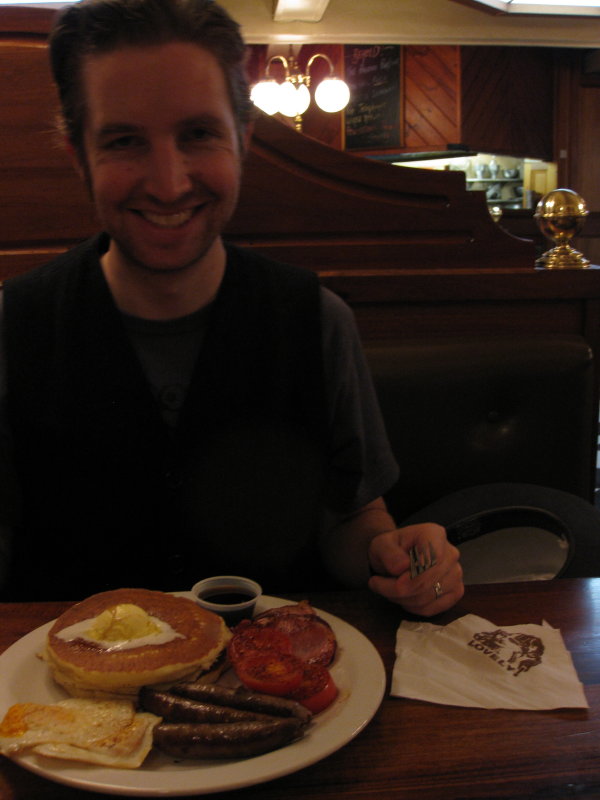
CJ had a full country breakfast:
I had a “Red Dawn”, which consists of two cheese pancakes with rashers of bacon cooked into them, served with a giant scoop of butter (it looks like the sun at dawn, see?), and grilled tomatoes. (As you can see from photos taken this week, that beanie is staying firmly planted on my head until Spring.)
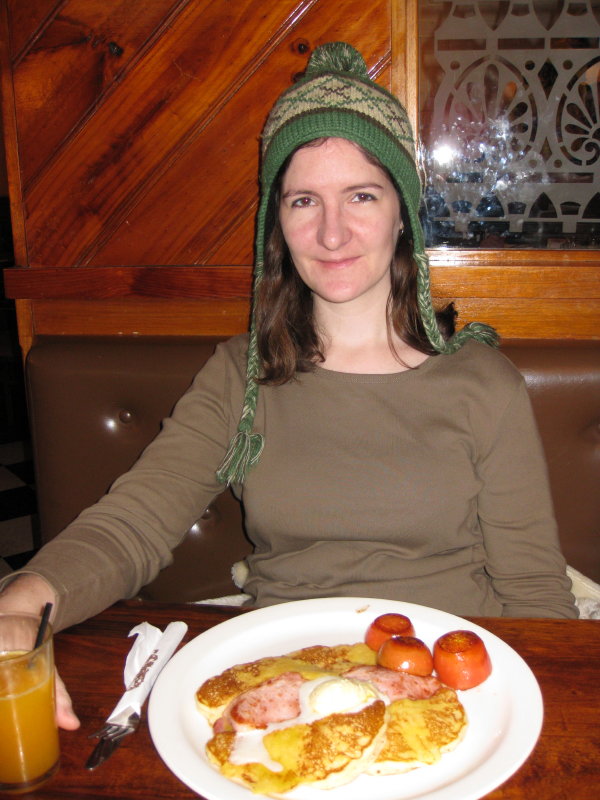
I didn’t finish the tomatoes (just empty vitamins). I did, however, steal some of CJ’s maple syrup – because although bacon and maple syrup is gross, when served with a pancake it’s sheer gastronomical genius.
Mmm. . . pancakes. . .
Why not make your own this weekend?
The ex-boyfriend, and an incident with a broom handle
I like my ex-boyfriends. Mostly because I’m only attracted to interesting, intelligent people who don’t hold grudges. Also because I am an interesting, intelligent person who doesn’t hold grudges.
One of my exes is now good friends with my brother, and has also run into CJ at work (which pleases all of us). This ex and I rarely see each other, because something about our complementary flaws makes us both depressed if we see too much of each other – but we always wish each other well and enjoy hearing positive goss about each other.
Also, he’s Koori. You wouldn’t know it to look at him, so for him the main benefit is that he can get into an argument about Koori issues and then spring his Koori status on his opponent just as they think they’re getting somewhere (I may have mentioned I like people who are – and I quote – “interesting”). Also, he’s allowed to eat certain endangered animals – and in the Northern Territory, he can legally ride without a seatbelt.
And so it was that I picked up the phone to call an ex-boyfriend I haven’t seen or spoken to in years – waking him up in the process – and asked, “Do you know what nation you’re from?”
He told me his Koori side is from the Canberra area, which I informed him was no use to me at all. But he happens to know someone who’s Koori and from Victoria – and into speculative fiction. So he gave us both each others’ email addresses, which gives me a brilliant place to start on my place-specific information and permission.
We talked for a while about various things (mutual friends having babies, rather gory traditional funeral rites – you know, the usual) and then he went back to sleep.
Man, I have excellent taste in guys.
Later in the day CJ and I went to the National Library (I badly wanted to read “Triumph of the Nomads” by Geoffrey Blainey and “The Mish” by Robert Lowe – who many will know as the awesome Aussie footballer who also happens to be a Victorian Koori). Every book that’s ever been published in Australia is available at the National Library, so it’s a brilliant resource for obscure bits and pieces (and/or books that are out of print). Here it is:

Naturally I was distracted and spent a big chunk of time looking at books on pepperbox revolvers, the Eureka flag’s peculiar journey, women of the Ballarat goldfields, and convict ships.
“The Mish” (short for “The Mission Base” – where he grew up) was a fun and fascinating book that saw the funny side of poverty and racism and the author’s many childhood accidents.
Here’s a chunk of the book that made me laugh in a manner that isn’t considered appropriate in a library (if you are Koori, be advised that he mentions a deceased Koori by name):


Thanks to the mother’s broom and the father’s plough (he ploughed severely all around the house, making a muddy moat the government men weren’t able to get their equipment through), the house was saved.
The Mish now belongs to the people living there.
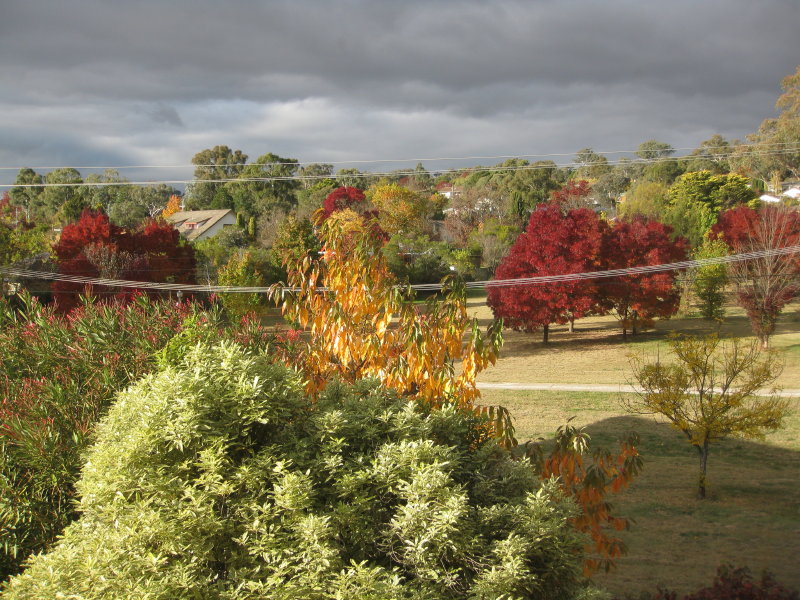
And here, because I can, is the pretty view out my window that greets me each Autumn:
BBQ at Pine Island
Bil (Brother In Law) and his girlfriend visited Canberra last weekend, and gathered their friends and relations for a barbeque at Pine Island. It was quite peculiar meeting the girlfriend because I know she reads this blog (which is really flattering – and makes me think, “Oh dear. What horribly embarrassing things does she already know about me?”) She was exactly as charming as I expected – and now I’m all annoyed because I have another non-Canberra person to miss when she’s not here.
Curse you, rest of the world!
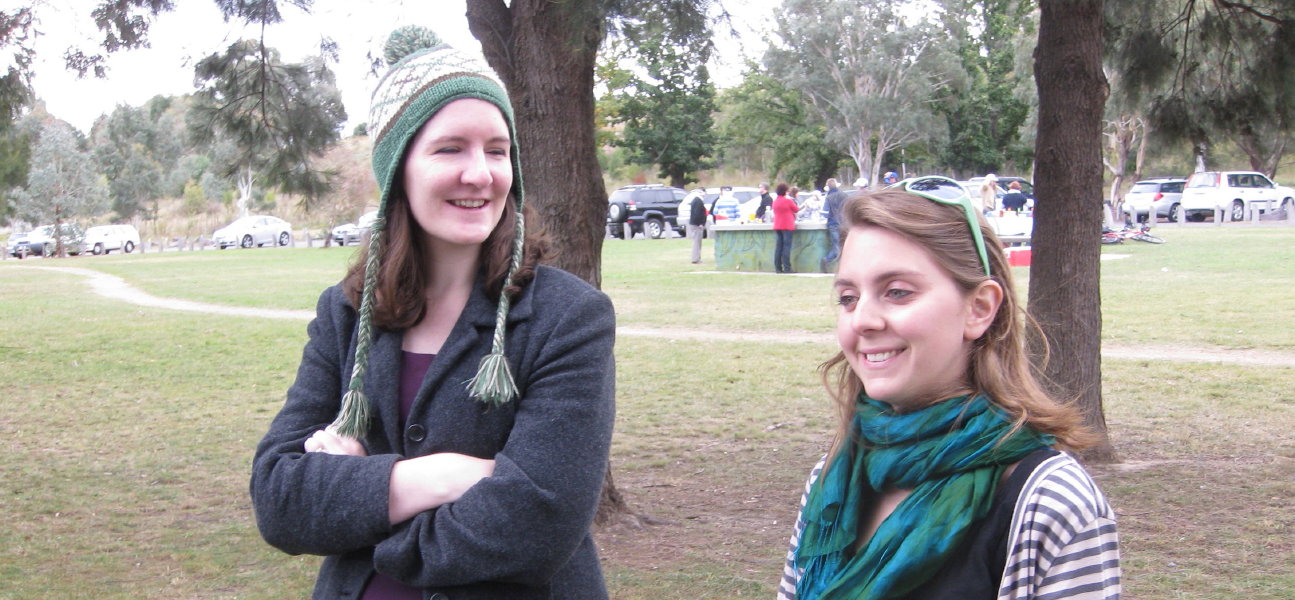
And here’s Bil:
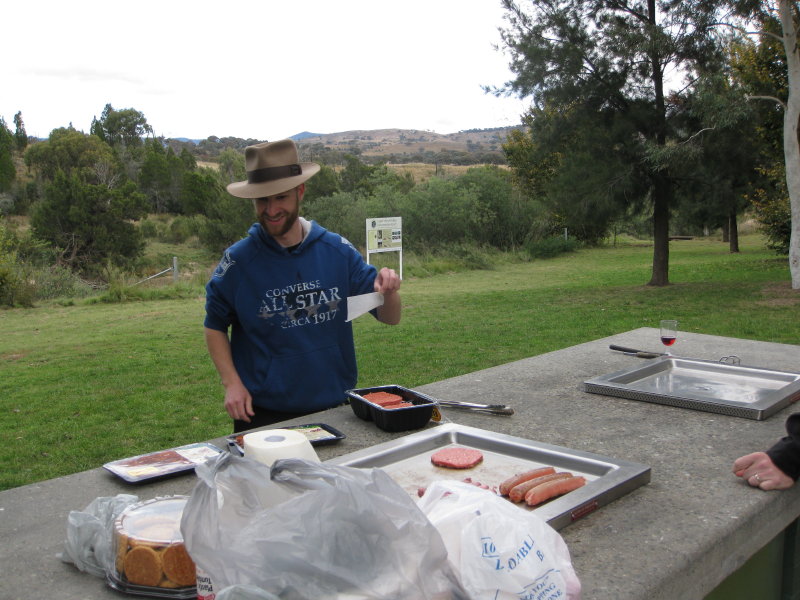
Here’s the paparazzi, in the form of Bil and CJ’s dad:

I’ve been to Pine Island exactly once before. On this occasion it was a cold and blustery day, but there was no way I was going near water without having a paddle.
The water was. . . well, let’s call it “invigorating”. The mud beneath had a surprisingly sticky quality, much like I imagine the slime from the Bog of Eternal Stench.
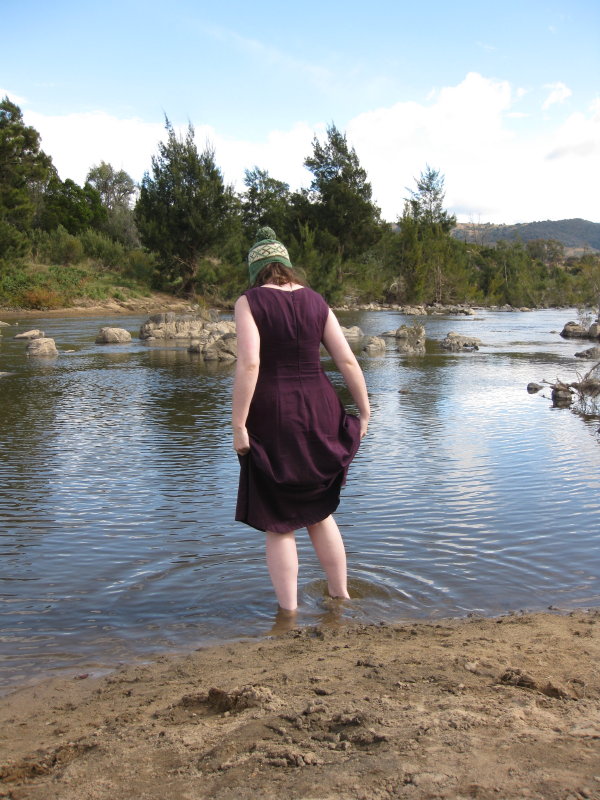
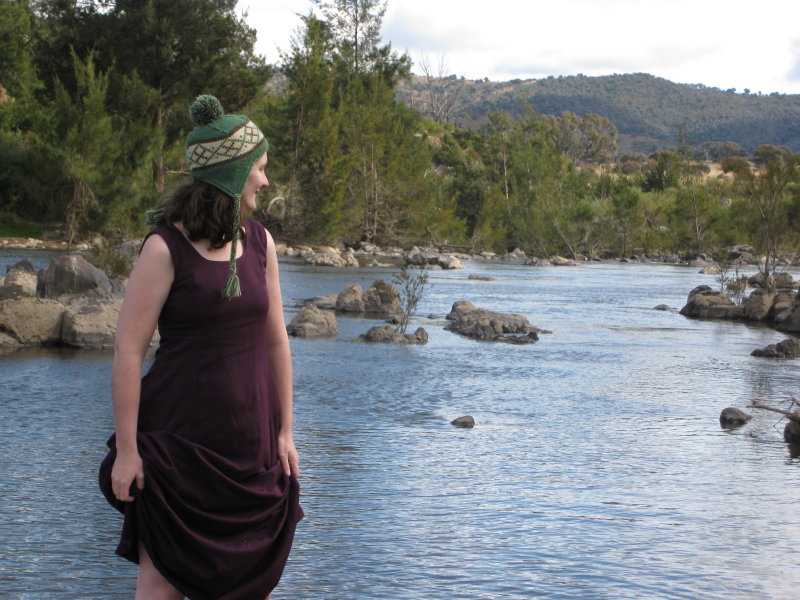
Totally worth it.


“Is that a. . . ?”
Play along at home: Imagine your own underwater horror and fill in the blank.
Mmm. . . cheap Easter eggs
Today’s awesomeness is one many of you are familiar with – and all of you can enjoy today. In fact, I command that you do so: Descend upon your local shopping centre for massively discounted Easter produce.
Excellent.
I bought “jelly eggs” – that is, cheap jelly beans slightly adjusted in shape. What a brilliant marketing ploy.
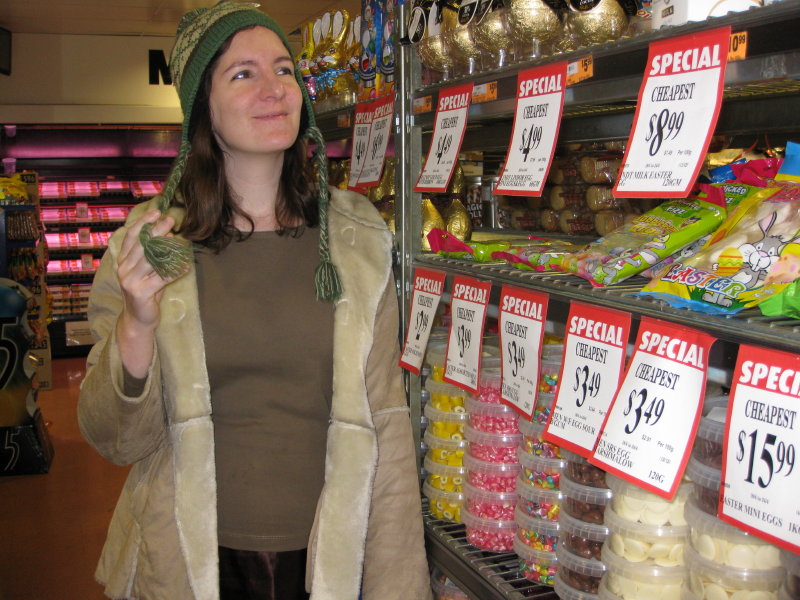
In related news, some friends of ours went away for the Easter weekend, so CJ looked after their rabbits. The friends thanked him by buying each of us. . . a Lindt chocolate bunny to eat.
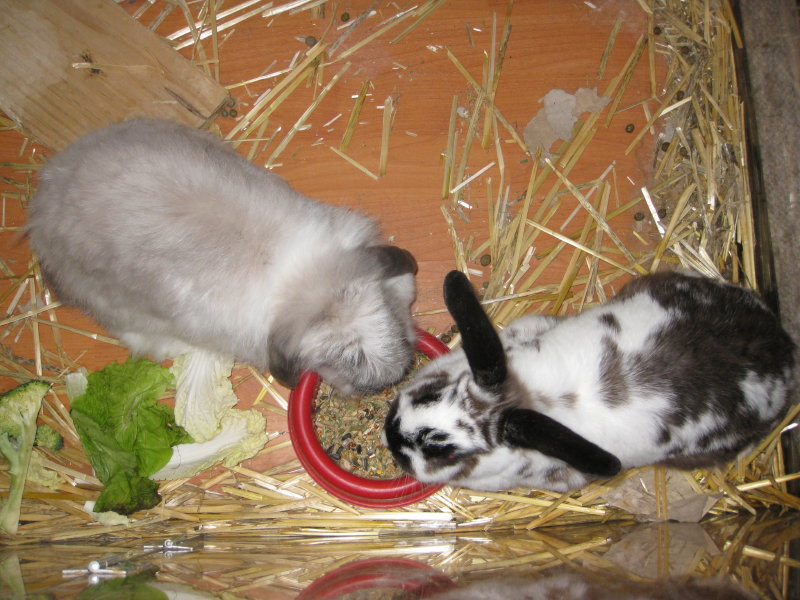
You’re making me hungry. . .

I hope all of you had a safe, happy, and chocolate-filled Easter.
An Australian, an American and a British girl walk into a Chinese recording studio. . .
This video was recorded by a British girl and features an Australian man and an American woman recording a dialogue intended to assist Chinese students learning English. It singlehandedly explains all the Chinglish you’ve ever seen. As you watch, keep in mind that they were not allowed to alter the script in any way. Enjoy the increasing insanity as the Australian man starts playing multiple parts. Don’t forget to listen carefully to exactly what they say.
The fake glasses are Korean.
And here are some random photos from January last year when CJ and I went to Beijing.


I blogged about China here and here, and about the Great Wall here.
Talking the steampunk talk (PG)
The Victorian Era was a time of miasmic fog, elegant manners, and the criminal classes. The slang of the time was often colourful (to say the least).
I took most of the following list from “A Long Way Home” by Mike Walker (and the rest from “Victorian London” by Liza Picard and my own nautical days), choosing those that were fun and/or largely self-explanatory (so I could potentially use them in my book).
I left out three-quarters of the original words because they were too rude.
Most of these words are from cant, and others are unique to Australia.
All nations – a mix of drinks from unfinished bottles
Avast – stop
Bacon-faced – full-faced
Baked – exhausted
Bark at the moon – to agitate uselessly
Barrel fever – illness caused by excessive drinking
Beef-head – idiot
Belay that – hold on a bit
Bingo – brandy
Bit of red – a soldier
Black arse – kettle
Blashy – rainy weather (Irish)
Blue as a razor – very blue
Blue stocking – learned woman
Bollocks –testicles
Botany Bay – vagina
Chunder – to throw up
To have some guts in one’s brains – knowledgable
Brandy-face – drunkard
Brattery – nursery
Break-teeth words – hard to pronounce words
Gold bridge – easy and attractive way to escape
Broganeer – one with a strong irish accent
Canting crew – criminals
Caper – to be hanged
Cast up one’s accounts – to vomit
Cat-sticks – thin legs
Caterpillar – a soldier
Chalk – to strike someone’s face
Conveyance – a thief
Cove – fellow
Cully – fellow
Swear like a cutter – swear violently
Dangle in the sherrif’s picture frame – to be hanged
Deadly nevergreen – the gallows
Gone to the diet of worms – dead and buried
Dilly – a coach
Dim mort – pretty girl
Dip – pickpocket
Dog booby – an awkward lout
Empty the bag – to tell everything
Enough to make a dog laugh – very funny
Duke of limbs – a tall, awkward fellow
Eternity box – coffin
Step into eternity – hanged
Expended – killed
Fence – receiver of stolen goods
Fiddler’s money – all small change
Flash the gentleman – pretend to be a gentleman
Footpad – thief on foot, mugger
Fork – pick a pocket
Game – plucky
Gammon – nonsense
Gentleman in red – soldier
Glass-eyes – person wearing glasses
Glim – lantern
Groggified – tipsy
Gut-foundered – extremely hungry
Half seas over- half drunk
Hanged look – villainous appearance
To be under hatches – dead
Hog in armour – finely dressed lout
Irrigate – take a drink
Jack ketch – hangman
Jack of legs – very tall person
Jaw-me-down – talkative fellow
King’s Head Inn – Newgate
Knob – an officer
Lappy – drunk
Lift – shoplifting
Light-timbered – weak
Little house – a privy
Make – steal
Monster- huge (as in “The Monster School”)
Red-letter man – a catholic
Repository – jail
Ride as if fetching the midwife – to hurry
Rusty guts – a blunt, surly fellow
School of Venus – a brothel
Scragged – hanged
Shake a leg – wake up/get to work
Shiners – money
Smart as a carrot – very smartly dressed
Snail’s gallop – to move very slowly
Squeak – betray
Swag – shop
Tilter – a small sword
Tommy – lesbian
Whisk – an impertinent fellow
The sad part of discovering such wonderful words is most of them are too startling to work in a book. I cut most of them in editing, because they were simply too distracting. Any vaguely historical book (including medieval-style fantasy) has to find a balance between accurate historical language and comprehensibility to a modern audience. On the up side, some Victorian slang has trickled through to today (“fence” for example) – so that helps.
My advice: always use contractions (I’m, he’s, they’ve, haven’t), never use thees and thous (except in an actual poem – an unfortunate number of fantasy writers use them incorrectly, which is just embarrassing), avoid visual dialects like the plague they are (“‘Ave a good day ya fine chappy, wot wot?” – stick to an occasional verbal tick like “what what” if you must) and of course avoid all modern slang (“My fine fellow, your tale about that strumpet was seriously TMI.”)
I found my own steampunk voice by soaking in books and letters written by real people living in Victorian times – and then just writing what felt natural to me.
Some of the words stayed, however, and I’m glad.
How to be awesome (here)
Today’s article is written by Nathan Bransford, who is a writer, ex-agent, and social media expert.
It’s called “How to write a good blog comment” and I can heartily confess to rampant self-interest in sharing it here.
Let’s begin:
The art of writing blog comments may at first blush seem like a frivolous and unimportant one, but that is not actually the case!
Writing excellent blog comments is perhaps the very best way to build your own blog and/or social media presence. Consider a blog comment an audition to show off your own personal awesomeness.
Not all blog comments are created equal. Here are some good rules of thumb as you work your way up to becoming a blog comment ninja.
Read the Post You’re Commenting On, Then At Least Scan it Again
Yes, this takes time and the careful suppression of twitchy fingers. But there is no quicker way to leave an ineffective blog comment than to miss something in the actual post or to accuse the poster of saying something they didn’t actually say.
Accuracy is important. Good blog comments take into account the entire post and then come up with a good and original response. So not only take the time to actually really read the post, keep the comment on topic rather than bringing in an outside and unrelated agenda.
That said……
Get There Early
The most effective and influential comments are near the top of the comments section.
Read Nathan’s other four excellent points here.
My own personal tips:
1. Always assume everything you post online will be read by your mother, your boss, your worst enemy, and your best friend.
2. Never, ever express anger online (see # 1) unless you are fighting for a cause outside yourself.
I’ve also discovered that writing about where your manuscript is at with agents/editors/publishers (or how long they take to reply) is also a no-no. Unsurprisingly, they don’t like to be publicly discussed.
Perhaps more importantly, proudly reporting – or weeping over – your dozens of rejections has the effect of making you look unpublishable, which can put professionals off – because they definitely do look at your blog and google you before offering representation (see #1). Which is why you won’t be hearing any more about the publication process until I have an offer (and permission to talk about it here).
3. If you’re young, invent a fake last name that you use everywhere online (if you’re a writer, it can become your pen-name, so make sure it’s distinctive but easy to spell).
I also recommend you visit Nathan’s blog and/or his top-notch writer forums.
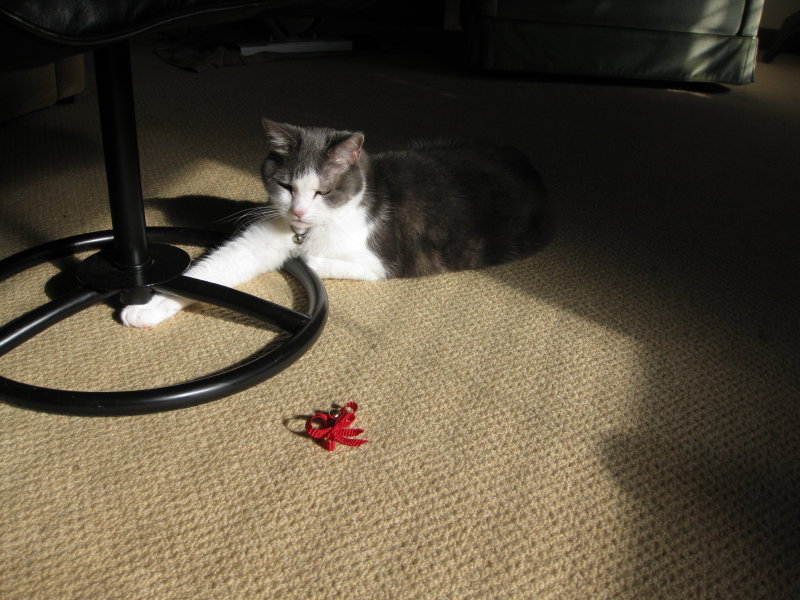
Here’s an Easter-themed cat picture – this is Indah pointedly ignoring the Lindt Bunny bell I tinkled and then threw at her.
Hosting Christian Passover
My family has two feasts each year: Christmas and Passover. Both are hugely significant. In some ways Passover is more special because I’ve never knowingly met another family that celebrates it – so there’s absolutely no commercialisation (not even presents – not even *gasp* chocolate!)
I blogged about our Christian passover ritual last year, and I’ll almost certainly blog about it again next year.
This year was unusual. My Mum was running a passover at her church, which meant I could either join her church for the day or do something completely different. Since I’ve recently developed a strong phobia of church and even church buildings (sad but true – although a Bible Study group still meets at my house each week), I decided to look at it as an opportunity rather than a barrier, and run my own.
It was actually quite special to run my own without my parents’ presence – it meant I could do things in whatever way felt best to me – instead of trying to recreate past Passover experiences. (For example, my parents have a script with questions and answers that we read aloud – but I just told people what things mean.)
Sidebar: Passover is a Jewish festival. According to the Christian Bible, Jesus celebrated Passover with his disciples just before he was arrested (Christians know that meal as the last supper). The reason Easter moves around each year is because it’s linked to Jewish Passover (which moves because it’s linked to a different calendar) – which is the Thursday night before Good Friday.
For better or worse, CJ and I celebrated our own version of Passover this year (with four friends who had never been part of a Passover ritual before). Be advised that I’ve blurred together several quite different rituals with information from google and my own family’s traditions.
As people came in, they washed their hands in a bowl of clean water.
All the ritual foods (except the lamb) were set out on the table:
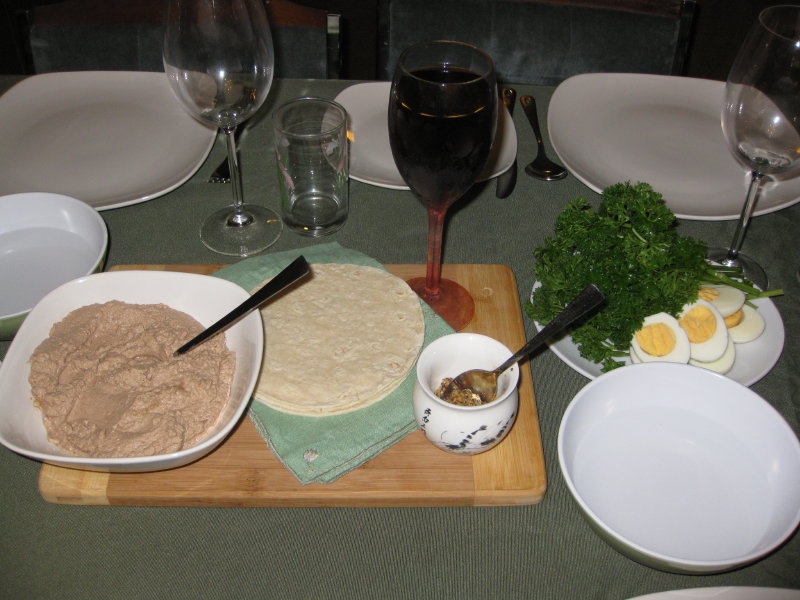
In the centre is the matzoh bread – bread made without yeast, representing the hasty departure of the Israelites from slavery in Egypt.
Beside it is a full wine glass that doesn’t belong to any of the guests. It is called the Cup of Elijah, and it represents the expectation that Elijah will return. Many Christians leave it empty, on the basis that we believe Elijah has already returned.
On the right and left of the matzoh there are bitter herbs (I used mustard, ugh), representing the bitterness of slavery; and sweet charoses (a blended mix of grated apple, grape juice, cinnamon and crushed walnuts – yum), representing the cement used by the slaves to bind bricks together.
On the right there are boiled eggs, greens, and salt water. The eggs represent life and the perpetuation of existence. The greens (parsley) represent hope and redemption. Salt water represents the tears of slavery.
The lamb represents the lamb sacrificed and eaten at the original Passover. On God’s instructions via Moses, the Israelites put lamb’s blood over their doorways on a particular night. The Angel of Death passed over those houses – but killed the firstborn children of the Egyptians (note to self: don’t make God angry, particularly after being warned by Moses and by numerous miraculous plagues). That night, the Israelites were finally released from generations of slavery.
And on to the ritual. . .
We drank the first cup – the cup of sanctification.
CJ took the three pieces of matzoh, broke the middle piece, and hid it.
We ate the other two pieces of matzoh with the bitter herbs and then with the sweet charoses (putting the charosis in a matzoh sandwich to represent bricks).
We drank the second cup – the cup of deliverance.
We ate the eggs and greens (first dipping them in the salt water – they taste very nice that way).
We drank the third cup – the cup of hope.
At that point we served main course and dessert, and I took this photo of my friend’s seven-month old trying sweet charoses for the first time:

We drank the fourth cup – the cup of praise (which for Jews is the final cup).
At that point, with a teensy bit of help, our youngest guest found the hidden matzoh from the start of the evening and gave it back to CJ.
I personally believe that it was at this point in the last supper that Jesus (like CJ, the patriarch of the ritual) took the matzoh – the bread that was broken, buried, and then brought out again – and said, “This is my body broken for you. Eat this in remembrance of me.” I believe that he then took the Cup of Elijah and passed it around for everyone to drink saying, “This is my blood, shed for you. Drink this in remembrance of me.”
I believe that when Jesus was crucified the next day, he fulfilled the symbolic promise of the original sacrificial lamb of Passover – saving us from death and slavery to sin – and that the Passover ritual was designed as a supernatural foreshadowing of Easter. Because God knows his literary techniques.
Christians echo the bread and wine of Passover every time they take communion – but most don’t realise the fact that Jews celebrated this ritual for centuries before Christ was born.
Get it right – this time

I knew before I began my steampunk novel that I would need to learn a whole new set of rules when it came to my Koori character, Matilda (you’ll notice that’s not a Koori name – names are just one taboo area).
A week or two ago I attended a lecture (in the gorgeously squished building above) by bestselling chicklit author Anita Heiss, who is a member of the Wiradjuri nation.
The lecture itself was very interesting (especially the various covers – some early drafts had Koori art from utterly the wrong nation, ugh), but the best part for me was that, as I’d hoped, Anita was able to tell me exactly where to look to find out how to write respectfully about a Koori character.
These are the two documents she recommended I read before approaching the correct Koori nation for more detailed consent:
http://www.australiacouncil.gov.au/__da … _guide.pdf
http://www.asauthors.org/lib/ASA_Papers … tralia.pdf
The bits about copyright were especially fascinating, because of course copyright law isn’t designed for oral stories – which means extremely valuable stories are not legally protected. Not yet.
Also, I’ll probably need to pay actual money to representatives of the nation I choose for Matilda’s background. I can handle that. Given the classic steampunk theme of rampant colonialism, it’s neat that I will be giving something back in order to honourably write about that era.
There is a huge wealth of religious tradition that non-Koori Australia is largely unaware of – not because we’re helplessly undereducated, but because much of it is secret, and needs to stay that way. My rule when it comes to other religions is, “What if they’re right?”
What if it’s true that a woman playing a didgeridoo causes terrible harm? What if outsider knowledge of sacred rituals destroys a people group?
Frankly, I’m not going to risk it.
This was part of the reason I made Matilda half-British, and a rebel against both her parents’ cultures. That way I can steer well clear of a lot of traditional knowledge or ritual – since Matilda has left much of it behind her.
And of course I’ll take care that the facts about historical Koori that make it into the book are accurate.
If you are writing about a people group you’re not a part of, here’s a good list for you to think about:
1. Respect
2. Indigenous control
3. Communication, consultation, and consent
4. Interpretation, integrity and authenticity
5. Secrecy and confidentiality
6. Attribution and copyright
7. Proper returns and royalties
8. Continuing cultures
9. Recognition and protection
And here’s a great resource for finding Koori artists by state:
http://www.theblackbook.com.au/
I’m setting my book in Australia because I love it with all my heart. Matilda exists because there is no WAY I’m going to pretend Koori people didn’t exist in 1854. (That’s exactly what was done at the time – nice work, Empire.) I’m so pleased to have finally found some detailed resources so I can make the book something special for all Australians.
Or at least, all those who like steampunk.

 Felicity Banks