Revise, but don’t re-use or recycle
I’m pretty sure I’ve linked to ex-agent Nathan Bransford before. (Incidentally, he’s just released a children’s book.)
Here’s today’s article – a revision checklist, which I’m posting today as I re-re-re-re-revise my steampunk novel (I printed it out in hard cover, which always makes me see the book slightly differently, and thus more clearly).
– Does the main plot arc initiate close enough to the beginning that you won’t lose the reader?
– Does your protagonist alternate between up and down moments, with the most intense towards the end?
– Are you able to trace the major plot arcs throughout the book? Do they have up and down moments?
– Do you have enough conflict?
– Does the reader see both the best and worst characteristics of your main characters?
Read the rest (including suggestions drawn from the comments) here.
And remember, don’t take your ideas from TV shows (or bestselling books).

Horse
On the day of the steam train, a bunch of us wandered down a Bungendore street to a cafe. A horse in a field beside the pavement hung its head over the fence. I patted it on the nose, then invited my six-year old nephew to do the same. The horse was calm but optimistic. Just as CJ took this photo, it tossed its head – hoping the hand that patted it also brought it some food. It made BJ jump.

Steam Train
Last Sunday, a bunch of my friends and family dressed up and rode a steam train (built in 1903).
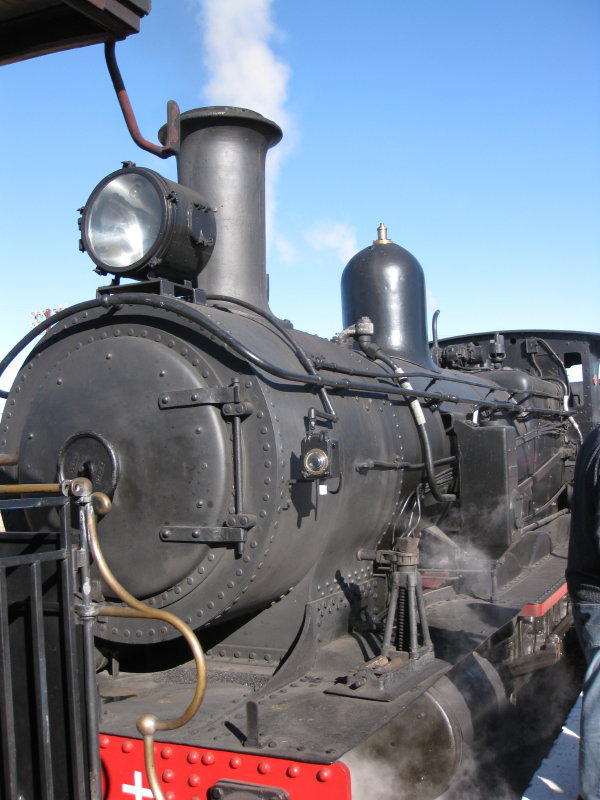
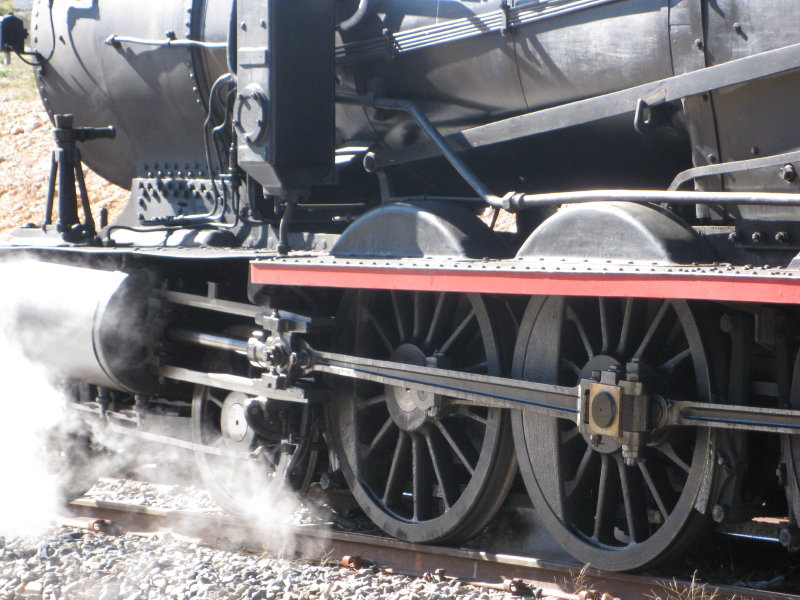
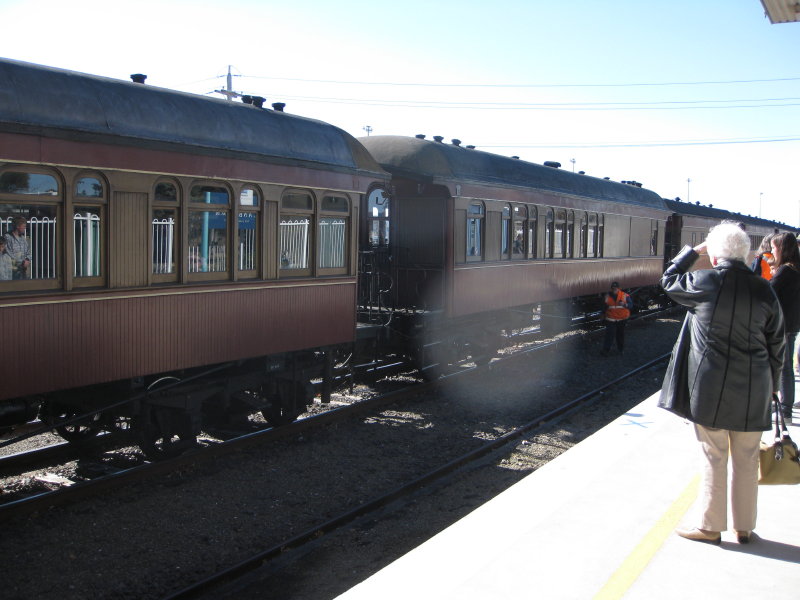
The ride was similar to any other train ride, except for the clouds of smoke and steam through the windows. The windows themselves, being antiques, would sometimes slam shut with no warning. This only added to the thrill.
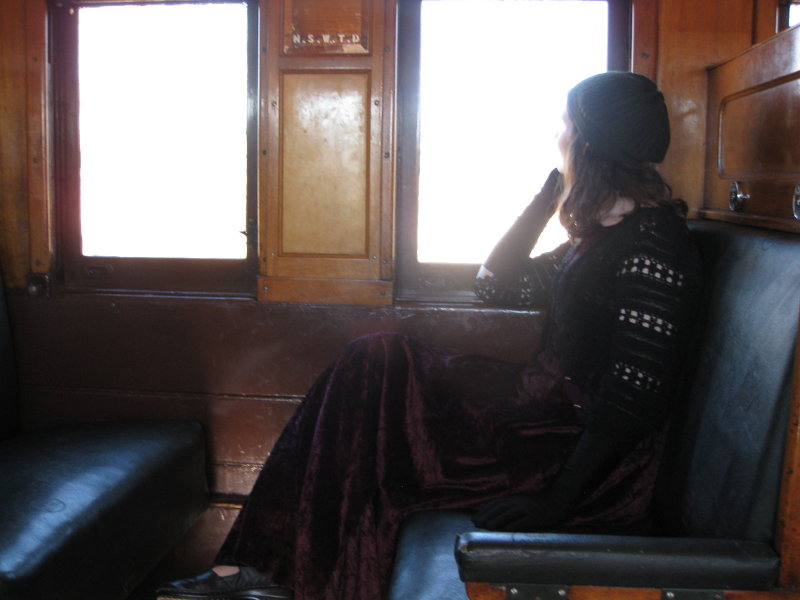
My nephew is six years old now, and is a charming (and effervescent) gentleman. He regaled us with a long story about a kangaroo that had wandered into his front yard (plausible) and cleaned the windows (not so much).
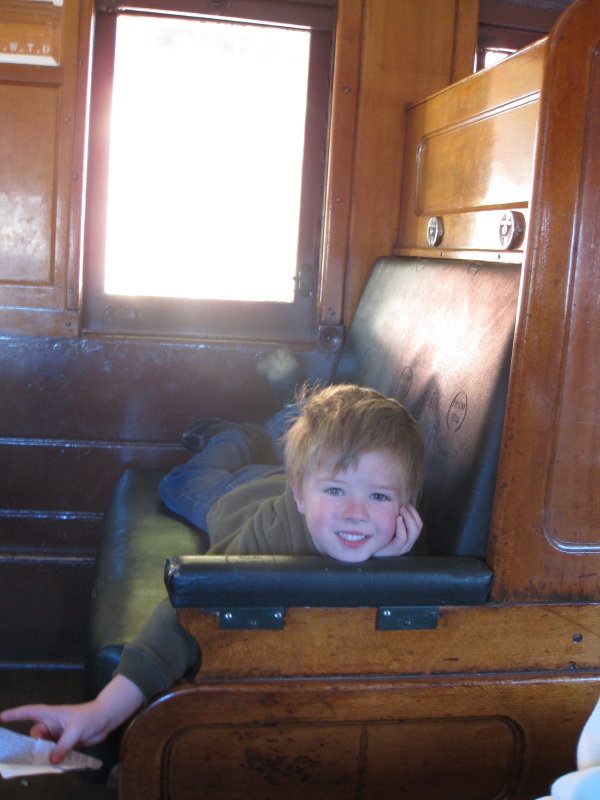
That’s a paper plane in his hand, with which he grew more closely aquainted with everyone else in our carriage.
The train took us to Bungendore (a classy antiquing and craft-oriented small town) and back again, through three tunnels (all unlit). We discovered that burning coal smells precisely like dirty nappies – so much so that, even after the ride up to Bungendore, everyone in the carriage checked their children’s nappies when the wind changed.
The smell was strongest in the tunnels, as the smoke had nowhere to go but inside our carriage, casting lines of visible sunshine across the air.
At Bungendore we were allowed inside the locomotive (I smelled the unburnt coal, and it was a lot like burnt toast).

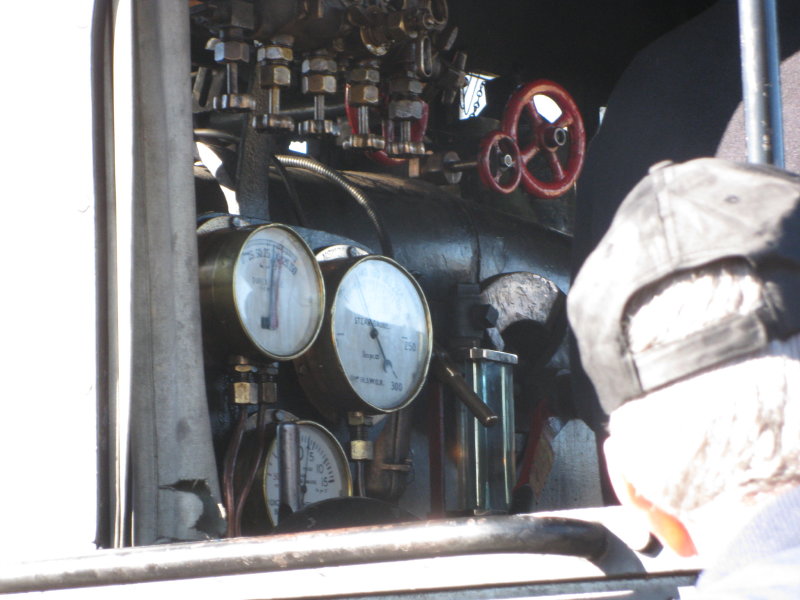
Just as I stood outside for yet another classic author photo. . . the whistle blew.

Surprise!
I have done something awesome. Something so awesome it’s going to change my life forever – and change this blog, too. It is very, very good – and required a little luck to achieve.
I’m not going to tell you what it is. Not until exactly one week from now.
I will tell you that if you know me (even just through this blog) you know that there are only two things it could possibly be.
It’s the second one.
Feel free to make guesses in the comments if that’s your thing – but I won’t confirm or deny anything until Wednesday next week.
Tomorrow: Steam Train!
Eurovision Party
Eurovision: The world’s greatest drinking game*. You drink every time you see white pants, three or more nonsense syllables in a row (eg la, la, la), a dramatic key change, an on-stage costume alteration, lyrics that are in English (but barely recognisable as such), and so on.
Eurovision is a massive international contest for up and coming musicians. All Europe (and several other countries) competes, the finals run for several nights, and then the 25 best songs are performed in one massive night, followed by a LOT of voting. Abba first became famous at Eurovision.
Sounds sane, doesn’t it? I assure you it is not. The thing that makes Eurovision special is the astonishing array of poor singing, apalling songs, and sheer exuberance. I dressed up for the occasion, and so did a few others:

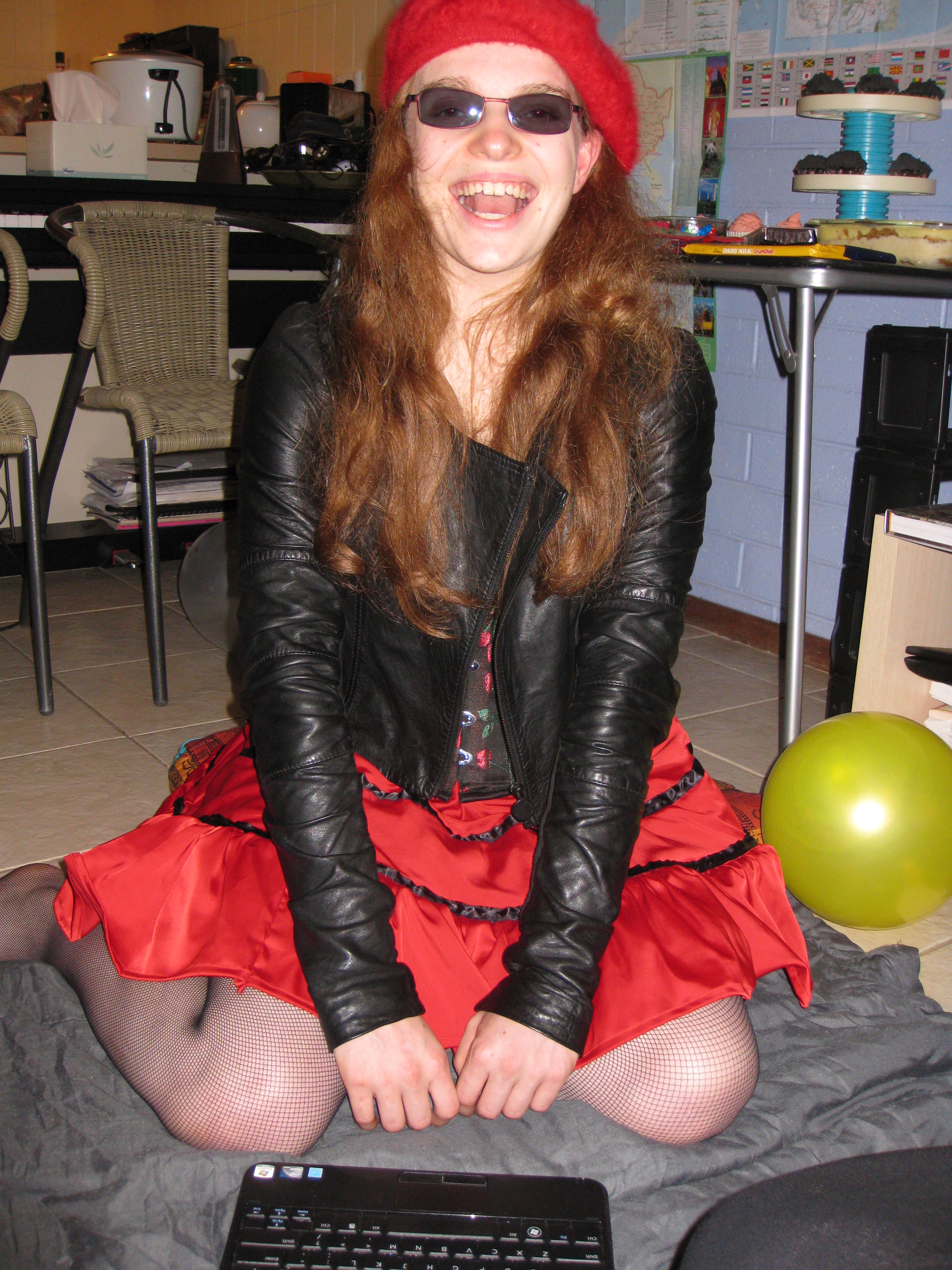
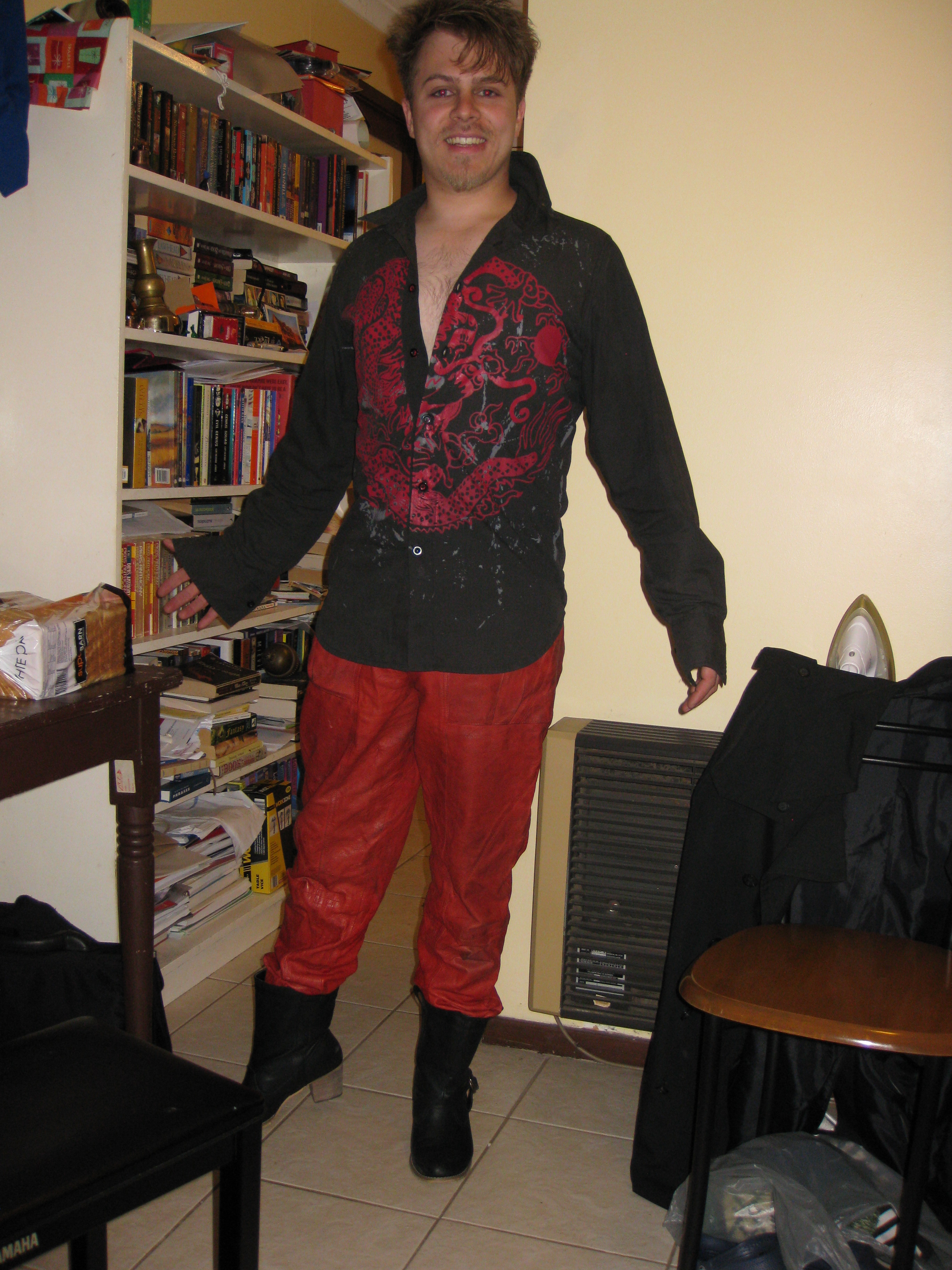
Last year a German woman named Lena won the contest. The opening number celebrating her 2010 song featured sixteen synchonised male dancers dressed all in white (that’s sixteen drinks), then (I kid you not) twenty-four fake Lenas in little black dresses and wigs, singing and dancing together with the flags of the twenty-five finalists (Lena was representing Germany again this year, so she was among them).
All my doubts about Eurovision 2011 (could it be as spectacularly wrong as previous years?) were banished at once.
I was a little disappointed that only one lady (Lithuania, if memory serves) showed massive cleavage, and not a single girl ripped off an item of clothing at an opportune moment.
Ah well. 2011 was all about boy bands, magic, and hoop skirts.
One of the early gentlemen had hair that looked like he’d stuck his hand in an electrical socket, but even he was outdone by Ireland, who had a pair of male lead singers with five-inch high hair on top and giant dice-shaped shoulder pads. Oh, and they were twins, too.
My picks for the top three:
1. France’s tousle-haired opera singer.
2. Italy’s soft jazz.
3. Finland’s oh-so-subtle environmental pop, “Da Da Dum” (that’s three nonsense syllables, by the way).
The host of our Eurovision party assigned each person their own country. Austria was mine – a lady with six-inch heels apparently welded in palce (to a podium in an inpenetrable sea of fog from which several backup singers appeared). It was rather dull in Eurovision terms – nothing but a few hundred sequins flashing on her dress. . . which turned out to be real diamonds. Yikes.
Ukraine stood out. She had a cool dress and the song was fine (again, Eurovision standards apply). The REALLY cool thing was that she had a sand artist on stage, making brilliant pictures that appeared on the giant screen as they were formed. And so it was that the Ukraine was upstaged by sand. Badly.
The best part about Lena’s triumphant re-entry into the contest was her interview, when she replied to the question, “Why compete again?” with “Because I am an egotist” and to the question, “Are you nervous?” with “My legs are shaking and my breasts are ready to BCHOOO!” (With mime of exploding breasts). Her song (along with two others) was terribly derivative of last year’s winning offering – although this time her backup dancers were dressed in hooded silver unitards.
Because it’s Eurovision, that’s why.
Serbia’s song had a pleasantly psychedelic 60s vibe (with a charming lack of actual dancing ability), but my heart will always belong to Moldova.
Every single person on stage wore a 2.5-foot cone-shaped hat on their head through the entire song. Just when I thought it couldn’t get any better, a fairy (also in a giant cone-shaped hat) rode onto stage on a unicycle, wearing a short hoop skirt with bells all around the hem, and carrying a two-foot long fake trumpet. At the last moment, the lead singer produced and wore a monocle.
Don’t believe me? Want to see it for yourself? Okay.
I’m sad to report that none of my favourites won. The winner was Azerbaijan, with a harmonious and catchy song about – ah, whatever. I don’t care. Probably love.
*Those of us working the next day tend to play the drinking game with M&Ms/smartes/skittes/pods/etc.
Like to laugh?
If so, today’s miscellaneous Monday is for you.
Ally Brosch‘s entire blog is hilarious (sometimes a little rude, although this entry is a-okay for any age). Her pictures look simple, but they convey so much.
The God of Cake
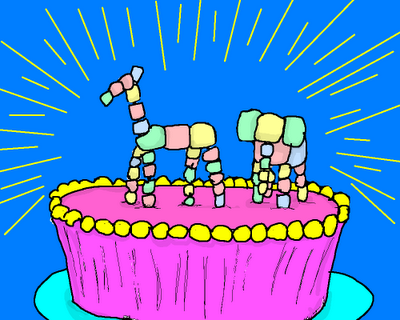

Read the rest – you really really want to.
Tomorrow: Eurovision Report!
A Desperate Adventure at Sea
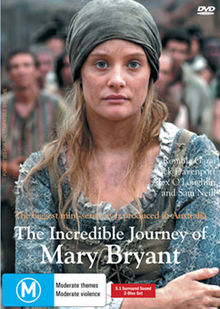
In honor of Doctor Who’s recent pirate episode, here’s a true Australian story that actually predates steampunk (the first picture is from a mini-series I haven’t seen, and the second is yours truly on the Young Endeavour tall ship).
From the appendices of “A Long Way Home” by Mike Walker ( the appendices are from James Martin’s memorandums):
[The convict James Martin escaped Botany Bay in a tiny boat and aimed for the Indonesian island of Timor, along with several other convict men, plus Mary Bryant and her two very young children. This is taken partway along the insane journey North, when the boat is already leaking and they hoped to make repairs on land]
Here we found aplenty of fresh water – hawld our Boat ashore her Bottom being very leaky they Better to pay her Bottom with some Beeswax and Rosin which we had a small Quantity Thereof – But on they Same night was drove off by they natives – which meant to Destroy us – we launched our Boat and Raod off in they stream Quite out of Reach of them – that being Sunday Morng. We Attempted to land when we found a place Convenient for to Repaid our Boat we accord. We put Some of our things – part being ashore there Came they natives in Vast Numbers with Speers and Shields etc we formed in parts one party of us Made towards them they better by signs to pacify them But they not taking the least notice accordingly we fired a musket thinking to afright them But they took not the least notice Thereof –
On perceiving them Rush more forward we were forced to take to our Boat and to get out of their reach as far as we Could – and what to Do we Could not tell But on Consulting with each other it was Determined for to row up they harbour which accordingly we rowed up they harbour 9 or 10 miles till we made a little white sandy isld. In they middle of they harbour – which land. Upon and hawled up our Boat and repair her Bottom with what little materials we had. [Soon they were using soap to minimise leaks, and bailing constantly. They did, however, make it safely to Timor – a voyage of 4000 miles – without a single death, and managed to pass themselves off as shipwrecked sailors. Their feat was one of the greatest maritime adventures of the age, and made Bligh jealous because he simply wasn’t as awesome as they were.]

Writing Historical Fiction
Depite its many gleeful anachronisms, steampunk is one form of historical fiction (which is why I wouldn’t recommend it to people who refuse to do research*) – so here’s a post by Glass Cases on doing it right.
The full article is here.
When You Should Go Back to the Future
The triumphs and struggles of human beings on a personal level transcends any decade. When deciding when to set your story, ask yourself if this story could be told just as easily in present-day. The Diary of Anne Frank, for example, cannot. The Vampire Diaries, however, can. It wouldn’t matter if Elena is a young hippie from the ’60s, a tech-crazy gamer in the ’90s, or (as it stands) fairly popular former cheerleader in present-day Mystic Falls. Likewise, it wouldn’t matter if Stefan and Damon were turned into vampires in the 1400s, 1800s, or last week. The plot is independent from personal attributes.

In the next VERY short while (within two weeks, I promise), I have three particularly cool awesomenesses planned:
1. Eurovision party
2. Steam train!
3. Something even more awesome than those two. . . but I’m not telling what it is!!**
*or writing in general, for that matter.
**I use two exclamation points wisely. This awesomeness is the biz, big time.
Sit in the sun
Right now the Northern and Southern Hemisphere meet weather-wise as they head in opposite directions. The weather here is getting colder and colder, and my washing no longer dries fully on the line.
But today was sunny. There wasn’t any rain, and there wasn’t any gale-force wind (yet). So I went outside (*gasp*) in my beanie and fuzzy jacket, and I sat in the sun and read a Scott Westerfeld (Behemoth, again).
Do play along at home, if you can.
Indah knows how it’s done:

PS Sherlock now has a thing for Gimli.
Politics of Fish
Right now, CJ and I have six fish.
Gandalf is a male siamese fighting fish. He can’t live in a tank with other long-finned fish because they’ll attack each other, but in general I’ve found him to be surprisingly placid.
Frodo is the last of our neon tetras, and is reasonably old now (named “Frodo” on the basis of being the last one of the tetras, all of whom are clearly small and helpless and thus names after hobbits). He doesn’t bother anyone, and is the smallest fish. He’s of indeterminate gender. Usually tetras are happiest in groups, but he appears to be coping with his newfound solitude. Sometimes he hangs with the guppies (who are the next smallest).
Our guppies are Aragorn and Gimli. Aragorn has a big decorative tail like a butterfly’s wing, and is more aggressive than Gimli. Gimli is orange – a colour most find unattractive (although there are some who REALLY like that sort of thing), hence the name.
Our bristlenose catfish is Watson, because he pootles about being a bottom feeder and generally cleaning up messes.
Our reticulate loach is Sherlock, because he runs about maniacally and is generally peculiar and fascinating. (Another bottom feeder, but a carniverous one – the last one bit off Sam’s eye. Sam has since died. Bad, naughty, violent Sherlock.) He’s also of indeterminate gender (which I can only presume is good news for Watson).
Gandalf is elderly now, and deserves his own tank. Unfortuantely, the new tank is infested with snails – so I bought Sherlock to deal with them. Gandalf took an instant dislike to teeny tiny Sherlock, and chased him excessively. Naughty, crochety Gandalf! He used to be so good-natured before I let him have his own pad.
Aragorn has been biting Gimli ever since Gimli arrived. I spoke to the pet shop staff and discovered that, basically, that’s what boys do. The only way to stop them is with women – LOTS of women. (Rather disturbingly, a single female with two guys will be killed in the battle for her love. Does that add insight into Lord of the Rings, or is that just me?)
Aragorn and Gandalf don’t get on (I never expected they would).
In an effort to maintain peace while simultaneously killing the snails in the small tank, I moved Gandalf to the big tank with Watson, Frodo and Gimli. Aragorn and Sherlock both buzzed around happily in the small tank, not killing each other. Gandalf hid in a plant and Gimli left him alone. All good!
Then the filter in the big tank broke.
Most fish need the filter for oxygen as well as cleanliness. So I moved Gimli and Frodo into the small tank with Aragorn and Sherlock. Aragorn and Gimli immediately resumed their territorial wars – but at least it’s a match of even strength.
Gandalf is fine without a filter (in the short term) and Watson is big enough that I’ll see signs of distress before he’s in any real danger – so they’re remaining in the big tank. For now I’m manually adding oxygen (ie periodically picking up water in a cup and pouring it back in again to create bubbles), and keeping an eye on everyone.
Every so often, my neighbours hear one of the following plaintive cries:
“Aragorn! Leave Gimli alone!”
“Sherlock! Eat the snails. The SNAILS!”
“It’s all right Gandalf. You can come out of your tree now.”
 Felicity Banks