Save the world – in your PJs
Amnesty is an organisation that defends human rights internationally by researching unjust situations and then writing letters and petitions to those in power. Which means ordinary schlubs like you and I can simply go to their website, click a few buttons, and help save lives around the world.
How awesome is that?
Indulge your ennui
Meh. Couldn’t be bothered being awesome today. Anyone else just wanting a nice lie down?
Here’s some cat pics to inspire you.


Science of dating
Here is a fascinating article on how to figure out if your date is a raving loony and/or compatible with you. It’s PG/M, because of discussion of romantic things (she says euphemistically).
Here’s the beginning:
First dates are awkward. There is so much you want to know about the person across the table from you, and yet so little you can directly ask.
This post is our attempt to end the mystery. We took OkCupid’s database of 275,294 match questions—probably the biggest collection of relationship concerns on earth—and the 776 people have given us, and we asked:
Love, sex, a soulmate, an argument, whatever you’re looking for, we’ll show you the polite questions to find it. We hope they’ll be useful to you in the real world.
First—define “easy to bring up”
Before we could go looking for correlations to deeper stuff, our first task was to decide which questions were even first-date appropriate. I know each person has his own opinion on what’s okay to talk about with a stranger. I also know that if I had to wade through hundreds of thousands of user-submitted questions like these verbatim examples:
Read the whole article here.
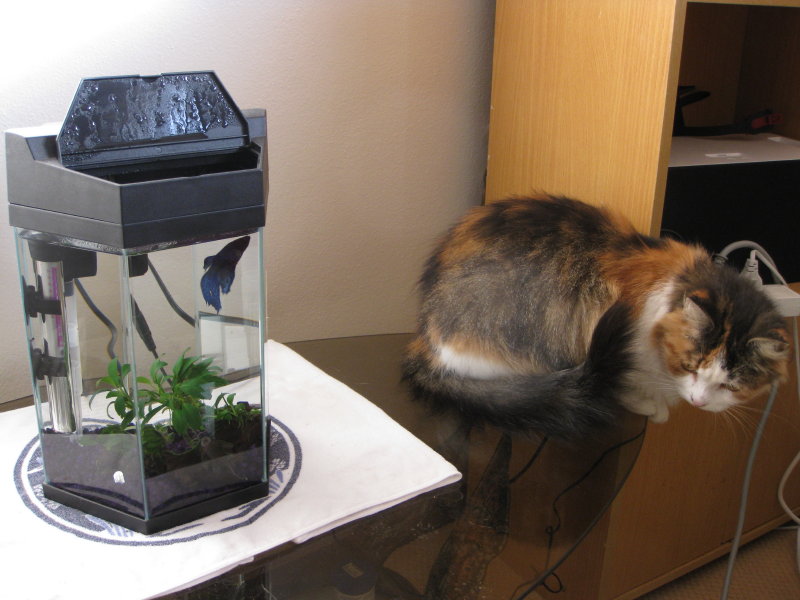
In the meantime, here’s Ana ignoring Gandalf (Gandalf is the fish).
And here’s something even more miscellaneous:
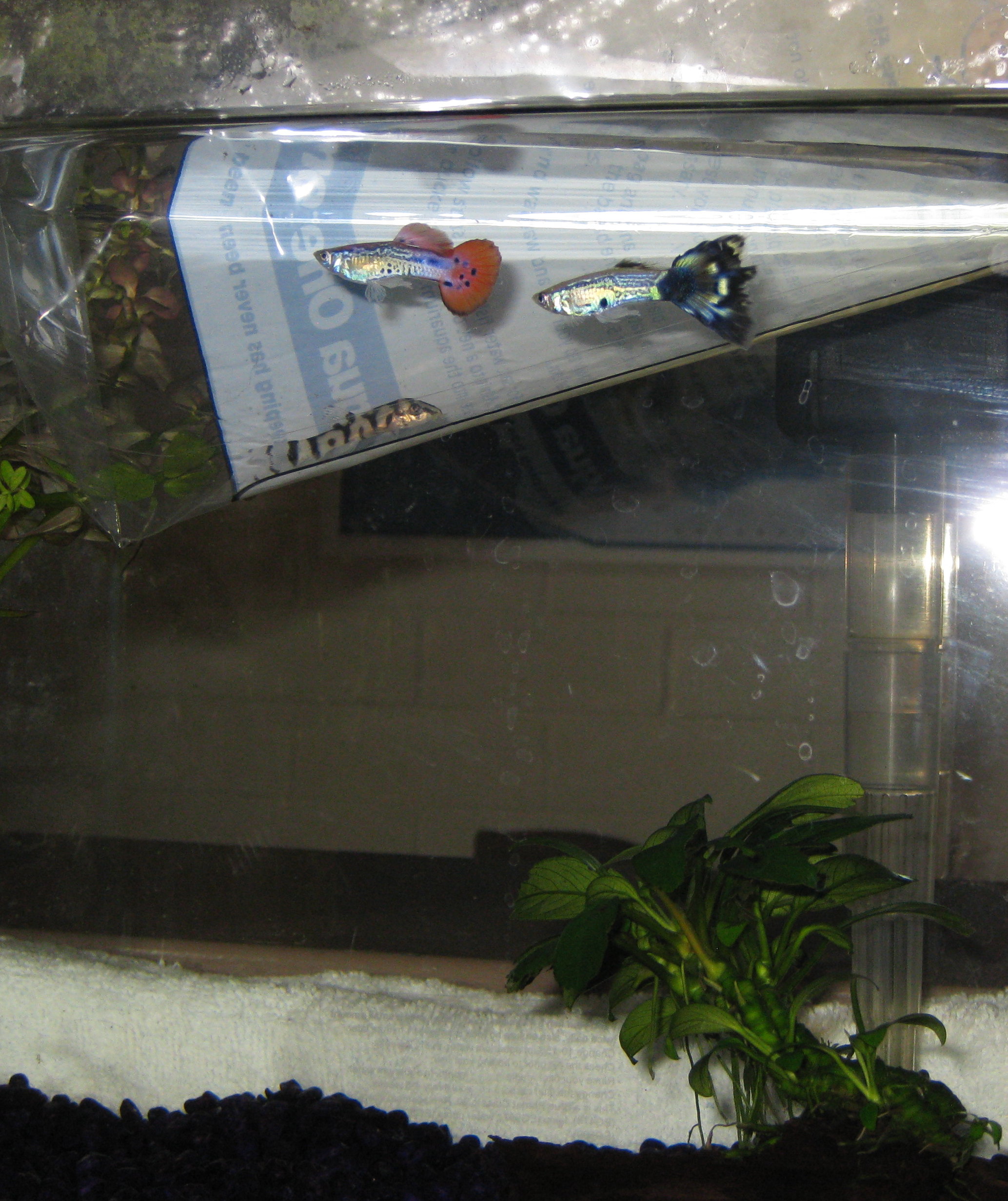
You know what’s interesting about that second photo? The orange fish and the striped fish are new today – and I haven’t told CJ. Will he see them for the first time when he comes home – or here?
*shrug*
*wander off*
*hope he’s pleased, not mad*
Why pickling isn’t a popular form of burial (PG horror)
From “Colonial Ladies” by Maggie Weidenhofer, here’s a horrifying true story of two ladies: one dead, and one disturbed.
Mrs Short had wanted her body taken back to England for burial. This account was written by the woman who sailed back with the corpse.
. . . the only way was to put her in a cask of pickle. . . had she reflected before her death what was really necessary to be Done—for the safety of all our Healths—I am sure poor soul she would much rather have consented to a Watery Grave. Should it please God to take my life on the Seas I shall not care what becomes of my Body provided it goes all together—but to be Mangled (as poor Soul, she was Done) is enough to frighten any Christian from Consenting to be served so. . .
Why your first book sucks
I follow Rachelle Gardner‘s blog. She is a sweet, selfless literary agent*. I was quietly surprised to see her post on four reasons you shouldn’t even bother submitting the first novel you write. Given that, shortly afterwards, she posted an entry that mentioned her gentle surprise at meeting many writers who don’t even read books in their own genre, I think it’s been a bad-slush week for her.
Kids, don’t cause nice agents/publishers to burn out by being a moron.
Today’s post is unusual, because I disagree with the gist of her argument. I think writers SHOULD submit the first novel they write (my own first novel did rather well in a contest, and I later sold it for actual money – although nowadays I’m deeply grateful that the publisher never actually produced it), with the following caveats:
1. They have edited it, then left it for at least a month, then edited it again. At least one person (who is not a relative or in love with said writer) must also help with editing – you can tell a good editor because they make the writer cry and/or consider deleting the whole book at least once. After the crying/giving up, the writer must then fix 90% of the problems the editor has pointed out. You can find critique partners all over the internet, including at http://www.critiquecircle.com/default.asp.
2. The writer has read at least three books that are in their genre and published within the most recent five years (look on actual bookshop shelves – and if you’re too poor to buy them, go and get the exact same books from the library for free).
3. The writer has helped to edit at least three opening sections (chapters 1-3) of other people’s unpublished novels, and has also edited one full unpublished novel. You can find heaps of critique partners online, eg at http://www.critiquecircle.com/default.asp.
After the horror of reading someone else’s book (which will almost certainly be deeply awful), the writer must have another honest look at their own book, and do one more edit (or more if needed).
Congratulations! You are now ready to submit your first novel.
Was it a mistake? Here’s how to know:
If three publishers (who produce the right genre!) have rejected the opening chapters without requesting the full manuscript, it’s probably worth setting that book aside and writing a new one (which you’ll probably begin while waiting for your responses – which take 1-6 months each). The new book should NOT be in the same series – it should be something genuinely separate. (Otherwise you may find yourself dragging the corpse of a bad book around, because it’s part of a series – been there, done that.)
Here’s Rachelle’s article:
There is a cliché in publishing that by the time a writer finally gets published, she already has a whole stack of novels completed and hidden in a drawer, never to see the light of day. No writer gets their first book published, right?
Well, there are exceptions of course, but mostly, it’s true. Nearly all successfully published authors will have written two or more books before they get their first contract offer. Here’s why:
1. Practice. It takes most people a few tries to write a viable and saleable novel. Like it or not, this is true for the overwhelming majority of writers.
Read the rest of the article here. I definitely agree with #1.
Don’t forget to glance at the comments of the article – the second person has FIFTEEN unpublished books. Most of the people there had four or five unpublished books.
And here’s my cat, who has a thing for styrofoam:

* If that sentence surprised you, you’ve probably never met a literary agent.
Fish tanks are like tattoos. . .
. . . once you have one, you want more.
And so it was that CJ and I bought another fish tank (just a little one, and with the totally rational excuse that our fighting fish would be happier on his own).
Here it is, before little Gandalf was put inside:

Naturally this meant I had an excuse to buy more fish. I bought two semi-tropical guppies. One of them died more or less immediately (presumably, since only one died, he was sick when we bought him – and it’s therefore not my fault). The other looks a little like this:
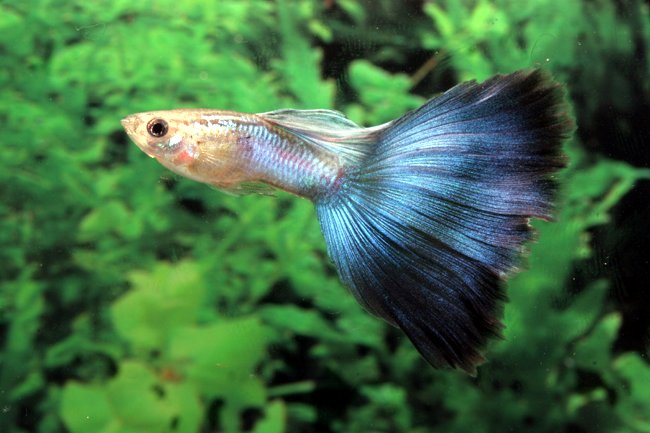
Shiny, shiny colours!
Coming soon: Steam Train to Bungendore (there shall be costumes, and pics) – and a Eurovision party (ditto).
What could possibly go wrong?
I haz discovered cheese!
Pay attention, and I’ll tell you the secret to the most awesome home parties: Know the weaknesses of your guests.
Here’s some examples from my own life:
Parental units: They no longer have children at home sucking them dry, they have actual real jobs, and their mortgage is almost paid off. This means they have a steady income – and they’re old enough that they no longer try to impress people with home-cooked meals (that’s a phase young parents go through). They’re also polite and reliable.
Conclusion: Whatever part of the party you assign to them will be bought, and will be high quality. It will also arrive on time and on the right day. Exploit this for all it’s worth.
Intellectuals/Writers: Poor. Addicted to sugar because they can’t afford alcohol.
Conclusion: Ask them to bring lollies. Their nose for cheap, tasty lollies is infallible. Plus they’re constantly on the verge of starvation, so they’ll inevitably impulse-buy far too much. Make sure they know in advance that there is going to be a free meal and a lift home.
Sidebar: Make sure you get them to take home any leftovers – especially meat or vegetables.
Sidebar #2: I had scurvy one time (self-diagnosed and self-treated with instant results). Another friend of mine used to look through university rubbish bins for scraps others had thrown away (before we met, obviously).
Extroverts: The default extrovert social occasion is, “Let’s go out for drinks” which means they live in a mental space that simply assumes wine must be present.
Conclusion: Ask them to bring drinks. Leave the interpretation of the word “drinks” up to them (but be aware that they probably won’t think to bring anything for those who don’t drink alcohol). They’re probably good for taking people home, too.
Vegetarians: Will probably have to cook their own meals at/before many parties.
Conclusion: See if they’d like to cook the main meal. It means they get to eat WITH everyone else, and the meal will probably be both healthy and delicious (assisting the intellectuals, and totally offsetting all the lollies).
Close friends: Love you.
Conclusion: Some friends can handle complicated tasks – others can’t. Since they’re close to you, they have specific likes and dislikes, and specific weaknesses. Individualise tasks accordingly – keeping reliability in mind as your #1 concern (eg don’t assign a vital ingredient to your heroin-addicted workmate).
My friend Ann has a weakness for cheese, so I tend to suggest it whenever she’s bringing something. It seriously paid off last week when she brought a BRAND NEW CHEESE.
Okay, it wasn’t a brand new cheese really – but it was to me. Can you believe I’d never had goat’s cheese before?
It’s a lot like really delicious cream cheese (but tastes nice by itself on a cracker). We ate it with quince paste (another substance new to me). It was a taste sensation and a personal revelation (that’s brie and hommus in the background, in case you’re wondering).
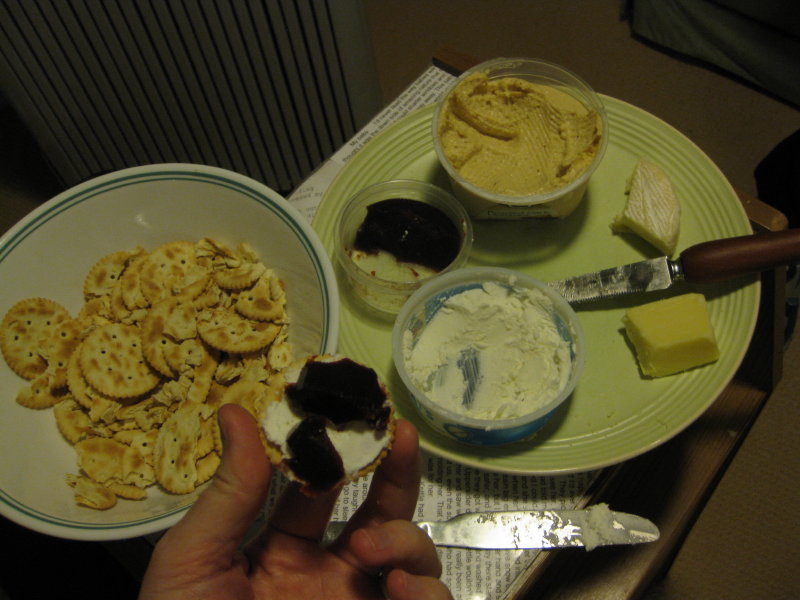
Today’s blog entry was brought to you by my new book How to manipulate friends and influence pizza.
Oh, and you can get away with ridiculously complex demands when it’s your birthday.
Pie, professionalism, and panic
Today’s official awesomeness is pie. Specifically, pecan pie from the Cheesecake Shop. Being healthily obsessed with that particular pie, I decided to buy some two months ago (a rare treat) only to discover that my usual Cheesecake Shop haunt doesn’t make it any more! Disaster!
Luckily, I was able to travel across town and buy one elsewhere.
Here’s what it looks like – it’s surprisingly heavy and rich.

Yesterday’s contest fiasco was simple lateness on the part of the judges (I assume the relevent web sites were simply programmed to shut down when the results were announced – which of course they weren’t at the time). With the help of that publisher’s customer service people and Mr Google, I was able to prove to my own satisfaction that the competition was legit after all.
Boring, I know. I’m so sorry there wasn’t a giant conspiracy. Also, I didn’t win.
You know what else is boring? Dryers. After two years of marriage, and having written a “Thank you for your lovely wedding gift of cash. We used it to buy a dryer” note (we actually spent it on groceries) – CJ and I bought a dryer.
We bought a Simpsons 4 litre, and bargained the price down to $287.
Still bored?
Here’s a panicked kitten picture just for you.
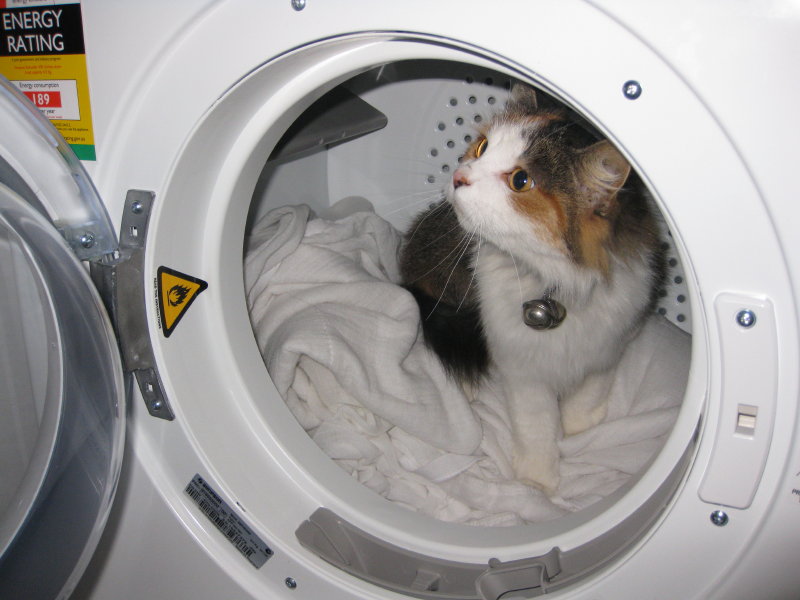
We didn’t switch it on, but we did close the door.
You can expect to see at least one picture of her enjoying the styrofoam packaging in the next little while.
Name and shame?
I recently entered a short story contest.
It had several peculiar characteristics (danger! danger!), so I wouldn’t have entered except that (a) It didn’t cost anything to enter, and (b) It was backed by one of Australia’s biggest and most reputable publishers (I checked on their web site and it was indeed legitimately based there).
The results should have been announced yesterday. Instead, all traces of the contest were deleted from the internet.
It looks rather like I’ve been had.
A few moments ago, I emailed the publisher with the details and let them know they had six weeks to explain and/or fix what I graciously pretended to assume was a technical glitch.
After that six weeks, if they don’t do the right thing, I will share with you – and any blog or media outlet that will listen – exactly who they are. Which of course I also told them in the email.
Will this be the greatest showdown since my cats decided they didn’t like getting picked up? Or will this reputable publisher explain that actually it WAS a technical glitch and they’re awfully sorry?
I hate that thousands of dewy-eyed writers get preyed on every year by unscrupulous people claiming to be real publishers/agents/contest judges. It’s not gonna happen in MY town. . . not without consequences.

 Felicity Banks