Jelly beans
I’m not able to eat much yet, but I AM able to eat natural confectionary jelly beans.

That is awesome.
The delicate business of husband-hunting
I’ve said it before and I’ll say it again: If you want to write steampunk, read “Victorian London” by Liza Picard. She is often extremely detailed – and often extremely funny.
Here is some of her section on how a Victorian lady should conduct herself – continued from last week:
With all these hints as to advisable demeanor for every day, the reader may think that nothing remains to suggest for the delicate business of husband-hunting. Alas, in these days when any gentleman belongs to a club where he can find almost every advantage of matrimony, potential husbands are like shy animals, vanishing when most hotly pursued. Do not be tempted to offer, in your own person, those advantages of matrimony which are not available in his club. He is all too likely to obtain these, too, elsewhere than at the domestic hearth. Subtlety is needed, and evasion on your part, never fleeing so swiftly, of course, as to be beyond the reach of the most ponderously slow suitor if he is potentially acceptable. As to your own appearance, I suggest, as with the management of carriage steps and the width of your smile, some consideration in the privacy of your own room. Which is your most advantageous profile? Or is an umbrageous candlelight advisable? An expression of admiring pleasure should be possible to sustain for most of the evening without becoming a rictus. Practise daily, for increasing periods. A conviction that your intended is the most desirable gentleman in every way already resides in his breast. Show him, shyly but unmistakeably, that you share this conviction.
. . . One investigation I must advise, however, before any notable expenditure of time and effort takes place: what is his financial position?. . . Fine whiskers are delightful, but a good income is infinitely more attractive.
Overdone movie tropes
John Scalzi has his own blog, and also writes a film critic column. This one is so funny I had to link to it. Here’s my favourite of his five tropes:
4. The very special youngster. This is more often the domain of fantasy (hello, Harry Potter!) but it was given a science fictional run-through this year with I Am Number Four, and of course Star Wars trotted out Luke, whiny as he was. These run down a checklist. Orphaned? Of course! Having special powers waiting to be unlocked? Yes, indeed! Found and trained (and protected) by a wise mentor? How could it be otherwise? Hunted by the forces of evil? That goes without saying. When this very special youngster shows up, we know where he’s going. Best to leave him in hiding.
Read the whole article here.
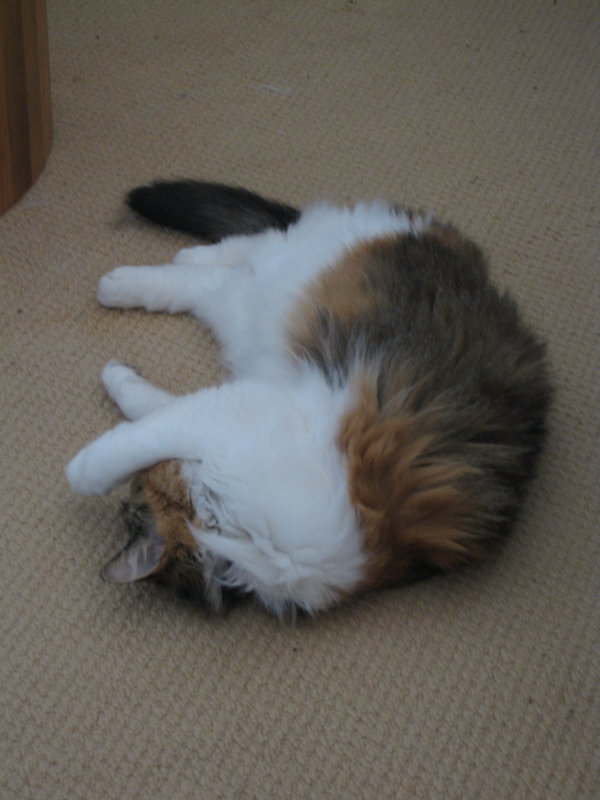
Your kitty pic of the week:
Jane Austen, Dance TV, and the Tour de France
What do they have in common?
Jane Austen and the Tour de France have an intricate web of intrigue and etiquette that only a moron can afford to ignore.
“So You Think You Can Dance” and the Tour de France (other than rhyming) remind me how lucky I am to be a writer rather than an athlete or dancer. I may have to wait years for responses, and get my work dismissed due to a change in market – but I can still write a bestseller when I’m eighty. Dancers and athletes have extremely short, extremely painful, extremely physically risky careers.
CJ and I view sport in general with cordial contempt. We unmute news breaks on TV, but mute them again as soon as they turn to sports. The Tour de France is the one exception. CJ inherited a fascination with the Tour de France from his Dad, and I saw a few bits here and there as he watched – and then was slowly drawn in.
For me, the first point of appeal was the scenery and architecture of France. Castles, chateux and beaches always feature prominently as the Tour passes by – usually with gorgeous sweeping aerial shots from the helicopter. A large number of passers-by also spice up the viewing experience by building giant sculptures in their fields (often giant bicycles with moving human/mechanical wheels). But it was the etiquette and complexity of the Tour de France that made me an addict.
The three most important categories are:
The winner – aka the yellow jersey – which is based purely on a man’s total time over the three-week race. The race covers thousands of kilometres, but for the last five years there has been less than a minute between first and second place – so the pressure is unrelenting. Whoever has the best time-so-far wears the yellow jersey that day.
The king of the mountain – aka the polka-dotted jersey (seriously – it turns out men who wear skintight lycra professionally don’t mind this kind of thing) – is the most skilled climber, based on how well they do in just the steep parts (including the Pyrenees and the Alps) of the various race stages.
The fastest sprinter – aka the green jersey – is the one who can leave all the rest behind (on average) in designated sprinting sections of the course (there is one in the middle of almost every stage, and the first twenty riders are awarded a decreasing number of points). It’s not so much “going fast all the time” as “putting on a herculean burst of speed when everyone else is already going as fast as they can”.
Climbers and sprinters have completely different body types, and riders always have a specialty one way or another. There are about half a dozen men who are serious contenders for the overall win. Each one is supported by a team of up to nine riders – a mixture of sprinters, climbers and those who are simply consistent riders. Many of the supporting team members are champions in their own right, but they have made the choice to sacrifice their bodies for someone else.
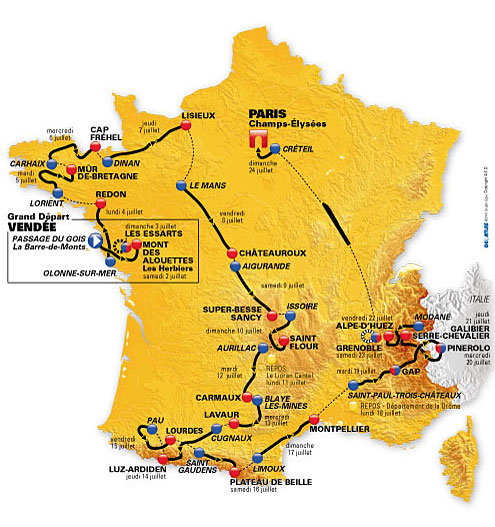
Race etiquette is all about wind – and glory. The wind (particularly from the front) slows riders and saps their energy. In such a long race, energy is the most important currency. So riders are constantly riding behind others in order to be in their slipstream. A team’s job is the protect their leader until the last possible moment – so that he will still have the energy to grab a win. They do most of the work, and he gets the glory.
It’s far more complex than that, however. The usual shape of the race is that there will be an early “breakaway” of perhaps two or half a dozen riders (all from different teams) who will go out ahead of the main pack, and attempt to keep their lead for the whole race. They usually fail – but they will spend a hundred kilometres or more taking it in turns to lead their own small group (which is especially vulnerable to the elements), and bear the brunt of the wind.
The rest of the two hundred riders (20% of whom will not finish the race) ride in a mass called the “pelaton”, mutually protecting one another. Safety demands riding within the first twenty riders – which is of course impossible, so there is a constant gentle shifting among the tightly-packed crowd. Etiquette demands that whichever team currently holds the yellow jersey must form the arrowhead of the pelaton, bearing the wind for the other one hundred and ninety riders.
When a crash happens at the back during the beginning or middle of the race, the pelaton will slow down to let them catch up. Sometimes a single man will race ahead unchallenged – which makes no sense, until he reaches his home town and hops off his bike to kiss his wife. It is one of the many traditions of the Tour de France, and it is universally accepted.
There’s plenty more, but this entry is getting out of control, so I’ll stop here. There are race highlights each day at 7:30am and 6pm on SBS.
At the moment (I haven’t watched Stage Six yet) Thor Hushovd of Norway (team Garmin) is wearing the yellow jersey. Cadel Evans, the Australian leader of American team BMC, is coming second – lagging by one second.
A few days ago, Thor knew he was close enough to the front to keep the yellow jersey, so he sacrificed his stage win for an American team member, Tyler Farrer. Cadel Evans has also won a stage this year, as has the British sprinter Mark Cavendish (and probably others, but I forget their names). Mark Cavendish is from team HTC and is supported by two Australians, Mark Renshaw and Matt Goss.
“Soulless” by Gail Carriger: hilarious steampunk
I promised to review a book that I really liked, and this is it.
It stands alone, but is the first of many Alexia books by the delectable Gail Carriger.
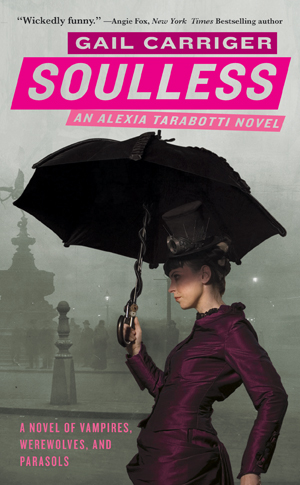
This review has been moved to Comfy Chair, where I get paid for it.
The purpose of parenthood
Last Friday I began eating solid food (including an egg for protein) at lunchtimes. Last Saturday (with CJ on hand) I taught a student for an hour (at home) without incident. Last Sunday (with CJ driving) I actually left the house for non-medical reasons (oooOOOoooh). Yesterday I began reducing my ondaz zydis medication, taking one instead of two, and substituting a maxolon for the other one. It didn’t feel great, but it’s certainly surviveable.
Today marks twelve weeks. I have one week left of first trimester, and this time next week I’ll be blogging about my twelve-week ultrasound (which will likely change the official due date, based on measurements of the baby).
——————————————–
CJ lives very much in the present. I. . . don’t. CJ is happier, calmer and less likely to show up on time (or at all, sometimes). I’m the one who figures out things like, “When we marry, CJ should have a study, at least in the beginning” because I can clearly see the stress that would result if he didn’t (he is messy; I am OCD-ishly tidy). When we think of parenthood, CJ sees visions of playing with children. I ask questions like, “What is parenthood FOR?”
I’ve concluded that the purpose of parenthood is to do our best to create a “good” adult. Here’s the list I’ve come up with for what that means, with my ideas of how to actually teach it.
In no particular order. . .
1. Physical health & Eating.
They need to know how to cook healthy meals and how to exercise. We teach this by modelling (particularly with exercise – which, amazingly, we both actually do – and how much junk food we eat), and by consistently cooking healthy meals (which sets a healthy standard of “normal”, as my parents did for me). Our kids will probably be hilariously uncoordinated, so we’ll need to start early (before they know they suck) at finding sports and exercise that they enjoy.
2. Finances
They need to know how to delay gratification by not buying things immediately or falling into credit card traps. They need to know how to manage household finances, and that you really do have to do your tax return.
We teach this by giving them an increasing allowance and hopefully teaching them to save up when they want a larger item than lollies. We live sensibly ourselves, and slowly involve them in observing how much we spend on groceries, petrol etc as opposed to how much we earn. When they’re earning above a certain amount but still living at home, we start charging rent (ideally we’ll have a bedsitter they can move into at a certain point, so they can learn how to live independently without it all happening at once).
3. Running a household
It’s difficult to coordinate food, bills, cleaning, washing, working, and a social life. So our kids will do plenty of chores – all chores, including the rare ones like cleaning gutters. At certain ages, the chores will be just theirs (eg shopping for their own clothes with their own money, doing their own washing). The bedsit plan comes into play again here.
4. Smart romance (and parenthood)
Mostly this will be us (and our parents) modelling how romantic partners should treat each other, and (hopefully) how parents should treat their children. Hopefully our children will realise that kindness and good conversation are the most important qualities to look for, if you want to live happily ever after. I think pets help teach some of the responsibilites (eg cleaning up after accidents, and training good behaviour with consistent discipline) that are useful in parenthood.
“It’s like having a dog that slowly learns to talk” – Dr Cox on his son, from Scrubs.
5. Human relationships
Our kids need to know how to hold a conversation, how to make friends, how to accept people who are different, when to listen to peer pressure (shower = yes; drugs = no), and how to treat people. Modelling comes into play again, but I also plan to do my best to encourage good friendships in primary school (when I still have some influence) in hopes that kids from various families will continue to teach one another when I’m just a blobby shape that makes food. Several of my friends (friends who I like and respect, and think will produce good kids) have had/will have babies soon, so I’m angling for our kids and theirs to spend plenty of time together. I also plan to have our own two kids sharing a room until they’re about ten – which builds character, but also celebrates their increasing maturity when they get their own room.
6. Self-worth
I’ll do my best, but CJ is going to be much better at teaching this than I am. I can love the kids unconditionally, though. That should help.
7. God/spiritual health
I’ll take them to church and hopefully send them to a Christian primary school, but ultimately the only thing I can teach about spirituality is honesty (and respect for others).
8. Job and/or contributing to society in a healthy way.
I talked about this last week.
9. Contentment/psychological health
Again, CJ shines here. Probably the greatest gift I can give is to teach them resilience – which I’ll teach by letting them fall over in the playground, or make that obvious (but non-fatal) mistake – possibly after warning them it’s not a great idea. Some mistakes harm us permanently, but others teach us that a scraped knee is okay. The second type of mistake is very important, and needs to be made.
10. What do you think? Have I left something out?
Tradies
You may have heard that our ceiling fell in last Thursday night. On Friday we made contact with our landlady (may heaven rain odours on her*), and she immediately made several rapid calls. By 4:30pm, the first tradie arrived: a blond and genial plumber (someone somewhere had assumed that “water damage” meant “a burst pipe”), around six feet eight inches tall. He immediately climbed up onto our roof and tramped about in his tradie boots.
It’s a tin roof. A single sparrow landing on the roof makes a noise – noises that are carefully monitored by our self-appointed cat guardians.
Ana (who despite her cuteness is a cold-blooded killer) crouched on my desk. Her pupils narrowed to terrified slits and I could see her thinking, “It’s finally happened. The Great Bird has come to wreak a horrible revenge.”
Meanwhile I lay, swathed in my ever-present doona on the couch. My Mum sat on one of our many shoved-aside couches, doing her embroidery. We couldn’t have been happier with our afternoon’s entertainment.
The giant returned and announced our roof was A-okay. This was good news, since the alternative was having him land in Mum’s lap. He stood on our oven and poked his head through the ceiling vent, shining a torch into the flat roof. “Can’t see water. Can’t see much though,” he declared.
He exited scene left, replaced instantly by a builder who asked all the same questions and declared the ceiling past redemption. Two more men in orange tramped in, and they decided to nail some battens (temporary beams) up for us. The boss left and the other two climbed all over a ladder and our windowsill with the confidence of monkeys. They found the structural supporting beams through the ceiling by swearing profusely and bashing holes in the plaster with a screwdriver. Mum and I watched in delight.
As they stabilised the ceiling, they took apart CJ and his Dad’s (rather artsy-looking) pillars, admiring the standard of the work (“Is he a chippy then?” “He done a good job”) as they went.
The “before” shot:
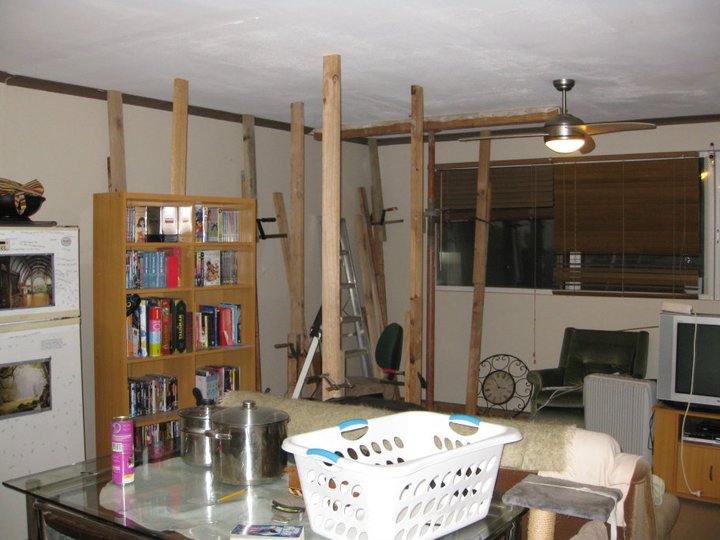
The “after” shot:
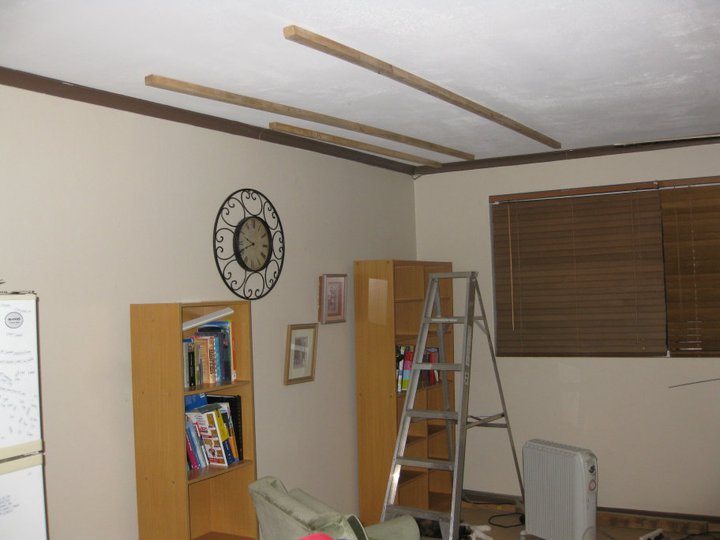
As you can see above, I wasted no time getting my furniture back where it belongs (all the tools were gone by Saturday morning). The insurance assessor did his clipboard thing mere moments ago, and said the ceiling tear-down and rebuild will be covered by the Body Corporate insurance. From where I’m sitting, there’s no hurry.
I was also cunning enough (with visions of a month-long stay at a parents’ house) to ask how long it would take to fix when the time came. The tradies said that if it was just the quarter that was obviously broken, it would take a day. Good to know!
*I THINK that’s a good thing. Anyone recognise the misquote?
Oh, THAT invasion
The Sydney city council recently voted to re-word the official city literature so that the arrival of British settlers in Australia is now called a “European invasion” rather than the “European arrival”.
Here’s a Daily Mail article.
Some argued against the change of wording, either because the word “invasion” is rather unpleasant, or (more openly) on the basis that the change was merely semantic.
Despite the obvious devastation of the original Aboriginal population, and the fact that all Australians are taught about the horror of the Stolen Generation, it only really occurred to me in a meaningful way recently that my beautiful Australia would not exist except that it was built on a foundation of breathtakingly matter-of-fact racism. The phrase “Terra nullius” (empty land) really says it all.
So why didn’t I realise the truth of my own history (and the REASON for so many of the divisions between the first and third world) sooner, given that I knew the facts? Mostly because history is taught by the winners, and in Australia that is most certainly the Europeans. All my life in school I’ve been taught to see Captain Cook as a hero – a brave, brilliant, compassionate man (compassionate because he actually made an effort to ensure his entire crew didn’t die of scurvy). He probably was all of those things. But he was also the man who doomed hundreds of nations of one of the oldest, most interesting, most environmentally conscious, and most mysterious group of cultures on Earth.
It’s an uncomfortable truth that I am wealthy and safe and will (probably) live a long and healthy life because my ancestors committed horrible crimes against innocent people on a huge scale.
Advice to Victorian Ladies
This is taken from a mid-book compilation by author Liza Picard, in Victorian London. Enjoy!
Advice to Ladies:
Most wind instruments are decidedly inelegant, they should be left to the gentlemen. Playing the violin-cello is of course out of the question, while the violin, while not so openly obscene, necessitates an awkward position of the head and neck which is not recommended. The piano-forte is an elegant woman’s best friend. There is room on a properly designed piano stool for two, in delightful proximity, when attempting pieces for four hands. Remember that if your companion stands up you may be deposited on the floor unless you stand at the same time. Pages need turning, by someone standing close behind you. This will be present to your mind when adjusting the neckline of your dress before a musical evening. Do not spare the application of perfume.
Never be in the company of an unmarried man alone, unless considerations such as the imminence of an acceptable proposal of marriage outweigh the normal rules. If about to faint with emotion, make sure there is a convenient sopha on which to subside. Not all gentlemen can be relied upon to catch a falling female in time.
When other peoples’ children are presented to you, express delight and admiration, no matter how unprepossessing the infants. Resist any temptation to call attention to their running noses, wet pantaloons, or digital nasal explorations. One can only hope that all these matters will be taken care of by some third party such as the nursemaid. Mothers are often blind to any imperfection in their offspring. Meanwhile try your utmost to avoid physical contact with them, combining an adroit management of your skirts with uninterrupted paeans of praise. Much the same applies to other peoples’ pets, with obvious amendments.
Death of “Traditional” publishing?
A whole lot of people point to success stories like the self-published Amanda Hocking and say, “Hah! Those cold-hearted publisher types are dying, and we laugh at them and stomp on their graves!”
These people are stupid.
I often wish publishers were more cold-hearted. They’d get through submissions way faster if that were the case. But if publishers were less in love with books, they would not be publishers. Small publishers are dying – they always have been, and they always will be. It is an extremely financially shaky business in which MOST BOOKS ARE BOUGHT AND SOLD AT AN OVERALL LOSS TO THE COMPANY. Sometimes, large publishers are unlucky and they die too. Most large publishers survive on the occasional how-did-that-happen-exactly? bestseller. In short, they survive by picking the best books they can, and then crossing their fingers and praying that THIS book is the one that keeps the company afloat for another month.
People think publishers are cold-hearted because over 90% of books are rejected, usually without stated reasons. People are constitutionally incapable of believing that THEIR sweet precious manuscript that took five years to write is, in fact, terrible. (“But my mum LOVED it!”) These people are especially offended that “bad” books are published. Having read unpublished manuscripts, I assure you that publishers set a standard that is largely consistent and has saved the reading public from worse pain than you can imagine. Self-publishing often lowers those standards to, “Do you have a few thousand dollars? Then you’re a published writer, yay!”
Personally, I don’t see rich idiots as a threat to the publishing industry. I know enough to be grateful for the gatekeepers – and secretly or otherwise, so does the entire reading public.
*personal rant over*
I like the Behler blog, and especially this article, which inspired today’s post.


 Felicity Banks