Conflux 7: From here to there
Conflux 7 is a speculative fiction conference in my own home town – Canberra. The official program is here (and currently incorrect), but I’m guessing the bits you want to know are:

It’s not about the money. . . or is it?
I’ve said about a million times that if you don’t enjoy writing for the sake of writing – don’t write.
Crime pays more often than writing does, and I’m willing to bet there are more millionaire fraudsters than there are millionaire writers.
On the other hand. . .
If you want to get published, you need to actually connect both with individual readers (ie you need to make sense, and to CONVEY all that emotion in your imagination) and with the market (ie you need to obey certain conventions, such as a 60,000-80,000 word length in young adult books).
Lynn Price of the Behler Blog talks a bit about the difference between “writing for the love” and “lazy writing” here.
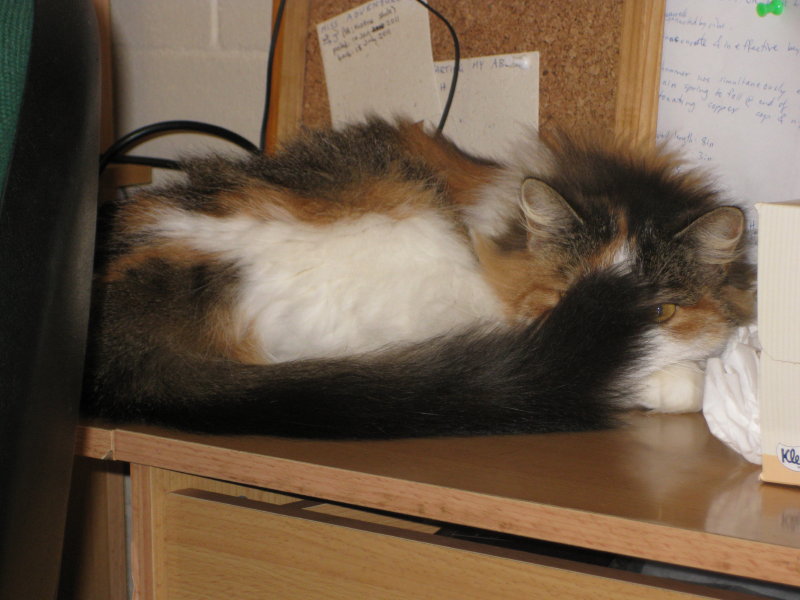
Speaking of lazy, I keep telling Ana that leaving muddy pawprints on my notes does not constitute co-writing. It doesn’t seem to bother her.
Philip Pullman book review # 2 of 4
“The Subtle Knife” is the second book in the “His Dark Materials” trilogy. Lyra – and several friends in unusual places – is still vital, and so is Will. Will is from our world, and he needs to find his father – an explorer who found something powerful enemies wanted, and hasn’t been seen since.
The rest of this review has been moved to Comfy Chair, where I get paid for it.
One-sentence rant
I am disheartened that so many Australians do not trust Indonesia to kill cattle – but do trust Malaysia to jail refugees.
It’s aliiiiiiiive!
I gained a kilo and a half this week (“normal” weekly weight gain is meant to be an average of around half a kilo, but I guess my body is trying to catch up from losing seven kilos). The baby was very clearly growing yesterday, as I felt hungry every hour and had to eat almost constantly (which is really annoying since I’m still nauseous).
Under the heading “Pregnancy tales of woe” I drank over a litre of off milk this week due to the assumption that it tasted funny due to pregnancy wackiness (it was well within its use by date; I later discovered there was an issue with the delivery truck). That, combined with the return of a nearby-but-not-actually-in-my-house student this week means I’ll be putting off my attempt to reduce the amount of ondansetron (zofran) that I’m taking.
The good news is that, on Sunday night just after CJ fell asleep, I think I felt Mini-Me move for the first time. It was as gentle as the touch of a hand – but nausea and cramps don’t feel like that. I didn’t wake up CJ (it’s not like he’d be able to feel anything anytime soon), but just lay still feeling incredibly special.
Here’s a random picture of a sunset from a day or two ago, so this entry isn’t all text:

I’ve been unable to read scary books or watch scary TV (the slightest tension makes me sicker – one of the curses of having a great imagination + being sick), so I’ve been reading baby and child-raising books (which are sometimes even scarier, but oh well). There are some aspects of parenthood that I am dead set against for various reasons. Here’s a selection of five.
1. Home births.
If the “Worst-case scenario survival handbook” taught me anything, it’s that birth is usually a largely automatic process. Unfortunately, the key word is “usually”. One of my best friends had her first baby just under a year ago. Throughout her pregnancy, her blood pressure was normal. During labour, it shot up. She had pre-eclampsia, and her organs began to shut down. Her baby was hastily removed, and my friend went into surgery and was basically dead to the world for three days.
Since she was at a birthing centre, the reaction to her life-threatening condition was to put her in the lift – within minutes, she was with doctors and surgeons. Two weeks later, she and the baby were fine (although three days on the bottle meant the little one was unable to adjust to breast feeding). If she’d had a home birth, the reaction would be to call an ambulance. She would probably have died en route.
When things go wrong during labour, they go wrong quickly. Sometimes the result is the loss of both mother and baby. This is why I am against home births.
2. Co-sleeping (that is, having the baby sleep in the same bed as one or both parents).
This is a SIDS (Sudden Infant Death Syndrome) risk for numerous reasons. Heavy sleepers can crush their babies (far more likely after taking drugs or having a few drinks), or the baby can get stuck or suffocated by the bedding. Like #1, this is a no-brainer that will probably one day be made illegal.
3. Lying about Santa.
The idea of a heartfelt belief in Santa being a vital part of childhood means that childhood must also include the growing realisation that every trusted adult in your life has been lying to you for years. That’s not a realisation I want my children to go through. My own parents always said that Santa was “a game we play at Christmas” and that never posed the slightest problem for me or my siblings. It also meant we didn’t give away any secrets to other kids.
PS Also, Santa is just scary for many little ones – he is, after all, a strange man whose face is almost entirely concealed )by artificial means). Santa photos are definitely not worth tears and trauma.
4. Raising gender-neutral children.
Until relatively recently, my nephew’s favourite colour was pink. None of his extended family ever “corrected” him. That’s stupid. But they did dress him in male clothing and refer to him as “he/him/handsome/a boy”. We all know that young babies are impossible to recognise as male or female (leading to many a fractional pause as a friend describes the infant as either handsome or beautiful based on the parent’s timely advice), and it makes very little difference outside of a nappy.
Except that it does. Countless psychological studies show that we treat children differently based on gender from the first hour of life (girls are cuddled more, boys are bounced more roughly, etc). Some parents go to extreme lengths to try and prevent this different behaviour from touching their child. Since our society is so obsessed with gender (it’s often the first thing we notice about new people, for example) I think it’s best to let my kids have that socialising effect from the very start – and then let them choose when and where to defy it.
And yes, I’ll be skipping that awkward baby moment by dressing my kid in gender-specific colours most of the time. Mostly because gender is very strongly linked to attractiveness, and I want my child to be treated as beautiful/handsome as much as possible. Also, at a certain age children feel that their clothing decides their gender, so it becomes desperately important for them to dress to exaggerate their gender. It’s cruel not to let them do so.
I don’t see any connection between childhood gender-based behaviour (or the opposite) and homosexuality.
5. Peer pressure.
Parents in particular often think of peer pressure as extremely harmful – linking it immediately with drugs, binge drinking, teen hatred, and lots of underage sex. Yes; there certainly is a link. But peer pressure also helps our kids shower regularly, hold conversations that other teens find interesting, and feel strongly that kicking a dog is a bad thing. So peer pressure actually has a lot of value – it’s what holds society together, and I wish I’d followed the crowd a bit more when I was young.
What child-rearing or birthing techniques do you find noticeably nutty or downright harmful? (Please stay polite.)
Done and done
Want to know the most stupid movie cliché?
It’s the whimsical writer character who’s secretly poured their heart and soul into a book* that they’re too afraid to let anyone read. As the movie plods towards its happy ending, the writer finally finds the courage they need to send their book to a publisher**. They are instantly published.
If someone told me they’d peed on one of my cats, it could hardly be more offensive.
Writing needs editing – by you, by an HONEST friend (who tells you it has enormous flaws – because it always does), and by a professional.
Writing a good book takes time and practice. This almost always means THROWING AWAY that first, treasured book. Personally, I’ve thrown away several. Most people take five to ten years to get vaguely competent at writing – which seems crazy, because any literate human can, technically, write a book. The problem is that you can’t measure good writing, so people tend to vastly overestimate their own skill – hence the need for real editors.
Getting a good book published isn’t a given either. You need a little bit of luck to hit the market at the right time and place (which includes learning the stylistic writing fashions of the day – which are constantly changing, hence the need to read modern books in your genre). In practice, this means writing more than one book.
I’ve said it before and I’ll say it again: The average book has a 1 in 10,000 chance of getting published. If you really love writing for the experience of writing, that’s no problem at all.
Which leads me on to what I’m actually celebrating today. Two months ago, an industry person asked to read the full manuscript of my YA steampunk novel. Unfortunately I needed to write an extra scene – something that would normally take me a day or two. I was too sick to sit up for more than a few minutes at a time, so I was forced to put off the industry person. . . for two months. If I’d been well at the time, I’d know her answer by now (argh!) – she is one of the rare people that replies when she says she will (in this case, within two months).
But.
YesterdayI finally reached the point where the book was good to go (and I used my extra time to also have CJ check it over from cover to cover and make several suggestions, some of them quite large – that’s the best kind of editorial suggestion), and I sent it off yesterday.
I happen to know my chances of an “I want to work with you” response are now 1 in 10 – which is a huge improvement. On the other hand, that also means there’s a 90% chance she’ll say, “Thanks, but no thanks.”
It doesn’t particularly matter. The thing that excites me most of all is the pride I feel in knowing I’ve written a really good book – because I’ve been writing for so long, I actually CAN tell that the writing is good (the whole “requesting of the full manuscript from the first person who saw it” is also a handy clue).
Since early this year, my writing area has been slowly spreading and overflowing with information on duelling guns, historical architecture, steam engines, character sheets, and clockwork rats. Since the book is now polished to a shine, I can FINALLY tidy all the notes and pictures away for a rainy day – which is to say, the next round of editing.
I can’t wait.

*often written by hand or by typewriter, which is even more offensive – because it means they’ve done no editing whatsoever.
**sometimes after showing the book to a close friend, who tells them exactly how wonderful it is.
Place your bets
On 7 September (if not before), I will be announcing whether Mini-Me is a boy or a girl (or indeed a hermaphrodite cthulhu). Place your guesses here, and I’ll pick a winner.
I should admit there’ll almost certainly be no prize other than personal satisfaction. . . but you never know what I’ll feel like doing on the day.
Multicultural Steampunk
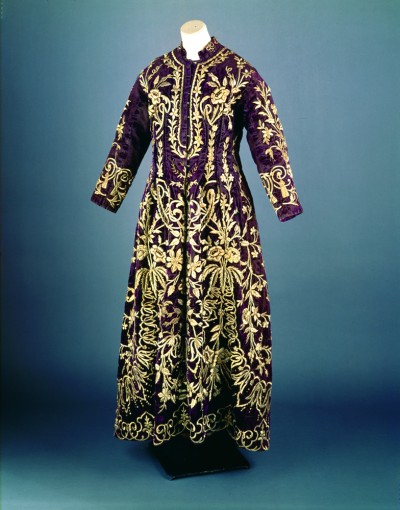
The Victorian era was a time of unprecedented global interaction (yes, usually with unfortunate results). Miss Kagashi has devoted herself to exploring some of the wonderful (and usually non-British) dress, customs, and rituals of the time. If you need inspiration, go there!
For example, here is a wedding dress from the Magnes Collection:
The dreaded semicolon. . . of DOOOOOOOM!!!
The semicolon has been known to divide loving families into shouting melees, and to send careers down in flames. It is the most contentious and passion-inducing piece of punctuation – and the most addictive.
How NOT to use a semicolon:
1. Frequently. I once had an editor add more than a dozen semicolons to a single page of a story (and there weren’t any lists). When I politely pointed out that he’d let his punctuation run away with him, he took another look and soon apologised profusely. My peeps, don’t let over-semicoloning happen to you!
2. To show off. This is particularly true in academia, where the person marking you has been scarred by both #1 and #3. Between Year 11 and the end of university (which was heavy on English courses) I discovered that a significant number of teachers and lecturers were so passionately opposed to semicolons – any semicolons – that they would mark essays more harshly if a single semicolon was spotted lurking (correctly or otherwise) in the text. For this reason, I did not use semicolons in essays for six years. I honestly recommend you do the same.
3. Incorrectly. If in doubt, use a comma. It will be correct.
Moving on, here is a simple tutorial on semicolons, with pretty pretty pictures to help you through the strain of intellectual effort on a Saturday morning. Enjoy.
And here is Ana. . . lurking like a semicolon gone bad:

Philip Pullman month
Judging by some of the things he says in interviews, Philip Pullman can be quite unpleasant. His books – every single one – are brilliant.
“His Dark Materials” is the trilogy he’s best known for. I can’t actually write the kind of epic work that this is, and I rarely read it – but some people do it extremely well. Philip Pullman is unmistakably a master writer.
The rest of this review has been moved to Comfy Chair, where I get paid for it.

 Felicity Banks