First Electric Vehicle
The world’s first reasonably functional electric vehicle was made in 1881 – just over a year after Edison’s public unveiling of the electric light bulb. It travelled up to fourteen kilometres an hour.
You can read all about the new reverse-engineered model here. The opening paragraph:
As more and more mainstream car manufacturers join a new wave of electric vehicle development, it looks like we’re definitely headed for an electric transport future. While powering a car with an electric motor is not exactly a new innovation, you may be surprised to learn exactly how old the technology is. A team led by Horst Schultz – the director and founder of Germany’s Autovision Museum – has spent the last year or so painstakingly recreating the world’s first street-ready electric car, designed and created by English scientists William Ayrton and John Perry, and which first hit the streets in 1881.

Conflict
Lynn Price of the Behler Blog wrote a great article on conflict, beginning with: “Day in and day out, I reject queries because they have no discernible conflict. Conflict is what keeps readers turning the pages.”
She then went on to talk about writers who think they’ve got conflict – but don’t. Read the article and get better at writing.
Or just gaze at a sleeping cat*. Whatever.

*Which is, technically, how I’m spending my weekend. But CJ and I are both sick, so we have an excuse.
Narnia #4 of 7: “Prince Caspian” by CS Lewis
Narnia has long since been conquered by the Calormenes – a neighbouring country who are entirely unmagical and who loathe anything fantastic. Prince Caspian is an unlikely hero – a Calormene himself but a boy who loves the whispered tales of Old Narnia. His uncle and guardian, Miraz, is a vicious king who usurped the throne. When Miraz’s wife bears a baby boy, Caspian’s life is suddenly in grave danger. He falls in with the remnants of Narnia’s magical past, and uses a magical artifact to summon the legendary kings and queens of old – the four children readers know and love from “The Lion, the Witch and the Wardrobe”.
I truly love both the book and the movie of “Prince Caspian”. The book has all the excellent writing characteristics of the rest, but it opens with such eeriness as the children find themselves in a Narnia in which thousands of years have passed since their time. I love that. And I love the joyful explosion as magic comes alive in Narnia after years of stifling “civilisation” by the cynical and capitalistic Calormenes.

Free sample:
The first house they came to was a school: a girls’ school, where a lot of Narnian girls, with their hair done very tight and ugly tight collars around their necks and thick tickly stockings on their legs, were having a history lesson. The sort of “History” that was taught in Narnia under Miraz’s rule was duller than the truest history you ever read and less true than the most exciting adventure story.
“If you don’t attend, Gwendolen,” said the mistress, “and stop looking out the window, I shall have to give you an order-mark.”
“But please, Miss Prizzle –” began Gwendolen.
“Did you hear what I said, Gwendolen?” asked Miss Prizzle.
“But please, Miss Prizzle,” said Gwendolen, “there’s a LION!”
Rating: PG. I’d call it absolutely G and safe for anyone, but one character is a close parallel to Jesus Christ (in one of the later books this character clearly states that he exists on Earth as well, is known by a different name there, and that the children have been brought into Narnia so that they can more easily recognise him on Earth), and some atheists have found that offensive. The books do focus on the adventures, rather than allegory about 95% of the time.
Canberra Exhibit at Regatta Point
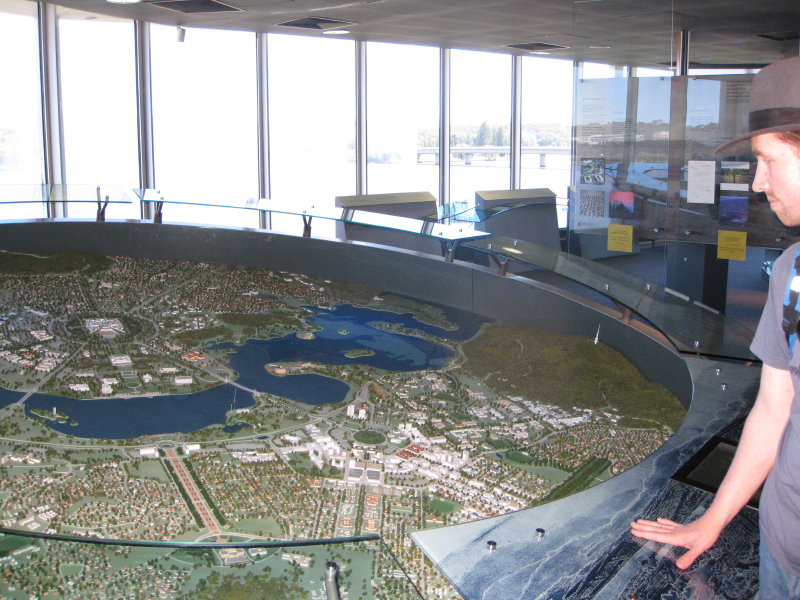
Canberra has several man-made lakes (a kind of apology for being the only Australian capital city without a beach), and dozens of picturesque penninsulas including the tourist-oriented Regatta Point.
I’ve been there several times in my life, and my favourite part within the Canberra exhibit (which is pleasantly compact) is a beautifully made 3D display that talks to you at the press of a button, and lights up the areas of Canberra that it’s talking about. It reminds me very much of certain videos of Walt Disney (or the equivalent 50s-ish videos in Iron Man 2). It’s very well done, and I’ve found it strangely compelling since the first time I saw it as a child.
Failing as a parent
One of the things about parenthood is that you’re guaranteed to fail. Most women first feel their dreams of supermumhood falter during labour, when they decide after planning for months (or years) to have a natural birth that what they really want is AN EPIDURAL, NOW. And despite the fact that childbirth involves sensitive, private organs being shredded, many women feel awful about using a very safe and common medical procedure to deal with it.
Then there’s three seconds after birth, when a slippery, pruney gross thing is put into mum’s arms. Shockingly, her reaction is not always one of consummate joy. Particularly not when, three days later, she is still sore and exhausted and her entire chemical makeup drastically alters in one day – while she’s also dealing with relatives, pain, bleeding, more pain in her OTHER sensitive private organs (breasts this time) – and the baby that has taken over her life is doing nothing but scream, poo, and cause pain. It doesn’t even smile yet. Having been blasted with cooing, airbrushed infants for nine months, many mums are shocked to find that they don’t feel high on sheer maternal love.
Again with the guilt.
I’ll stop there, rather than doing a blow-by-blow account of the next twenty (or thirty) years until the job of being a parent is mostly (but actually not at all) done. Suffice to say, none of us get it right, no matter how hard we try.
Personally, I got a head start on practising self-acceptance of parenting failure. Like most mums, I wanted a medication-free pregnancy. Hah!
Here’s some of the medicines I’ve taken (all but the last two on a daily basis):
1. Zofran (which many doctors won’t give to pregnant women because they feel it needs more testing first).
2. Maxolon (also a prescription drug).
3. Gaviscon (for heartburn and reflux – so far I’ve drunk over two litres).
4. Durotuss for dry cough (which keeps my cough mild enough I don’t throw up, but doesn’t actually get rid of it completely).
5. Metamucil (pregnancy, zofran and iron supplements all cause constipation).
6. Vitamin B, C, D, iron, and folic acid.
7. Kenalog (for mouth ulcers).
8. Panadol (pregnancy, zofran, and nausea-induced dehydration all cause headaches).
I don’t blame myself for any of this. It’s just. . . sad.
It’s been a little while since I gave an update on my current physical status, so here are my main issues:
I’m still extremely nauseous, and lately I’ve started losing some of my range of edible foods (now I can’t eat avocado – my one edible green substance – or chicken, and I’m iffy on tomatoes and mince – and, unfortunately, bread), and my sense of smell is starting to cause issues again. Drinking more than 100mL of water in a half hour period generally makes me throw up in my mouth (I regularly fantasise about how nice life would be if I was on a drip), and I’m not able to clean my teeth every day. Lying down now makes me nauseous, so I’m learning to sleep at a 45 degree angle to minimise illness. Louisette’s movements often make me feel sicker, or they hurt. Sheer gravity means that every time I shift position in any way, Louisette pushes against my skin and/or organs, which also hurts.
I have muscle pain in my hip/s or back about 90% of the time. I never walk faster than a zombie shuffle, take forever getting up the stairs, and I wish I had a crane and sling to help me turn over at night.
Some days, I am sore and fatigued as if I have the flu.
Overall, I’m down to an average of two functional hours a day (from three). I have bad days and good days. Luckily, tonight is the last of the two-and-a-half hour birthing classes (which have been exhausting and nauseating, while also interesting) and my three hours of tutoring per week is about to start dropping off as my students get close to the end of the year. I was hoping to be in better shape at this stage of the pregnancy, but if I have to eat nothing but breakfast cereal, and do absolutely nothing but watch TV and sleep for two months – well, CJ and I have been through worse.
Louisette now weighs one and a half kilos. This Friday marks the beginning of the second-last month. Every day that passes is one day less to go. I’m still looking forward to labour (and yep, I’ll be trying for a natural birth. Make of that what you will).
Construction
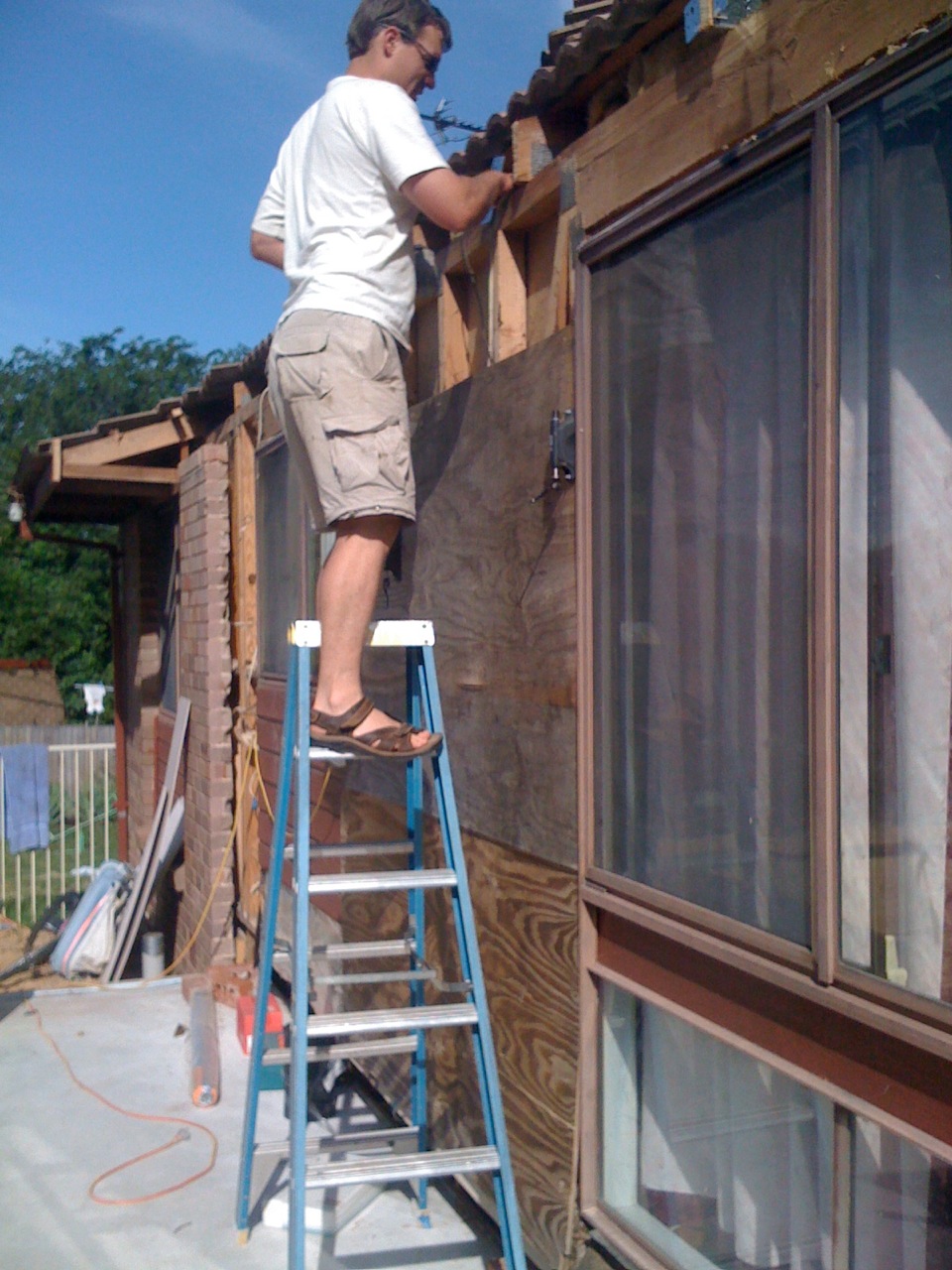
I think when a person gets to a certain age, there is a huge amount of joy to be had in knocking down bits of one’s house and making them better. I don’t own a house yet, but I’m already looking forward to being fifty or sixty years old and enjoying a parade of home improvements.
My friend bought a house only a few years ago, so she has a long way to go until that certain age – but, on the other hand, her husband (pictured below in non-OH&S-approved footwear) is a builder. So they bought a really cheap house and they’ve been doing marvellously messy things to it ever since.
I am heartily enjoying watching all of it. . . from a safe distance, of course! Renovation is a wonderful thing, but it can also be incredibly stressful for all involved.
By Christmas, this space will be a gorgeous North-facing multipurpose room. I can’t wait to see it done!
Do you look forward to renovations – or dread them?
What do you look forward to doing when you’ve reached fifty or sixty years of age (or, if you’re there already, when you’re another ten or twenty years older)?

Adoption in Australia
Every country has its areas of weakness, stupidity, or sheer badness. Australia has three that I know of that are fairly unique to us:
1. Our bizarre paranoia and lack of compassion regarding boat people – that is, refugees who arrive by boat (who are constantly the target of political rhetoric despite being incredibly rare compared to say, illegal immigrants who are rich enough to arrive by plane).
2. The life and death and health and crime statistics for Aboriginal Australians are drastically worse than those for the rest of Australia (although this is in part due to the city/country divide).
3. It is incredibly difficult, invasive, and time-consuming to adopt a child. Clearly, we want children to be protected from bad parents if possible, but this process in Australia is simply tragic. Good people who want to adopt children are put through so much lengthy red tape that even if they are eventually approved, they have passed the acceptable age range and are not allowed to adopt younger children.
If someday you get a chance to vote to change #3, please do so.
Kaja Foglio on Steampunk
Phil and Kaja Foglio – or their creation, the Girl Genius online comics and graphic novels – come up quickly in almost every steampunk discussion (at least, all of the discussions that run along the, “Ooh! Such-and-such is SO COOL!” lines). I have mentioned them myself many a time; they are one of very gew graphic novels I truly love.

Here is an article written by Kaja herself. I’ve always been careful to mention that they call their genre “gaslamp fantasy” rather than steampunk, but it turns out they’re perfectly happy for observers to call them steampunk as much as we like – so I shall do so in an unfettered manner from now on. Here’s what Kaja actually said on the matter:
(Officially, I still use the term “gaslamp fantasy” to describe Girl Genius. This saves me some time and grief, since, like any subculture or artistic movement, we have our share of people happily fighting about “what it all REALLY means.” Not slapping “steampunk!” all over my books keeps me from having to argue with them about whether or not we’re “doing it right.” They may be having fun arguing about what is and isn’t “proper steampunk,” I’ve got a story to tell. If it doesn’t fit into someone else’s box, well, so what? It’s mine.)
National Novel Writing Month (PG mild swearing)
National Novel Writing Month (generally called NaNoWriMo – and of course it’s international, not national) happens in November each year. It is a heady and caffeinated time when thousands of writers around the world attempt to write an entire novel (or at least the first 50,000 words) in one month. That requires an average rate of over 1600 words a day.
I’ve done it myself, more than once – successfully, I might add – and I don’t think the resulting novels were any worse than the rest of my books (make of that what you will). But it is important to note that the massive emotional high of the winners (if you complete your 50,000 words, you win) has led to many headaches for agents and publishers around the world.
Kids, do NaNoWriMo. It’s awesome. But for the love of all that is pure and good in the world, don’t send it anywhere in December. Or January. Or February. Maybe by March (especially if you do National Novel Editing Month – fifty hours of editing in the month of March each year) it will be okay. MAYBE.
Never forget: Your odds of publishing your finished book with a reputable publisher are about 1 in 10,000. Don’t be such a moron that you think finishing a first draft means you’re some kind of genius and can defy the odds without any more work. NaNoWriMo is mostly good for giving you a sense of how long 50,000 words is (NB: a lot shorter than most books, unless it’s for children) – so you have a better sense of what you’re doing next time. It happens to work well for me, because I already spend 90% of my writing time editing. THINK about how many hours that 90% is, and you’ll have an idea of how unfinished your “finished” book is on December 1st.
Here‘s an article by the M-rated Chuck Wendig (who has a wicked way with words). And here’s the bit that I think is the most important:
The one flaw in NaNoWriMo (and why it sometimes earns the ire of professional writers) is that it kind of floods the marketplace a little bit. November 30th rolls around and suddenly you have a world with thousands of new novels birthed screaming into an unkind world, and while that remains a truly sublime act of creation, it also means that you have a lot of writers who don’t have the sense of a tree grub, and these writers decide to abdicate their own sense of work and responsibility by throwing their unformed fetal drafts into the world. They choke the inboxes of agents and editors with their protoplasmic snot-waffle novels and they think, “Gee golly gosh, I’m a real writer now!” Except, they’re not. They’re rosy-cheeked, empty-eyed shitheads. Don’t be that shithead. Don’t just loose your garbage onto an unsuspecting world (which creates more work for agents and editors who already have a hard time finding diamonds in a sewage tank). Take time. Polish your work. Give it six months. Give it a year. Give the novel the air it needs to breathe. Give yourself, as a self-serious novelist, time to realize when this book is ready to roll or (a bigger and more mature revelation) that this book just isn’t “the one” — and that it’s time to write another better book, a book that doesn’t beg to be written only from November 1st to November 30th, a book that can be written whenever your fluttering wordmonkey heart so desires.

Narnia #3 of 7: “The Horse and His Boy” by CS Lewis
This is a truly interesting book, because it takes place entirely within the world of Narnia and the surrounding lands – in fact the whole book technically takes place within a sentence from “The Lion, the Witch and the Wardrobe” – and the children from our world barely appear.

Shasta is a boy who overhears his father arranging to sell him to a passing lord – which is when he finds out his “father” found him, the only survivor of some seafaring disaster, and took him in (not out of compassion; Shasta is essentially a slave and his facial features show he is of Narnian birth). He considers running away, and is more than slightly surprised when the lord’s horse advises that he do so. The horse was taken from Narnia as a colt, and brought to a much more “civilised” world where he has been pretending to be a normal horse for most of his life.
And so the horse (Bree) steals the boy, and their escape to Narnia begins. They soon fall in with a second talking horse and a local girl who is fleeing an arranged marriage. The horses get along rather better than the humans do, since the local girl is rather high-class and Shasta is anything but.
There are lion attacks, breathless flights, haunted tombs, and our heroes accidentally discover a plot to take Narnia by force. It’s all very exciting J
Free sample:
The cloud was bigger and thicker than it had looked at first and soon the night grew very dark. Just as Shasta was saying to himself, “We must be nearly at the sandhills by now,” his heart leapt into his mouth because an appalling noise had suddenly risen up out of the darkness ahead; a long snarling roar, melancholy and utterly savage. Instantly Bree swerved round and began galloping inland again as fast as he could gallop.
“What is it?” gasped Shasta.
“Lions!” said Bree, without checking his pace or turning his head.
Rating: PG. I’d call it absolutely G and safe for anyone, but one character is a close parallel to Jesus Christ (in one of the later books this character clearly states that he exists on Earth as well, is known by a different name there, and that the children have been brought into Narnia so that they can more easily recognise him on Earth), and some atheists have found that offensive. The books do focus on the adventures, rather than allegory about 95% of the time.

 Felicity Banks