Wattleseed bread, finger limes, and bush tomato
Yesterday I sold books at the Goulburn Reader Writer Festival, and met Fiona, who was selling a range of Australian native foods from Bent Shed Produce.
Naturally I was deliriously excited and I tasted several different things before settling on buying lemon myrtle (which I already know is delicious; it really is as if lemon has magically turned into a herb), forest berry (which is actually made from a particularly aromatic eucalyptus; the smell is delicious and it’s especially good mixed with sugar), bush tomato, wattleseed (I’d heard people used it to make bread), and finger limes.
Bush tomato/Akadjura
I just made tuna mornay (a somewhat bland dish) and sprinkled it with dried and powdered bush tomato. It was incredible! Apparently when it’s dried it’s called Akudjura, so that’s how I described it to the kids (who think they hate tomato). They both said it was great. It’s very similar to sundried tomato in taste, but sweeter (and of course it lasts longer because it’s fully dried). It was utterly delicious simply on it’s own (so I’ll be having it with cheese and crackers very soo—
Excuse me.

Well that was delicious.
Cheese and crackers and akudjura = yum! I do believe I’ll have some more once I’m finished this blog. I used water crackers (nice and plain; perfect) and Massaman cheese (ditto, although next time I’ll put much more akadjura on).
I’d definitely recommend akudjura for any cheese platter or dukkah (powdered herbs, spices, and nuts for sprinkling or dipping), or with bread and olive oil (macadamia oil would be even better, if only because macadamias are Aussie too). There are lots of really excellent Aussie dukkah recipes out there, and there are several Australian salts (bizarrely, some are saltier than others) too.
I now wish I had a kilo of this glorious substance in my cupboard. The 20g I have may not make it to the weekend.
NOTE: There are several species of bush tomato and some are poisonous, so don’t pick your own unless you know what you’re doing.
Finger Limes
I’d heard a lot about finger limes so I was eager to give them a try. This is what they look like (although different varieties can get a lot bigger, like banana size):

Unfortunately they’re a semitropical fruit so they’re unlikely to become part of my regular diet (unless they show up in shops, which is already happening). But if I’m ever lost in an Australian rainforest, I’ll definitely keep an eye out for these.
Their taste is sour, very much like lemons or limes (or both). Apparently different colours have different tastes, but I couldn’t tell the difference. It’s very cool that the inside echoes the colour of the outside (particularly if one wants to colour-coordinate one’s food). But it’s their texture that really blows my mind. I don’t want to open any right now because I have plans to make finger lime sorbet another day (gonna stir in the finger lime at the last minute to see what happens to the texture; I know they freeze well usually), but you can see a pic (along with instructions on how to grow them yourself) here. A lot of people talk about “finger lime caviar” and that is exactly right. The entire fruit is these tiny, perfect crystals that pop in your mouth with a tiny explosion of juice.
They’d be brilliant on pavlova, on a fruit salad (this recipe recommends sweetening them first, which could be a great technique for all sorts of things), and anything that could do with a zap of citrus. I hear they’re great in drinks, but I badly want to know if they float or not. If they float, that’d be brilliant. If they sink it’d be a waste (you’d have to crush them, which would still have a grand taste, but I’m so in love with the texture I don’t want to do that).
I fed some to several children (aged 3-8) this morning, and they loved how easy it is to break open the limes in the middle (with fingernails or a butterknife or whatever; it’s easy) and then squeeze them (also easy) to get the crystals out. The 8-year old tasted some and said, “It makes my body all tingly!”
Wattleseed
I was extremely excited about trying wattleseed because I’ve recently discovered that Australian Aborigines were probably the first bakers in the world—and wattleseed (one of the few plants I know by sight) was one of the possible ingredients. Given that our neighbour’s wattle bush is hanging over our fence (that makes it ours, right?) I thought I might be able to harvest it myself. Unfortunately, there are several species of wattle trees and some are poisonous, so I won’t be picking my own wattleseed anytime soon.
The wattleseed I bought was roasted and dried, ready to go. The process of making any kind of flour is very labor intensive. (You can read a bit about it here.)
It was immediately obvious that if I made “proper” wattleseed bread it would take a lot more wattleseed, would not rise, and would taste incredibly intense. I suspect (given the intensity combined with the wide range of native flours) that it wasn’t used alone, but in combination with several other ground-up foods. The smell alone was like walking into a starbucks: so much coffee, and chocolate too. Unsurprisingly, a lot of people recommend making wattleseed coffee or hot chocolate.
Hold on. I have an idea.

I just heated some milk (400mL) with some wattleseed (three teaspoons) in the microwave for 4 minutes (you can see the milk-covered microwave plate in the pic above), then added four teaspooons full of milo and one of sugar. Finally I put canned whipped cream on the top, and sprinkled a 2:1 mixture of sugar:wattleseed on that.
A lot of recipes say wattleseed should be soaked before cooking, which is why I put the wattleseed in the milk before heating it. Certainly it absorbed a lot of milk.
There’s two mugs because I fed one to Chris, who (unlike me) likes coffee. We both very much enjoyed our drinks. The wattleseeds didn’t dissolve at all, and sunk to the bottom. It still tastes nice, but that wasn’t the effect I was going for. It’d probably work better if I either blended it or strained it before serving.
The sugar-based powder on top of the cream, however, was utter genius. Highly recommended, even for anti-coffee freaks like myself. It’d work on anything that would usually be improved with cinnamon sugar (or just cinnamon).
This morning I made wattleseed “damper” (I’m putting damper in quote marks because damper is bread you cook when you’re walking across Australia… which means buttermilk etc is somewhat unlikely). Plus obviously it uses standard refined white flour (which does made a great bread of course). This is the recipe I used, from here.
Bush Damper
Ingredients
2 cups self raising flour
1 Tbspn Ground Wattleseed
1 tspn Ground Lemon Myrtle
1 tspn Ground Mountain Pepper (I used forest berry instead)
250ml well shaken buttermilk (I only had 110g)
1 Tbspn Macadamia Nut Oil (I used peanut oil; a total of 110g to make up for the lack of buttermilk)
Milk for brushing
Preheat oven to 180C
Sift the flour and seasonings into a large bowl and make a well in the centre. Combine the buttermilk and oil and pour into the well. Mix quickly and lightly to a soft dough. Turn onto a floured board and knead until smooth. Shape into a round (or whatever shape you like) and place on a lightly oiled baking tray. Brush with milk. Bake for 40-50 minutes (it will sound hollow when tapped).
Serve with Macadamia Nut Dukkah
I mixed and kneaded it in the thermomix and served it with butter (although it was nice by itself too).
The smell of bread and wattleseed filled the thermomix, and the house. Here it is, raw and cooked:
I sprinkled akudjura on top, which unfortunately just burnt. Other than that, it was great. It had a pleasantly thick texture with a crumbly crust. It’s got a vibe a little like hot cross buns—something that has a distinct flavour, except that the flavour of wattleseed bread is. . . well, distinct. Not much like hot cross buns at all.
It was very good. Someone I fed it too described it as “fresh”—not because it was cooked this morning, but because of the flavour.
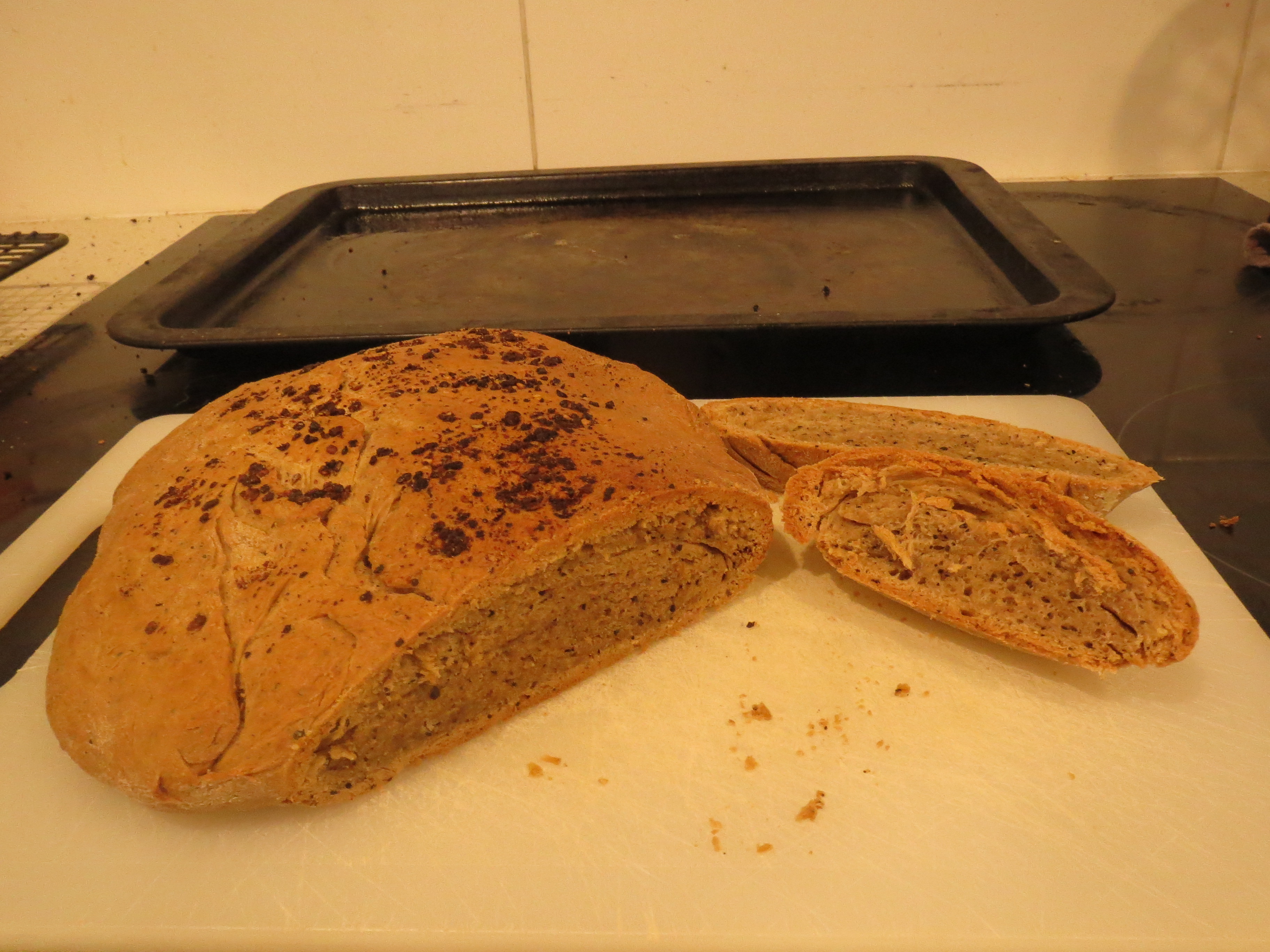
I think, generally, wattleseed is too similar to coffee for me (more so the smell than the taste)—but I’ll still gladly buy it anytime I see it, for sugary sprinkles if nothing else.
Monsters
Spoilers for The Shape of Water.
(And highly unrelated pictures, because I’m hazy on copyright law for movie stills.)
Last night, I saw The Shape of Water, which recently won an Oscar and (more importantly in my world) has been talked up by The Mary Sue.
I walked into the movie saying to Chris, “I have no idea why a movie about fish sex just won Best Picture.”
I walked out saying the same thing. I still don’t get it.
The Shape of Water is a fantastic movie. No doubt about that. So I watched a brilliantly written and acted speculative fiction movie and… the more I think about it, the less I like it.
I certainly do appreciate that this is a movie for and about freaks: a fishman, a mute orphan, a black woman (possibly an atheist), an older gay man, and a Russian scientist. (The villain is an oh so heterosexual white man.) It’s also really cool that the film doesn’t suffer from the “male gaze” problem that so many films do (there’s a “normal” sex scene which made the audience audibly horrified, and sexy scenes with Eliza and the fish man focus on her pleasure via her delighted smile). Guillermo del Toro was very careful to give the fish man a lean, muscular body (and especially butt) for female audience members to appreciate (seriously; he consulted regularly with his wife and others) but there aren’t any lingering shots of the fish man either. It is, in short, not a film that’s all about being sexy to the audience.
However, the movie makes it abundantly clear that yes, Eliza (the main character) and the fish man definitely have sex. In her extremely interesting video on Monster Boyfriends, Linday Ellis says The Shape of Water finally took the monster movie “where scores have women had wanted it to go for decades”.
I am just not one of those women. I’m a little disappointed in myself, to be honest. Surely my imagination and empathy aren’t letting me down right here in my favourite genre?

I really like Lindsay Ellis’s take that “Beauty and the Beast” stories are a way for women to talk about their anxiety—and hope—when facing the daunting spectre of arranged marriage. I’ve spoken to quite a few Indonesian people who are in happy arranged marriages and it’s a topic that has fascinated me for years (and that I’m not necessarily opposed to… except of course that it gives men even more power than they already have, with the inevitable awful results in way too many cases).
Elliss’s video has changed my view of the entire “Beauty and the Beast” concept, except of course that (a) Most of the audience is NOT facing arranged marriage, so there’s clearly something else at play (b) The idea of a super-virtuous female changing a bad man into a good man is so awful. First because that’s a classic inverse of famous abuser lines (“I love you, but sometimes you just make me so angry I can’t help it.”), secondly because it relies on fundamental personality change for a relationship to work, which is both patronising (don’t ever go into a relationship thinking you can mould someone to your specifications) and dangerous (false hope and false reality, both of which aren’t healthy).
I DO think that a healthy relationship improves people, but in a mutual and mutually beneficial way. I like a romance where people are partners, and I hate a relationship where someone (pretty much always the woman in a hetero pairing) is the parental figure—either disrespecting their partner, doing more than their fair share of the work, or constantly nurturing someone who doesn’t nurture them back. (This is a topic very close to home as my husband has inattentive ADD, which causes a lot of behaviour that appears childish in a grown man. Luckily-?-my own anxiety and bad health causes a lot of childish-like behaviour in me, too.)
The adjacent idea of “Men will do anything for a pretty woman” is also super problematic. It’s linked to rape culture as well as the infantilising of men (which then links to men not doing their share of household chores, which isn’t good for anyone). I do understand the appeal of that idea. I like the idea of women being powerful, even if only because they own a pair of boobs.

Ellis’s video also talks about King Kong and other movies, and the shift from hatred of monsters to sympathy. She says that, overall, monsters tend to represent the anxieties of whatever time they’re written in.
Which brings us to King Kong. Unfortunately, any kind of primate tends to represent (unconsciously or otherwise) black people, and it’s no coincidence that the darkest/hairiest monsters tend to be paired with the whitest possible females (Sally Hawkins is incredibly white, and her fish man is dark—another problematic element of The Shape of Water). King Kong isn’t a romance (or is it?) but a story of how a white woman is more powerful than a black man (and/or monster). Which is appealing, even to me, but also deeply messed up as I explained above.
On reflection, I think the romantic “monster” of modern books/movies is all about the “bad boy” thing. (Or, in some cases, a case of “Us freaks have finally found each other” crossed with “OUR romance is special and unique”. Both of which I’m actually fine with.)
I have a really close friend who I respect deeply (and who is an adult, mother, and wife) who loves both Twilight and Beauty and the Beast. Both of us are married to very stable, reliable men. Her life is quite stable and responsible and adult-like because her husband has a stabilising influence (it’s not boring; they can do really cool things with their whole family because they actually do planning and budgeting and stuff); my life is risky and chaotic and exciting because I know my husband will be there when I fail. So I think that might be at the heart of things. The bad boy appeals because he is exciting; ditto monsters. To me the bad boy has no appeal because I am already wild and destructive and risky. I am the monster, so I don’t look for those qualities in a partner.
Yep, I think that’s it. Okay! I feel better about monster movies now.
So what about the movie?
First, let’s talk masturbation. The Mary Sue web site loved the fact that Eliza’s life was perfectly content—she didn’t need a man (amphibious or otherwise). She was sexually satisfied by pleasuring herself, and her daily routine was exactly what she wanted it to be. When I watched the movie I wasn’t sure what the purpose of showing Eliza’s masturbation was—why have a masturbation scene, when it clearly wasn’t to titillate the audience?
I think a lot of it was just to say, “Yes, this is set in the 60s, but people were sexually active then too”, so that it felt more natural for her to have a sexual relationship with someone (the fish man, in this case) that she hasn’t known very long.
And I think it was also to hint that Eliza wasn’t necessarily entirely human herself. She was a foundling discovered by a river, with what looked like knife slashes on her neck that later turn into/turn out to be gills. She masturbates in water because she’s part fish person herself. (The fish man is clearly very comfortable mating with a human, so it’s entirely possible fish people have been interbreeding with humans.)
So that’s fine. I found it slightly jarring that Eliza’s face is quite old for a romantic lead (why, she’s over forty! Which is lovely) but her body is VERY young. Not a wrinkle, freckle, sag, or blemish.
Eh, I’m probably just jealous.

I mentioned earlier that the film is all about freaks, which is lovely. (A mute woman, a gay man, etc.) But I hated hated hated that the gay man’s crush was on a twenty-something. The actors are about forty years different in age, and the crush was framed in the film as sweet and life-affirming and charming. I just found it creepy. I would have found it creepy in any much older person crushing on a much younger person, but so much homophobia is based on the idea that homophobia = pedophilia, and although that’s nonsense, having a huge age gap like that in a film is really unhelpful.
I was surprised and disappointed at how little time was spent developing the relationship between Eliza and the fish man. To me, you get to know someone and have a deep connection with them, then you have sex. In the movie, the fish man learns how to say “egg” and “music” and… that’s it. It’s clear that time is passing and there’s more to their growing friendship that we the audience don’t see, but they never actually have a conversation. Couldn’t we have a scene where Eliza and the fish man actually talk to each other? It doesn’t even need to be in words (or in sign language, or whatever). Although having said that, how about they learn one another’s names? Or invent names for each other?
It just didn’t seem to me as if there was much more to the relationship than a bit of sex and a rescue (which is noble and exciting, but doesn’t make a relationship). Clearly the movie portrays sex AS communication/connection.
Okay, fine. Sorta.
It also disturbed me very much that the fish man was child-like in some ways. That’s never not going to make me hate a romantic pairing. I’m fine with someone having fun and being silly, but I’m not okay with someone having the intelligence of a child and then having sex.
Much is made of the fish man’s intelligence, but he doesn’t behave like an intelligent adult. He behaves like an intelligent child.
Ew, ew, ew, ew, ew.
And I have one more big problem with the movie (an issue linked to the slightly-off choice of a speaking woman actress for a mute character—when it would be so much better to use a mute actress). I feel like the movie contradicts itself. Eliza appears content from the beginning of the movie (in her rather ordinary life), and she has two excellent friends who don’t see her as a mute woman but as a person.
But then she gives an impassioned speech about how the fish man is happy to see her, and doesn’t see her as incomplete.
Sure, that’s nice. But she already has at least two friends who don’t see her as incomplete either. She’s doing just fine. So what is that speech doing there? There are so many other things she could have spoken passionately about at that exact moment.
Then, in a scene that a lot of people love, she is sitting across the table from the fish man knowing she soon has to let him go, and she sings to him and has an imagined dance sequence with him (much like the TV she loves to watch). So she longs to talk—and sing. Fair enough.
Except… she was so content until then. So it’s as if the fish man brings out her unhappiness, making her life and sense of self seem poor and shabby when they were fine before. No relationship should make you feel worse about yourself or your disabilities (a passing moment of wistfulness, sure—but not an iconic movie scene, weighted with meaning).
I would have been so much happier if her impassioned speech was about something—anything—else. The character is so much more than her disability, yet the movie treats her muteness as her most important character trait in the two most emotional scenes. I hate that.
Maybe the masturbation was all bout Eliza longing desperately for a romantic relationship—the one thing her life lacks most (other than a nicer apartment and job, two things that apparently never bother her). But a romance is so much more than sex. In my opinion.
And, finally, the body horror of the bad guy’s injured fingers is a total cliche, in my opinion, and something rather unworthy of a film that treats a fish man as beautiful and a mute woman as the hero. Yeah, I get that the bad guy is… well… bad. So does that mean everyone with a physical deformity is bad, too? So muteness is fine but physical disability = evil?
I really wanted to like this film, and there are so many wonderful and original things about it. But I don’t have a thing for monsters, I don’t think adult-child romances are ever cute, and I don’t think being mute is the most interesting (or the most tragic) thing about Eliza.
Chocaroo
I’ll be going to this year’s Goulburn Reader Writer Festival on Saturday 24 March (10am-8pm). The theme is “Feed Your Mind” and there will be a bunch of food-oriented authors. “Murder in the Mail” has two clues that can be consumed (technically you could consume all of them, but I would NOT recommend that) so I’ll fit in nicely, in my own peculiar way.
One of the authors is John Newton, and when I realised he’d written a book on pre-European Australian food I grabbed it at once. The Oldest Foods on Earth: A History of Australian Native Foods With Recipes was enthralling and I finished it quickly. . . but of course I had to stop and copy out a recipe while I was there. That recipe was “Kangaroo Loin, Semi-Smoked in Lemon Myrtle” by Indigenous Chef and star of “Wild Kitchen”, Clayton Donovan. You can see the real recipe here. and can follow the movements of the Jaaning Tree Restaurant (it does pop-ups and stuff) here.
The mechanics of smoking the kangaroo reminded me of the epically delicious Chicken and Cashews with Coconut Satay Sauce and Coconut Rice by thermomix cooking genius Quirky Cooking, here.
One of the cool things themomixes can do is cook rice while also steaming meat and reducing the liquid of a sauce. But it’s possible to still cook this recipe without one, especially if you use a rice cooker that can fit a wire frame inside. I’ll leave the Macgyvering up to you.
I found ALL my ingredients in Woolworths except the cooking wine (our Woolies has a separate shop for booze). The kangaroo was very near the chicken (and it cost the same amount to buy the marinated ones, so why not?), and the Masterfoods herb and spice mixture was just below all the herb and spice bottles (I didn’t find any plain lemon myrtle but I did order some online via ebay once I’d tasted it).
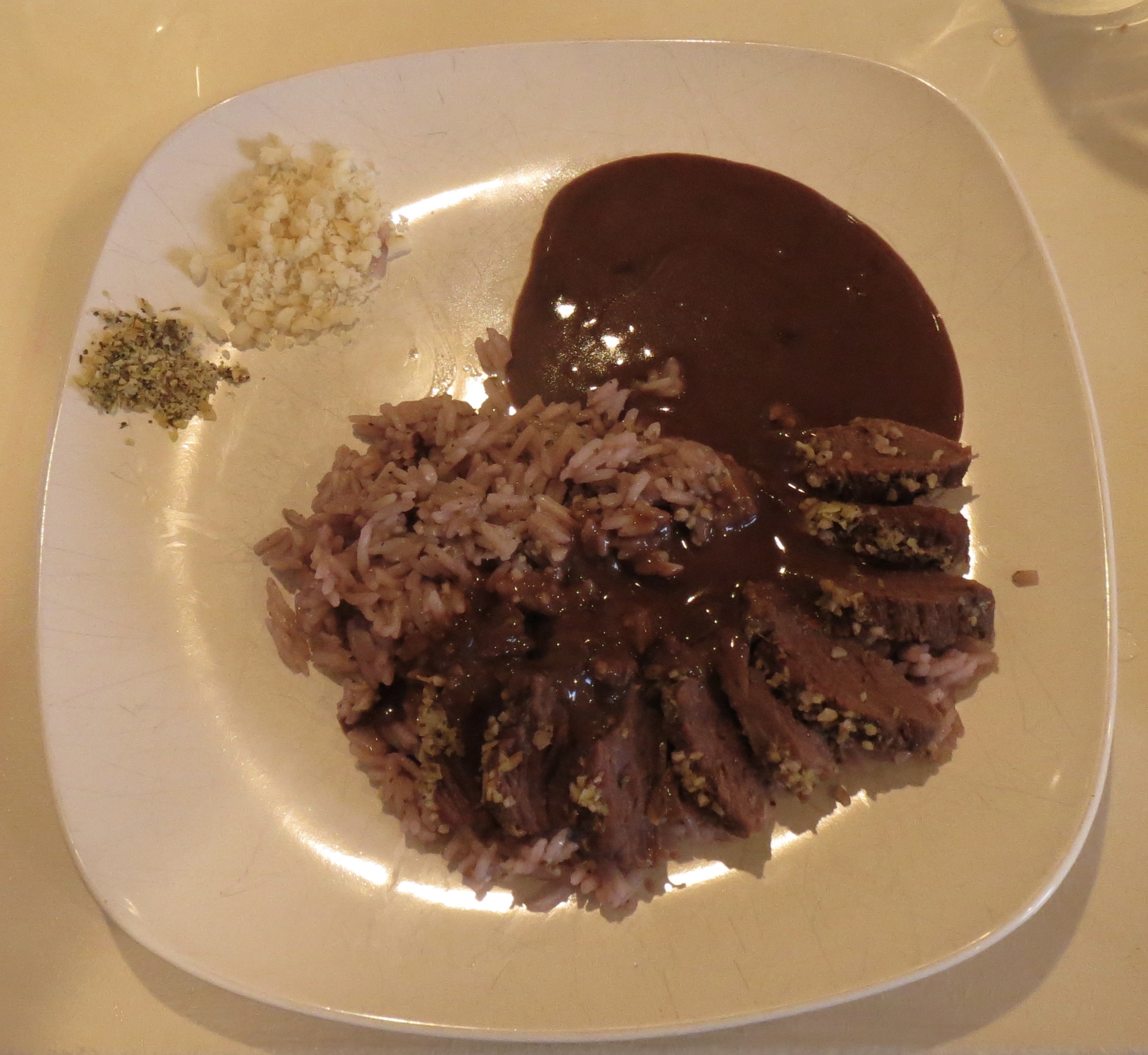
I was extremely excited about trying this out, and the results were spectacular. TJ and Chris were both impressed; Louisette refused to eat anything other than the sauce (3 out of 4 happy at dinner time is well above average). It’s incredibly rich, and the meat is lean and tender with a taste similar to lamb but. . . well. . . richer. It may have actually knocked lamb of its podium for me, which is incredible. There’s no fat to trim and no bones to negotiate. You can certainly taste the French influence. It feels weird to have rice with kangaroo, but it worked. The wine turns the rice a gorgeous purple, and the coconut makes it taste delicious.
Ingredients:
4ish kangaroo steaks, marinated in garlic and herbs (ie one pack)
Rice (enough for four people)
100mL red cooking wine
1 can coconut milk
20g bag Masterfoods “Coconut, Lemon Myrtle, and Garlic” Herb and Spice Blend (pictured, after I tore off the top).
1 tsp sugar (optional)
20g crushed macadamias (I crushed them on speed 6 for 1 second in the thermomix; putting them in a clean back and hitting them would also work)
2 tablespoons dark chocolate, broken (choc chips are handy)
1 tablespoon cranberry jelly/sauce
1 tsp stock (I used thermomix vegie stock; I recommend beef stock if you don’t have a thermomix)
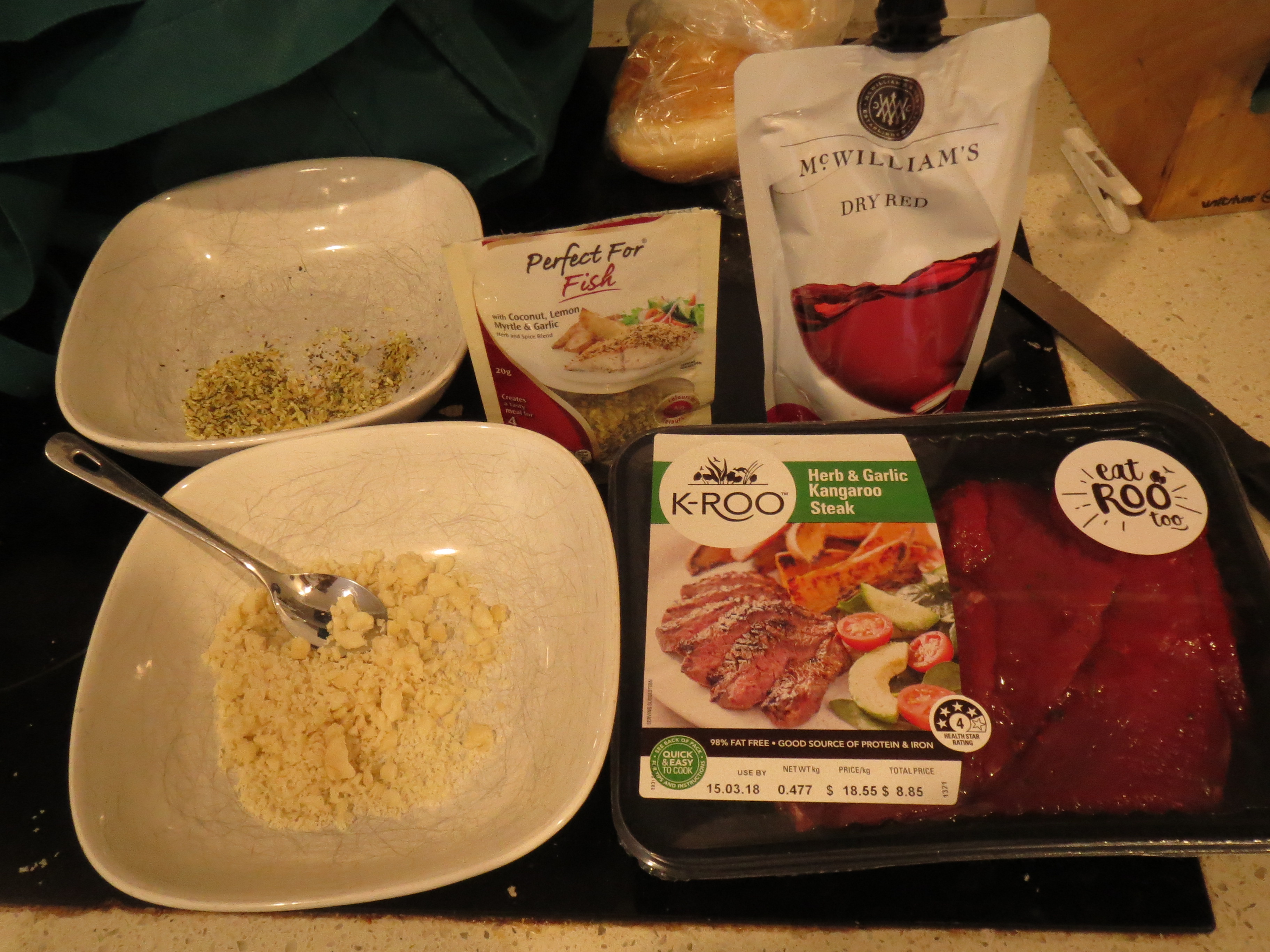
- Pour the coconut milk and red wine into the thermomix/rice cooker. Place the rice in the thermomix basket and rinse thoroughly with water (or it doesn’t cook right).
- Place the kangaroo steaks on the top layer of the wire rack/thermomix steamer (the lower layer stays empty, or can be used for vegetables).
- Mix the herb and spice mix with the sugar and 1/2 of the macadamias. Sprinkle half the resulting herb mixture over the rice, and another tablespoonful (or two) over the kangaroo steaks. Keep the rest for now (taste it; it’s salty but delicious).
- Put the thermomix basket (with the rice) into the thermomix, with the steamer (containing the kangaroo) on top. Then cook rice as normal (Varoma temperature, Speed 4, twenty minutes).
- When the rice is finished, put it in the thermo server (or other closed container) and mix in half the remaining macadamias. Put the steamer (with the kangaroo) on top of the rice (instead of the thermoserver lid) or cover it with an al foil tent.
- To make the chocolate sauce, add the chocolate (first, so it has time to melt), jam, and stock to the coconut milk and wine mixture remaining in the thermomix jug. Mix it on speed 1 for up to five minutes (until everything else is ready).
- Thinly slice the kangaroo and arrange it on plates with the rice. Add little piles of the herb mixture and macadamias to the side of the plate for diners to use for dipping (I literally couldn’t decide which flavour combination was the greatest). Pour chocolate sauce over and beside the kangaroo.
Serves 4
Useful stuff:
As with all meat, the kangaroo will be best if you leave it at room temperature for 30-60 minutes before cooking (but I didn’t do that and it was glorious).
Take your time making the sauce. It’s good for the kangaroo to ‘rest’ for up to ten minutes before getting sliced.
The sauce is amazing, and would also go beautifully with a pavlova (keeping in mind that this version will have some juice dripped down from the kangaroo, so you’ll need to use it fairly soon or make a fresh batch solo).
I’ve heard kangaroo is difficult to cook, and there seems to be a consensus that it’s important to leave it rare. But this was a winner on my first go. I’ll be cooking it VERY frequently from now on.
Kangaroo is a brilliantly lean, tasty, sustainable meat. One of the reasons it’s sustainable is that sheep and cows harden the ground they walk on, but kangaroos don’t.

 Felicity Banks