Ten Days in a Mad-House (trigger warning for dark mental illness stuff)
The title is stolen from reporter Nellie Bly, who spent ten days in an asylum in 1887 and then wrote about the horrific conditions inside, changing the care of the mentally ill forever.
I have also spent ten days in a psychiatric ward, but unlike Ms Bly I didn’t fake madness to get in. And I can report that I was treated with respect and kindness at all times, and given as much autonomy as possible.
Going to a psych ward is scary—and yes they WILL lock you up if they think they need to. I was lucky enough to have a friend, Aaron, who periodically goes to a psych ward and had told me about it. If you want to know what it’s like, read on. But this’ll be long, so feel free to just read the above paragraph.
If being locked in a psych ward seems like it would be more pleasant than being at home, go. If you’re not sure you’ll make it through the night, go. If you’re nervous but think it might help…. go.
As I said, this is gonna be long, and super personal since that’s easier for me than trying to be a neutral observer. I’ll break it up with kitten photos for you. You’re welcome.
At 10:00am on Friday 20th February 2026, I walked into the Emergency Department at Canberra Hospital. The hospital has undergone renovations lately and I was a little disoriented. But facing the door was a free-standing desk staffed by a man with very clear blue eyes and the reassuring manner of someone who is either gay or just very good at customer service.
I was carrying three bags: my sleep machine pack; my clothes and devices and chargers; my medications and lollies. I did not intend to go home.
“How can I help you today?” he asked.
“I need to check myself into the psych ward.”
“Why is that?” he asked.
“Because I want to kill myself.”
He politely explained the emergency room system (go to the desk with the window and tell them what you told me; in a bit someone will come and get you for triage and decide what to do with you from there).
Every time I met a new person—the one at the freestanding desk; the one at reception; the triage person; the nurse; the doctor; the social worker—I had to tell them again that I wanted to die, and why. They almost always asked if I had a plan, which is a dangerous question because of course my brain then immediately comes up with plans for how to die (which obviously is not helpful—I mostly ignore depressive thoughts, rather than dwelling on them!) But people also said, over and over: “You’re in the right place.” That was indeed helpful.
For the record, my life is both wonderful and terrible depending on your angle. I live in one of the richest, most privileged countries in the world; I own my home; I am married with two great kids. I’m also disabled by both fibromyalgia and Level 2 Autism, either of which makes life difficult and painful on its own; I am under considerable financial stress; etc.
My immediate triggers were: We have to take a tenant into our already-uncomfortably-small house (I have been working on making a space for six months); I have to give up fostering cats (again, this has been clear for six months); I am exhausted and stressed from trying to look after my special-needs household; my functionality is dropping eg I used to have four functional hours per day on average and now it is less which hurts; I am increasingly unable to do many simple tasks such as attending a straightforward doctor appointment on my own, which is both humiliating and frightening.
After I had reported myself to the reception desk lady and received a hospital band around my wrist, a random waiting room woman approached me. “I heard what you said at the desk,” she told me. “I want you to know that you are precious and I’m so glad you are here. Can I give you a hug?”
I said yes and got a hug. Slightly confused, I thought she was my cousin*. She corrected me gently, gave me another hug, and went back to her seat to wait until she would be seen for her own emergency. I will probably never see her again.
*I find pretty much everything confusing. Autistic people are terrible at faces, so I rarely recognise people (I was once waiting for my sister to arrive at our parents’ house and because it was barely post-lockdown she was wearing a cloth mask… I didn’t recognise her). And thanks to being overstimulated by any conversation with a new person + having ADHD, I also never remember names. New places are even more confusing, especially when they’ve been built in phases without a really clear route from one place to the next. My life is genuinely terrifying, like a person in the early stages of dementia who is still expected to remember literally twelve different meds each day (ranging from pills to heat packs to injections) and generally function independently. A couple of days ago I took two wrong turns on the way to fetch my daughter from her school. The best part is that it’s all completely unpredictable! MAYBE I’ll get everything right all day. Maybe I’ll think I’m doing fine but end up in the wrong city (this has happened more than once).
Quite soon, I was called into another room for triage. They sent me to the “fast track” room where I got a kind of dentist chair (highly adjustable and padded, with arms) and a curtain around me for a degree of privacy. I spent many hours there and saw at least three different medical people. Maybe five? One of the purposes of the fast track room is to have doctors of different specialties seeing one patient in the same place rather than sending the patient trekking through many waiting rooms.
At one stage, an older woman was in the medical chair next to me (behind the curtain). She insisted she was in great health, but also had “a crackle in my lung” (which they couldn’t hear) and “a tremor in my heart” (which didn’t show up on their tests). She went to the bathroom and came back with a “new rash” that no one else could see. When they tried to take blood, she screamed in pain. They put numbing cream on her then came back and drew blood successfully. As I predicted from the start, they ultimately found nothing wrong with her and sent her home with reassurance and nothing more.
As an old-ish woman myself with the chronic, vaguely-defined symptoms of fibromyalgia, I hated her. Either she is an extraordinary hypochondriac, or she has something going on that medical people are unable to spot. That question hits way too close to home (although I’m clinging to the fact that I can handle the pain of blood tests just fine). The way she came back from the loo with a Mysterious New Symptom very much echoes my own process whenever I have a new type of pain: is THIS some new clue that’ll reveal I actually have some other condition—something that can be cured??
Unusually for me, I didn’t live-tweet or live-FaceBook the experience. I live-blogged the birth of my daughter, but not this. I’m generally an extreme over-sharer (if you’re here, you’ve probably figured that out) but it occurred to me that I was suuuper mentally deficient and shouldn’t do anything public or I might regret it later. I kept my husband Chris updated on the basics, said it was fine to tell anyone he wanted what was happening in as much detail as he liked (eg his boss, who let him work from home the whole time I was in hospital). Meanwhile I kept up conversations with my three best online friends, who all have deep mental illness knowledge and who I’ve known in real life for years. One of them is Aaron, the one who’s been to the psych ward several times. One of them, Bob, said that they’d once tried to check into the psych ward and they were turned away. (This made me furious because I’ve wanted Bob to seek treatment for about twenty years and I guarantee it was a one in a million chance to actually help him. It also made me scared I’d be turned away as well, so I shared some stuff with the staff that I’d been planning to keep secret. I don’t know if that is good or bad—I think I’m on some government lists now—but at least I wasn’t told to go home.) It helped me a lot to have the online friends to report to, as it instantly turned the whole thing into A Story. Which makes me a Character In A Story, which makes me braver. It worked when I was in labor and it worked for this. I was pretty much writing this blog, even then.
Later on but still in the so-called “fast track” room, there was a young man screaming about how someone had tried to kill him that morning, and why was no one calling the police, and FUCK!
He yelled a lot for quite a while. A lady came to talk to me around then. I can’t remember if she was a social worker or what, but she had that vibe. She was visibly annoyed by the yelling man on the other side of our curtain.
Perhaps if health services were properly funded, I wouldn’t have had to hold such a delicate conversation in a crowded ward with another patient close by screaming and swearing and trying to hide under a chair.
“I’m sorry,” the young man sobbed to the medical staff gently talking him down. “I’m so, so sorry.”
My nurse brought me an orange juice and a ham and cheese sandwich on brown bread. I’m intolerant of oranges, processed meat, lactose, and brown bread but I can have a little bit of each usually and get away with it. I was certainly hungry by then, and grateful for food. Honestly by my food-intolerance standards, a ham and cheese sandwich is pretty good.
I experimented with adjusting my chair, and found I could approximate a bed. Good enough for napping, at least. I nap most days and I came in and out of a doze as the day went on around me. My nurse checked on me several times, always with a sympathetic and steady demeanour.
Eventually, I was moved to a slightly different ward very close by as I was clearly going to be sticking around for a while, and the fast track ward needed space. The chairs were the same, so I napped some more. My nurse gave me a blanket.
The awesome thing about the epic fatigue that comes with fibromyalgia is that I am always in need of a nap. It passes the time very nicely, even though napping in a not-quite-horizontal chair made my back ache more and more.
I got hungry again and asked for another sandwich. They offered egg salad, which is a pretty safe choice for my digestive system. But somehow, it had a chewy texture, like meat. How??? And above all, why??? It was in date, but I threw the rest away. It haunts me still. (Ten years ago, I ate a chicken sandwich that also haunts me. It was also a Canberra Hospital sandwich. It was chicken and mayo, and it was crunchy. I think they took the bones out of the chicken but kept the cartilage? And someone somewhere figured that if the chicken-cartilage mixture was minced, it would be a-okay. Reader, it was not.)
Eventually they told me that they wanted to admit me, but their psych ward was full so they were sending me to North Canberra Hospital, who would be expecting me. “All but two of their rooms are private rooms,” someone told me. “It’s really very nice.” (I would discover that the reverse is actually true: all but two of the rooms at the North Canberra pysch ward are shared rooms.) They gave me a taxi voucher and helped me call the taxi service before directing me to the taxi rank.
The second I had a hospital band on my wrist, I automatically went into Hospital Mode: a very zen, passive state in which I do whatever I’m told and nothing else. I imagine it was obvious to all the hospital staff that I was naturally obedient. But I could easily have taken the taxi home to my knives, or to a nice high building to throw myself off. It seems crazy (hah) to me to let any suicidal person walk out of the hospital at all. Of course I don’t blame the staff, either for having a completely full psych ward or for not having enough staff to babysit me from one location to another.
I do blame the enthusiasm of politicians to always cut the health budget. People don’t like to think about having health problems. Healthy people think their good choices protect them (which for the record, they don’t—injuries or even disability can happen to anyone at any time). Health Care is a big expense, but it matters. Anyone who lives long enough will eventually become disabled. Australia’s health care system is pretty darn good, but anyone who has used it knows it’s not nearly as good as it should be in a developed country.
At North Canberra’s emergency department, there was a nurse at a stand-up desk as well as the main reception desk, so I went to the stand-up desk first, saying I’d come from Canberra Hospital. “You need to line up,” she said, indicating the (ominously long) queue at reception. I grabbed a wheelchair and got in line.
Eventually I got to the reception desk and told them Canberra Hospital had sent me over. They sent me to the psych ward immediately, and the nurse I’d originally spoken to apologised for making me line up. So I guess that was a mistake. Also I was probably meant to tell the taxi driver to go to the psych ward, but I didn’t know how to do that. (It’s the Keaney Building, but if you want to check in as a first-timer you should go to emergency.)
In North Canberra Hospital, there are three psych departments next to each other: Adolescents, adults (that’d be me), and elderly. I never saw any patients from the other wards. I was buzzed through into the Acacia Ward and sat on some seats near the reception desk. There were a few people around, but none of the movement patterns of the ward made sense to me. Were those crazy people over there? Don’t stare! The people with me handed me over to the psych ward staff and left, taking the emergency ward wheelchair with them.
Someone asked for my meds, and I handed them over with my usual reluctance. If I don’t take panadol at the right time in the morning, I will get a migraine. Hospitals are perpetually understaffed (FUND HEALTH CARE PROPERLY PLEASE) and I’ve had a migraine at hospital before because of course medical people often have to deal with emergencies at inconvenient times and that means people who aren’t actively dying get gently neglected. Panadol is highly dangerous in large doses, so I was never going to get to actually take care of it myself.
“This is not about whether we trust you or not,” said the nurse. “It is also about the safety of everyone else present.”
At that, I gave them the other two Panadol hidden in my bag. (I’m happy to report that they never missed a Panadol dose or any of my other meds.)
“We also have to look through your belongings. I’m sorry about that, but of course we don’t want anything that could potentially prove harmful to either you or any of the other vulnerable people here.”
Luckily I spend so much time in my underwear with medical folk that I’d packed only my non-embarrassing underwear. I had also prepared for hospital by washing and brushing my hair, and cutting my fingernails (because washing my hair is a big physical and psychological ordeal that I knew I wouldn’t be able to handle in a strange place, and obviously I wouldn’t be allowed nail clippers). I also realised around then that the psych ward is on the ground floor rather than somewhere with nicer views because gravity is a great method of killing oneself.
It was clearly not my choice whether to have my bag searched or not, but it was done as gently and respectfully as possible, which was odd. Hospitals are clinical, fast-moving places but I consistently found that the nurses in the psych ward took an extra few seconds to be … kind. A lot of nurses are kind, and funny, and wonderful, and some have the gift of giving the impression that they have all the time in the world. Others are, frankly, mean. Many are visibly burned out from understaffing and/or horrifyingly low pay. There were no mean nurses here, and although I could see the staff had a lot of work to do (especially paperwork) they all spent those extra few seconds to treat me as a person and pay attention to my emotional well-being. It was subtly but profoundly different to the normal hospital experience. I realised quickly that there was a relatively small pool of staff and I’d see the same faces many times, so I tried to learn the nurses’ names (I failed, but I tried all the same).
One of the nurses gave me a tour of the ward. All I remember from that whirlwind tour is that (a) There was no food as it was after dinner time. (b) They write word puzzles on a whiteboard near the laundry (there’s a laundry by the way) so people have something fun to do.
I had almost no interest in the tour whatsoever, and the allure of word puzzles was at an all-time low. I just really, really wanted to have a bed to call my own. I think I probably filled out my food choices on the printed menu that would not actually be served for two days (uh oh). I probably also said the spiel I always say when someone asks about allergies: “I’m on a low-FODMAP low-salicylate diet, which includes almost all human food so it’s best to just give me some choices and I’ll pick whichever seems safest. And don’t put me on a diabetic diet as that makes things worse.” She advised me to write “full” but I absolutely did not understand when or where to do that until about a week later. My brain is very bad at verbal instructions at the best of times (it’s an Autism thing).
“You’ll see a regular doctor on Monday,” she said, “because only the weekend doctors are available until then.” That I remember. It meant I would be in hospital for at least four days. I was enormously relived, even if it sounded like I’d be basically waiting around twiddling my thumbs for the next sixty or so hours. Being away from normal life seemed like a Very Good Idea.
I told the nurse that if I was asleep and there was food, please definitely wake me up. “Oh!” she said. “That’s good to know, because a lot of the patients here get grumpy if we wake them up.” She wrote a note on my whiteboard.
This was so confusing. They… cared that a person didn’t like getting woken up? This was hospital, where people will get woken up to take a sleeping pill. This is hospital, where the best thing you can hope for is that you’ll be treated as a piece of meat that sometimes makes talking-type noises. (Which I generally love, as being treated like a piece of meat or a broken machine is 100% body neutrality, which for a morbidly obese woman is an absolute delight as I’m often seen as lazy and stupid because I’m fat, and stupid and greedy and irresponsible because I’m poor… Being treated as a meat puzzle to solve is lovely compared to that.)
They showed me to my room, which was a shared room. The other side—the window side, dammit—was clearly occupied. I put my bags down at last.
It was 7:00pm. It had taken nine hours to get from the emergency ward to a bed.
I wanted desperately to lie down, but I also needed food. Did I mention I’m diabetic, as well as having eleventy billion food intolerances? One of my friends told me hospitals used to have staff specifically trained in dietary needs. They sure don’t have that now. (Because of cuts to Health spending? OF COURSE because of cuts to Health spending.) Australia has more food allergies and intolerances than almost anywhere in the world, but why should hospitals bother providing edible food for their patients??
The room had an adjustable hospital bed separated from the other bed by a wall with a desk, shelves, and cupboard going most of the way across the room. The wall had a gap at one end (the foot end) the size of a wide door. Each side had a plastic chair and various electric sockets. The bathroom was on the side nearer the window, so when I used it I passed by the my room-mate’s bed. It was beautifully made up with a patchwork quilt and three soft toys propped up on the pillow. Although I’m not into soft toys myself, I felt immediately comforted by the homeliness of the textures, and also immediately thought, “I bet she’s autistic.” Which was also a comforting thought, given I sometimes accidentally enrage neurotypical people and generally don’t know how I did it.
The nurse mentioned that I probably needed food, which I emphatically agreed with. I told them I was diabetic and hadn’t eaten much all day.
“I have some diabetic lollies, if that would help,” came a voice from the other side of my room.
“Thank you so much, but I’m wildly allergic to artificial sweeteners,” I called back. “Plus I do have lollies, so I’m good sugar-wise. Are you diabetic too?”
“No, but I often have a room-mate who’s diabetic so I keep them on hand.”
Whoever my room-mate was, she was an absolute sweetheart.
I was given a sandwich: ham and cheese (identical to my lunch in every way). I was also given a “snack box” as dinner was over. The snack box contained:
-an apple (can’t eat)
-probiotic yogurt (can’t eat)
-a juice (my hard limit is one per day)
-a ham and cheese sandwich (yup, another one).
I ate the ham and cheese sandwiches and tried to kick my brain into figuring out some way of getting something a bit more like an actual dinner so I wouldn’t be lying awake later, too hungry to sleep.
At around that time, I heard a thump and a “fuck” from my roomie, and I laughed at such a relatable moment.
“I’m not laughing at you, I’m laughing with you,” I said.
She laughed back. Fortunately.
I went to reception with an idea: hospital cafe. It wouldn’t have much variety, but often hospital cafes have fish and chips, which is my go-to “safe” meal when out and about.
The nurse told me that patients weren’t allowed to leave the ward after eight but they’d make an exception (breaking rules out of kindness is another surprising facet of the pscyh ward… it’s almost like the patients matter more than the rules, which can’t possibly be correct). I had no idea where a cafe was and knew that even the simplest directions were beyond me. Also, my back was very unhappy so I needed a wheelchair.
A nurse took me to the cafe in the Acacia Ward’s wheelchair. I pushed myself, which was very hard work as I’m not one of those awesomely buff wheelchair users but actually weaker than the average cooked fettuccine. She didn’t grab my chair and just push me, which was unusually respectful (it’s very rude to push someone without their explicit consent because a theoretically helpful move can be shocking or even dangerous for the wheelchair user—and is always an abrupt theft of the precious independence that a wheelchair gives). I was too embarrassed to ask her for help until we were on the way back.
“Do you have any hot food left?” I asked the cafe person, feeling like a child because the counter is high.
“Uh…. there is one wonton left.”
(I’m intolerant of processed meat. And of course intolerant of the meat-like substance found in wontons.)
I chose a turkey, cranberry jelly, lettuce and pineapple focaccia, asking her to remove the pineapple for me (I’m very intolerant of pineapple and try not to touch it) and saying yes please to having the sandwich toasted. A hot meal! Or at least a warm sandwich! I removed the lettuce myself (again, intolerant) and enjoyed the fourth sandwich I’d had that day. (Mildly intolerant of the turkey as it was processed; the cranberry jelly as it contains berries; and the cheese that also turned out to be there—but only mildly intolerant.)
I called home to say goodnight to my kids—a familiar routine from other (non-psychological) hospital visits—and changed into a nightie. The various exertions of the day had made me so sweaty my skin was sticky to the touch, but I was way too tired to face a shower (especially in an unfamiliar place). I shoved the bed over to the desk so I had a place to set up my sleep machine, and got ready for bed.
I’ve been mentally ill for decades and I’m pretty good at handling it. It’s easy for me to spot most of my depressive or irrational thoughts, and I’m careful not to commit to things if I’m feeling a bit mentally off. For a while, I’d held the psych ward in my mind as a last resort. And now I was playing that final card. I was cautiously optimistic that they’d give me a different medication and that it would help, at least a little. But if it didn’t, I had nothing left except pain. And now I was a really crazy person. Like, literally “lock them up” crazy. Was it enough to get real help? Did real help exist? Or was this going to be my life now: someone who couldn’t be a part of society any more, not even on the fringes where disabled/neurodiverse people live?
It was strange, how so many people had been so kind to me all day. Confusing. Sort of nice, maybe, but just… weird. It hurt, to be looked after in a professional way. Like having an infected wound cleaned out by a steady hand.
(I DO get looked after at home. For example, on cold mornings Chris will scrape the ice off the car on his way to the bus. I drop things a lot due to fatigue and it’s painful to pick them up… Chris dives in to pick things up for me so often that our son sometimes does it too. About once a year I send Chris a message saying I’m having a bad day and he leaves work immediately and comes home to take care of everything. Etc etc.)
It is worth noting here that if the Disability Support Pension was linked to the cost of living and/or the costs of being disabled (medical costs, transport costs, pre-made meals because you can’t cook, tutoring for the kids because you can’t stay awake long enough to do their homework with them, a cleaner because you’re not well enough to clean your own house…) OR if if was simply paid to you as an individual, rather than getting cut (often to nothing) if you are married to an able-bodied person with a job… then I would never have needed to go to hospital. It would also help if all disability and poverty support wasn’t specifically designed to be exhausting and difficult to access, and far from guaranteed—so it’s an incredible ordeal for the very people who are the least able to deal with it. Hey, wouldn’t it be nice if health was properly funded?
Thus endeth the first day.
I woke up hungry around 6:00am, which often happens. Of course I couldn’t even test my own morning blood sugar because that involves a sharp, and my back hurt too much to go back to sleep. Fortunately I am gifted at faffing around when required, so that’s what I did until 8:30 when it was time for breakfast.
This is when I received my next major shock. Usually, hospital patients get their food tray in their room. At Acacia Ward, we needed to go out past the patient lounge (which looks like a waiting area except the TV is bigger) to the dining area, where there are several round plastic tables with chairs. We took our own trays off the trolley, and ate with the other patients. Like, talking to other humans and EVERYTHING. This struck me as highly alarming. Of course I sat at an empty table.
Breakfast for me that day was literally just a slice of bread and butter. Or at least, that was all that I could eat from the tray assigned to me.
At the table next to me, two female patients were talking in a mixture of Mandarin and French. Now that was interesting! I love listening to other languages and being around immigrants. There were plenty of wonderful accents among the staff, but mixing Mandarin and French in one conversation? Vrai ma?!
“Hi!” said one of them, a girl with bright pink hair. “Would you like to join us?”
I scrambled over with my tray, fascinated and delighted.
The girl with pink hair was Hannah (three points for palindrome names) and the Chinese girl was Mei. They were both in their early thirties and rather pretty. Hannah was as tall as I am, and Mei was delicate enough that she’d probably blow away in a strong wind (I never did see her go outside).
Hannah talked enthusiastically, half in French, about literature and travel and languages. She has a Philosophy degree (I’m not saying that caused her to end up in a psych ward, but it sure didn’t prevent it). Mei smiled a little awkwardly and joined in here and there.
I finished my breakfast—I hadn’t brushed my teeth or showered since I arrived, and I wasn’t wearing a bra—and went back to my room rather impressed by the innate optimism of having psych patients talk to each other without supervision. Also impressed and delighted by Hannah and Mei.
Here’s a snippet of what I wrote to a friend:
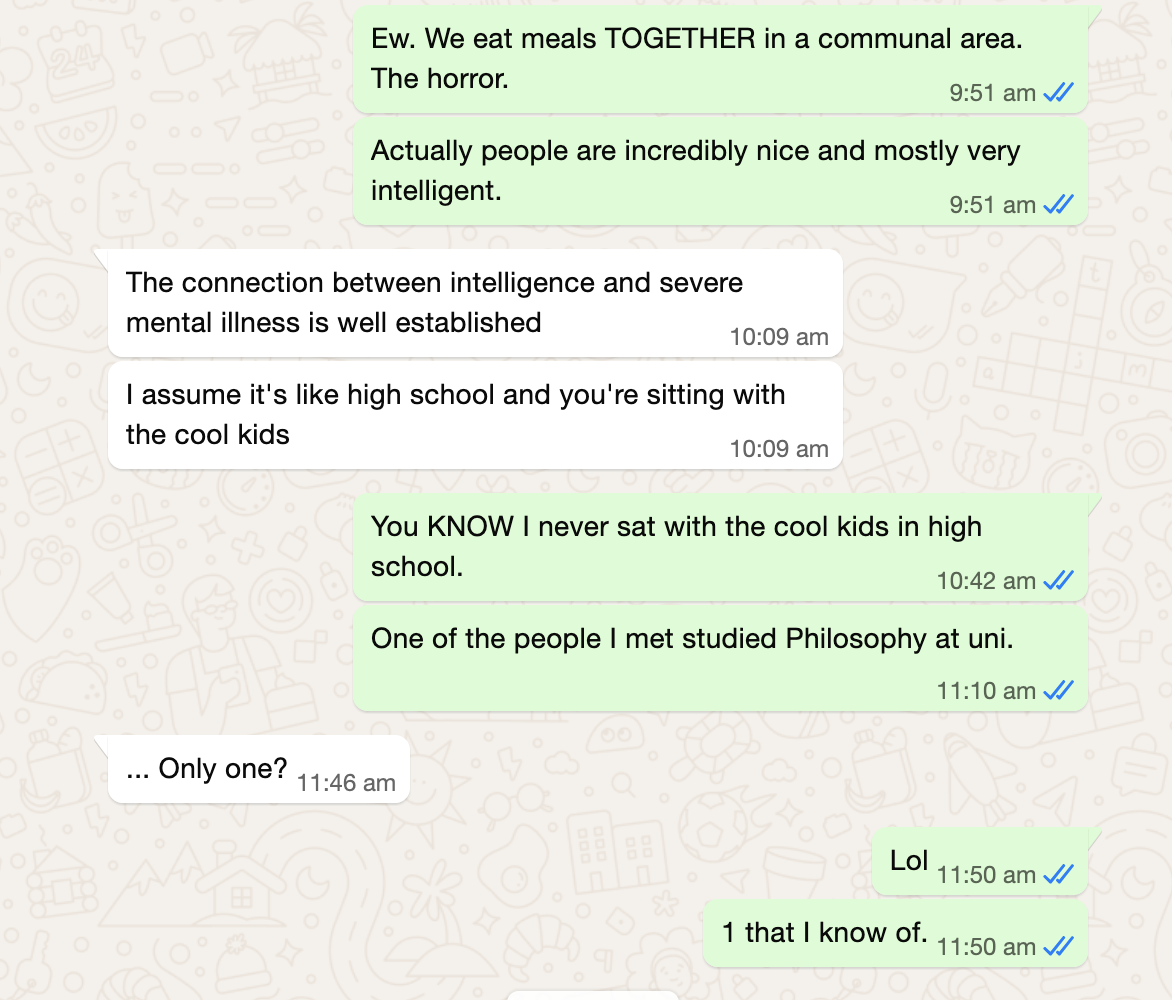
Several days later, I asked Mei if she actually spoke any French. She does not.
“Ah,” I said. “Hannah just got enthusiastic?”
She nodded.
I definitely found that almost everyone I talked to was obviously both intelligent and kind. Which is lovely, and also very much not surprising if you think about it at all. Sadly, kindness and intelligence are risk factors when it comes to mental illness. A lot of the world’s loudest and most powerful people are both dumb and cruel.
I brushed my teeth, and then a nurse came into my room and sat down and asked how I was, clearly expecting a detailed, thorough, and honest response. It was impossible to answer without crying, but that’s nothing new. It was very weird to have a full-on conversation with a nurse. Generally all they want to know is whether one’s physical pain is more or less than the previous day. It turned out that the psych nurses do this whole sit-down conversation every day. And technically it’s the same thing—is your pain more or less? But it feels very different. It certainly takes longer.
Soon after that she took me to see the weekend doctor, who had me go through things again (I was getting much better at summarising by now) and then increased the weirdness factor by asking how I was finding the ward. Did I feel safe? Was I comfortable?
I blurted out that my back hurt because of walking back and forth from my room to the main area, and that none of the chairs were suitable for me as I usually minimise pain by dividing my time between my bed and an armchair with arms to lean on (I’m most comfortable lying down, but if I lie down for too long that will also start increasing pain levels). To my surprise, they asked follow-up questions about whether some of the chairs around would be helpful.
I was even more surprised some hours later when the nurse pointed out a specific chair and asked if it was suitable, then when I said yes told me I could take it to my room. Which I did.
Once again, I was being treated so much like a human that my pain was discussed like… it mattered? And should be minimised if possible, even if I wasn’t actively dying? So weird. This is NOT how the health system usually works.
On the other hand, I asked if they had hospital physios who could visit me in the ward to help with pain management, and they said no. Some physios around Canberra are willing to travel, but of course I couldn’t afford that and there’d probably be a delay of several weeks anyway.
I had an EKG that day too, and they tested blood pressure twice a day. Presumably those are two relatively simple measures that can quickly indicate if something physical has gone badly awry. Holistic health is smart.
At lunch time, I was given roast beef with mashed potato. This was extremely exciting as I can eat both meat and potatoes (although I’m moderately intolerant of gravy). I also met my room-mate at last, a younger woman named Missy with the marks of self harm decorating her arms like beautifying scarification from an undiscovered desert tribe. She was, as I had guessed, friendly and kind. I relaxed more than I usually relax in an opening conversation and asked her if she was Autistic, making it clear that I am Autistic myself and that it’s a compliment. I was apparently not the first one to bring up the possibility to her, lol.
I would have liked to get to know Missy better but she went home. Which is good, of course. Just personally inconvenient.
There was the usual several days of confusion over my various medications. It turns out that even a Webster pack isn’t good enough; the hospital wants to supply all meds itself. Except, as it turns out, cannabis oil. They don’t have a licence to dispense that, sadly. But I’m happy to report the only meds I missed out on during my stay were eye drops, and I could make up for that by using a heat pack on my eyes. There is a microwave but it’s in a locked kitchen so I had to get a staff member to heat it for me every time, but I managed it. That was easier than coordinating my eye drops, because I need to lie on a bed to administer them, and my bed was (for me) a fair distance from reception.
When Missy and I were in our room, we mostly ignored each other except for practicalities such as, “Let me know if I’m too loud.” It occurred to me this is a nice way to pretend we have actual privacy, which is important. Later on I had a chattier room-mate (also very sweet) but that was okay too.
I basically never wore a bra, and I wasn’t the only one. However, we were expected to change our own bedlinen as needed (not to actually wash it though) and someone at a breakfast briefing reminded everyone to keep up with their personal hygiene. It’s entirely possibly that was for my benefit, if I’m honest. I showered on the Saturday (without soap, as the only soap seemed to be some shampoo Missy left there) and actually that was the only shower I took the whole time because I was so tired out from everything. I ALMOST showered various times but wasn’t able to manage it.
Nurses checked on us very frequently, day and night, and also checked our belongings daily for dangerous objects. But they always tried hard to be as respectful as possible and not to interrupt us if we were sleeping or doing something.
Every week day there were about four activities that we were encouraged to join. Usually a morning bushwalk was one of them; one was something psychological like methods for dealing with anxiety; and at least one was some kind of art or music therapy. Talking to people at meals, although surprisingly pleasant, was enough to exhaust me so altogether I joined exactly half a session. But I’m glad they were there.
I remember one of the men crowing at another in delight because he’d found the nine-letter word on one of the word searches. If I’m honest, I filled in a word or two myself and felt quietly proud about it.
Over that first weekend my mood shifted all the way over to manic and I was (sort of) having a lovely time. Without the need to supervise my family (much—I was still reminding Chris of things and checking in on his tenant-prep progress, which was impressive) I could sleep when I wanted (other than meal times), read as much as I liked, daydream, and so on. If I felt social, I could walk out to the lounge and there’d always be someone there. I could wheel my bed away from the wall and then lie down and see this view, which I very much appreciated:
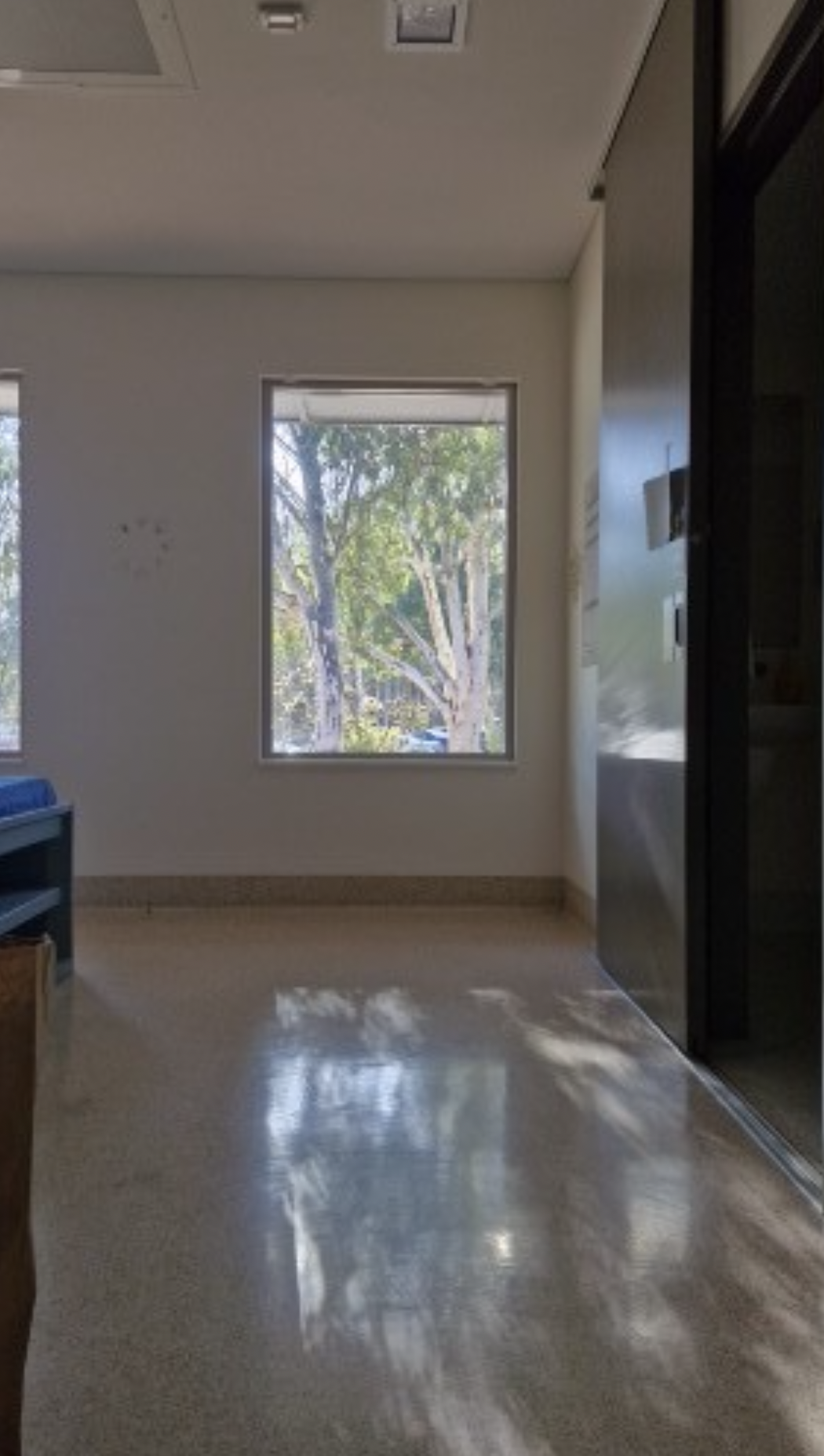
As you can see, Missy’s bed was plastic rather than an adjustable hospital bed. You can also see there’s no blind on that window. Every single blind in every room was broken to the point that they had to be taken down and away. (You know what you need to fix that kind of thing? DECENT HEALTH FUNDING.) So I was lucky that I wasn’t on the window side after all.
Once when I was in the dining area Mei was in the lounge and started crying. Two of the other female patients immediately went over and comforted her. Maybe this whole “having people get to know each other” thing isn’t such a risky endeavour after all. (I fled the scene like the coward that I am.)
Another day, one of the patients told me that he was super uncomfortable with another patient and didn’t like the idea of continuing in the same ward. So yeah, that happens too. From what he told me, the scary patient had made some jokes that were maybe intended to be ironic. I presume if someone was dangerous they would be moved… somewhere. Not sure where though; it’s not like the budget is likely to have room for frivolities like separating dangerous people from the rest. (During one of my other hospital visits I was in a room with a man who was talking to himself out loud about how he mustn’t hurt the nurses, they were only doing their job. I chose a moment when he wasn’t within earshot and told the nurses what he was saying, adding my opinion that he was nearing the end of his rope and needed a solo room. They said he was totally fine and hadn’t given them any trouble. He continued to talk through his violent urges several times per day. Cool.)
Although the psych ward is locked, patients are typically allowed to sign themselves out for twenty minutes at a time, several times per day. So really it would be quite easy to escape if you wanted to.
Romantic relationships are forbidden, of course. Mental illness is complicated enough without throwing more chemicals on the fire.
I did some writing, which was great as I hadn’t touched my writing for at least six months. It always makes me feel more myself, and I am rare in that my fiction writing does actually get paid. (Not much, but some. There are people out there who buy everything I write, which is incredibly flattering.) I haven’t done any writing since I came home from hospital, except for this blog. Which is something, but not ‘true’ writing as far as I’m concerned. For me it’s the difference between doodling with a pencil and painting with oils. But if pencil work is all I can do, then I need to do that. Plus this particular blog entry is very meaningful, because it might help someone else go to hospital who would otherwise be too scared.
Nights were usually quiet, but one night I heard a man yelling and another night I heard a woman pacing up and down, saying loudly, “It’s a prison. It’s a fucking prison!” Most hospital wards have a skeleton crew at night, but I noticed that this ward seemed to have a decent amount of staff at night. Smart, considering a lot of mental illness stuff gets worse when the sun goes down.
Most patients were very easy to talk to, but one woman with long white hair and very bright green eyes muttered to herself quite a lot, and although I did talk to her a couple of times her volume never changed so I couldn’t make out what she was saying. Honestly, I gave up. The nurses seemed to handle her just fine, and sometimes other people talked to her (although they had trouble hearing her too). I think she liked me, as she sat at my table once or twice.
Once I was settled in, I kept my own lactose-free milk (labelled of course!) in the patients’ fridge. One day, I opened the fridge door to find that everything had been thoroughly categorised and re-arranged. Normally there was a pile of sandwich spreads and minor snacks (like the ubiquitous jelly pots) jumbled in the top shelf of the door. That day, they were sorted by type and stacked neatly. And so was everything on the tables. And on the bench where various foods were always found (usually several teas, coffee, Milo, crackers, biscuits, brown and white bread, fresh fruit, etc, but some things ran out sometimes). We had a new resident, and she was determined to neaten everything, everywhere, all the time.
I very much enjoyed the company of a rather handsome Kenyan man named Aguta. He felt ambivalent about his status as an immigrant, and I enjoyed talking to him about it. Hannah also talked to him a fair bit, especially when I was there, and we had one conversation about colonialism and culture that was super interesting and deep. I could see Aguta being left behind but fascinated. Later he told me that Hannah and I “sounded like a podcast” and I know just what he meant. Talking to Hannah was like being in an unusually good tutorial at university. I haven’t had a conversation like that in years, partly because I know my brain isn’t what it used to be and I’m scared to expose myself as less intelligent than my friends. Aguta is definitely intelligent and his life could have gone in a nerdy direction (like Hannah and I) but he’s very physically clever as well so he’s gone for a more tradie-type life. He’s taught himself 3D printing and all sorts of things. Talking to him was a treat in its own right and he is one of those guys who has a really gentle, safe vibe. If you scanned a group of men looking for someone to mind your kid, you’d pick him. He asked for my email so he could buy my novels and I gave him the titles instead because (a) The nurses encourage us NOT to exchange details as we’re not in a good decision-making state, and (b) If he gets to know my normal self, he won’t be quite as impressed with how brilliant and talented I am, because he met me when I was manic and on my most charming behaviour, and with almost no real responsibilities to distract me. Oh, and (c) I already have several mentally ill friends to worry about and it’s emotionally risky to take on more.
I regret that now, as I wonder how he’s doing. And I’m sure his high opinion of me wouldn’t crumble THAT much. Plus I believe that a mentally ill friend who is self-aware enough to check into a psych ward is unlikely to hurt me by killing themself.
One of the patients, Wren, has a toddler daughter named Sparrow (okay, none of these names are real) who visited most days and ran up and down the hallway screaming with laughter while Wren played with her. She was adorable.
One day I came into the lounge and found several long-haired patients including Wren and Hannah braiding each others’ hair. It turned out that Wren wanted to know how to braid Sparrow’s hair, and so someone was teaching everyone else how to do it. I would have loved to join in (and I know I would have been welcome) except my hair badly needed washing by then. It was a beautiful scene though. There were plastic flowers around the place from one of the art classes and one of the older ladies decorated her braid with flowers.
The doctor officially diagnosed me with Bipolar Type 2 (as Bob has said for years) and started me on a mood stabiliser, but said he’d like me to stay at hospital for a few days in case of side effects. I read about the medication a little, and it takes quite a long time to make a difference. But at least my skin didn’t slough off, which was the side effect they were watching out for. So THAT’S nice.
Each day, Hannah picked fresh Rosemary and Sage from the garden in the psych ward’s private courtyard and blessed the communal piano keyboard with them. When my kids visited, my son was extremely enthusiastic about the Ping Pong table. I even played one game with him (and won, hah!) There is also a book room (far away from the lounge, so it was perfect for private conversations), a rather nice guitar, an exercise bike, and games and puzzles and suchlike. There were also various brochures, not just on stuff to help us psychologically, but on places to report abuse or get legal help. That is so important and good because psych patients are extremely vulnerable to abuse.
One day, two people from Feros Care (which helps with NDIS/disability support related stuff) visited. There was an instant queue for their help which is an excellent indication of what every disabled or chronically ill person already knows: Illness and disability is very financially stressful; help is very difficult to access; and the relationship between those facts and severe mental illness is no coincidence.
They helped me a lot. I still haven’t managed to actually apply for the NDIS for myself (I am so very traumatised by the whole process) but I HAVE managed to hook up with Carers ACT (as a carer for my daughter; I can’t seem to figure out how to get support for Chris as my carer yet)… and yesterday a cleaner came to our house and I actually got some real help!! There was so much dust in some of our light sockets that they magically started working after getting cleaned. (Chris and I keep a reasonably clean house but we both have ADHD and no amount of willpower is going to make us truly competent.)
One day, Hannah showed me what was written about her in her file. She was furious that they described her as manic, saying that her real problem was low iron and gluten intolerance. I made polite noises. Later in that same conversation (with Hannah, Aguta, and I) I was talking about how a study has shown that people sense something “off” about an Autistic person within seconds of meeting them, but they don’t know it’s Autism. That study has comforted me so much as I’ve had some close friendships blow up really dramatically and even years later I’m still hurt and confused by the whole thing. I mentioned how much I, as a writer, don’t feel like I know someone until I know their faults, and that that probably doesn’t help people get along with me either.
“Do me,” said Hannah. “I won’t be offended.”
“Uh… are you sure?” I said.
“Yes.”
“Okay then,” I said, and without any further warning or hesitation, “You’re definitely manic.”
She shoved back her chair and swore.
Aguta was wide-eyed.
And then we kept talking.
Hannah is an absolute shining sun in this life. I often heard her singing or playing her flute (both of which sounded really nice) and always felt a room was brighter if she was in it. She forgives instantly and unconditionally, always. Her only drawback is that she doesn’t see how she absolutely definitely is totally manic. And, it’s difficult to keep her on topic (much like anyone with ADHD, which she may also have, but a bit more so).
She gave me her number, and I waited a few days after I was out of hospital to make sure I wanted to open the door to an ongoing friendship, then I messaged her. At the time of writing, she is still in the psych ward. And she is my friend.
As per usual in hospital, someone somewhere wrote “diabetic” on my food file and my choices were modified as a result (to something that was less healthy for me). I think I may have forgotten to fill out the menu once or twice too.
One night, after I’d taken my pre-dinner insulin, I got out my food tray and realised there was nothing I could eat. There was mashed potato, which is usually reasonably safe, but I’d been eating it twice a day (and definitely getting signs that I was eating too many risky foods) so I couldn’t face it. Presumably there was lactose in it, and I’d passed my tolerance limit.
Once you take insulin, you need to start eating a proper meal within twenty minutes or you risk a blood sugar event including possibly a coma.
I’d already bought a cafe sandwich for my lunch, and couldn’t stomach another one. I freaked out a fair bit, and even worse when I had trouble negotiating the uber eats app. But I drank a Milo (with my milk, and my personal stash of Milo) to keep my blood sugar from dropping in the short term, and eventually managed to order and enjoy some fish and chips. Still, it was scary stuff. Altogether I spent over $100 supplementing the hospital food just because of my intolerances, which for me is a lot.
Six days after I arrived, the doctor said I was free to have an unsupervised outing for up to five hours. I went home, spent some time in our inflatable spa (it helps so much with pain levels), showered and washed my hair, and cooked a delicious dinner. It was amazing.
That was Thursday. In the morning of the same day, Aguta told me that he was allowed to go home for good. He was so nervous his hands were shaking. I congratulated him and said I’d miss him.
The next day, Friday, the doctor said I could go on another weekend outing if I wanted, and could almost certainly go home on Monday; ten days after I had arrived. I didn’t go on any more outings because Chris was doing amazing pre-tenant work that I didn’t want to interrupt (or participate in if I could avoid it).
Aguta stayed in the ward too. He just didn’t feel ready for the real world.
On Monday, I said goodbye to my roomie, to Aguta, to Mei, and to Hannah. And once I’d had one last check-in with the doctor and all my meds were sorted and everything, I went home. A little scared, but looking forward to proper food and my shower and spa and family.
It’s just under a month later and I’m still very depressed but pootling along okay. I have good moods sometimes, so not every day is just a miserable wait for endless hours to pass. My partner and I found a really cool tenant (neurodiverse and self-described recluse) who moves in on Sunday, which will help our finances a lot even though it will be hard to cope with the lack of space. I went to work yesterday for the first time post-hospital and it was sort of really nice and sort of really awful (like going to work with the fatigue of the flu).
Aguta has discharged himself from hospital now, and I bet he’s doing fine.
Hannah is still on the inside, visited most days by her parents. I’m sure she’s still brightening the whole ward with her hot pink hair and her presence, although I hope she lets the doctors medicate her for mania soon.
I might go back to the psych ward one day. I might not. But I know it’s there if I need it.

 Felicity Banks