Party Post-Mortem
At a typical book launch, this is what happens:
Someone does an intro; the author talks a bit and reads a bit; people buy the book; the author signs it; people mingle and eventually depart. There’s food and usually wine. A lot of launches happen at conferences, where new fans are everywhere… but mostly those potential fans ignore the launch and walk on past.
I hate book launches.
At a typical book launch, this is what happens (redux):
A desperate author silently screams for the fame and fortune that will never come. They dance like a chained monkey at the whim of social expectations and a necessary gamble.
An apathetic audience squirms inside, watching the slow death of dreams and wondering if the brie is still fit for human consumption (and if so, then for how much longer?) The cut-price chardonnay slowly warms to room temperature as the red wine and last hopes of artistic survival attempt to breathe.
Everyone (who knows what’s good for ’em) buys a book and the author signs them. There is an awkward pause, and then everyone goes home.
The above is not at all true of course; but that’s the experience as seen through a social anxiety disorder (combined with chronic illness and the associated financial problems laid on top of the pre-existing artist poverty). So, although book launches are legitimately fun, I just can’t handle them. There are only three possible social occasions more awful: a doomed wedding; a musical performance by someone I know (regardless of their talent level); a poetry reading.
One of the peculiarities of my anxiety disorder is that I’d rather BE the desperate author than watch them. I feel more in control; I am certain that whatever I feel is entirely delusion-free (even if I thought something quite different five minutes earlier); and adrenaline works with me instead of fighting against me.
In any case, with “Attack of the Clockwork Army” I decided to do things my way. So I had an epic book launch party that ran from 10 in the morning until 9 at night (that’s eleven hours) so people could drop in and drop out whenever. I hosted it at my own home, and welcomed both small children and strangers (an interesting combination). There was a room just for duplo, and a designated reading room.

In this picture there are phones (including one toy phone), ipads, and a kindle. It’s not even the reading room, and that was fine by me! (I did spent some time in the reading room with two people showing them the mechanics of ChoiceScript. They and I enjoyed it thoroughly.)
I prepared various foods in advance, and cooked several low-maintenance things during the party – a chocolate fountain, sausage rolls, a terducken roast (duck and turkey and chicken), pre-mixed cookies.
And, to my amazement, people actually came. Here’s some interesting (to me) stats on the attendees:
People related to me (not counting people that live here): 10

People from Canberra Speculative Fiction Guild (and their families): 11
Assorted friends and their families from various schools (including Louisette’s school): 9
Miscellaneous: 12 (including an ex, two complete strangers, one of Louisette and TJ’s babysitters, an ex-workmate, a role-player, a ballroom dancer, and someone I met at a party one time).
Total number of people in the house throughout the day: 46.3. And a cat. There was a moment after lunch when there was no-one there for about twenty minutes, and then the arvo crowd flowed in. Other than that, it always felt like a lot of people – but never so many that it was unpleasantly crowded (although in the morning there were 8 kids at once, which is a LOT – having a bucket of chalk outside was absolutely perfect.)
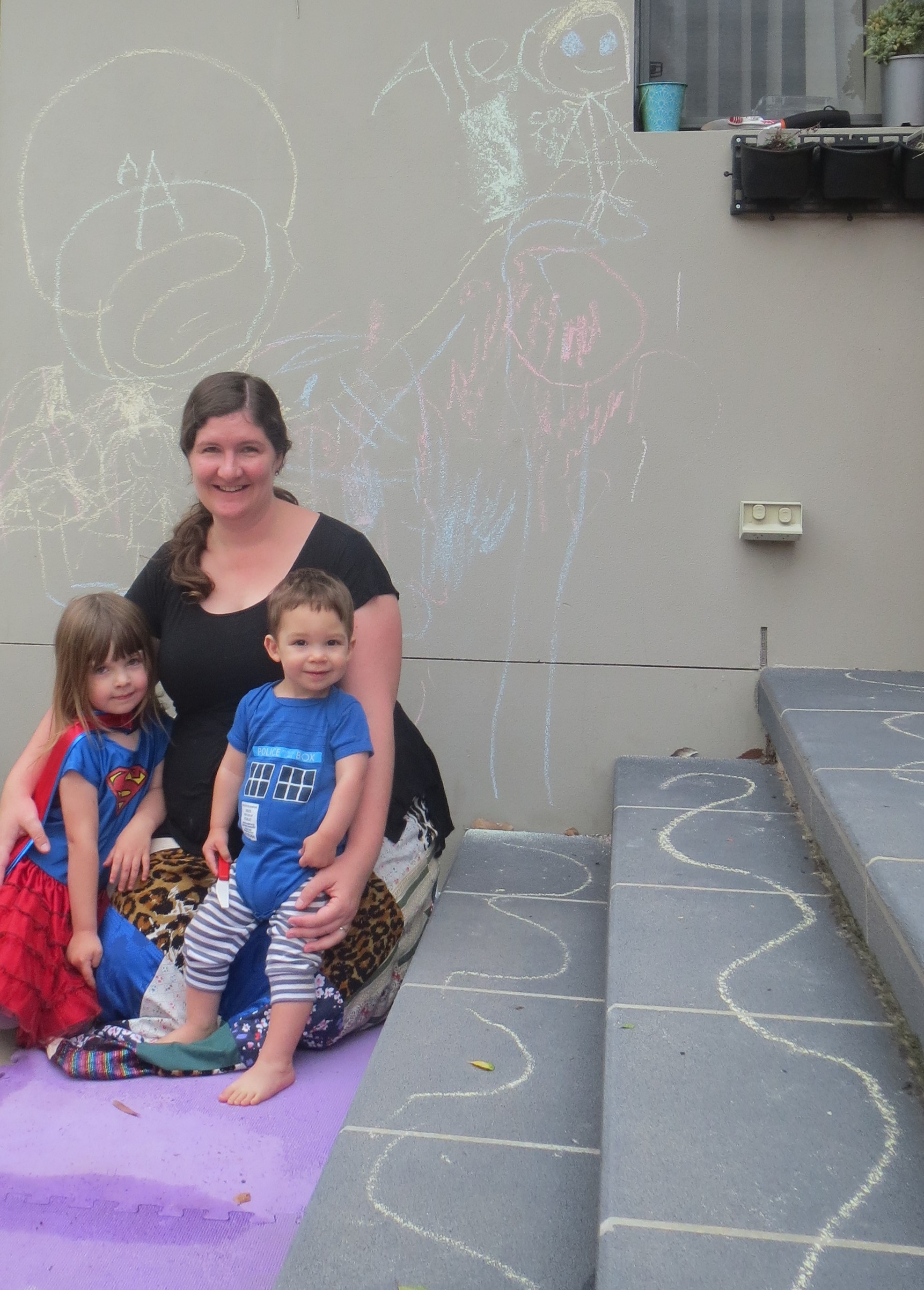
-People who’d never been to my house before (from the above lists): 16 (one of whom I hadn’t seen for over ten years)
-In costume: 8


-Kids: Twelve; all but one aged 5 or less.


I didn’t do any official reading of the book at all (but encouraged people to read the book for themselves – it’s very easy to find on any app store; you just search for “Attack of the Clockwork Army” and it comes up with gratifying readiness).
But. My writerly friend (pictured here showing off his “Cat in the Hat” tattoo while playing with play-dough) decided to do a live reading of the romance scene. He was reading it for the first time, and he happened to have chosen the character of a lesbian woman.
That was an unforgettable experience.
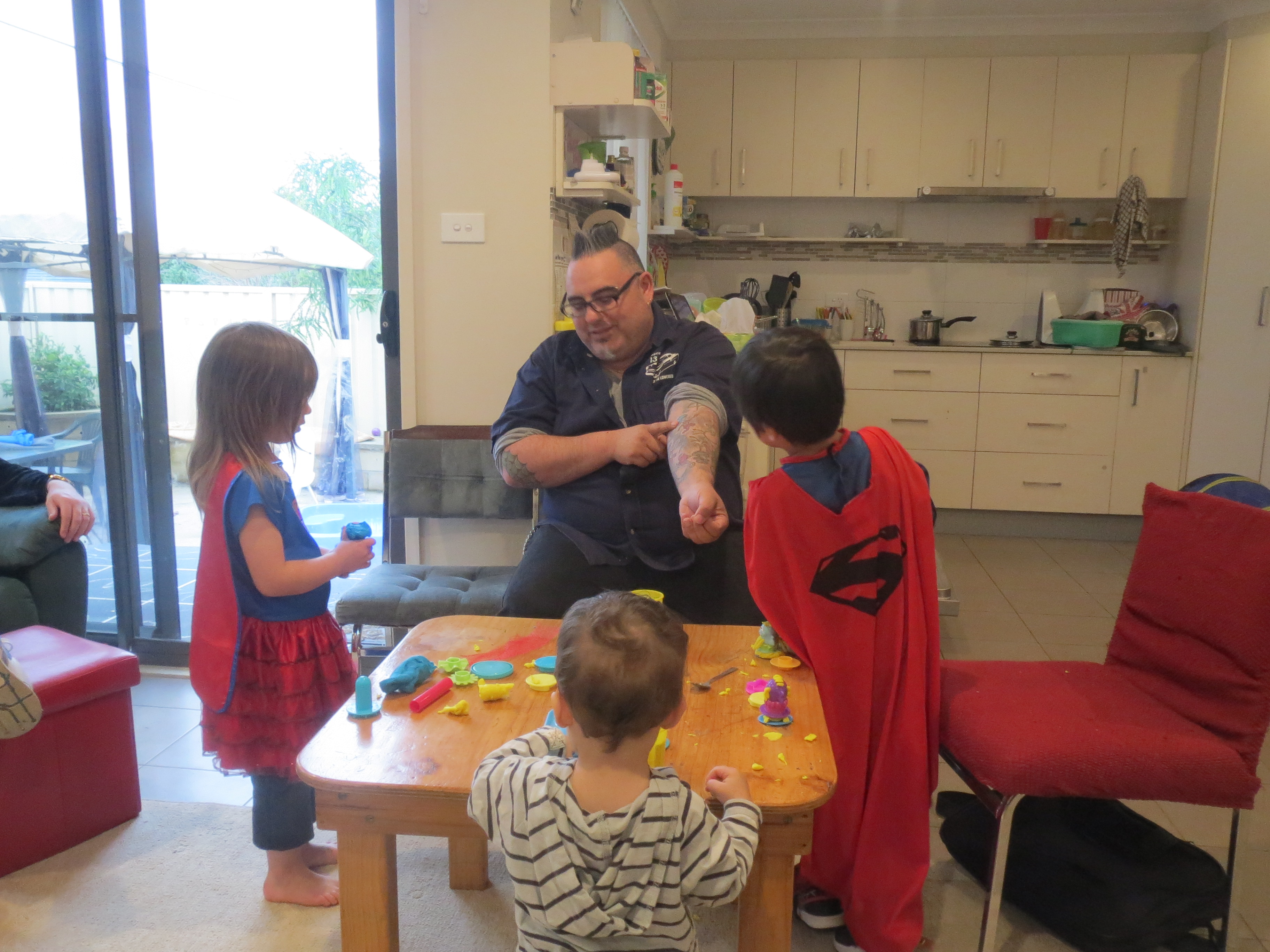
Not long after this photo was taken, Superman and Supergirl were having adventures outside when Superman decided it was That Kind Of Party and promptly got naked, immediately followed by Supergirl. Superman’s mum and I nearly died laughing.
As evening closed in, new clothes were applied and the party calmed down. TJ decided it was the perfect time to perform the famous “why-are-you-people-still-here-the-party’s-over” manoeuvre. He fetched his sister’s toy vacuum cleaner and got to work.

He and Louisette had a marvellous day; I discovered the sheer culinary glory of double brie dipped in a chocolate fountain (DO try this at home, if you possible can); people discussed interactive fiction, famously awful parties I’ve hosted in the past (the one with the fake guests was only the second-worst); steampunk, gaming, when plates were invented, and data collection laws; my historical food expert friend discovered terducken (and white chocolate raspberry sorbet); a few people left reviews of the book in various places; and I had fun.
Pretty sure that means it was a success.
Every book launch should have a chocolate fountain, a lesbian man with a Dr Seuss tattoo, and a pair of buck-naked superheroes.
“Worst one I’ve played”: Reviewing the Reviewers

Or you can play directly through the publisher’s web site, here. That’s the simplest if you’re not tech savvy (although you’ll need a credit/debit card there).
On most sites, it LOOKS like the game is free, and has in-app purchases. This is just a backwards way of saying, “You can read the first bit before you pay for the rest.” It’s a one-off $5 payment.
I’ve started up a facebook page just for this specific gamebook (discussion, reviews and steampunk/Victorian-era fun), at https://www.facebook.com/attackoftheclockworkarmy/
Interactive Fiction: My Shiny New Obsession
If you’ve set eyes on me for more than thirty seconds at any point this year, you know all about my shiny new obsession: interactive fiction. It’s the digital form of “Choose Your Own Adventure” novels.
As of seven minutes ago, my first publicly-available interactive fiction story is live (and also free… for now) right here – scroll down to the bottom of the linked page and click on this:

You don’t need anything more specialised than a computer, and you’ll read the book within a Firefox browser.
This particular story (which takes about twenty minutes to read) is about what happens when a two perpetual students fall through a portal into the magical, tropical world of Rahana. It’s a place where a pregnant queen’s island is under siege, and where a handshake can kill.
You, dear reader, are one of those perpetual students. You choose whether you’re male or female, happily single or crushing on your best friend (who just happens to fall through the portal with you – you also choose their gender). You decide whether you’re a natural fighter or a master manipulator; a doctor or a jack of all trades. When the battle begins, you can choose to kill or heal, to strategise or inspire. Even if you’re completely useless as a character, you get a good story out of it – and you can be someone completely different the next time you read it, too.
How does it work?
Funny you should ask.
As a player, it’s a simple matter of clicking your mouse (or in some cases your finger, since most interactive fiction can be read on smart phones) on the choice that looks best to you, then on the “Next” button to go to the next page. Your choices make a difference in various ways. Usually, choices change your statistics (for better or worse) – recording your personal traits, your relationships with others, and the skill/s you practise along the way. Later on in the game, those choices change your ability to succeed or fail in certain endeavours. You can check up on your stats along the way (there’s a button at the top of the screen), or ignore them and choose with your heart every time (that’s what I do, especially on the first read-through). I also like having “Achievements” listed as a tantalising hint of some of the story’s possibilities. There’s a button for achievements, too, but it’s not possible to gain all of them in a single play-through.
I really like the American company Choice of Games (yes, that’s why my spelling is suddenly non-patriotic) because they’re fun, non-graphic, and determined not to discriminate. In their games, it’s always possible (when relevant) to pick both your gender and orientation.
The lack of strong female characters in fiction magically disappears when a player chooses his/her own gender – and I love that!
So, that’s a lightning-fast preview of the big news I’ve been hinting at all year. “Down the Wombat Hole” isn’t even my first interactive novel…. but the details of the others will have to wait for another post! Let’s just say my days of steampunk and piracy are just beginning.
Oh, and by the way? It just so happens that “Down the Wombat Hole” is set in the same world as my print novel (coming out in 2016) “Stormhunter”. So if you’ve ever read a fantasy book and wished with all your heart you could visit it yourself, now is your chance.
Edited to add: “Down the Wombat Hole” is now part of a full-length collaborative game called LOST IN THE PAGES (with the new chapter title THE QUEEN’S CHILD, and no wombat).
And the small press Satalyte that was going to publish STORMHUNTER has stopped running, but Odyssey Books has just (as of October 2017) taken on the middle-grade pirate trilogy set in the same world, which suggests STORMHUNTER will sail again (it’s young adult, and set hundreds of years after the middle-grade trilogy, so it makes sense to publish the middle-grade trilogy first).
Do Pirates Squee?
This one does.
Fifteen – yes, fifteen – years ago I invented a fantasy world called Rahana based on Indonesia (I was sitting on a folding chair in a concreted Indonesian room attempting to listen to a sermon at the time). My idea was that if I had a rich and complicated world I could base a whole lot of books inside that world.
I was sick of white men dominating. . . everything. . . so I wanted a fantasy world that, to me, felt female. And non-white (much as my own heritage is Omo-white for generations). So I created a tropical world where there was enough magic that physical strength wasn’t necessarily important to gain power, and where art and storytelling was considered to be the most valuable (and best-paid) type of skill. People looked Indonesian, and people and place names were based on Indonesian words.
Soon after that, I began writing a young adult trilogy set in that world. Then I wrote a middle-grade trilogy set in the same world. Altogether so far I’ve written around half a million words and received seventy rejections just for this series.
Every time a book was rejected I asked myself, “Why was it rejected? How can it be better?”
The first book of the young adult trilogy has been edited so dramatically and so often it barely resembles the original draft (which I wrote in three weeks). Eventually, gradually, it became a good book. The simplest way to describe it is in three words:
Narnia with pirates.
A few days ago I received an offer of publication for that book – my paper baby – STORMHUNTER.
It’s really happening. My first book is going to be published. I can’t believe it. . . this is so great. . . I’m going to tell EVERYONE EVERYWHERE. . . pirates are so cool. . . this book helped me meet my husband. . . I’m going to sign books, and do conferences, and schmooze reviewers!. . . What the. . . has it really taken FIFTEEN YEARS!?!?!?!?
I won’t actually publish this blog entry until I have the green light to do so, but I thought I’d better write it now (Easter Sunday 2015). At the very beginning. [Observant readers will notice that I accidentally posted it at the time, then deleted the content. . . but left the tags, which are pretty awesome clues.]
Anything could happen from here. Ninety percent of published books flop. . . but I’ve come this far, and I intend to keep going. Ninety-nine percent of books don’t get published at all, so I’m doing pretty well 🙂
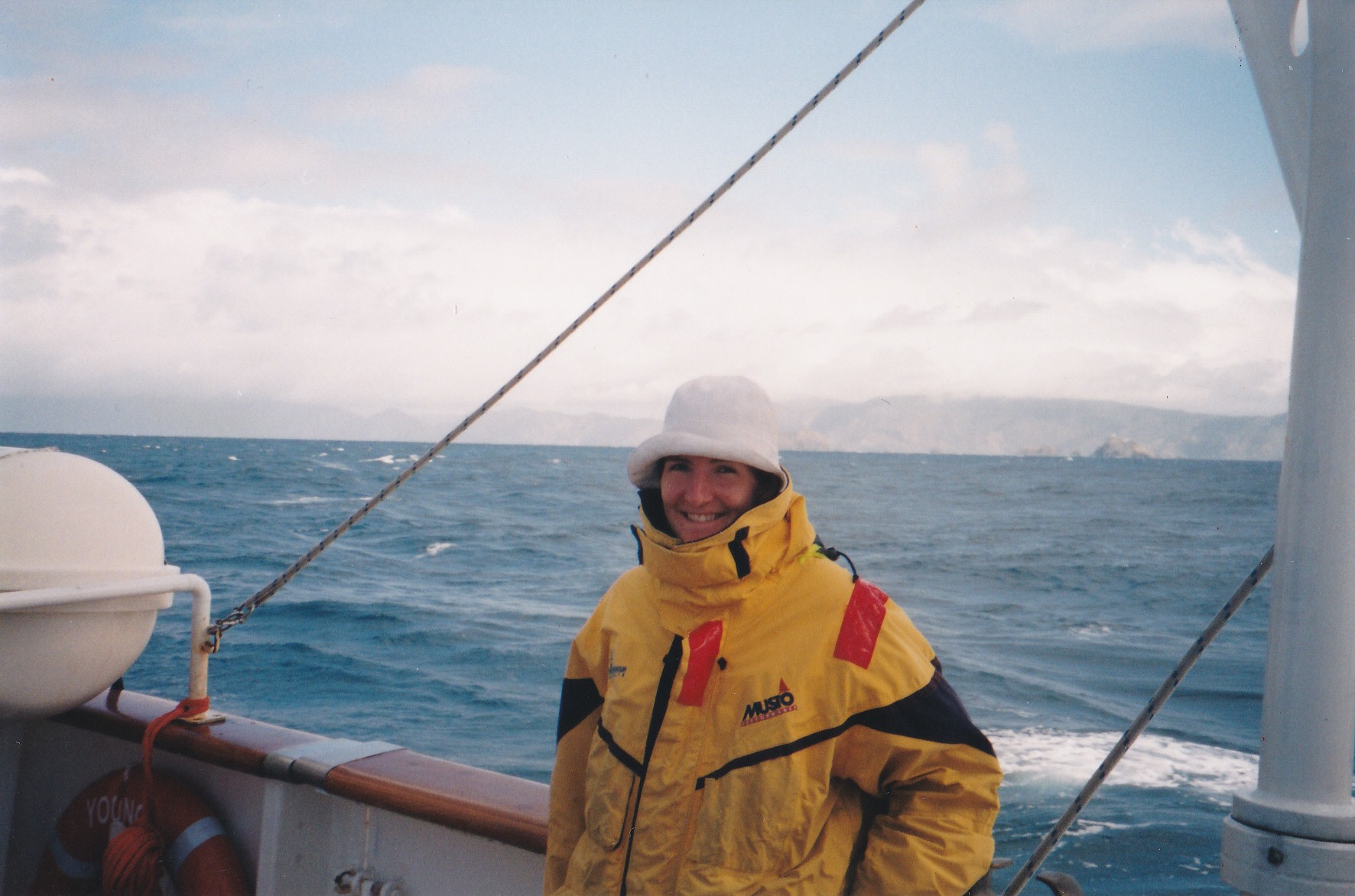
This is a picture of some of my pirate research – aboard the Young Endeavour sail training vessel at the tender age of twenty-three. That was ten years ago, and I was doing research specifically for STORMHUNTER. I guess it paid off, huh?
Some of my main audience wasn’t born when I came up with the idea for the world of Rahana. In fact, the middle grade readers weren’t born when this picture was taken five years later. What were YOU doing in the year 2000?
STORMHUNTER will be released in both print and digital formats in 2016, by Satalyte.
If you’re interested in writerly stuff, stick around and/or like my facebook page. TJ turns one in less than ten days, and after that this blog will be much more about writing (and piracy, and reading) than it has been for a long time.
If you want to know major announcements only (but reliably – unlike facebook), send me an email at fellissimo[at]Hotmail.com and I’ll add you to the official mailing list, which will average less than an email a month (including info on conferences I’m attending and book signings etc).
Squee!
Pitch Me A Pitch
Conflux is Canberra’s annual speculative fiction conference. I’m there most years, one way or another – wandering around in garb (see pic at right), going to sessions, leading sessions (!), and of course pitching.
Pitching is when writers get five or ten minutes one-on-one with a publisher or agent to try to convince them to read their novel. Usually the writers are required to send in their first three chapters, synopsis, and bio beforehand (so those who want to pitch can be whittled down into a reasonable number, and sometimes so that the publisher/agent gets an idea of the book beforehand).
The first time I ever pitched was in New Zealand – I literally flew to New Zealand for that ten minutes (then the exact same publisher came to Conflux the next year!) The worst pitch I ever did was to someone who had read the first chapters and thought the entire book was all a dream because there were pirates in it, and pirates are apparently all imaginary (what the. . . ?!)
Quite a few people who let writers pitch novels to them will read all the opening chapters they’re offered during the pitch (including, luckily, the one in New Zealand). Others will pick one beforehand, and read only that one. Still others are genuinely making up their minds in the moment.
This year, no-one read our opening chapters, so I didn’t have my usual advantage (a LOT of beginning writers are truly terrible, so among unpublished authors my writing usually looks pretty good). Without quite naming anyone, here’s what pitching was like this year (I literally pitched a book to everyone – got a bit excited after being too sick to write for so long due to pregnancy).
Pitch # 1: An Agent
I pitched my newest book (YA fantasy, “Flight of Fancy”) to her, on the basis that if she was shocked that it actually wasn’t polished enough to send, at least I hadn’t looked unprofessional directly to a publisher. In truth, I used her as motivation to finish the book – and she was extremely useful for that!
I’d actually never pitched to an agent before. In Australia, agents aren’t essential to the publishing process. Also, they are just as hard-working and underpaid as publishers, and tend not to take risks. Some Australians only use an agent AFTER receiving an offer for publication (so the agent can look at the contract and negotiate terms), and I may well end up using her for that some day.
She was extremely friendly (a common phenomenon in pitches) and after I described the plot she said how much she loved fantasy’s ability to talk about real-life problems such as mental illness in a different way. That is also one of my favourite things about fantasy, and I felt like we really connected. She was more than happy to look at “Flight of Fancy” when it’s ready, and I blurted out a bit about my steampunk YA novel because it’s ready to go and seems really well suited to her – but it’s already done the rounds of quite a few publishers (which is bad for agents, because publishers won’t look at something twice). She said slushpile rejections are fine, so I should send it to her with a detailed submission history.
I finished the post-TJ edit of the YA steampunk that day, and sent it to her. I’m quite excited by the idea of having an agent in my corner, but she said up front she takes ages to read things. . . so we’ll just see. I’ll send her “Flight of Fancy” late this year – probably before she finishes the YA steampunk.
Still, that’s two “yes” answers from one pitch – a good start!
One of the most interesting things about that pitch was that she said most publishers are dead-set against anything labelled “steampunk” (as my daughter would say, “NOOOO!!!! WHYYYYYYY?????????”). Readers still like it, so steampunk sells as “gaslight fantasy”, “Victorian paranormal”, “Urban fantasy”, “Alternate history” etc.
She also said about “Flight of Fancy” – “Can you make it a bit longer?” Which I can – especially when there’s so much editing to do. Hopefully an extra 5000 words qualifies as “a bit” (when I emailed her the YA steampunk I asked if it was).
Pitch #2
This was the pitch that was the most important to me, because the publisher (what I call a “medium” publisher because they’re certainly not one of Australia’s six biggest publishers, but I’ve read several of their authors) really likes Australian female fiction and “things other publishers wouldn’t dare take on”. My YA steampunk has a female protagonist (like most of my books), is set in Australia, and has a major character who turns out to be gay.
The person was unusual in her manner – thoughtful rather than friendly (not that she was UNfriendly, but she wasn’t going out of her way to put me at ease – and I could tell she wasn’t going to read the book just to be nice, which was scary at the time).
When I explained the plot of the book her face lit up. It turned out she doesn’t usually like steampunk (despite the fact it was specifically mentioned online as something this publisher will accept!) because of the upper-class stuff – but because my series is all about dismantling the so-called superiority of the higher classes, it sounded great. Could I please send it to her? (Yes – but not until December, because it happens to be in a contest-type thing and I can’t send it elsewhere until the results are announced. She understood perfectly.)
That was a close-run thing, and all the more satisfying as a result. It’ll be interesting to see how she likes it when she reads it.
Pitch # 3
This was a large publisher – or at least, large enough that any writer would have heard of them. It was a slightly-awkward pitch because the actual person listening to pitches represents the adult fantasy section, and I was pitching my YA steampunk novel (I called it “YA alternate history” based on the agent’s advice – and it seemed to work).
This was another publisher who was making up her mind as she went along. She was very friendly, and even stopped to chat to us outside afterwards (brave, since she’d said no to at least one person in the room).
I was very clear it was a young adult book. . . but she said it sounded so good she hoped to be able to keep it for the adult department. This was a huge and pleasant surprise (I’ve actually had VERY slow responses from that exact publisher in the past, so I didn’t expect enthusiasm at all). It’ll be interesting to see if she is still enthusiastic when I actually send it to her (in December, because of that contest – again, she understood the situation perfectly and didn’t mind at all).
Pitch # 4
This publisher is small – I recognise the name of one of their authors, but haven’t read his books – and has an incredibly enthusiastic vibe, so I felt very confident they’d just say yes to everyone who pitched. I met several of the staff in the dealer’s room the previous day, so that gave me a bit of a sense of them too.
Being aware that small publishers tend not to pay advances (unfortunately, most books make a LOSS for most publishers – they’re kept afloat by the rare successes – but a small publisher can’t take financial risks like that), I chose a book that has been rejected very thoroughly in a lot of places.
It was a pretty friendly pitch, and they gave me a card and said to send them the whole thing. There were two unusual things – first, there was a second person in the room. To this day, I don’t know what her position in the company is (and I promptly forgot her name in the general nervousness, so I can’t even google her). Secondly, they asked, “Why are you pitching this book to us instead of someone else?” Instead of saying, “Well, everyone on Earth other than you has already rejected it” I chose the other honest reply – that they’re a vibrant, exciting, fast-moving publisher, and it seemed like fun. And of course mentioned that I’d written a book since TJ was born, and can produce books pretty quick if required. And that the YA fantasy book I was pitching was the first in a trilogy (which was written, but needed to be re-written), that was linked by the setting to a kids’ trilogy which is entirely finished and polished (I didn’t even realise until later that they also publish kids’ books).
Oh! The other unusual thing: At their book launch the previous night, the publisher had been chatting to someone and told them to come pitch their book (I met her in the waiting room, and declared that we’d be their children’s line). So, like I said, enthusiastic.
They requested the full manuscript. I hadn’t looked at it for a long time, so I gave it an extremely hasty edit and emailed it to them about midnight that very night (since I’d said how cool it was that they were fast-moving, it seemed wrong to not send it on the day). I was very pleasantly surprised by how good my book is after all this time – perhaps I shouldn’t have been, because a lot of the people who rejected it gave me great advice on fixing it, and I took it all.
Pitch # 5
Another medium publisher – and another person I’d met in the dealer’s room.
She also asked, “Why this publisher?” and I gave what amounted to a general “why a medium publisher?” answer – that is, they’re willing to take risks (with unusual writing, I mean) and they tend to like stuff set in Australia. The book I was pitching was a YA realist novel (set among a group of geeks), mainly because it was the best book that wasn’t earmarked for anyone else, or actually sitting on someone’s desk waiting for a reply.
It was actually HER first time pitching, which was funny to me (having spent much of my day in a room of deeply nervous writers). She gave me a piece of paper with instructions on how to send the first three chapters – ie she was clearly going to read everyone’s opening chapters. Which suits me fine. It was a relief NOT to send the whole book, because I’ve done two manic edits in the last week – plus a bunch of manic writing lately on “Flight of Fancy” – so all I had to do was check over the first three chapters and send it.
In the email, I made it clear that I usually write YA fantasy, so if the writing seems good but the book doesn’t suit them, I’d very happily send them something else (once it’s free). I’m not sure I made the right choice of novel, but I’m still grateful that she gave me the benefit of the doubt.
The book is so unusual that there may not ever be a publisher who likes it – I suppose it deserves one last chance at publication before I give up on it. The manuscript assessor I hired adored it, and I think the opening won $75 in a contest, too. But neither of those means much when it comes to publication.
All in all, an extremely exciting weekend. It’s fun to be back in the saddle writing-wise, and sad to realise that I’ve been excited so many times before, and never got a publishing contract out of it.
My lack of health is frightening at the moment. I can write, but almost everything else is hazardous or impossible. It would be nice if life was like fiction – if you work hard enough, follow your dreams, and have a desperate need to succeed – you will.
But I’ll keep working on my health, and hopefully I’ll be able to do some properly paid work early next year. In the meantime, at least I can write.
Less and More
From next week, I’ll be reducing this blog to two days a week – Miscellaneous Mondays (anything from a rant on equal rights to a picture of a cat) and Louisette Wednesdays. I’m hoping this will result in an increase in quality. Either way, I’ve been blogging faithfully for many years as I wait for a book deal to come my way – knowing all the while that it could happen at any moment.
But it hasn’t, so far, and I finally have something better (hint: see Wednesdays) to do. Literally for the first time in my life. So I’m powering down the writing obsession, and delightedly replacing it with the (far healthier and more rewarding) obsession of looking after a little person (that I MADE) – combined with the heady excitement of actually having paid, moderately reliable work. It is the simplest thing in the world to power back up my writing career at a moment’s notice – right now, my best shot is the steampunk novel, which is currently sitting on the desks of three large Australian publishers, all of whom are reading it in full already.
As I power down, the famous slushwrangler “The Intern” has a real actual book coming out. Her blog is now “Real Actual Hilary” and it’s better than ever. In this entry, she writes about the final edit of her precious book. I definitely understand the obsessive joy of writing. And the pain of it, too.
“In my determination to put everything I had into this last chance, I lost my sense of taste and smell. If you asked me which clothes I was wearing, I wouldn’t have been able to tell you. If you asked me which plants had blossomed by the back door I barged in and out of several times a day, I wouldn’t have been able to guess. My body hurt, and by the eighth or ninth day a profound exhaustion made it harder to work for longer than an hour at a time, although I was wary of straying more than a few feet from the stack of paper on my desk.”

The changing face of publishing
Here is quite a long and thorough article on how publishing is changing. I picked the bits I found most interesting about the present. . .
Indeed, the problem for readers is that regardless of which side you agree with in theory, in practice you probably love the idea of buying books for under $5.00 but hate the idea of having to sort through quite so much junk to find good books at that price.
. . . the pricing. . .
Books deliver three sorts of value: good writing, good stories (true or fictional) and social connection. By the last, I mean that reading is a social activity and we like to read what others are reading. So popular books are worth more to us than less popular books.
. . . and the future. . .
Publishers also need to manage their backlists more effectively. Hugh Howey points out that in fiction many of the top-sellers are not recently published novels. Publishers are used to pulling titles out of physical circulation after a few months and focusing their promotional efforts on new authors. However a rich back catalog, all made available in electronic format will allow publishers to respond more quickly to emerging market trends.

Read the article here.
The long, long road
I know better than most how long it takes for publishers to make a decision on a book that is reasonably well-written and therefore difficult to reject. Right now I have books at two of Australia’s big publishers. One has been there for almost a year; the other has been there for literally years. Even when a book is accepted for publication, there is a lot of editing, proofing, and maybe even illustrating to do.
This is an article about how long it takes to go from acceptance to publication.

Making your book look like a book
In order to get published, some people get their book made up all pretty-like, with binding and cover and all. According to Lyn Price’s article here, those people are just dumb. Well, dumb and annoying. (Okay, I might be making it slightly clearer than she does – she is more well-mannered than I, but her frustration comes across nonetheless.)
And if you think self-publishing will get a reputable publisher to take you seriously, you couldn’t be more wrong.
If this is actually news to you, please read the article. Join the battle against epic stupidity!


 Felicity Banks