Handy International Resource
This site has a LOT of publishers, and is searchable by genre. It’s somewhat skewed towards the USA and UK, but us antipodeans often publish overseas (for the moolah) anyway.

Don’t be an idiot (warning: some swearing)
The real title here is: Don’t be a shit.
If you want to be a professional writer, be polite. No matter what. This article by Chuck Wendig (who has a potty mouth with occasional vivid sexual references – but he sure is worth listening to) is worth reading and obeying.
Here’s a bit:
Editors and agents have it tough. They get a lot of shit for being gatekeepers, but here’s what happens at the gate: they stand there, arms and mouths open while a garbage truck backs up (beep beep beep) and unloads a mountain of submissions upon them daily. And, spoiler warning, ninety percent of those submissions won’t cut it. Hell, a not unreasonable percentage are toxic enough that I’m surprised Homeland Security doesn’t show up with hazmat suits and flamethrowers. So, when you annoy them with constant emails, unedited manuscripts, work that’s already been self-published or with crazily presumptive tweets, well, it just puts them one step closer to a water tower with a rifle. I’m not saying every editor and agent is a shining example, but they don’t deserve you acting like a grit of sand in the elastic of one’s underoos.
—————————————
Making money as a writer
Someone on a writing forum said they “need” to finish their novel, both because the story won’t let them go and because they need the money.
This is some of what I said, which clearly not enough people are saying:
First rule of writing is never ever write for money. Here’s some reasons, as briefly and coldly stated as possible:
1. Publishers lose money on most of the books they produce (it’s the few bestsellers that keep them from going bankrupt). The market is just not big enough (think, for example, of how many books YOU have bought in the last year – and as a writer you’re a much more avid reader than 99% of the population). This means the advance is usually all the author gets. Which means (a) small publisher = small advance, so that won’t work for you (nor with print on demand or self-publishing, which despite the much-repeated success stories are MUCH less likely to get any money at all), and (b) your total profit for your book will be between $3000 and $10,000. Keep in mind that most writers tend to average a book a year IF they write full time.
2. You are not special. Major publishers receive literally hundreds of manuscripts each week. I recently went to a conference where there was a higher-up from a major publishing house (I don’t want to name them, but I guarantee you’d recognise the name). She mentioned that they’d just had a five year period where they did not publish a single book from the slush pile. She was excited because they’d changed their slushpile system and had published three whole slushpile books in two years. She was super pleased about that. . . . which works out to a one in 10,000 chance of publication….in a good year.
3. I personally have done okay as a writer. I’ve won or placed in more contests than I can remember without referring to notes (including three or four longer-manuscript contests). Five of my books have been recommended for publication by five different manuscript assessors. Publishers have requested the full manuscript after seeing sample chapters (this happens to about 5% of manuscripts in the slush pile – the rest just aren’t very good) more than twenty times.
Altogether I’ve written thirteen novels over thirteen years. At least one of them has been to an acquisitions meeting at a world famous publisher (ie when the head publishers sit down with books that deserve publication, and decide which ones to publish). Not a single one is published.
So don’t write for money. Third world sweatshops pay better – literally.
You will probably never be published.
If you are, you probably won’t get a career (a publisher probably won’t make money on you, therefore will not publish you again – even though it’s a series).
If you are extremely successful, you’ll probably earn around $5000/year.
I’ve probably given you a pretty bad day – but wouldn’t you rather know now than after thirteen years of trying?

By all means, write. But write for love.
Are you almost there?
A lot of writers laugh indulgently at the pile of rambling grammatical errors that is their first book, and try hard not to think too hard about whether or not their current work in progress will be just as eye-rollingly embarrassing a little while down the track. For those who’ve been around the traps for a while, here is an article on some signs that actually you HAVE made progress. The Intern (who knows her stuff) reckons these are strong indicators that you’re close to success (“close” being a somewhat relative term). Here’s one I think is particularly pertinent (given my plaintive cries to the world of, “If you don’t enjoy writing, DON’T WRITE”):

That First Chapter
Chuck Wendig at his blog says:
. . . the first chapter serves as an emblem of the whole. It’s got to have a bit of everything. It needs to be representative of the story you’re telling — other chapters deeper in the fat layers and muscle tissue of the story may stray from this, but the first chapter can’t. It’s got to have all the key stuff: the main character, the motive, the conflict, the mood, the theme, the setting, the timeframe, mystery, movement, dialogue, pie. That’s why it’s so important — and so difficult — to get right. Because the first chapter, like the last chapter, must have it all.
—————————————————–
I read the above just after writing this myself:
The best opening gives you an immediate and normal-life-of-your-protagonist goal that showcases the active agency of the protagonist, something of their character, something interesting (hopefully) about their normal life (eg the minor incident is harnessing a dragon). . . while simultaneously being so simple that no exposition is needed to follow what is happening. Oh, and something goes wrong in the minor incident that will lead you into the major goal of the book.
This is, of course, why novelists go mad.

You’re Not Special
You ARE special, actually, but those long-held dreams of becoming a *gasp* published author? That is not not not unique. In fact it’s common as dirt. I can say this clearer than most, because I’m not actually in the editing/agenting/publishing biz myself, and I therefore have the leeway to be more honest. I am, in short, one of you – one of the shuffling, slavering hordes.
Here is an article by Editorial Anonymous (a carefully anonymous editor, which is why this is the most honest article on this I’ve ever seen that wasn’t written by a purely novel-writing type). You really really should read the whole thing, but here’s some of the beginning (the “slush” or “slushpile” is the pile of books wannabe writers have sent to a publisher):
The fundamental lack of understanding about how much slush there is feeds many, many of the most commonly made mistakes writers make–mistakes that hurt their chances of getting published, and often hurt their morale. Some of those mistakes are below; but first, a visualization excercise:
Read the rest if ye seek wisdom. Also, it’s very funny.
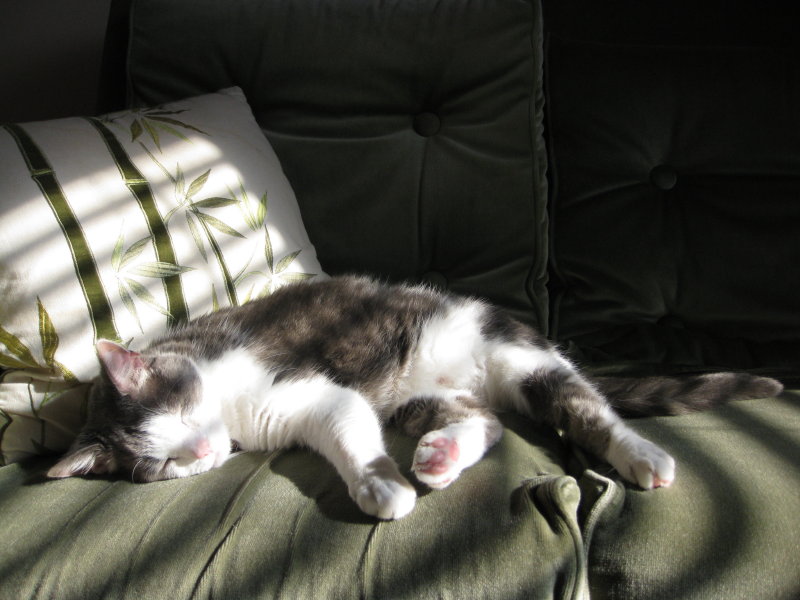
And here’s a cat. Because if you understand – really understand – what that article means for YOUR novel, you’ll need a quiet sit down with something soothing.

I disagree
I’ve written elsewhere how much I love the Australian blog Call My Agent! In fact I dreamed about meeting the blogger last night. But today I have some fightin’ instead of flatterin’ to do. Here’s a question Agent Sydney received, with the first bit of the answer:
There are publishers now who don’t give advances or royalties but share the book’s profits equally with the author. Do you think this would be a better deal for authors?
It’s a different deal for authors, and possibly a better one, but it’s really too early to tell. I think what’s good about some of these contracts is that the profit-sharing arrangement indicates more of a partnership between publisher and author. . .
The rest is here.
Here’s my answer:
No.
Well, okay. Perhaps once in a thousand times the author would benefit*. It’s a very simple equation: in today’s world, most publishers make a loss on most of the books they buy (and survive mainly because of bestsellers). Most books do not earn out their advance (which is based on projected sales from a publisher hoping for the next bestseller).
Therefore, it is not only safer but more profitable to get an advance. Yes, in the above scenario you get paid more per book – but books cost a lot to edit, proofread, print, and distribute. You still won’t get much of the purchase price.
Agent Sydney is not alone in steering wannabe writers towards smaller, less profitable publishers. They certainly have their place, and are not always a scam – usually, they’re just optimists. And writers are optimists. So they join hands and skip away towards the end of the rainbow, and are stunned to never find a pot of gold.
Writing is very rarely profitable at all. Make your choices wisely.
*usually, when people give something a “one in a thousand” chance, it is hyperbole. In this case, it is my actual estimate.
Jump on that Bandwagon: My Kindle Epiphany
There is a whole lot of hoohah about e-readers. Some of it is the usual rhetoric about the demise of traditional publishing, which is an emotionally appealing but fictional tale, to which I roll my eyes. People who use e-readers tend to use paper books as well, and the vast majority of readers, including myself, see the e-reader revolution as yet another big noise about a new technology that really isn’t as exciting as a particular kind of person thinks. Books are great: they’re reusable, lendable, reasonably compact, they don’t run out of batteries, and they’re nice to smell and hold. Perfection!
Or. So. I. Thought.
Last night my dad wanted to show me his kindle. I managed to put him off for a bit with this and that, but eventually I picked the thing up and opened the cover. And that’s when it happened: I looked at the screen, and it felt like a book. Not a computer, a book. But this is a book you can use to buy more books with. It’s a book that doesn’t have that annoying inner margin that makes you constantly bend it out of shape. It’s a book that has only one side, so when you lie down and read you never have that awkward position of holding it half off the pillow. The smaller ones cost around $100.
In short, I now want one.
My dad’s one is a larger-size kindle (about the size of an ipad), and it’s a little too heavy for comfort. Also, the amazingly comfortable screen *isn’t* in the newer models, so I’m going to have to examine and compare screens and sizes (and digital rights, because that’s a whole can of worms) before deciding what I specifically want. For example, the larger screen would be more comfortable to read – but less portable. As someone who loves those times when I leave the house with one of those ridiculously tiny handbags, I think the smaller one will be the one for me (and it’s cheaper) – and I suspect that once I have a tiny, incredibly portable library on me at all times, it is a technology that will change the way I live. Suddenly I’ll always have books with me, instead of making the decision on a daily basis whether I should take a book with me or not.
All in all, I’m sold. In the blink of an e-ink-reading eye.
Small Press: Hero or Villain?
I’m linking you to Lynn Price at The Behler Blog yet again, because she just keeps making so much sense. This time she discusses how, in the migration of definitions, you can figure out whether your “publisher” deserves the quote marks or not.
This section alone is why the world needs more blogs like this one:
Instead of guessing and pondering with a friend who isn’t well-versed in publishing, you should be asking your prospective publisher who distributes their books. If they say IPG, Perseus, Consortium, NBN, IPS, then you know they are working on all cylinders because they have to have a certain amount of $$ coming in to even qualify. They are a proven quantity.
If they say Ingram and Baker and Taylor, then they do NOT have distribution. These entities are fulfillment warehouses. They don’t have sales teams out there pitching their catalog to buyers.
How to write a sequel
Here, via John Scalzi, is one woman’s cunning plan for dealing with sequelitis. She makes a lot of sense. For example:
3. The plot deals with an entirely new problem. You can often pick detective novels up mid-series because each detective story is a self-contained plot. They start with a new question and then have to solve it, tidily, by the end of the book. Shades of Milk and Honey had a Jane Austen plot structure so the big question there was: Who is she going to marry? That’s no longer a question. Since I’ve sent [person A and B] to the Continent in 1815, the big question in Glamour in Glass is: What are they going to do when the Battle of Waterloo happens?

A lot of fantasy writers (myself included) write book two (or perhaps two and three) of their fantasy trilogy while waiting to hear back from publishers about the first book. The fundamental problem with this is that book one may never sell – and then you’re screwed.
Or perhaps, if you write very carefully, not.
PS Although I think it’s solid advice above, I also think she may have gone too far, since the first book is a romance. That technically makes the two books different genres.

 Felicity Banks