All about agents (PG swearing)
I had to link to this article, because one of the blogs I follow was recommended by another blog I follow. Chuck Wendig is a naughty, naughty man and his language and metaphors can be M/MA at times. Don’t say I didn’t warn you. The man has a wicked way with words.
Here’s some snippets from a doubly-great article:
Agents have seen it all. They are the first line of defense in the war against Bad Books and Shitty Storytelling. It’s a wonder that some of them don’t just snap and try to take out half of New York City with a dirty bomb made of radioactive stink-fist query letters and cat turd manuscripts.
. . .
It’s easy to imagine agents as iron-hearted gatekeepers guarding the gates of Publishing Eden with their swords of fire: marketing angels serving the God of the Almighty Dollar. Most of the agents I know and have met are readers first. They do this because they love this, not because it pays them in private jets and jacuzzis filled with 40-year-Macallan Scotch. They like to read. They love books. Which is awesome.
And here’s your weekly cat pic:

Self-publishing disappointment
http://accrispin.blogspot.com/2011/03/why-your-self-publishing-service.html
Writer Beware (a group that exposes those who are scamming innocent/ignorant writers) often hears from self-published authors who are convinced they’re being ripped off by their self-publishing services–but it’s more likely that their expectations were unrealistic.
Kids, major publishers aren’t out to gleefully reject you – they WANT to publish good books. They’re just aware that the market is lacking. Self-publishing is certainly not going to change that fact.
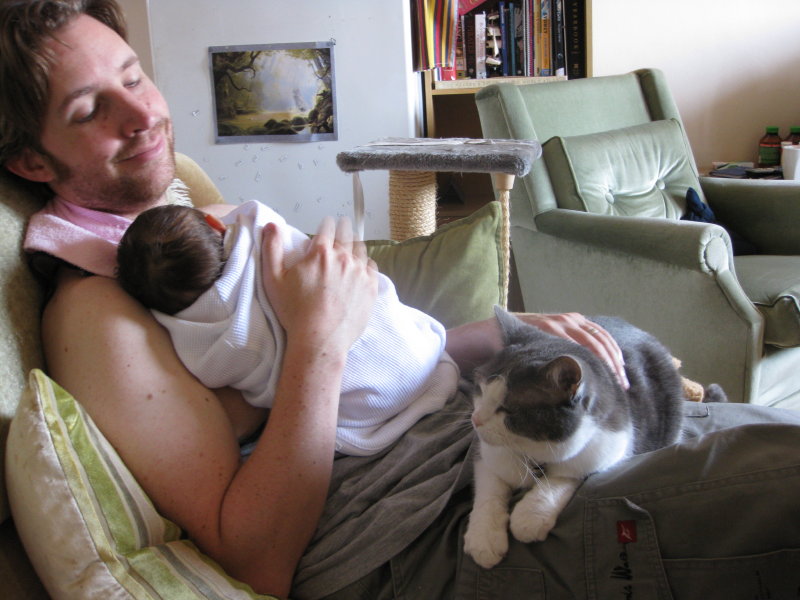
And here’s a picture of a cat, as per usual – but with a bonus baby and CJ, as our family gets used to one another:
Writing and Money
Here is an article on royalties, advances, and making money as a writer. I haven’t actually read it (too tired), but it sounds like useful stuff. My advice? Always get a good advance – it’s often all you ever get.

How good are your chances?
I’m a big fan of US agent Kristin Nelson’s blog, and one of the things I love is her transparency. If you look here and here, you can get a good idea of how many queries, samples, and full manuscripts get to the next stage at her agency. She is a successful agent with a strong web presence, so I imagine she gets more queries than the norm – but I also think she has the capacity to accept more books than a tiny agency. Therefore, I think the rate of these statistics gives a good general idea of how difficult it is to get an agent in the USA.
Getting an agent is not at all the same thing as getting published, but I think your chances of getting published with an agent are about 80% – more for someone of Kristin’s calibre. Which is a huge amount compared to the 1 in 10,000 shot of the average unpublished novel.

How to get published
Rachelle Gardner is an American Christian literary agent with a great blog. She wrote a post on how to get published, which is an excellent summary of the American system.
Australia is similar to the USA, except you don’t necessarily need an agent to get published (some choose to get an agent after having an offer for publication – agents are at their most useful when dealing with contracts), and the place to look for impartial advice is the Australian Society of Authors.

The myth of self-publishing success
Hollywood and the media feed us a lot of rubbish. Every school classroom (particularly in a rough area) is full of world-class singers/dancers who simply don’t realise how amazing they are until a teacher inspires them to follow their dreams. Every socially awkward girl is actually stunningly beautiful after a haircut and some contact lenses. Every nerdy kid is actually a mathematical genius. . . and so on.
I’m sorry, but it’s just not true. You are almost certainly not a misunderstood genius. Even with a whole lot of hard work, you probably won’t win gold at the Olympics (you’d be amazed how many people don’t). And even if you spend a year – or five years, or even ten years – working on a book (or ten books) – you may not be very good.
I fully understand how hard it is to accept one’s own lack of writing talent – particularly after a lot of hard work towards a goal that other people seem to achieve so easily. A LOT of people don’t accept it – and so they blame mainstream publishing.
And thus is born the extremely powerful myth that self-publishing is the road to success. The few tales of actual self-publishing success are given a huge amount of media time, because they make a great story. The reason they make a great story is because they’re extremely, extremely rare.
Here‘s one of many true and rational articles standing up against the tidal wave of “believe in yourself and self-publish your way to fame and fortune” articles that we’ve all seen.
And here’s my cat, showing us a far likelier road to happiness:

A writing scam? For ME?!?!
A few days ago, I received my first ever personalised writing scam via email. Here is the full text of that email:
Dear Ms Curtis,
I am writing on behalf of a new international publishing house, JustFiction! Edition.
In the course of a web-research I came across a reference of your manuscript Worse Things Happen at Sea and it has caught my attention.
We are a publisher recognized worldwide, whose aim it is to help talented but international yet unknown authors to publish their manuscripts supported by our experience of publishing and to make their writing available to a wider audience.
JustFiction! Edition would be especially interested in publishing your manuscript as an e-book and in the form of a printed book and all this at no cost to you, of course.
If you are interested in a co-operation I would be glad to send you an e-mail with further information in an attachment.
I look forward to hearing from you.
Kind regards
Evelyn Davis
Acquisition Editor
Just Fiction! Edition is a trademark of:
LAP LAMBERT Academic Publishing GmbH & Co. KG
Dudweiler Landstr. 99
66123 Saarbrücken
Germany
Phone: +49 681 3720-310
Fax: +49 681 3720-3109
Email: e.davis@justfiction-edition.com
http://www.justfiction-edition.com
Register court/number: Handelsregister Amtsgericht Saarbrücken HRA 10752 Identification Number (Verkehrsnummer): 12917
Partner with unlimited liability/Persönlich haftende Gesellschafterin: VDM Management GmbH
Register court/number: Handelsregister Amtsgericht Saarbrücken HRB 18918
Managing directors/Geschäftsführer: Dr. Wolfgang Philipp Müller, Christoph Schulligen, Esther von Krosigk
This is a fairly simple scam. They don’t charge money up front, but will presumably gain that cash by offering me copies of the book – probably at a reduced rate. The sales of that book to the author are probably the only sales that will ever happen. Interestingly, the first book in their “catalogue” was “published” less than a month ago. (Never publish with a company less than two years old and/or one that has no successful titles.)
It is clear from the email above that not only do they not bother with editing, they don’t actually bother READING the books they represent. In fact, my “manuscript” Worse Things Happen at Sea is a twitter tale – all of about 1000 words. They list a large number of distributors (many of which are probably actually wholesalers, meaning that they STORE books, not sell them – I strongly doubt any actually “distribute” books to bookshops). One of the American distributors sounded familiar, so I searched Writer Beware and found this excerpt about it:
Now, one of the tricky things in this industry is that one of the major players, Ingram, is both a distributor and wholesaler. They have separate arms to handle each. But, per the descriptions above, there’s a vast difference on what they do if you pay them to be your distributor, versus merely having a listing with them in their wholesale catalog.
Unfortunately, a lot of small presses and POD self-publishing companies try to make you believe they have the distributor relationship when, in fact, they have the wholesale relationship. Since Ingram won’t reveal its client list, it’s hard to know which is which. However, I believe that right now, Ingram requires that a publisher that’s a distribution client must have about $20K+ of income from Ingram in order to qualify. If you think logically, would even PublishAmerica, the powerhouse of POD presses, qualify? Probably not. PA has the titles, but not the sales.
Kids, here’s the take-home message: There are a lot of scams out there (plus, to make things worse, some helplessly naiive publishers who simply don’t have the business sense to function). Never forget that. If someone approaches you with a wonderful shiny offer, they have a reason, and – I’m sorry – it’s very rarely because your writing is as good as your dreams. Often people are dodgy even when it’s you approaching them (setting up a web site isn’t difficult). If their books aren’t on shelves at your bookshop, they’re not actually getting sold – and yours won’t be sold to the public either.
Middle Earth versus Narnia
I’ve just finished re-reading the seven-book Narnia series by C. S. Lewis*and I’m also an admirer of the Lord of the Rings trilogy by Tolkien. Around the time the Lord of the Rings movies came out, there were heated arguments at parties everywhere**about whether the Narnia series or the Lord of the Rings series is better.
I was going to begin a seven-week series of Narnia reviews today, but I’m JUST about to get my greasy mitts on “Goliath” by Scott Westerfeld, so I’ll review that in seven days’ time and then start on Narnia.
In the meantime, here’s a pre-review review:
CS Lewis and Professor Tolkien were close friends, part of a writing group called Inklings. Many members of the group were killed fighting in World War 2. Who knows what other books might have been written if the whole group had lived.
Leaving aside The Hobbit and all the other works by each author, there are some notable similarities and differences.
Both men were Christian, which is clear from reading their books if you’re into symbols (much, much clearer in Narnia’s Aslan character than in Middle Earth – in which the clearest parallel is the nature of Gandalf’s death). Both Lewis and Tolkien distrusted industry, and featured images of fighting trees (yay) and evil loggers (boo). Both wrote tales of high adventure, personal honour, and selfless sacrifice. Both featured heroes who were flawed but who could not be mistaken as anything but great heroes.
I believe that if the Narnia books were sent to a publisher by an unknown author today, they would be published.
I believe that if the Lord of the Rings books were sent to a publisher by an unknown author today, they would not be published. *gasp*
CS Lewis was writing in the 50s, so naturally women were not allowed to fight in the front lines (they could shoot arrows from the sidelines, but none ever wielded a sword), and baddies tended to be dark-skinned (or, in the case of the Black Dwarves, black-haired). However he has excellent heroic warlike female characters, and gracious and noble dark-skinned characters (Aravis is both).
Tolkien is infamous for having almost no female characters whatsoever, but he does mention (either in passing or in the Silmarilion) some truly awesome females – who fought in battles as well as any man. They did tend to be defined by the men they loved, which is a shame.
The true reason I think Lewis would be published today and that Tolkien would not is that first of all, Tolkien’s fantasy is for adults. Adult fantasy is simply harder to sell than children’s fantasy (and if we’re honest, it’s partly because adult fantasy fiction is just. . . long). But the main reason is that Lewis actually stuctured his Narnia books like modern books – starting with action/danger/conflict within the first few pages and never spending huge swathes of time on decription, rambling tangents, or – cosmic bunny save us – poetry. Lewis also has a brilliant eye for the tiny detail that makes a scene come alive.
Tolkien was predominantly a linguist – not a storyteller. I for one am grateful he was writing back when the market was quite different, and his books didn’t get rejected with the note “Needs editing”. As a modern reader (and I do read), I prefer the Lord of the Rings movies. I’m sorry, but it’s true. On the other hand, I understand that no writer in the past, present or future could create a world as rich and complex and fantastic as Tolkien did. I’m even a little glad that he didn’t get edited (as we all know, Tom Bombadil is largely irrelevent to the main plot, and would certainly be cut along with many other wonderful scenes, characters, and descriptions).
If I’m going to read a book, I pick Narnia every single time. I was pleasantly surprised this last week by how well written they are. No other classic books translate so well to the smart, focused modern reader.
And now I shall duck and cover as the argument continues.
In other news, one of my own books has been at a certain large Australian publisher for three years now. I have just discovered that the particular individual who I knew very well was holding things up has stopped working there. Which means there’s a small chance I’ll get a response in the next month or two, and a very good chance I’ll have a response in 6-12 months (ie the normal response time).
If I’d sent the book in via the slushpile, I’d have had an answer over two years ago. Kids, contacts in the biz aren’t always a good thing.
*Fun fact: The “C.S.” stands for “Clive Staples”. Abbreviation is sometimes a VERY good idea.
**This tells you exactly the kinds of friends I cultivate.
Versatile Blogger Award
I am, according to General Happenings in my House, hereby awarded a Versatile Blogger award! Thank you 🙂

My duties, upon receiving this much-coveted honour, are as follows:
1) Thank the awarder by linking back to their blog;
2) Pass on this award to 15 recently discovered blogs and let them know I have done so;
3) List 7 things about myself.
Here are some great blogs (in no particular order):
1) Ripping Ozzie Reads – an accomplished group of Australian specfic writers (including Richard Harland, Rowena Cory Daniells, and Margo Lanagan) share their know-how.
2) Pub Rants – pub as in “publishing”. This is the blog of a US agent – again, lots of great advice.
3) KT Literary blog – another US agent (in fact, she is friends with # 2).
4) Nathan Bransford – US ex-agent and children’s author (again with the advice). He also runs great forums.
5) The Intern – this time it’s a US ex-intern, but her advice is still excellent (more on writing, less on the industry).
6) Behler Blog – this time it’s a US editorial director giving free industry help.
7) Writer Beware – there are a LOT of scams out there designed to prey on writers. This blog investigates, then tells the horrible truth.
8) Call My Agent! – more industry advice, but this time from an anonymous Sydney agent.
9) Terrible Minds – advice, interviews, and very rude rants from author Chuck Wendig.
10) Slushpile Hell – when a writer needs a little more sarcasm in their day.
11) Brass Bolts – a steampunk writer blogs about steampunk (the pics are especially good).
12) Trial by Steam – steampunk articles and events.
13) Multiculturalism for Steampunk – a seriously excellent and well-researched steampunk niche blog.
14) Antipodean Steampunk Adventures – an Australian steampunk who actually builds his own stuff.
15) Blue Milk – a feminist blog on motherhood (not always safe for work).
Well! That list certainly answers the question, “So, Louise, what do you do all day?”
Now for seven things about myself:
1) Umm. . . I attempted my first novel when I was seven years old (it was about a family of cats – naturally).
2) My mum read the Narnia series in hospital after giving birth to me (I’m re-reading it at the moment).
3) I speak semi-fluent Indonesian, and once considered marrying an Indonesian man I was close to.
4) I leave the curtains open until dark most nights in case the sunset is pretty.
5) Only one of my grandparents is still alive, and he is not well.
6) I can juggle.
7) I have pre-ordered “Goliath” by Scott Westerfeld; the third book in his brilliant YA steampunk trilogy (“Leviathan” is the name of the first book).
Thank you and good evening!
Do independent authors sell?
Generally, no.
For one thing, bookshops will refuse to stock them. This is not because bookshops are mean and cynical; it’s because there are insane numbers of self-published books out there, and many of them are self-published because authors were either not good enough or not marketable enough for major publishers.
If you owned a bookshop (one of the ones that hasn’t already financially collapsed), wouldn’t you want to pick the best written, best edited, most marketable books?
On the other hand, here is an article about some independent books that mostly did quite well. This presumably involved a LOT of promotion work over time by the authors.
For those who want comparison numbers, the average book published by a large Australian company gets an advance of $3000-$5000 for children or young adult books, or $5000-$10,000 for other novels. Unless the book is a success (sadly, that just doesn’t happen often – a “success” would be selling over a thousand books), this is the only money the author gets.
But it’s almost guaranteed to be more than a self-published or POD author gets. So be wise with your work.


 Felicity Banks