Why your novel won’t get published (PG+)
My notes to this article read “LOL, fairly rude/graphic, and all true”. I’m a huge believer in a dose of realism every so often, so here it is: http://terribleminds.com/ramble/2011/01/10/why-your-novel-wont-get-published/
Here’s a bit:
Brutal honesty time:
That novel of yours isn’t likely to get published. The numbers just aren’t in your favor. Last I did a sweep of the Internet, it was home to 500,000,000 writers. Once you remove the wanna-be dilettantes, you still end up with 1,000,000 left. And they’re all fighting to have their manuscripts published.
And one more picture of Ana in a basket:

Halfway
. . . sort of. Today marks twenty weeks, which means that if Mini-Me appears on his/her due date (hah!) this pregnancy is half over. It also means that, should Mini-Me decide to appear this very afternoon, it’s not a miscarriage – it’s a premature birth. The reason for the distinction is that there is a chance (an EXTREMELY small chance) that a baby born this early would survive. That’s oddly comforting.
Also (you may have heard a hint of a rumour on the breeze about this) we find out the gender tomorrow (plus we’ll be reassured about the non-existence of a large variety of possible complications). By “we” I mean “CJ and I and various friends and relations”. I do promise to blog all next Wednesday – if not before. There will also be fresh Mini-Me pictures.
If you’re wanting gratuitous fat-belly shots (Mini-Me is now around 16cm from head to bum), just scroll down to the entries from yesterday and the day before. In the meantime, here’s some gratuitous cuteness from last night:

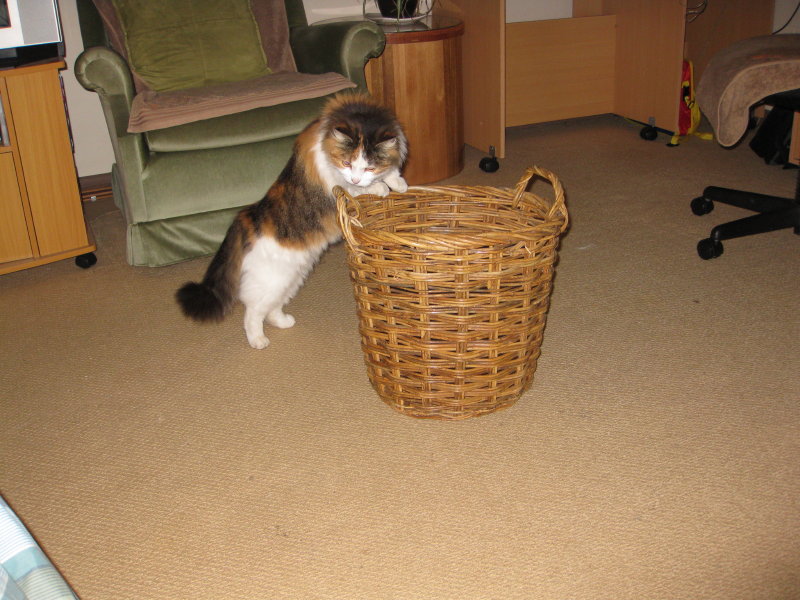
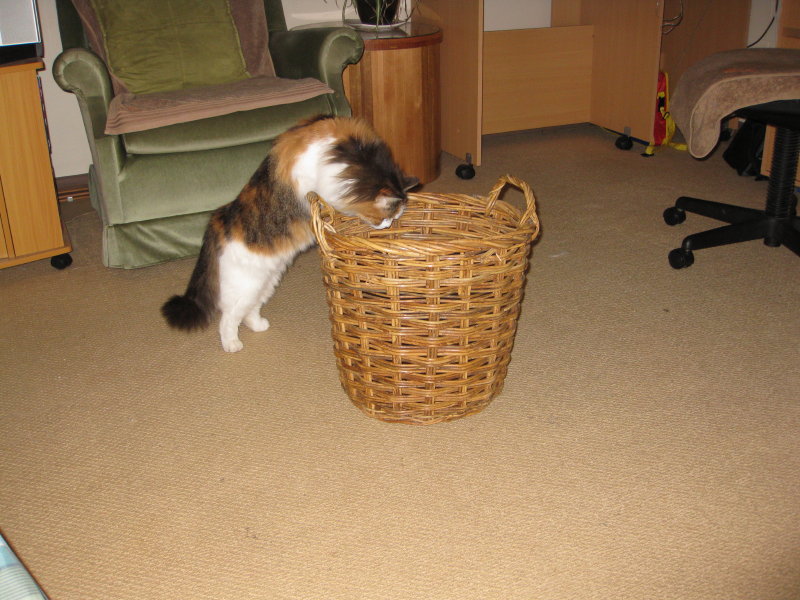
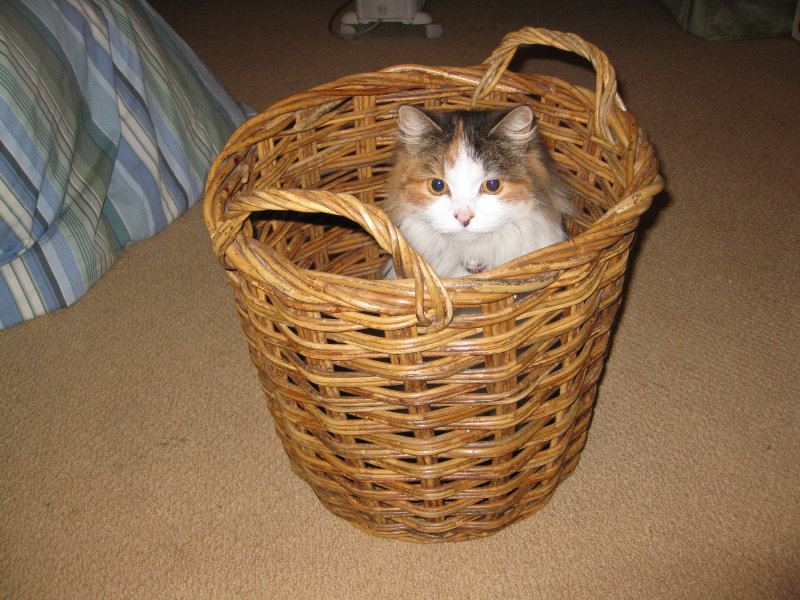
Last night I became concerned that I’ve felt only the occasional movement from Mini-Me – and I’d done a preliminary midday weigh-in yesterday that seemed to indicate I’d gained over two kilos (rapid weight gain can be a sign of something medically wrong – or it could mean I needed to drastically cut down on my chocolate). I had trouble going to sleep.
Sidebar: You know you’ve married well when you confess to your partner that you spent the last of the grocery money on a giant block of chocolate loaded with toffee-coated cashews and hazelnuts – and he says, “Oh good. I want our child to be eating nuts.”
Pregnancy is infamous for giving a girl peculiar dreams, and ondansetron/zofran has been giving me nightmares most nights. And so it was that I dreamt I accidentally went to a chemist for my ultrasound. All the various tests were done on my urine (“Does Mini-Me have spina bifida? Pee in this cup. Is Mini-Me a Rodent of Unusual Size? Pee in this cup.”) by incompetent and much-distracted trainees.
The final test – the one about gender – was fobbed off onto an extremely irritating child who desperately wanted some attention. So he took me on several epic mountain hikes, during one of which a friend of his fell off an especially treacherous cliff and was decapitated. This further delayed my stupid test, and I swear that kid was pleased.
I finally promised to play a game if he’d do the test first. I peed in a rather dirty plastic cup and he showed me the results sheet, which was gleefully flashing through possible options. Finally the whole thing lit up. . . and it was pink. It was a girl!
At this point my mother showed up and we fled the scene, shouting a cheerful goodbye to the abandoned brat. As we left, the severed head of the fallen hiker was making small talk with two others about the correct first aid procedure for decapitation (so THAT’S all right).
The End.
Kids, don’t do drugs.
I got up and weighed myself, and discovered I’d gained precisely half a kilo – the exact recommended amount. (I’m actually still more than two kilos lighter than I was at the beginning of the pregnancy.)
Then I crawled back into bed, and something under the donna poked me suddenly in the stomach – so suddenly and so distinctly that I yelped aloud (my first thought was, “Tentacle monster hidng under the covers! Aieee!”).
It was Mini-Me, of course.
Which doesn’t necessarily mean there WEREN’T tentacles involved. I assume that’s one of the things they check for at the 20-week ultrasound.
It’s not about the money. . . or is it?
I’ve said about a million times that if you don’t enjoy writing for the sake of writing – don’t write.
Crime pays more often than writing does, and I’m willing to bet there are more millionaire fraudsters than there are millionaire writers.
On the other hand. . .
If you want to get published, you need to actually connect both with individual readers (ie you need to make sense, and to CONVEY all that emotion in your imagination) and with the market (ie you need to obey certain conventions, such as a 60,000-80,000 word length in young adult books).
Lynn Price of the Behler Blog talks a bit about the difference between “writing for the love” and “lazy writing” here.
Speaking of lazy, I keep telling Ana that leaving muddy pawprints on my notes does not constitute co-writing. It doesn’t seem to bother her.
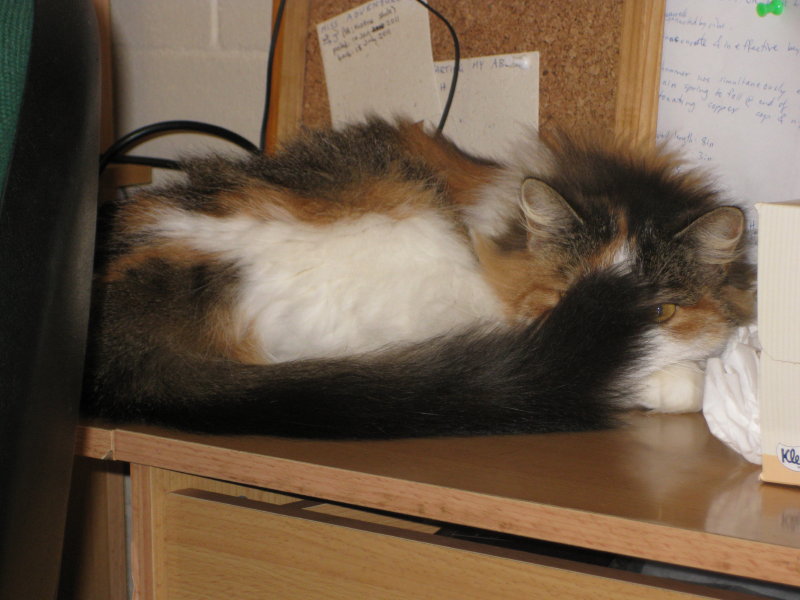
Done and done
Want to know the most stupid movie cliché?
It’s the whimsical writer character who’s secretly poured their heart and soul into a book* that they’re too afraid to let anyone read. As the movie plods towards its happy ending, the writer finally finds the courage they need to send their book to a publisher**. They are instantly published.
If someone told me they’d peed on one of my cats, it could hardly be more offensive.
Writing needs editing – by you, by an HONEST friend (who tells you it has enormous flaws – because it always does), and by a professional.
Writing a good book takes time and practice. This almost always means THROWING AWAY that first, treasured book. Personally, I’ve thrown away several. Most people take five to ten years to get vaguely competent at writing – which seems crazy, because any literate human can, technically, write a book. The problem is that you can’t measure good writing, so people tend to vastly overestimate their own skill – hence the need for real editors.
Getting a good book published isn’t a given either. You need a little bit of luck to hit the market at the right time and place (which includes learning the stylistic writing fashions of the day – which are constantly changing, hence the need to read modern books in your genre). In practice, this means writing more than one book.
I’ve said it before and I’ll say it again: The average book has a 1 in 10,000 chance of getting published. If you really love writing for the experience of writing, that’s no problem at all.
Which leads me on to what I’m actually celebrating today. Two months ago, an industry person asked to read the full manuscript of my YA steampunk novel. Unfortunately I needed to write an extra scene – something that would normally take me a day or two. I was too sick to sit up for more than a few minutes at a time, so I was forced to put off the industry person. . . for two months. If I’d been well at the time, I’d know her answer by now (argh!) – she is one of the rare people that replies when she says she will (in this case, within two months).
But.
YesterdayI finally reached the point where the book was good to go (and I used my extra time to also have CJ check it over from cover to cover and make several suggestions, some of them quite large – that’s the best kind of editorial suggestion), and I sent it off yesterday.
I happen to know my chances of an “I want to work with you” response are now 1 in 10 – which is a huge improvement. On the other hand, that also means there’s a 90% chance she’ll say, “Thanks, but no thanks.”
It doesn’t particularly matter. The thing that excites me most of all is the pride I feel in knowing I’ve written a really good book – because I’ve been writing for so long, I actually CAN tell that the writing is good (the whole “requesting of the full manuscript from the first person who saw it” is also a handy clue).
Since early this year, my writing area has been slowly spreading and overflowing with information on duelling guns, historical architecture, steam engines, character sheets, and clockwork rats. Since the book is now polished to a shine, I can FINALLY tidy all the notes and pictures away for a rainy day – which is to say, the next round of editing.
I can’t wait.

*often written by hand or by typewriter, which is even more offensive – because it means they’ve done no editing whatsoever.
**sometimes after showing the book to a close friend, who tells them exactly how wonderful it is.
Turtle Publishing
No, it’s not a hip new publishing company – it’s a comment on the industry. Now sometimes publishers are slow because they simply can’t make up their minds (one of my books has been with a major Australian publisher for two and a half years, and that’s way beyond normal). But most of the time there is a complicated process from slushpile to (hopefully) acquisitions meeting to (hopefully) bookshops.
American agent Rachelle Gardner talks about it a little here.
Personally, I’d consider six months a normal wait for a yes/no response (for either the opening chapters or the full book), and one year a standard acceptance-to-publication schedule.
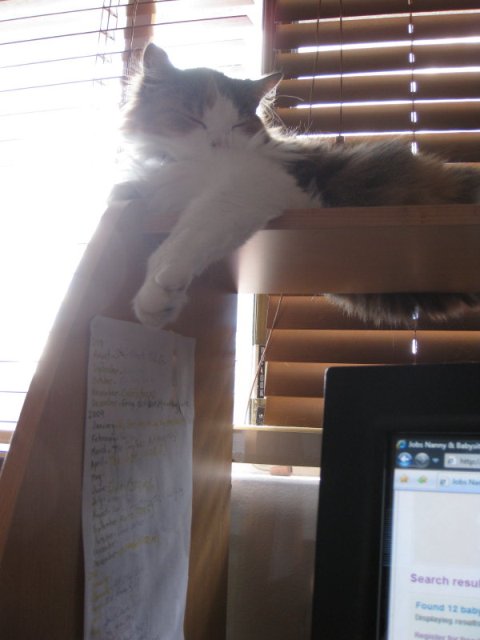
While you wait to hear back, here’s a picture of a cat:
Death of “Traditional” publishing?
A whole lot of people point to success stories like the self-published Amanda Hocking and say, “Hah! Those cold-hearted publisher types are dying, and we laugh at them and stomp on their graves!”
These people are stupid.
I often wish publishers were more cold-hearted. They’d get through submissions way faster if that were the case. But if publishers were less in love with books, they would not be publishers. Small publishers are dying – they always have been, and they always will be. It is an extremely financially shaky business in which MOST BOOKS ARE BOUGHT AND SOLD AT AN OVERALL LOSS TO THE COMPANY. Sometimes, large publishers are unlucky and they die too. Most large publishers survive on the occasional how-did-that-happen-exactly? bestseller. In short, they survive by picking the best books they can, and then crossing their fingers and praying that THIS book is the one that keeps the company afloat for another month.
People think publishers are cold-hearted because over 90% of books are rejected, usually without stated reasons. People are constitutionally incapable of believing that THEIR sweet precious manuscript that took five years to write is, in fact, terrible. (“But my mum LOVED it!”) These people are especially offended that “bad” books are published. Having read unpublished manuscripts, I assure you that publishers set a standard that is largely consistent and has saved the reading public from worse pain than you can imagine. Self-publishing often lowers those standards to, “Do you have a few thousand dollars? Then you’re a published writer, yay!”
Personally, I don’t see rich idiots as a threat to the publishing industry. I know enough to be grateful for the gatekeepers – and secretly or otherwise, so does the entire reading public.
*personal rant over*
I like the Behler blog, and especially this article, which inspired today’s post.

Dialogue
Want to write good dialogue? This article at Ripping Ozzie Reads has links to so much information you can go back to it every week for a year.
Dynamic Dialogue
Last week Rita asked about ‘beats’ in dialogue. This was a term I had only seen used in plays or scripts when the author leaves a ‘beat’ before the character answers to create suspense.
It appears the term ‘beat’ has been applied by writers as a form of tag, only this tag drives the story forward with action or reveal character reaction.
A dialogue tag can be:
‘How dare you!’ she said.
It can also be:
She slammed the mug down on the table. ‘How dare you!’
In this case the action is the tag because it identifies the speaker and tells us how the character is feeling. And this is what people are calling ‘beats’. It is what I was told was an ‘action tag’ when I first started writing.
For a fuller explanation. . .
Read the rest here.
And here’s your official cat pic of the week:

Ten Reasons to Rewrite that Scene
By The Intern.
The article is here.
Top Ten Reasons You Should Rewrite That Scene
10. The scene is not really a scene.
Your scene is not a scene if nothing has changed by the end of it.
Your scene is not a scene if there was no internal or external conflict, no matter how subtle.
Your scene is not a scene if you were too timid to let anything dangerous happen.
Your scene is not a scene if you were too cautious to let anything unexpected happen.
Your scene is not a scene if the reader is banging her head against the wall saying “What was the point of that stupid scene?”
Basically, your scene is not a scene.
9. The scene doesn’t achieve anything new.
Does your scene introduce important new plot information? How about new emotional information? Are the characters’ relationships developing? Or is this scene just rehashing material you’ve already covered in other scenes? You might have a case of scenis redundanitus (see here for INTERN’s post on that subject). If your scene doesn’t bring anything new to the table, what’s it doing in your story?
8. The scene isn’t “worse” enough.
Read more here.
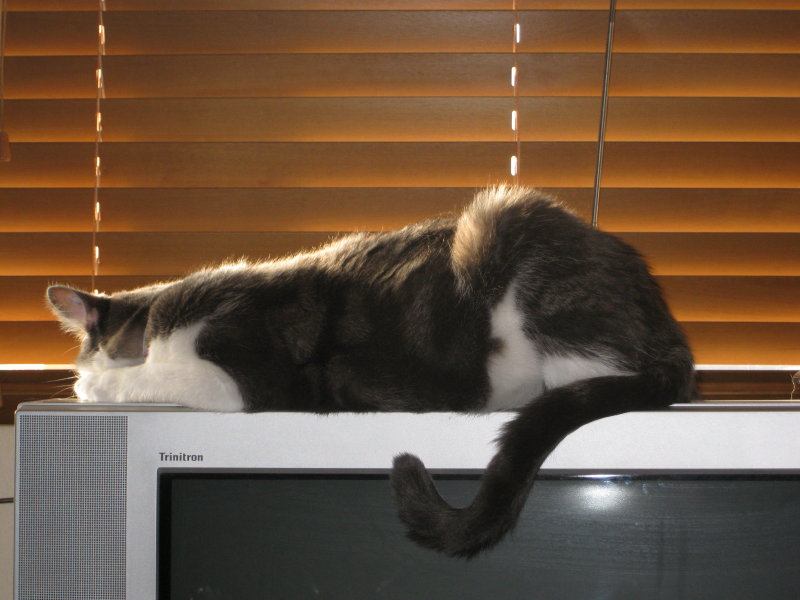
And here’s my older cat’s response to the prodigal’s return:
Revise, but don’t re-use or recycle
I’m pretty sure I’ve linked to ex-agent Nathan Bransford before. (Incidentally, he’s just released a children’s book.)
Here’s today’s article – a revision checklist, which I’m posting today as I re-re-re-re-revise my steampunk novel (I printed it out in hard cover, which always makes me see the book slightly differently, and thus more clearly).
– Does the main plot arc initiate close enough to the beginning that you won’t lose the reader?
– Does your protagonist alternate between up and down moments, with the most intense towards the end?
– Are you able to trace the major plot arcs throughout the book? Do they have up and down moments?
– Do you have enough conflict?
– Does the reader see both the best and worst characteristics of your main characters?
Read the rest (including suggestions drawn from the comments) here.
And remember, don’t take your ideas from TV shows (or bestselling books).

Why your first book sucks
I follow Rachelle Gardner‘s blog. She is a sweet, selfless literary agent*. I was quietly surprised to see her post on four reasons you shouldn’t even bother submitting the first novel you write. Given that, shortly afterwards, she posted an entry that mentioned her gentle surprise at meeting many writers who don’t even read books in their own genre, I think it’s been a bad-slush week for her.
Kids, don’t cause nice agents/publishers to burn out by being a moron.
Today’s post is unusual, because I disagree with the gist of her argument. I think writers SHOULD submit the first novel they write (my own first novel did rather well in a contest, and I later sold it for actual money – although nowadays I’m deeply grateful that the publisher never actually produced it), with the following caveats:
1. They have edited it, then left it for at least a month, then edited it again. At least one person (who is not a relative or in love with said writer) must also help with editing – you can tell a good editor because they make the writer cry and/or consider deleting the whole book at least once. After the crying/giving up, the writer must then fix 90% of the problems the editor has pointed out. You can find critique partners all over the internet, including at http://www.critiquecircle.com/default.asp.
2. The writer has read at least three books that are in their genre and published within the most recent five years (look on actual bookshop shelves – and if you’re too poor to buy them, go and get the exact same books from the library for free).
3. The writer has helped to edit at least three opening sections (chapters 1-3) of other people’s unpublished novels, and has also edited one full unpublished novel. You can find heaps of critique partners online, eg at http://www.critiquecircle.com/default.asp.
After the horror of reading someone else’s book (which will almost certainly be deeply awful), the writer must have another honest look at their own book, and do one more edit (or more if needed).
Congratulations! You are now ready to submit your first novel.
Was it a mistake? Here’s how to know:
If three publishers (who produce the right genre!) have rejected the opening chapters without requesting the full manuscript, it’s probably worth setting that book aside and writing a new one (which you’ll probably begin while waiting for your responses – which take 1-6 months each). The new book should NOT be in the same series – it should be something genuinely separate. (Otherwise you may find yourself dragging the corpse of a bad book around, because it’s part of a series – been there, done that.)
Here’s Rachelle’s article:
There is a cliché in publishing that by the time a writer finally gets published, she already has a whole stack of novels completed and hidden in a drawer, never to see the light of day. No writer gets their first book published, right?
Well, there are exceptions of course, but mostly, it’s true. Nearly all successfully published authors will have written two or more books before they get their first contract offer. Here’s why:
1. Practice. It takes most people a few tries to write a viable and saleable novel. Like it or not, this is true for the overwhelming majority of writers.
Read the rest of the article here. I definitely agree with #1.
Don’t forget to glance at the comments of the article – the second person has FIFTEEN unpublished books. Most of the people there had four or five unpublished books.
And here’s my cat, who has a thing for styrofoam:

* If that sentence surprised you, you’ve probably never met a literary agent.

 Felicity Banks