The dreaded semicolon. . . of DOOOOOOOM!!!
The semicolon has been known to divide loving families into shouting melees, and to send careers down in flames. It is the most contentious and passion-inducing piece of punctuation – and the most addictive.
How NOT to use a semicolon:
1. Frequently. I once had an editor add more than a dozen semicolons to a single page of a story (and there weren’t any lists). When I politely pointed out that he’d let his punctuation run away with him, he took another look and soon apologised profusely. My peeps, don’t let over-semicoloning happen to you!
2. To show off. This is particularly true in academia, where the person marking you has been scarred by both #1 and #3. Between Year 11 and the end of university (which was heavy on English courses) I discovered that a significant number of teachers and lecturers were so passionately opposed to semicolons – any semicolons – that they would mark essays more harshly if a single semicolon was spotted lurking (correctly or otherwise) in the text. For this reason, I did not use semicolons in essays for six years. I honestly recommend you do the same.
3. Incorrectly. If in doubt, use a comma. It will be correct.
Moving on, here is a simple tutorial on semicolons, with pretty pretty pictures to help you through the strain of intellectual effort on a Saturday morning. Enjoy.
And here is Ana. . . lurking like a semicolon gone bad:

Death of “Traditional” publishing?
A whole lot of people point to success stories like the self-published Amanda Hocking and say, “Hah! Those cold-hearted publisher types are dying, and we laugh at them and stomp on their graves!”
These people are stupid.
I often wish publishers were more cold-hearted. They’d get through submissions way faster if that were the case. But if publishers were less in love with books, they would not be publishers. Small publishers are dying – they always have been, and they always will be. It is an extremely financially shaky business in which MOST BOOKS ARE BOUGHT AND SOLD AT AN OVERALL LOSS TO THE COMPANY. Sometimes, large publishers are unlucky and they die too. Most large publishers survive on the occasional how-did-that-happen-exactly? bestseller. In short, they survive by picking the best books they can, and then crossing their fingers and praying that THIS book is the one that keeps the company afloat for another month.
People think publishers are cold-hearted because over 90% of books are rejected, usually without stated reasons. People are constitutionally incapable of believing that THEIR sweet precious manuscript that took five years to write is, in fact, terrible. (“But my mum LOVED it!”) These people are especially offended that “bad” books are published. Having read unpublished manuscripts, I assure you that publishers set a standard that is largely consistent and has saved the reading public from worse pain than you can imagine. Self-publishing often lowers those standards to, “Do you have a few thousand dollars? Then you’re a published writer, yay!”
Personally, I don’t see rich idiots as a threat to the publishing industry. I know enough to be grateful for the gatekeepers – and secretly or otherwise, so does the entire reading public.
*personal rant over*
I like the Behler blog, and especially this article, which inspired today’s post.

Ten Things Teen Writers Should Know
John Scalzi (NYT bestselling author) writes a good blog, with occasional writing advice.
This is one of my favourites articles (you’ll have to click through to see the picture of young John Scalzi.
Hm. It keeps crashing my computer when I try to cut and paste a section. Here’s the address again anyways:
http://whatever.scalzi.com/2006/04/27/10-things-teenage-writers-should-know-about-writing/
And here, as always, is a cat pic from the files:
Is your writing good?
Literary agent and all-around nice lady Rachelle Gardner blogged an article today that asked the question, “How can you tell if your writing is any good?”
Here is the link to that article.
How do you learn to write?
I think the answer is that you have to learn any which way you can. You piece it together. You take the lessons where you can find them. This could mean:
→ You read books on writing, and books in the genre in which you write.
→ You’re a member of writers’ organizations and online forums.
→ You take workshops offered whenever and wherever you can find them.
→ You take creative writing classes, such as at a local community college (although I’ve heard these can be a waste of time).
→ You have a critique group (this may or may not help, depending on the qualifications of your critique partners, as well as your own personality).
→ You submit your project to agents and editors, hoping for scraps of feedback.
Read the rest here.
Or just gaze at this kitten (yes, that’s a sword under her paw).

Writing Historical Fiction
Depite its many gleeful anachronisms, steampunk is one form of historical fiction (which is why I wouldn’t recommend it to people who refuse to do research*) – so here’s a post by Glass Cases on doing it right.
The full article is here.
When You Should Go Back to the Future
The triumphs and struggles of human beings on a personal level transcends any decade. When deciding when to set your story, ask yourself if this story could be told just as easily in present-day. The Diary of Anne Frank, for example, cannot. The Vampire Diaries, however, can. It wouldn’t matter if Elena is a young hippie from the ’60s, a tech-crazy gamer in the ’90s, or (as it stands) fairly popular former cheerleader in present-day Mystic Falls. Likewise, it wouldn’t matter if Stefan and Damon were turned into vampires in the 1400s, 1800s, or last week. The plot is independent from personal attributes.

In the next VERY short while (within two weeks, I promise), I have three particularly cool awesomenesses planned:
1. Eurovision party
2. Steam train!
3. Something even more awesome than those two. . . but I’m not telling what it is!!**
*or writing in general, for that matter.
**I use two exclamation points wisely. This awesomeness is the biz, big time.
Why your first book sucks
I follow Rachelle Gardner‘s blog. She is a sweet, selfless literary agent*. I was quietly surprised to see her post on four reasons you shouldn’t even bother submitting the first novel you write. Given that, shortly afterwards, she posted an entry that mentioned her gentle surprise at meeting many writers who don’t even read books in their own genre, I think it’s been a bad-slush week for her.
Kids, don’t cause nice agents/publishers to burn out by being a moron.
Today’s post is unusual, because I disagree with the gist of her argument. I think writers SHOULD submit the first novel they write (my own first novel did rather well in a contest, and I later sold it for actual money – although nowadays I’m deeply grateful that the publisher never actually produced it), with the following caveats:
1. They have edited it, then left it for at least a month, then edited it again. At least one person (who is not a relative or in love with said writer) must also help with editing – you can tell a good editor because they make the writer cry and/or consider deleting the whole book at least once. After the crying/giving up, the writer must then fix 90% of the problems the editor has pointed out. You can find critique partners all over the internet, including at http://www.critiquecircle.com/default.asp.
2. The writer has read at least three books that are in their genre and published within the most recent five years (look on actual bookshop shelves – and if you’re too poor to buy them, go and get the exact same books from the library for free).
3. The writer has helped to edit at least three opening sections (chapters 1-3) of other people’s unpublished novels, and has also edited one full unpublished novel. You can find heaps of critique partners online, eg at http://www.critiquecircle.com/default.asp.
After the horror of reading someone else’s book (which will almost certainly be deeply awful), the writer must have another honest look at their own book, and do one more edit (or more if needed).
Congratulations! You are now ready to submit your first novel.
Was it a mistake? Here’s how to know:
If three publishers (who produce the right genre!) have rejected the opening chapters without requesting the full manuscript, it’s probably worth setting that book aside and writing a new one (which you’ll probably begin while waiting for your responses – which take 1-6 months each). The new book should NOT be in the same series – it should be something genuinely separate. (Otherwise you may find yourself dragging the corpse of a bad book around, because it’s part of a series – been there, done that.)
Here’s Rachelle’s article:
There is a cliché in publishing that by the time a writer finally gets published, she already has a whole stack of novels completed and hidden in a drawer, never to see the light of day. No writer gets their first book published, right?
Well, there are exceptions of course, but mostly, it’s true. Nearly all successfully published authors will have written two or more books before they get their first contract offer. Here’s why:
1. Practice. It takes most people a few tries to write a viable and saleable novel. Like it or not, this is true for the overwhelming majority of writers.
Read the rest of the article here. I definitely agree with #1.
Don’t forget to glance at the comments of the article – the second person has FIFTEEN unpublished books. Most of the people there had four or five unpublished books.
And here’s my cat, who has a thing for styrofoam:

* If that sentence surprised you, you’ve probably never met a literary agent.
How to be awesome (here)
Today’s article is written by Nathan Bransford, who is a writer, ex-agent, and social media expert.
It’s called “How to write a good blog comment” and I can heartily confess to rampant self-interest in sharing it here.
Let’s begin:
The art of writing blog comments may at first blush seem like a frivolous and unimportant one, but that is not actually the case!
Writing excellent blog comments is perhaps the very best way to build your own blog and/or social media presence. Consider a blog comment an audition to show off your own personal awesomeness.
Not all blog comments are created equal. Here are some good rules of thumb as you work your way up to becoming a blog comment ninja.
Read the Post You’re Commenting On, Then At Least Scan it Again
Yes, this takes time and the careful suppression of twitchy fingers. But there is no quicker way to leave an ineffective blog comment than to miss something in the actual post or to accuse the poster of saying something they didn’t actually say.
Accuracy is important. Good blog comments take into account the entire post and then come up with a good and original response. So not only take the time to actually really read the post, keep the comment on topic rather than bringing in an outside and unrelated agenda.
That said……
Get There Early
The most effective and influential comments are near the top of the comments section.
Read Nathan’s other four excellent points here.
My own personal tips:
1. Always assume everything you post online will be read by your mother, your boss, your worst enemy, and your best friend.
2. Never, ever express anger online (see # 1) unless you are fighting for a cause outside yourself.
I’ve also discovered that writing about where your manuscript is at with agents/editors/publishers (or how long they take to reply) is also a no-no. Unsurprisingly, they don’t like to be publicly discussed.
Perhaps more importantly, proudly reporting – or weeping over – your dozens of rejections has the effect of making you look unpublishable, which can put professionals off – because they definitely do look at your blog and google you before offering representation (see #1). Which is why you won’t be hearing any more about the publication process until I have an offer (and permission to talk about it here).
3. If you’re young, invent a fake last name that you use everywhere online (if you’re a writer, it can become your pen-name, so make sure it’s distinctive but easy to spell).
I also recommend you visit Nathan’s blog and/or his top-notch writer forums.
Here’s an Easter-themed cat picture – this is Indah pointedly ignoring the Lindt Bunny bell I tinkled and then threw at her.
#57: Speed Writing
Want to write a bestselling novel? There are three basic things you need to do:
1. Write a novel.
2. Write a good novel, probably by much editing of #1.
3. Sell a lot of copies of your novel.
(Or alternatively, become a celebrity and ghost-write a novel. But I digress.)
Today’s all about #1, which is surprisingly difficult. Personally, I almost always write extremely fast first drafts (my realist novel was written in three days). I recommend every beginner uses a similarly manic method in order to finish that first book. Later on, you’ll know your own endurance better and can develop your own equally peculiar habits. (It also helps to split it up – I think of each 2000-word chapter as its own short story.) For your first book, the hardest part is physically writing it. So don’t worry; you can make it good LATER.
That means you DON’T re-read from the beginning every morning (you’ll get caught up in either how fantastic you are or how horrific you are, and both will slow down the actual writing), you don’t obsess over individual sentences, and you definitely don’t give the first chapter or first fifty pages to someone else to read and comment on.*
Today I’ll be taking my own medicine and speed-writing a 2000-word chapter in the next two hours. My computer says 11.42. See you at 1.42.
Here’s the notes I’ll be working from (divided into 500-word sections):
***search for Mrs Sweeton [who was recently abducted by the baddie]. They walk the grid, in pairs, in the nearby bushland. Yol and mr Johnson are left behind minding kids. Amy [that’s the hero] is paired with another character, Mrs banks [new character],
who is poking rudely at her mind.
They mentally fight, and go deep enough to satisfy amy that it wasn’t mrs banks who took mrs sweeton.
Is danny [amy’s boyfriend, who just publicly fought with her] planning to propose? What would amy say? Amy’s only just getting the hang of him, and is afraid. Mrs Banks comments on their fight.
——-
Hi again. It’s 1:26 and my chapter reached about 2005 words. I have a wonderful buzz of achievement, and I’ll come back later and probably find one or two good bits that I never planned. That’s the magic of getting words on paper – good stuff is bound to spill out with the bad.
*Partly because it’s just cruel to that person, and partly because your creative and editing selves are located in different parts of the brain, and simply don’t work well together. Write now, edit later. Trust me on this.
S#11: Paper Hat
Last night I took the entertainment section of the paper and made it more entertaining.
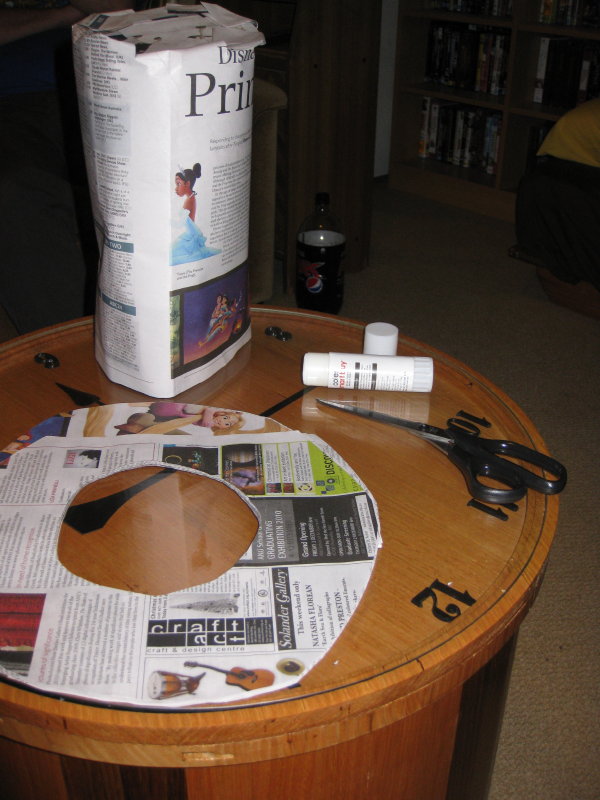
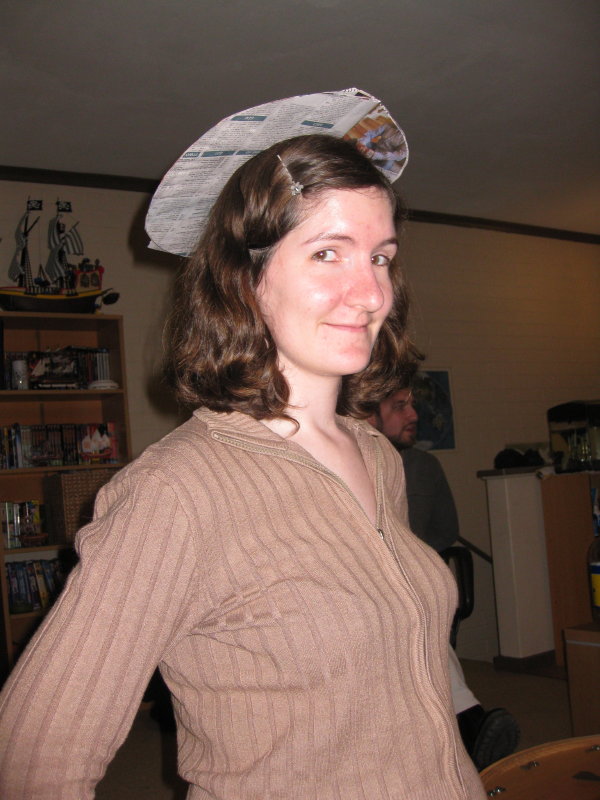
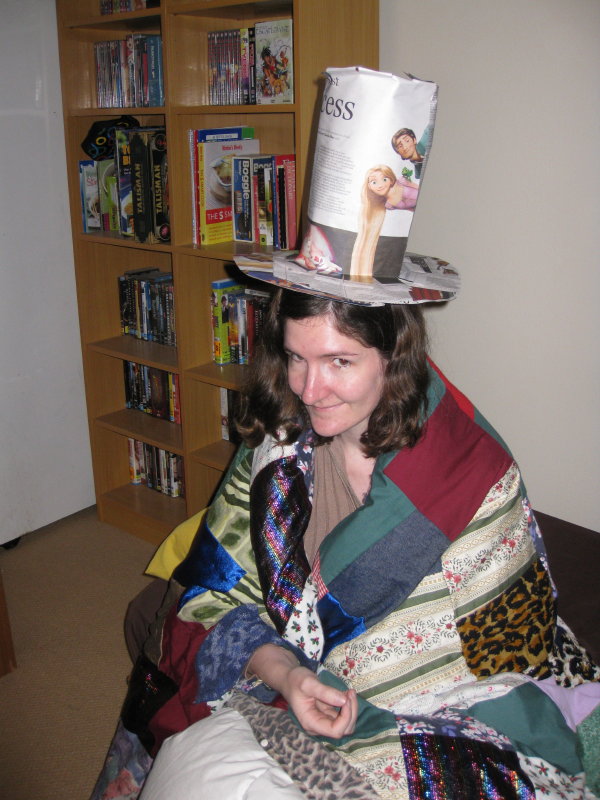
CJ was kind enough to also model for me.

The heading reads “Disney’s Last Princess”. It was quite an interesting article, saying that little girls no longer want to be princesses (unless they’re under five). Apparently “look pretty and find a man” (or its corollary, “look dashing and find a girl”) is no longer considered a universal goal.
I can think of one obvious exception to that rule (in which “look pretty” becomes “have extra-tasty blood”) but let’s ignore that and be encouraged.
To my fellow writers: Please, for the sake of all that is good in the world, write interesting, active protagonists.
Your homework: Read “Sabriel” by Garth Nix (PG/M for gore and violence). In my opinion, it is the best book ever written.
Three Things You Need to Begin a Novel
Some people believe you should write an outline of every scene before you begin. Others believe you should flow with the tale as it happens. I think that plot is important enough to deserve conscious thought – but I also believe that almost anything can be fixed by editing. And if you’re writing your first novel (or any novel), too much thought will kill you*.
There are only three decisions you actually need to make before you start.
1. If you’re writing for children or young adults, your main character needs to be a couple of years older than your target audience – and they need to stay roughly that age throughout the book. So your ten-year old won’t be driving a car, and your sixteen-year old won’t be getting married. Not if you want to one day sell the book. You also need to keep your themes relevent to the age group – so redemption isn’t a good theme for a ten-year old, and dealing with old age isn’t a go either.
2. If you’re writing for children or young adults, your length is relatively restricted – Ages 9-14 tend to read books around 30,000 words, and young adults read books around 60,000 words. More importantly, those are the lengths publishers buy. Give or take 5000 words, so don’t worry TOO much. Here’s a great post on word length by genre (including YA and children): http://theswivet.blogspot.com/2008/03/on-word-counts-and-novel-length.html
3. You’ll need to choose if you’re writing in first person (“I saw the duck. . .”) or third person (“She saw the duck. . .”). You probably do it automatically one way or the other. First person is much better for getting into the main character’s voice and head (or the narrator’s head, if he/she is a different person**), and for preserving a mystery (if the narrator doesn’t know something, neither does the reader – but it’s cheating to make the narrator not tell the reader what they know). Third person is less personal, but more flexible.
And that’s all you really need! Everything else can be fixed in editing.
But it’s useful to keep basic story structure in mind.
Basic Story Structure: An interesting character has a serious problem/goal and attempts to overcome it. It gets worse despite their efforts, and finally there is a crucial action-packed moment in the book when all is decided (for better or worse).
Fantasy example: An interesting character (Harry Potter, an orphan with magic powers) has a serious problem (defeating Voldemort, who killed his parents) and after many fights and more deaths and pain. . . he does.
Romance example: An interesting character (a charmingly quirky Sandra Bullock or Meg Ryan or similar) is lonely, and meets a guy (probably Hugh Grant). Her serious goal is to get the guy (it’s serious because it changes their lives). After feeling her loneliness more keenly than ever and having at least one major fight or embarrassment, the pair get together.
In order to get words on paper (that’s the hard part about first drafts), I recommend you treat each chapter as a short story that is relevant to the main plot (ditto your sub-plots, but you can always put them in later).
For example, if your main goal is to destroy an evil ring, some of your chapters could involve walking across a field and meeting more characters, running away from evil wraiths that want the ring, pausing to get advice from Cate Blanchett, and fighting a Balrog while taking a short cut. Each one of these has its own tension (will the farmer/wraiths/Balrog get them? Is the elf also evil/turned evil because of the ring?) and resolution (one step closer to the goal – but the main characters have a more complex or vulnerable situation to go on with, eg their powerful guide is dead or we have a greater understanding of the ring’s evil).
Here’s a funnier version of how to write a novel:
http://stiryourtea.blogspot.com/2010/09/how-to-write-novel.html
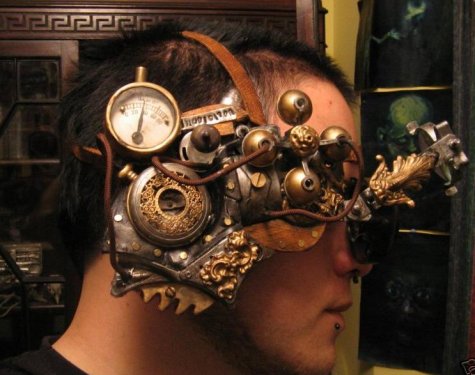
And since it’s Steampunk Earth Day later this month, here’s a pretty steampunk picture for you (from friedpost.com):
*Er. . . your novel. Whatever.
**Not recommended for your first book. Why makes things harder for yourself? Don’t challenge the establishment until AFTER you’ve proved you can write within the rules (say, after you’ve sold your first book to a major publisher).

 Felicity Banks