Mmm. . . cheap Easter eggs
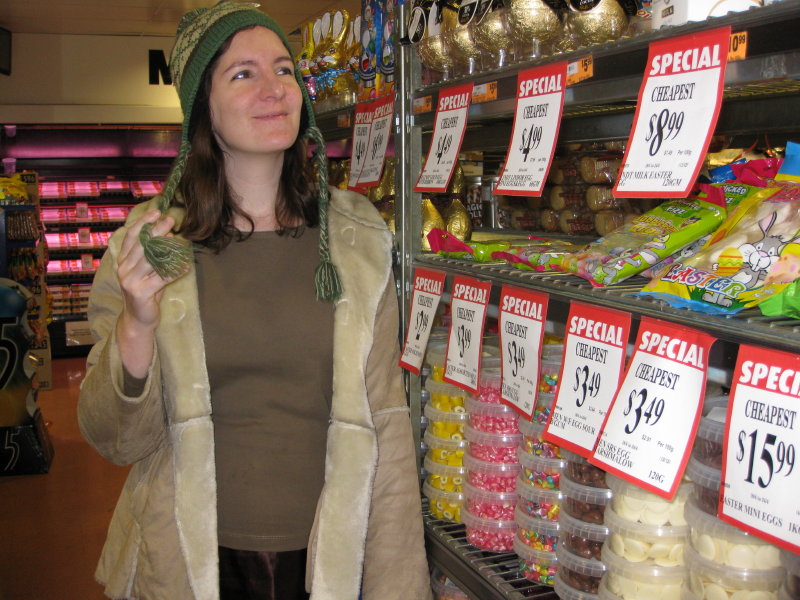
Today’s awesomeness is one many of you are familiar with – and all of you can enjoy today. In fact, I command that you do so: Descend upon your local shopping centre for massively discounted Easter produce.
Excellent.
I bought “jelly eggs” – that is, cheap jelly beans slightly adjusted in shape. What a brilliant marketing ploy.
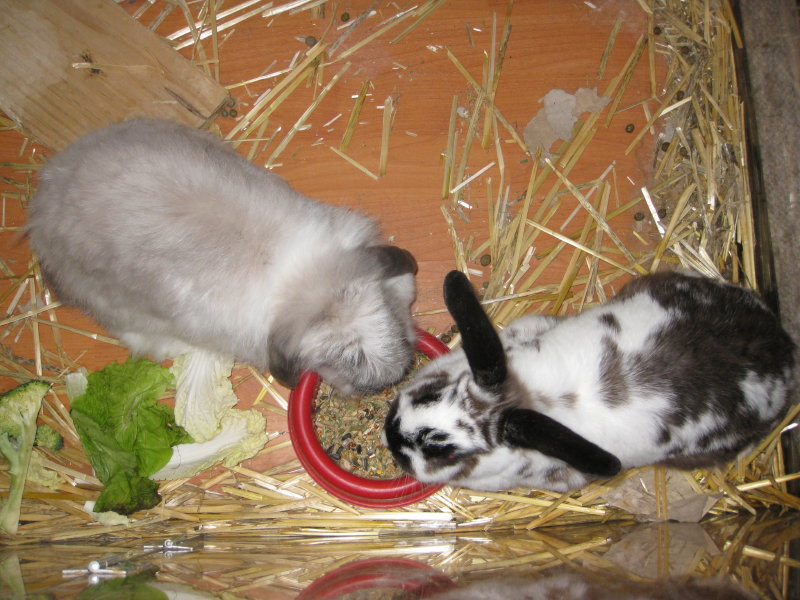
In related news, some friends of ours went away for the Easter weekend, so CJ looked after their rabbits. The friends thanked him by buying each of us. . . a Lindt chocolate bunny to eat.
You’re making me hungry. . .

I hope all of you had a safe, happy, and chocolate-filled Easter.
An Australian, an American and a British girl walk into a Chinese recording studio. . .
This video was recorded by a British girl and features an Australian man and an American woman recording a dialogue intended to assist Chinese students learning English. It singlehandedly explains all the Chinglish you’ve ever seen. As you watch, keep in mind that they were not allowed to alter the script in any way. Enjoy the increasing insanity as the Australian man starts playing multiple parts. Don’t forget to listen carefully to exactly what they say.
The fake glasses are Korean.
And here are some random photos from January last year when CJ and I went to Beijing.


I blogged about China here and here, and about the Great Wall here.
Hosting Christian Passover
My family has two feasts each year: Christmas and Passover. Both are hugely significant. In some ways Passover is more special because I’ve never knowingly met another family that celebrates it – so there’s absolutely no commercialisation (not even presents – not even *gasp* chocolate!)
I blogged about our Christian passover ritual last year, and I’ll almost certainly blog about it again next year.
This year was unusual. My Mum was running a passover at her church, which meant I could either join her church for the day or do something completely different. Since I’ve recently developed a strong phobia of church and even church buildings (sad but true – although a Bible Study group still meets at my house each week), I decided to look at it as an opportunity rather than a barrier, and run my own.
It was actually quite special to run my own without my parents’ presence – it meant I could do things in whatever way felt best to me – instead of trying to recreate past Passover experiences. (For example, my parents have a script with questions and answers that we read aloud – but I just told people what things mean.)
Sidebar: Passover is a Jewish festival. According to the Christian Bible, Jesus celebrated Passover with his disciples just before he was arrested (Christians know that meal as the last supper). The reason Easter moves around each year is because it’s linked to Jewish Passover (which moves because it’s linked to a different calendar) – which is the Thursday night before Good Friday.
For better or worse, CJ and I celebrated our own version of Passover this year (with four friends who had never been part of a Passover ritual before). Be advised that I’ve blurred together several quite different rituals with information from google and my own family’s traditions.
As people came in, they washed their hands in a bowl of clean water.
All the ritual foods (except the lamb) were set out on the table:
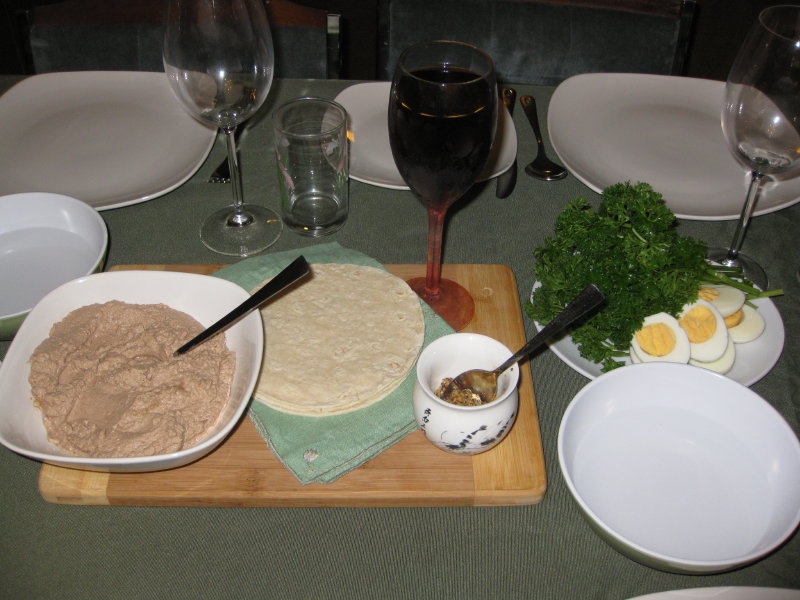
In the centre is the matzoh bread – bread made without yeast, representing the hasty departure of the Israelites from slavery in Egypt.
Beside it is a full wine glass that doesn’t belong to any of the guests. It is called the Cup of Elijah, and it represents the expectation that Elijah will return. Many Christians leave it empty, on the basis that we believe Elijah has already returned.
On the right and left of the matzoh there are bitter herbs (I used mustard, ugh), representing the bitterness of slavery; and sweet charoses (a blended mix of grated apple, grape juice, cinnamon and crushed walnuts – yum), representing the cement used by the slaves to bind bricks together.
On the right there are boiled eggs, greens, and salt water. The eggs represent life and the perpetuation of existence. The greens (parsley) represent hope and redemption. Salt water represents the tears of slavery.
The lamb represents the lamb sacrificed and eaten at the original Passover. On God’s instructions via Moses, the Israelites put lamb’s blood over their doorways on a particular night. The Angel of Death passed over those houses – but killed the firstborn children of the Egyptians (note to self: don’t make God angry, particularly after being warned by Moses and by numerous miraculous plagues). That night, the Israelites were finally released from generations of slavery.
And on to the ritual. . .
We drank the first cup – the cup of sanctification.
CJ took the three pieces of matzoh, broke the middle piece, and hid it.
We ate the other two pieces of matzoh with the bitter herbs and then with the sweet charoses (putting the charosis in a matzoh sandwich to represent bricks).
We drank the second cup – the cup of deliverance.
We ate the eggs and greens (first dipping them in the salt water – they taste very nice that way).
We drank the third cup – the cup of hope.
At that point we served main course and dessert, and I took this photo of my friend’s seven-month old trying sweet charoses for the first time:

We drank the fourth cup – the cup of praise (which for Jews is the final cup).
At that point, with a teensy bit of help, our youngest guest found the hidden matzoh from the start of the evening and gave it back to CJ.
I personally believe that it was at this point in the last supper that Jesus (like CJ, the patriarch of the ritual) took the matzoh – the bread that was broken, buried, and then brought out again – and said, “This is my body broken for you. Eat this in remembrance of me.” I believe that he then took the Cup of Elijah and passed it around for everyone to drink saying, “This is my blood, shed for you. Drink this in remembrance of me.”
I believe that when Jesus was crucified the next day, he fulfilled the symbolic promise of the original sacrificial lamb of Passover – saving us from death and slavery to sin – and that the Passover ritual was designed as a supernatural foreshadowing of Easter. Because God knows his literary techniques.
Christians echo the bread and wine of Passover every time they take communion – but most don’t realise the fact that Jews celebrated this ritual for centuries before Christ was born.
Get it right – this time

I knew before I began my steampunk novel that I would need to learn a whole new set of rules when it came to my Koori character, Matilda (you’ll notice that’s not a Koori name – names are just one taboo area).
A week or two ago I attended a lecture (in the gorgeously squished building above) by bestselling chicklit author Anita Heiss, who is a member of the Wiradjuri nation.
The lecture itself was very interesting (especially the various covers – some early drafts had Koori art from utterly the wrong nation, ugh), but the best part for me was that, as I’d hoped, Anita was able to tell me exactly where to look to find out how to write respectfully about a Koori character.
These are the two documents she recommended I read before approaching the correct Koori nation for more detailed consent:
http://www.australiacouncil.gov.au/__da … _guide.pdf
http://www.asauthors.org/lib/ASA_Papers … tralia.pdf
The bits about copyright were especially fascinating, because of course copyright law isn’t designed for oral stories – which means extremely valuable stories are not legally protected. Not yet.
Also, I’ll probably need to pay actual money to representatives of the nation I choose for Matilda’s background. I can handle that. Given the classic steampunk theme of rampant colonialism, it’s neat that I will be giving something back in order to honourably write about that era.
There is a huge wealth of religious tradition that non-Koori Australia is largely unaware of – not because we’re helplessly undereducated, but because much of it is secret, and needs to stay that way. My rule when it comes to other religions is, “What if they’re right?”
What if it’s true that a woman playing a didgeridoo causes terrible harm? What if outsider knowledge of sacred rituals destroys a people group?
Frankly, I’m not going to risk it.
This was part of the reason I made Matilda half-British, and a rebel against both her parents’ cultures. That way I can steer well clear of a lot of traditional knowledge or ritual – since Matilda has left much of it behind her.
And of course I’ll take care that the facts about historical Koori that make it into the book are accurate.
If you are writing about a people group you’re not a part of, here’s a good list for you to think about:
1. Respect
2. Indigenous control
3. Communication, consultation, and consent
4. Interpretation, integrity and authenticity
5. Secrecy and confidentiality
6. Attribution and copyright
7. Proper returns and royalties
8. Continuing cultures
9. Recognition and protection
And here’s a great resource for finding Koori artists by state:
http://www.theblackbook.com.au/
I’m setting my book in Australia because I love it with all my heart. Matilda exists because there is no WAY I’m going to pretend Koori people didn’t exist in 1854. (That’s exactly what was done at the time – nice work, Empire.) I’m so pleased to have finally found some detailed resources so I can make the book something special for all Australians.
Or at least, all those who like steampunk.
Zombie Begonia
Not all plants die horribly immediately after I bring them home. Some manage to live despite the odds.
Others die. . . and then claw their way back from the grave.
You may remember my heavy metal begonia. It looked cute for a bit, and then it died – emphatically.
I googled begonias and decided to keep it inside, and water it less.
So, after a few weeks of having a dead plant on my writing desk, I was as surprised as anyone to see new leaves emerging beneath the dead sticks.
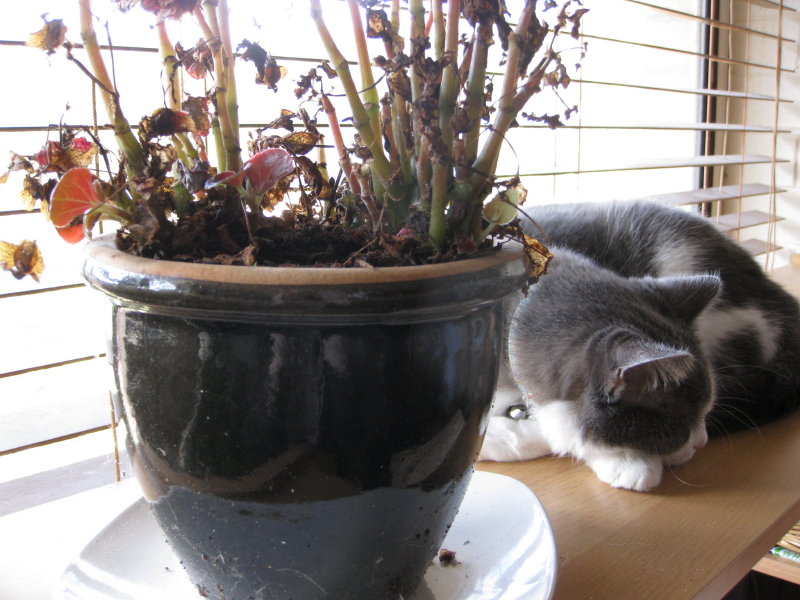
It’s ALIIIIIIIIVVVVVVEEEEE!!!!
I might not be good at caring for plants, but this is also not the first time I’ve watched a dead plant spontaneously revive after getting moved inside. Evidently it’s not me that kills things. . . it’s nature.
*walks off whistling innocently*
Today is day three of my writing binge, and I’m loving it. Ana decided to get in on the paperweight action (FYI, the gun on the left is a pepperbox, and the other is a Colt – the same type Ned Kelly used):
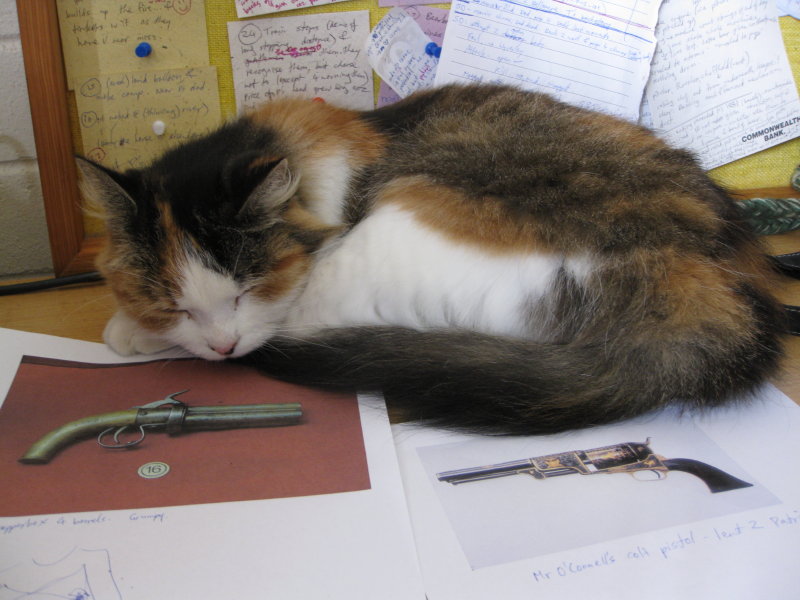
Writing Binge
Guess what I did yesterday?
I slept in, then did some writing.
I rode my exercise bike, then did some writing.
I went shopping, then did some writing.
I did a load of washing, then did some writing.
I cooked dinner, then did some writing.
I saw friends, then did some writing.
Due to the vagaries of my tutoring schedule, I have absolutely no work – not a single hour – for the next two weeks. So from my absolute lack of lemons, I’m making lemonade.
The Easter Weekend is pretty busy, but before and after that I’m doing almost nothing but write.
Today, for example, is just like yesterday except without the shopping and the friends coming over. Instead I’m vacuuming the house and getting the car blinker fixed.
Tomorrow is similar, except I may dust. Or not. And I may have a job interview (for reasons that I think are pretty clear). Or not.
On Thursday I’ll emerge blinking into the non-fictional world. Until then, I’ll be wearing my pajamas and having a ball.
And, as always, discussing the finer points of grammar with my paperweight, Indah:

Top Ten FREE Awesomenesses
It’s finally here! The ultimate awesomenesses for my poverty-striken peeps. I’ve marked with an asterisk those I think are worth clicking on (either for stylish writing or for pictures). And without further ado. . .
10. Feed ducks
8. Join the Library and Read Scott Westerfeld’s Leviathan trilogy*
7. Lord of the Rings Movie Marathon*

6. Sculpture Garden or The National Carillon or whatever’s free in your area*

5. Kidnap your date (or a friend)
4. Light a Fire
3. Steal Flowers*
2. Bubbles!*
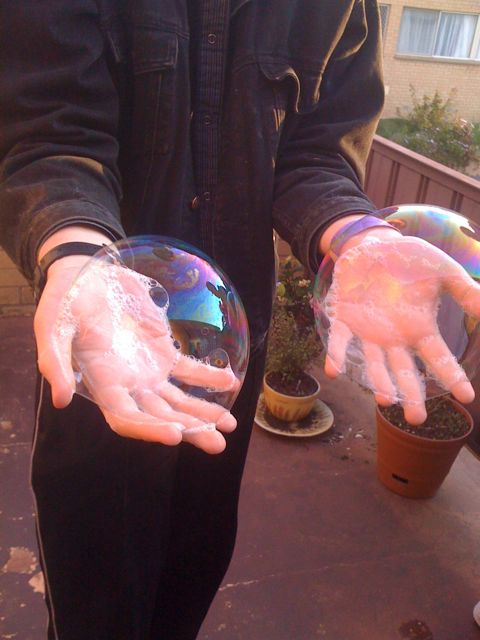
This is it. . . the youtube clip that’ll soon reach 13,000 views. I can only conclude that the internet was expecting something else.
I have a special treat for next Monday. You’ll never guess what it is, but here’s some random clues all the same:
1. It involves a visitor from China (who is not Chinese).
2. Americans should find it especially entertaining/horrifying/insulting, depending on their personality (but it’s not at all mean in any way).
3. It is, allegedly, educational.
4. It is very, very funny.
Mmm. . . cafe
The other day I discovered a new cafe – the Red Herring (near Canberra’s merry-go-round). It’s all couches, books, movie and TV posters, free foosball, ug-booted staff, and young ruffians either playing acoustic guitar or sleeping.
Yes. Literally people sleeping, and others playing acoustic guitar with their friends. And I was only there a few hours.
It’s not Melbourne-ish, but it’s pretty darn good.
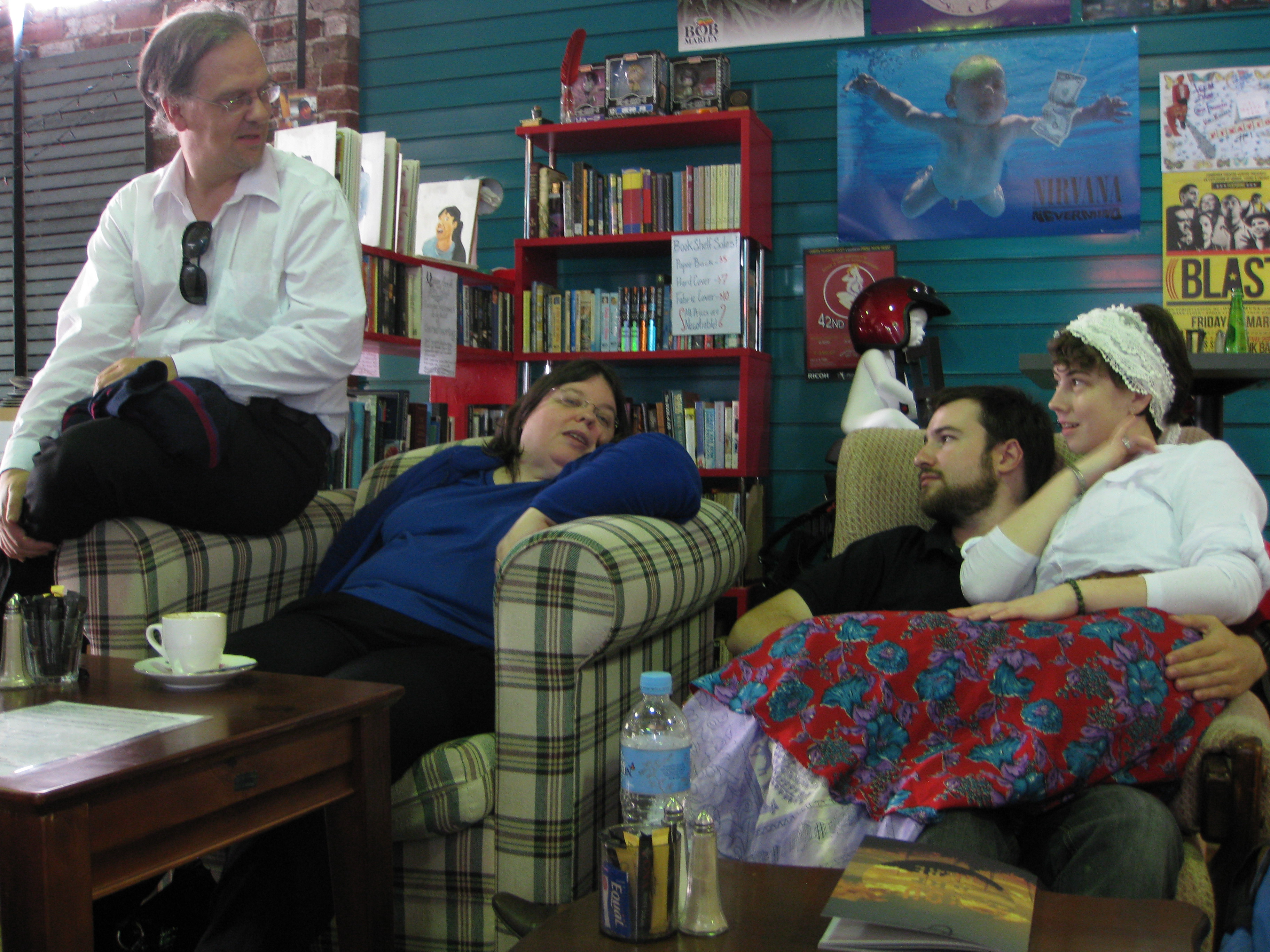
Unsurprisingly, it’s run by uni students. All the best cafes are run by uni students, artists, or both.


Celebrate your bad mood
I feel rubbish today. May as well make a party of it – like so:

And now, high on sugar, colourings, chocolate, and alcohol – I’m gonna go do some writing.
PS For those who are wondering, “Tema” is a brand of halva/halawa – a very sweet Middle Eastern substance that is popular around the world (in fact, in Spain it’s traditional Christmas fare). I buy pots of it at Cedars of Lebanon shops.

 Felicity Banks