Expectations
Our house is back to normal (well, it’s tidier than usual), and school is back on.
I didn’t do nearly as much around the house as I thought I would last weekend, and I didn’t write as much as I thought I would either. Today’s writing was ridiculously slow too, which is driving me bonkers.
Fundamentally, I need to calm way down, especially about the expectations I place on myself. This disabled thing really is a drag.
Oh well.
My medications have been switched up, too. I’m taking 50% more antidepressants (I’ve been pretty miserable ever since the diabetes diagnosis) and a third diabetes pill. So I shouldn’t be surprised that I’m not feeling great (I should feel better in a week or two). Plus Conflux was only a week ago, and if this is the post-conference low then it’s much milder than usual.
I just wish I could do stuff like I used to be able to do.
A couple of weeks ago I set up a small tropical fish tank. So here’s a cute pic of that, taken as the kids were examining the fish through binoculars and a magnifying glass.
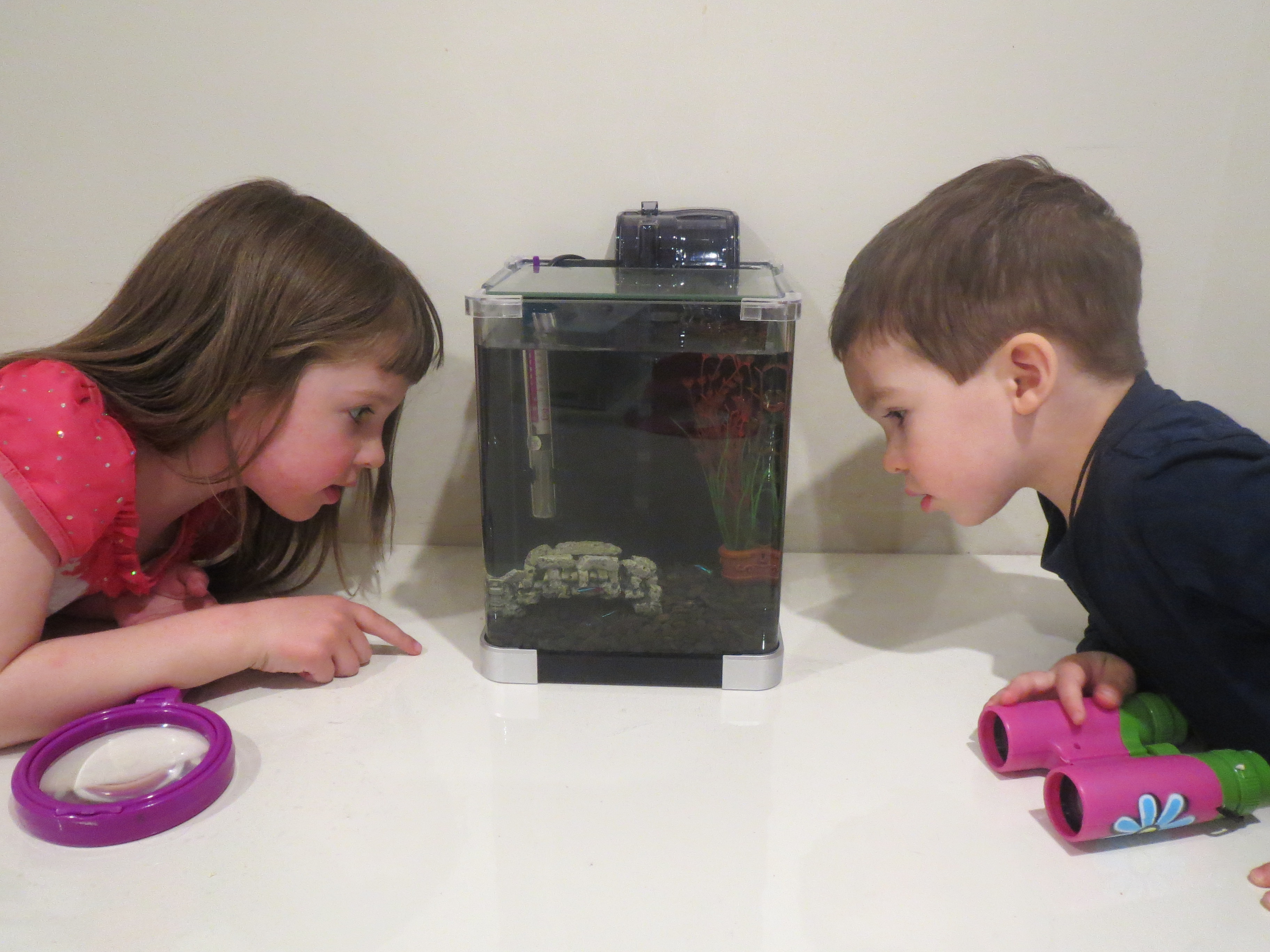
SCIENCE!!
Medical Money
It’s been an interesting year health-wise.
Long story short, I have diabetes now (which is terrible, but also means I’m already on meds that are helping my overall health, yay) and I just discovered that my fifth attempt at getting stomach surgery through the public system has been refused.
I will be getting the surgery privately, which will cost around $10,000 (surgeon + hospital + anaesthetist), and will most likely happen in June or July this year.
It is extremely exciting to finally know it’s really happening!
Some people on facebook offered to help with the cost, so I’ve set up a donation page here. I’m already very touched to see so many people helping out.
For those interested in knowing all the history of this journey…
My first pregnancy was very, very unpleasant. My hips and back were permanently damaged.
This is what I looked like before having kids (not my normal attire, but close enough :P):

Louisette weighed 4.15 kilos (9.15 pounds; an average baby is 3.2 kilos, about 7 pounds).
Something in my chest was screwed up, meaning that every time I lost a couple of kilos (trying to get back to the healthy weight I started with) I got very sick, usually with bronchitis that started off acute and then hung around for months and months. The great news on that front is that I’ve recently discovered that REFLUX is the likely cause (yes, another classic pregnancy symptom that just never quite went away) and all I need is a course of pills to not just end the current round of coughing but to help heal my stomach long-term. Yay for pills! Yay for modern medicine!
When I realised I was just getting sicker as time passed, I decided to get pregnant with our second child so that I could get it over with sooner—and then get things fixed that could only be fixed after I was done having kids.
 (Still worth it.)
During this period, someone congratulated me on my (non-existant) pregnancy about once a month. I also discovered that I was now intolerant of FODMAPs (ie, all sugars other than glucose—most fruit, most vegetables, dairy, and sweeteners), which made it tricky to eat healthily.
The second pregnancy gave me the gift of gestational diabetes (and firmly established that I am intensely intolerant of all artificial sweeteners, especially the “natural” ones like stevia), and intense, unrelenting pain. My hip would fall in and out of joint as I turned over in bed, and the back pain from spinal damage was so intense that it was a factor in my choice to have an epidural. (I still remember those pain-free hours with great affection. Yay for epidurals! Yay for modern medicine!)
While pregnant, I saw a nutritionist who was impressed with my sound knowledge of food groups and how to eat well. She told me to do my best within my food intolerances and physical mobility.
I exercised as often as I was able, but it was quite risky due to an irritable uterus, culminating in a hospital visit as TJ was almost born a month early. (For the record, this means my labour was four weeks long—but of course it didn’t hurt much during that early stage.)
TJ was induced (gestational diabetes babies usually are induced due to weight concerns) and weighed 4.325 kilos. He’s never shown any sign of damage from the gestational diabetes, thank goodness.
During the period after TJ was born, someone congratulated me on my (non-existant) pregnancy about twice a month. I went to a family event and a man I didn’t know gave me a pat on the belly and asked when I was due.
This photos were taken before and after TJ was born:
Did I mention I have a social anxiety disorder? And depression? And of course PPD (post-partum depression) because I was and am literally afraid of my kids, since looking after them so often causes back injury or panic attacks even now.
I lost the pregnancy weight (from the second pregnancy; I still had an extra 20 kilos from the first pregnancy) but then regained it as I dealt with daily migraines, chronic bronchitis, a new set of food allergies (salicylates, which neatly removed almost all my remaining “safe” fruits and vegetables, as well as all nuts and some meats), arthritic feet, prolapsed uterus, etc.
My stomach felt wrong. Different than before. Every medical professional I spoke to told me to wait, and it would get better. (Obviously, it didn’t. It’s normal for the stomach muscles to separate during pregnancy, and then mostly close up over the months after birth.) I was given “safe” physio exercises that underestimated the amount of permanent damage, and injured me even more (only temporarily, fortunately). I was told that plenty of women have babies and don’t complain about their changed bodies like I do. I was told that most mothers have a post-partum bulge, and I shouldn’t expect a bikini body (since when was I a bikini model??? lol…)
I saw a nutritionist, who put me on an elimination diet for 6 weeks. It became clear that salicylates were a problem for me… but it also nearly destroyed me cooking up to three different meals each night (I had three “safe” meals which I just ate every night, but of course that didn’t meet the needs of the rest of the family) as I catered for myself, kids, and Chris. My habit of regular exercise was broken, and I kept getting infections (throat, tonsils, chest, etc) that prevented me swimming.
Once I’d reached a truly horrifying weight, people finally stopped asking if I was pregnant. That was such a relief. I still find clothing really difficult, as even the biggest sizes aren’t designed for an enormous stomach bulge (most maternity clothes don’t fit me either, due to already being tall at 175cm).
I was not able to return to work at the childcare centre that I’d enjoyed so much post-Louisette and pre-TJ during the two months between months-long hip and back injuries. (Having Louisette actually cured my depression, but it comes back with physical pain/illness. There is still hope that if my body starts to behave, my mind will be non-crazy too.)
I had an operation that mitigated the effects of the prolapsed uterus, and I was able to work at a new job for about six months. Unfortunately standing/walking was getting more and more painful so ultimately I had to stop. Luckily my writing really took off at just the right time, so technically I was never out of work. Obviously writing isn’t the kind of job that keeps us in caviar and champagne (and besides, I’m intolerant of alcohol now)—the average full-time Australian writer earns around $12,000.
Go on, buy my book.

I began to realise that salicylate intolerance had a wider range of symptoms than FODMAP intolerance (including skin rashes, irritability, and joint pain) so I decided to try to do a salicylate elimination diet to see how much of my pain/depression could be cured by eating differently (and using special toothpaste and other products—salicylates are in a bunch of things) so I slowly drew up the courage to see another nutritionist.
She and I exchanged several emails before meeting, so she was warned about my cornucopia of physical and mental conditions, and knew that I wanted help going off salicylates. Unfortunately, she decided before we met that we should ignore salicylates entirely, since it was too difficult to deal with them and eat well at the same time. So that was a bust.
I’ll be seeing yet another nutritionist now I’m officially diabetic. Hopefully they don’t choose to ignore things that are inconvenient about me.
There is a lot of anecdotal evidence saying that fixing a separated stomach also fixes or improves a lot of food allergies. It would be awesome to be able to eat a balanced diet without it making me sick.
Another piece of good news: I am 90% migraine-free thanks to seeing a neurologist last year and working very hard to find the right medication. It’s entirely possible that with experimentation and medical assistance, I can actually reach a normal level of health for my age.
Once TJ was six months old, it was clear my stomach wasn’t going to get better, and my GP referred me to both Canberra Hospital and Calvary Hospital.
-Canberra Hospital lost the referral.
-I eventually got to see a surgeon at Calvary Hospital, who told me that my problem was probably too minor to fix and that it was out of his hands, but referred me to a CT scan place. The scan revealed that my stomach gap was 9cm wide. I returned to the same surgeon, who told me that it was too big for Calvary, and I needed to see a surgeon at Canberra Hospital. It was out of his hands. (We actually met in a room at Canberra Hospital, since this doctor works at both.)
-The scan also revealed a 2cm spleen abnormality, so when my GP wrote me a new referral for Canberra Hospital, she referred me to a general surgeon on the basis that maybe he’d want to operate on both things at the same time. When I finally saw the general surgeon, he told me the spleen thing was totally fine, showing me images to prove how it was centrally located and thus unlikely to burst and kill me (2-D images, despite the fact that the spleen is a 3-dimensional organ. I was never scanned from the side). By that time I’d had a second scan 6 months after the first, which showed no growth. So, not dying of aggressive spleen cancer. Yay. He told me he couldn’t sew my stomach back together (and acted as if the surgery was impossible, rather than referring me to a colleague who could do it), but could fix the umbilical hernia by adding surgical mesh over the gap in my stomach. I ultimately said no, since it would make the full stomach surgery more complicated and less likely.
-At this stage I contacted the health minister, and was told that my surgery would happen within three months. Wow! Unfortunately, that was still the hernia surgery, not the actually-fixing-the-primary-problem surgery.
-I looked up surgeons and found one who was both a private and a public surgeon (Dr Tony Tonks), and made an appointment with him. I figured a private surgeon would be honest about surgery, and then once he’d confirmed that the surgery was possible and useful, I’d let him know I needed to go through the public system. I did that. “I could tell which surgery you needed when you walked in,” he said. I told him I needed to go through the public system, and he told me that he was so frustrated by the lack of support for this kind of surgery that he no longer does it through the public system. He wrote referrals for me, to Canberra Hospital (to the right kind of surgeon this time), and to a hospital in Sydney where they had done that kind of surgery relatively recently.
-The Sydney hospital called and told me that they no longer do that kind of surgery through the public system.
-The Canberra Hospital apparently sent notice to my GP that they no longer do that kind of surgery. I waited nine months and then called the hospital to follow-up. After the phone rang for ten minutes, someone answered. That was when I found out that I’d been refused the surgery (sight unseen) way back in July last year.
-I gave up, and called Dr Tony Tonks’ office to begin the process of prepping for private surgery. I have an appointment for late May, and will have the surgery 3-6 weeks after that.
After all this time, I’m very excited to finally know that it’s really happening—and with a surgeon who treated me like a human being, which is a particular bonus.
So feel free to give me money to help me on that long road to recovery.
Several people have donated since I began writing this post.
THANK YOU.
Have a kitten.

Little Miss Helpful
For those who aren’t up to date on their classic picture books, “Little Miss Helpful” is about a person who’s always trying to help people and ultimately makes their lives much, much worse. One of her friends is sick and trying to rest, so she shows up to help. She wakes him up over and over again in the process of attempting to clean for him (destroying his kitchen in the process), and ultimately both are injured and I presume the friend gets pneumonia and dies. (I’m extrapolating from the fact that he ends up in a pond.)

(Pictured: An unrelated children’s picture book.)
So this week I’m struggling to accept the fact that an introverted kid who is not mine doesn’t get to sit next to her best friend (aka my kid) six hours a day (but is still able to play with her multiple times a day). Her mum is long since over it but I’m still in overprotective mode.
Today I have a brand new drama that also fits the “Felicity Banks clumsily attempts to help a person/people who would be much better off if she didn’t bother” narrative.
The oversimplified version—also the version that I’m emotionally responding to—is that I wanted to write a story with a protagonist who was disabled, in part because that’s one of the many groups suffering from Trump’s power… but it has become clear that I’m not smart enough to cause more good than harm.
Like most oversimplifications the above is not entirely true, but has an element of truth in it. It was mostly a structural issue that caused me to need to drop that particular aspect of my protagonist. Still. . .
It’s hard for privileged people to learn how privileged we are. It doesn’t matter how many advantages you’re born with, life is hard. Stuff happens. And when someone points out that an aspect of their life is harder than yours, it hurts. It feels like your own struggles are less legitimate. When you’re trying to remember whether “gay” is still a insult or not, and then you find out that intersex is a thing that you also need to understand and learn about, it feels like people are just taking offence no matter what you do.
Those feelings are knee-jerk reactions, and they’re not actually true. There’s a really thoughtful article about emotional exhaustion here.
So yes, privileged people also have struggles. But part of being a decent human being is to get past that knee-jerk “Arg too hard!!” reflex and realise that it’s vitally important to acknowledge other people’s struggles, and to use what power we have to help others.
I’ve been passionate about discrimination against people who are LGBTIQ since before I knew that one of those letters applied to me. I’m a Christian and have felt since my teens that Christians treat gay people and Muslims poorly—which is exactly the opposite of what Christian behaviour should be. But even thought I’m disabled myself, I’ve never fought for the rights of people who are disabled. (Partly, if I’m honest, because I’m still coming to terms with it in my own body and mind… after fifteen years.)
The term “Social Justice Warrior” is an insult, but since Trump was voted in as US president the world is badly in need of exactly that kind of warrior to mitigate the damage he is doing to pretty much every vulnerable minority group anyone can think of.
When my daughter found out about Trump, she gave up her allowance for months so she could donate it to kids and communities in the third world. I thought about what I could do and realised that financial help and/or things that involve me leaving the house (like protest marches) are rarely an option. But I still have a working brain (sometimes) and I have two powerful resources at my disposal: my imagination, and my readers. If I write interesting and diverse characters, it will help all of my readers to understand and empathise with people who are different to them. And it won’t feel like work.
I can’t earn a living wage; I can’t walk or stand or march without pain; I can’t vote in US elections; I can’t run to Nauru and singlehandedly gather up all the innocent children and bring them safely home with me; I can’t roam the streets making sure non-cisgender people aren’t getting beaten up; I can’t teach manners to Islamophobic trolls; I can’t stop Australian politicians from stoking racist fears in my own country—but I can write.
Here is a music clip (technically an ad for last year’s Paralympics):
I watch this all the time. It’s one of the greatest music video clips ever made. I actually have a real-life problem with Louisette being jealous of people with physical disabilities because of this clip (specifically, she wants to have either one leg—so she can do a kick-ass hopping high jump—or no arms so she can be an awesome drummer). I have to keep explaining to her that if she wants to have the amazing abilities of these musicians and sportspeople, then she has to train like they do.
Unlike most inspirational stuff (which is nauseating at best, and insultingly incorrect at worst) this actually works for me. I know that every single person in this clip has thought, “My life sucks! I can’t do anything! My body is holding me back from the life I want to have! This is so unfair!” at least once. I’m technically disabled physically, but my depression usually bothers me even more than the physical side, so getting told to look on the bright side or cheer up (by healthy, not-depressed people) often actually means, “Stop bothering me with your pain.” The clip above makes me feel good with the music, and means more to me than any other song because every person in it still has big parts of their life that suck. It hits the exact right place between pity and awe (both of which are foolish reactions able-bodied people often have to people who are disabled, ie “Oh, poor you!” or “Wow, you’re SO brave!”). Actually, people who are disabled do have unique challenges, but they’re also just… people. (There’s an interesting article about the social pressure to be the “perfect” disabled person here.)
The clip cleverly erodes the patronising pity I might feel towards people who are physically disabled in various ways. There really are certain elements of physical disability that are wicked cool. These are my two favourites:
- Prosthetics. The whole field of prosthetics is evolving so quickly that it’s incredibly exciting. Those curved “running legs” sportspeople use are actually faster than normal legs. There are other prosthetics that also do certain things better than nature. I’m with Adam Hills (who, incidentally, has one leg): Instead of calling people “disabled”, he says we should call them something that reflects how freaking cool their bodies are. Hills suggests “mutants”. Like, X-men style. Obviously that’s not going to happen, but there’s truth in the comedy. Now that I think about it, I actually had a one-legged romantic interest in “Scarlet Sails“, just because piracy does rather lend itself to non-standard body shapes. She even has a slightly-awkward sex scene due to my remembering Adam Hills talking about how he always needs to remove his prosthetic leg before sex. And in “After the Flag Fell” the main character almost certainly loses an arm—not just because steampunk lends itself to cool prosthetics, but because he’s an actual historical figure who lost an arm due to a battle wound.
- As a failed linguist (literally; I failed my second semester at uni) and a retired cross-cultural missionary (also literally; for ten years I worked towards a career in Indonesia teaching English etc to kids in the slums), I’m fascinated by the deaf community. Sign language is such an interesting set of languages, and the community itself is just that: a community. A lot of deaf people who could have their hearing restored through technology choose not to, because their deafness is as much a part of their culture as breasts are to a woman (As a breast owner, let me explain: So what if I’m not breastfeeding and never will? So what if my breasts require expensive specialised clothing and constantly get in the way? They’re mine and I’d be VERY upset if they were removed).

(Picture: Would YOU waste time looking at her wooden leg?)
So as I was working on the outline of an interactive story, I had an idea. I could have the reader choose a disability for the protagonist from three options:
- Someone with a double above-the-knee amputation. This is a significant disability in the real world, but in my world the character lives in an enormous floating city (influenced by, among other things, the Bajau people, a refugee people group who live almost entirely on water and have extraordinary abilities as a result) so I wanted to write that they had the usual prosthetics (cosmetic, running, practical, “shorties”, etc) as well as a prosthetic tail that makes them look like a real-life mermaid—including a superior swimming ability. I’m already jealous of this character’s ability in my mind, despite the fact that they’d also have significant disadvantages.
- Someone who is mute. Originally I wanted to write a character who was both deaf and mute, but a writerly friend pointed out that not being able to describe sounds would cut back on sensory immersion (a vitally important aspect of writing; my writing isn’t good enough to make up for it) so I toned it back. The protagonist’s city is made of transparent spheres, and getting from one to another is slightly awkward. I’d already designed it as a place where everyone uses sign language every day to chat through the glass during that awkward transition from one sphere to another. As I was thinking about the real-world deaf community, I developed my setting into a place with a large minority of deaf-mute individuals (not such a surprising thing, given a recessive gene for a condition causing people to be deaf-mute, combined with a relatively small population). That way I could develop a whole bunch of different and complementary sign languages (slang, trading, one-handed, something specifically for talking underwater, something specifically for the protagonist to talk privately with their best friend, etc). It would be such an interesting and fun world! Languages are fun! I’m also borderline bilingual (Indonesian) and have lived in Indonesia with Indonesians for six months, and observed firsthand the way language changes the way I thought about things.
- A phobia of deep water. This is actually one of my own (extremely numerous) phobias (making research a breeze), and of course would be very difficult when the protagonist lives in a floating city. Unlike depression, it’s specific enough (and has so little effect on my actual life) that I could write about it without getting depressed myself (I’ve written a story about the real-life experience of depression, but it’s…well, depressing). Although I wouldn’t recommend an anxiety disorder to anyone (duh), it DOES have the positive side effect that I deal with fear every day, so when something really scary happens (like having a baby, or having Chris in hospital with a rare disease that is both incurable and potentially paralysing or deadly… yes, that happened; he got better) I actually handle it quite well. It also means that the character would adjust more easily to the time they spend on land (the Bajau people get badly landsick, and so will my non-player characters—but less so if they choose option #3).
So now that everyone is dying to read my nonexistent book, here’s why it probably isn’t happening:
Good intentions are not the same thing as good results. Obviously, my aim is to write a positive, enjoyable, interesting story that also gives people with certain disabilities a chance to play a character who actually shares that aspect of their life. And a story that helps people who don’t have any of those conditions to feel that classic “oh they’re just like us” moment that we all need to have about… well, everyone who is not our physical & psychological clone.
However.
One of the places I started my research was in the “Choice of Games” forums. “Choice of Games” is a hugely influential American interactive fiction company. (I am not associated or affiliated with them in any way; but I’m a huge fan and a Hosted Games author several times over.) They work hard to be inclusive, and it shows. The forums are a friendly, welcoming, helpful, and diverse place. I have accidentally stepped on people’s feelings there in the past (again, helping where help was not wanted) and people took me aside privately, and politely taught me how to be a better person. I was also forgiven by the people that I hurt.
I have genuine friends there that have made my life better, plus a really cool arch-enemy (you can read about him in the special features of Starship Adventures), and even someone I’ve since met in real life. Some of them are very different to me in various ways, and some are very similar (poor things). But I knew that I needed to research deafness, muteness, and the lives and feelings of amputees in order to write about them in a way that did more good than harm. I also knew that my research needed an extra layer: I needed to find at least one beta reader from the groups I was trying to represent. They would pick up on dumb mistakes I made. The forum was the perfect place to start looking for those beta readers.
(Pictured: Not a suitable beta reader.)
So I started a new topic, called something like, “Looking for beta readers who are deaf-mute or double-amputees”. I winced as I wrote “deaf-mute” and “double-amputee” but even someone with one leg has a very different life to a person with both legs amputated, so I needed to be specific.
Within 24 hours people had already replied telling me they’d thought (based on the title) that I was deliberately trolling the forums, and an admin had changed the title (with my belated blessing) to be less offensive.
So as quickly as that, I screwed up. Alarm bells began ringing, and they continued ringing as various people talked to me via the thread, communicating (gently) how very uncomfortable they were that someone so ham-fisted would be writing such a story.
I immediately googled the terms I’d used, looking for less offensive words to mean “deaf” “mute” and “amputee”, while also asking the people in the thread. I found that the correct words are (wait for it) “deaf”, “mute”, and “amputee”. I also found that it’s preferred that people put the “person” first, ie I should say “A person who is deaf” rather than “a deaf person”. But clearly the title I used for the forum topic was still deeply offensive.
So I’m already at a loss. How can I write about this set of disabilities when it’s apparently not okay to say the words aloud? Someone (rather brilliantly) suggested that hey, it’s a fictional world, why not make up words? The only problem is that I then have to explain that “sffhuiwe” (or whatever…) means “deaf”. So we’re back to square one.
I have since worked out that (a) The thing that’s offensive is that my attempt at brevity made it seem like the disability was the most interesting part of the character, which it definitely isn’t, and (b) It’s easy enough to describe the actions of the characters without using any of the words that may be offensive to some people.
Now is a good time to mention that Australians have much more casual manners than Americans. It’s actually something I love about Australia. I find it more honest and open and straightforward… but I’ve run into trouble at least once before because people thought I was being rude when I thought I was being friendly. So that complicates matters, especially since the vast majority of my readers are from the US.
In the meantime, someone I deeply respect (especially in the field of interactive fiction) pointed out that if I had the reader choose one of those three options, it was structurally saying that all three options (I called them “quirks”) were comparable. Which is just not true (even though it’s true within the story).
So that’s almost certainly the nail in the coffin for my “pick a quirk” idea. Which is sad, but a far better fate than having me write 200,000 words that made the world worse.
So that’s what I’m crying about today. I really wanted to represent disabled people in fiction, but my own limitations (and privileges) make it a terrible idea.
Having written all the above, I’m no longer sure that giving up is the right option (even though it almost certainly is) so I’ll think some more, and talk to some more people, and make my final decision after that. But before I make too much of a nuisance of myself.
Well, probably.
As always, the questions that matters most to me is, “Will this cause harm?” but the second most important question is, “Will it make the story better?” It’s clear to me that these aspects of a fully realised and interesting character absolutely DO make the story better. That’s not an easy thing to give up.
Reality
Lately, when I see someone walking, I get panicky.
Each step is so small, and it seems like they probably have a long way to walk. Maybe they’re shopping, maybe they’re walking along the side of the road. Either way, what they’re doing seems to me like an impossible task. The weight of that impossible task feels like an ocean on my back. I have so much to do, and so little strength to do any of it.
I don’t walk much. For various health reasons, a ten-minute walk can leave me crippled for a fortnight. It’s been like this for years now, and I can’t remember what it was like to be healthy.
No, I do.
I remember a family holiday, when I was a teenager. We stayed somewhere with a pool, and I jumped into the delicious clear water almost the second we arrived. I might have still been fully dressed, except for kicking off my shoes. I remember thinking how I was young, and healthy, and how easy it was to move through the water.
I also remember a window of maybe two months, when I was an adult and healthy. Louisette was about six months old, and my back had just stopped hurting from that first pregnancy. I was in love with her, high on hormones, and my body felt strong. For the first time in over ten years, I wasn’t mentally ill. I remember feeling so powerful when I picked her up out of her car seat, and how good that felt. I remember not being afraid of what the day would bring.
That window of good health ended when my hip fell out of joint one day, and it hurt hurt hurt for months. (After that I had bronchitis, and then I hurt my back, and then I realised I wasn’t getting better and I talked Chris into letting me jump into a second pregnancy so I could get the whole pregnancy thing over with.)
I remember changing a pooey nappy in the back of the car as I took myself to a free post-natal physio and rain and hail fell on my back while Louisette screamed at me. I remember applying for a babysitting job and trying desperately to mask the agony as the mother proudly invited me up the stairs to see the rest of their million-dollar house. (I succeeded, too: I got the job and I enjoyed it. Of course my ability to babysit is over now. Just this year I tried to look after my beloved nieces for a few hours while my sister was at my grandfather’s funeral, and I ended the day screaming at strangers and throwing things.)
Today’s a bad day brain-wise. I’m wading through mud and I hate everyone I see.
The up side is that when a day is so moustachio-twirlingly bad, it’s obvious that my brain is messing with me. I can’t delegate everything, but I can delegate some stuff, and I already have. It’s so operatically bad that, for the moment, the fact that I brushed both my hair and teeth today counts as a win.
The down side is that the ocean is still there pressing down on me. It’ll be there tomorrow, and the next day, and if I don’t manage to trick my brain into letting me be semi-functional ASAP there is plenty more for me to lose than just one miserable day.
Merry f*cking Christmas, everyone.

Parental Fears and Failings and Fab bits
I like to think about what I’m doing as a parent, and of course talk about it, because that helps me to understand what matters to me and what I can just let slide. Some things I know I’m doing really well – Louisette’s diet is amazingly healthy a lot of the time (I can literally eat a chocolate bar in front of her and she won’t for a second think she’ll get a taste or treat for herself – when she wants comfort food, she asks for milk. Obviously I need to change my role-modelling, but right now I’m also eating a balanced diet and losing weight, which is impressive enough), and she usually plays very well with others. Her physical skills and vocabulary are excellent too. She is very brave and very friendly (I often see her initiating games with other kids at Questacon), imaginative and gentle and clever (some of which is clearly innate). She’s somehow not managed to pick up on my swearing yet. She can last up to about twenty minutes playing alone in her room on command once a day (rest time) despite being a strong extrovert. TJ is too young to have bad habits, but he’s clearly happy and healthy. On the other hand….
The dummy thing (times two).
Both kids are total dummy addicts. Louisette used to have good boundaries – dummies were for sleep, illness, car rides, or sitting on the toilet – but since TJ was born she’s become obsessive and when we don’t have visitors over she pretty much always has a dummy in her mouth. We fought it for a bit, but that caused her to say she was sad or scared in order to get the dummy, so ultimately we decided it was better to let her have a dummy than to let her self-identify as chronically depressed at the age of two! The brilliant thing about dummies is that, unlike thumbs, they can be taken away. Having a few days or even weeks of misery is vastly outweighed by having something largely harmless than she can use to regulate her emotions. She also has nightmares now, and has been picking at her fingernails, both of which are more concerning. All three activities have improved since TJ began settling in his cot for at least a few hours most days (meaning he’s not the centre of all household activities 24-7), and I hope with a bit more care and time Louisette won’t be anxious any more.
As a baby, TJ’s dummies cause only minor parental judgement. We had strict dummy rules for Louisette from when she was a baby – but TJ can have his whenever. As a result, we’ve had WAY less crying from TJ. So I’m comfy with the judgement there. (Not comfy enough not to write blogs about it, but that’s me. . .)
Babysitting
I’m so weirded out to need babysitting – yet I need it so badly that I now have a regular schedule with at least some babysitting every single day. It feels so pathetic to spend so much money on something that, apart from anything else, is my own actual paid job. Until I got sick with pregnancy, I never once paid for babysitting for Louisette. When she was born, I really was that ecstatic glowy enjoying-every-minute (not literally; no-one enjoys EVERY bit of motherhood) new mum. . . but since TJ was about six weeks old I’ve had an awful time mental-health-wise. Dieting (including swimming, which uses up all the free babysitting from grandparents), physical pain, and concern for Louisette certainly don’t help (my Monday bit of babysitting will usually be just TJ, so I can spend some uninterrupted quality time with Louisette). I’m getting reconciled to the babysitting idea by recognising that it’s totally the kids’ fault: the combination of an extravert developing anxiety (something she inherits from both sides of the family, unfortunately, and something I will save her from if I can) and a baby who doesn’t sleep well means that having only one parent on hand for 10 or 11 hours a day just doesn’t work.
And the drool
Somewhat related to the dummy addiction mentioned above, Louisette drools like CRAZY. Without a dummy it’s not too bad – with a dummy, it’s really bad. I’m hoping that the only dramas in our house for the next year or so will be toilet training for Louisette and starting day care for TJ. . . which should mean that we can handle eliminating all dummies at once shortly after TJ’s first birthday. If only all problems could be ceremoniously thrown in the bin. I’m hoping the drool will clear up soon after that.
Food messiness
Food mess bothers me so much that I don’t dare try and regulate it (except for extreme events, like deliberately pouring out water or throwing food), because then I’d have to lift my expectations – which wouldn’t be met, which would make me angry. Louisette also has an amazing range of food-related activities (painting action scenes in yogurt; building a village from her vegetables; wearing carrot rings on her finger, etc) which are probably educationally amazing. Plus she’s usually exhausted and emotional by dinner time (we don’t eat until Dad gets home at 6:30) and dinner time is often really difficult without adding manners to the mix. This is another area where I hope to lump the kids together so we don’t have to go through a difficult transition twice. Once TJ’s old enough, we’ll start upping our table-manner standards.
And the TV
CJ and his dad both have ADD, and CJ and I watch TV to relax (we relax a lot, when we can) so based on a science study or two we aimed to reduce the kids’ risk of ADD (and partially break our own antisocial habits) by trying not to let the kids watch TV until at least 2 years of age. With Louisette we were amazing – with a few exceptions (holidays/while I was babysitting other kids) she genuinely didn’t watch TV until she was 18 months old. . . at which point she began watching about three hours a day (90% Playschool, because Mummy ain’t watching anything too annoying) because she and I were both very sick. Then I was pregnant, and stayed extremely sick for nine months. Then TJ arrived, and he still doesn’t settle well, so Playschool keeps Louisette away from him when he’s getting settled to sleep, AND distracts her from the lack of parental attention.
As a result, TJ (who as a boy induced at 38 weeks from a gestational diabetes pregnancy is WAY more at risk of ADD than Louisette ever was) gets loads of TV every day.
Sadly, until I’m healthier and/or TJ sleeps better and/or the kids play together better and/or until Louisette is less anxious. . . the TV is happening. It’s already clear that TJ loves TV -it’s a great way to keep him calm when he’s tired but not yet actually ready for sleep.
Sadly I don’t have a hope of giving up on TV anytime soon, and I’m not even making tentative plans for how to limit it in future (although that will definitely happen before the kids leave home). The best I can do is treat each day as a new day – if there’s little or no TV, great! – and be self-aware enough to realise that sometimes initiating a “good” activity with the kids will just push me too far and end up backfiring. Better a whole lot of TV than a screaming Mum.
And the toilet training *sigh*
Although technically we are still well inside average ability for her age, we spent over two months last Summer working SO hard with Louisette – who mastered the basics before we even officially began (she would often correctly announce both poos and wees in a timely manner, and do everything herself). Ultimately I was too sick from the pregnancy – she was already regressing in some minor ways – and she had several bouts of gastro in a row that didn’t help. After the first two weeks she was doing extremely well. . . and then something clicked and it all fell apart.
We could have done things differently – used pull-ups instead of undies so the process was more gentle; used a potty in the living room so she didn’t feel like going to the toilet meant missing out on the action – but I didn’t want to go through two distinct stages. We’ll see how things go this Summer. CJ already has leave prepped (again), and we’ve talked a lot about it with Louisette, who is largely positive. She’s started putting off bedtime by going to do a wee on the toilet, which is frustrating (she’s taking an hour to settle at night currently, which sometimes means CJ and I only get half an hour “off” in the evening before I go to bed) but is brilliant for both practising her toileting skills and rebuilding positive associations with the experience. When we have a good chunk of time at home, I’ll sometimes let Louisette wear undies for an hour or so (generally with a wee first, and then a wee at the end – she and I both wee insanely often).
Packing away toys
I don’t have the physical strength to consistently get down and pack up with her (a necessary thing at least some of the time – if only so it LOOKS like she tidied up), so it’s not happening. I might institute a tiny bit of regular packing up at some point – five toys away before Playschool for example – but not yet. This might be another thing I do with both kids at once – for example, at some point each day (maybe before lunch – bedtime seems like a good idea, but it really isn’t!) have Louisette pick up 5 toys and TJ pick up 1. Again, not until TJ has some more capability.
Obedience
I feel fairly okay about this – though wistful for an easier future. Louisette rarely has major tantrums (and when she does, she doesn’t expect to actually get her way – she’s just not able to regulate her own emotions). She’s cheeky and troublesome in a lot of areas, and is sometimes just ridiculous about everything (“Do you want an icecream?” “No!” *screams of rage*) but she’s usually considerate of others, patient for her age, and reasonably good at sharing. And I think at two years of age you want exactly two things: 1. Not causing too much danger (eg falling) to themselves. 2. Not causing too much danger (eg hitting/snatching) to others. As her primary carer, I’ve been sick or largely unavailable for the last year and a half – half her life – and she deserves a bit of slack, especially at her age. Overall I think she’s doing fine – but I keep a sharp eye on her when she’s interacting with other kids, especially those who are younger, smaller, or who have a personality that’s likely to cause friction.
So that’s all the stuff that I’d improve if I was a slightly different person.
Here’s proof that Louisette can still come up with new facial expressions, even after all this time:

I’m scared of the most physically hazardous part of TJ’s life – from about 6 to 18 months if he’s like his sister. Crawling off things, falling off things, having the mental skills to zero in on anything forbidden with remarkable persistence, eating EVERYTHING (Louisette ate, among other things, gravel. Repeatedly), breaking everything, snatching everything, spilling everything. In the terrible twos you get tantrums and emotional problems. . . but I guess I’m better at emotional than physical stuff (which is a big part of why I’m not truly a baby person, much as I look like it at the moment). And I’m scared of the beginning of food – the messiness and complexity in that transition stage (which hasn’t truly ended with Lousiette – she eats 95% of what we eat, with 90% independence and usually causes a wipe-down mess rather than wipe-down and mop-up mess every darn time).
We’ll start feeding TJ solids (not that they’ll be particularly solid for a good long while) next weekend. Expect some messy photos in this space soon. . .
I’m dreading the constant mopping but looking forward to (hopefully) being able to have him in a high chair rather than a lap at meals. Fingers crossed it goes well.
Milk and Mental illness: ten days as a mum
I am very, very good at being rational. The odd thing is that it’s a skill I’ve learned because of mental illness. I always work hard to sort my feelings into rational and irrational. For example, I felt afraid I’d never give birth and would be pregnant forever – which honestly had me on the edge of a panic attack at times. But I could tell it was irrational, and that kept it under control. (Usually, rationality isn’t as black and white as that.) I habitually sort my positive feelings into rational and irrational too – for example, I feel that Louisette is the best and prettiest and most charming baby I’ve ever seen and I’m bewildered that anyone could be in the room with her and not spend all that time watching her face. But I can tell rationally that, like all newborns, she looks mostly like a potato – and that the person she most resembles is E.T. I can also rationally say that she is way above average attractiveness for her age. The fact that I know I’m right makes that last statement all the sweeter.
Observe, and judge for yourselves:

I mentioned in that epic labour entry last Wednesday that giving birth wasn’t the hardest thing I’ve ever done. The real hardest thing I’ve ever done is to endure seven years of mental illness (which, may I say, I’ve done spectacularly well, keeping almost all of my friends and never causing harm to myself or others – plus I somehow managed to snare CJ in there, which is definitely my most impressive life achievement thus far). My anxiety disorder has made me unable to support myself financially (which unfortunately has always been my concept of adulthood, and far less than I planned to do with my life – I was going to devote myself to the poor in Indonesia, and had consciously prepared and trained to do so for twelve years). But I was right: it gave me certain skills.
All of which is to explain the full context (ie my mind and body) of the following journey:
From late Tuesday (day two) breastfeeding was very painful, and something I dreaded. With each suck I felt unpleasant faintness in my whole body, as if someone was hitting my funny bone over and over. By Wednesday it made me feel like I was about to faint and made my whole body shake – an echo of the way it shook with the pain of childbirth.
When the midwife visited on Wednesday (day 3), we discovered that Louisette was dehydrated due to my lack of milk. Apparently it’s extremely rare for a woman to produce so little milk that her newborn is in danger. Not only did this mean we had to give her formula (which I was well aware would make the problem worse), but it felt awful. One of my peculiar foibles is that I tend to think in symbols and archetypes – so much so that I’m unable to give blood, because blood is too powerful as a literary symbol of life itself (ZOMG, the vampires are TAKING MY BLOOD!) So finding out MY BOOBS DON’T WORK AND MY BABY WILL DIE WITHOUT MEDICAL INTERVENTION was devastating. So the faintworthy pain of breastfeeding was accompanied by devastating depression.
I’d heard a great deal about the hormone crash and painful arrival of milk on day 3/4 after birth, and had carefully and repeatedly announced that I’d see absolutely no-one on those days. Thank goodness for that.
I’d been feeding Louisette on demand, and on the midwife’s advice immediately switched to feeding her (or at least trying – she is one extremely sleepy baby) every three hours – twenty minutes of breastfeeding (so my breasts were still getting the signal to produce milk, and would hopefully tune in at some point) followed by a bottle. From that instant, Louisette’s health improved – and I began to live in three-hourly bursts. I’d slept fairly well (between feeds and crying) on the first night, but had been so excited and happy since then that even when I lay down to sleep I tended to have trouble dropping off. I was vaguely aware that this was a bad thing.
On Thursday we went in to hospital for a variety of health checks. I was perfectly upbeat in the morning (still so excited between bouts of sobbing that I couldn’t get myself to sleep properly when I had the chance), and took the trouble to dress Louisette in an especially gorgeous manner (the red dress and booties). The midwives in the birthing centre nearly came to blows over who could claim her as “their” baby.
I saw a lactation consultant who said various useful-type things. Towards the end, I mentioned I’d been trying to stimulate more milk production with a breast pump and with my hand, and neither had produced a drop. I showed her the pump, and she explained it was the wrong type for early breastfeeding. When I showed her my clumsy attempt at hand expressing, I saw a look of, “Oh, how VERY stupid” flash across her face before she caught it – and explained how to do it properly. (The birthing class demo – with an attractively knitted prop breast – apparently didn’t work for me at all.) Within moments, I saw a couple of drops of milk – my milk, real milk – for the first time. This was enormously encouraging, and I went home delighted.
My midwife is aware of how much my bad pregnancy has cost in financial terms, and whenever there is something we need she does her best to get us a free one. She gave us nipple shields to reduce the pain of breastfeeding, and lent us the hospital’s clanky but effective double electric breast pump (double = takes half the time, and electric means it will help stimulate more milk production rather than simply taking what’s already there).
Artist’s impression of the breast pump:

It was a very long hospital visit because there were a variety of people we needed to see. The lactation consultant had told me to use the pump for 10-20 minutes each hour in addition to everything else. She’d emphasised it was vital for me to think loving baby thoughts when I used it, or my milk wouldn’t flow.
As soon as I’d attempted to feed Louisette I attempted the pump for the first time. It was very awkward to hold it in place and all I got for my twenty minutes’ of muscle pain (muscles still aching from giving birth) was a couple of drops of milk. Cue more desperate, helpless crying. So much for loving baby thoughts. The long hospital visit had brought back my labour-exhaustion shakiness, even when I lay down in bed to sleep. Louisette had also suddenly developed a very gross eye infection – yuck.
Thursday was similar. Plenty of sobbing and almost no sleep. Finally around midnight, after another pathetic feed (as Louisette grew noticeably less interested in my breasts – a very bad sign for the future) I lay down to sleep. Addled by sleeplessness, hormones, and depression, I had an episode that reminded me strongly of a schizophrenic woman’s description of a psychotic attack (in an Andrew Denton doco). I fell into a kind of dream of mother and baby, but I wasn’t asleep. In my dreams I’m often a different person (every so often I’m Buffy, for example – or a man) but I always have a sense of self.
I had no idea who I was. I was fairly sure I was a one-week old baby, helpless and confused by the world. I knew something was wrong, but I didn’t know where or who I was. All I knew was that something was wrong and I couldn’t fix it myself. Rather intelligently, I said, “Help, help” until CJ woke up. Even more intelligently, I explained what had happened as well as I could (and later reported it faithfully to the midwife, despite how stupid it all sounded in daylight). Even more more intelligently, I decided to skip the 4am feed and let CJ just give Louisette a bottle.
That night, my body remembered how to sleep again. I was still very depressed the next day, but the worst was over. I’ve had a couple of times when I woke up and didn’t know where I was for just a second (as if I was on holiday), but I’ve been more careful about my sleep (within the realm of the possible – last night I had four hours in a row, which is very rare; a mix of luck and planning) and all the depression is gone.
From Saturday, I began to see genuine improvement in my milk flow, thanks to that breast pump (it’s nice to have measurable progress, and we’re getting along fine now). Since then, Louisette has been taking a little less of the formula. This means she’s getting more milk.
She also has a blister on her lip from her inability to attach properly, but that should go away soon (her eye infection is long gone). Yesterday she had her tongue tie cut (an operation about as complex as cutting one’s fingernails), and she seems to be much more patient with my breasts (now she’s getting a better flow), although the different shape of her mouth is confusing her a little.
Things are good mentally. I believe I’m being rational when I say that the last week – including labour, and including the lack of sleep and my first ever true break with reality – has singlehandedly made up for the last seven years of seemingly meaningless pain. I also think it’ll help me feel better about my novel writing attempts (there’s an epic tale there, but it’s long, boring, and depressing) for at least the next two years (by which time hopefully I’ll have a major publisher signed for at least one of my books).
I’m also cautiously hopeful about how my mental illness will react to my being a mum. It was noticeably dampened during pregnancy (weird but true: I was less anxious while pregnant than I am usually), and I began to wonder how nine months of intense chemical goings-on would affect what is, after all, a chemical imbalance in my brain. Perhaps pregnancy would hit a kind of “reset” code. Many women become mentally ill because of chemical goings-on and major lifestyle change. I may just head in the opposite direction.
Maybe. We’ll see. Either way, I have plenty of rational reasons to be happy. I have a beautiful, extremely pleasant little girl, and my life has a sense of purpose I lost seven years ago, and have badly missed ever since.

 Felicity Banks