YA steampunk: The Sky Village
“The Sky Village” by Monk & Nigel Ashland
It hurts my brain trying to figure out if I love or hate this book. The front cover and the title location – a village of hot air balloons strung together – appear steampunk, but it’s not steampunk. It’s post-apocalyptic YA.
The rest of this review is at Comfy Chair, where I get paid for it.
Australian steampunk novel
“Ichabod Hart and the Lighthouse Mystery” by James Roy
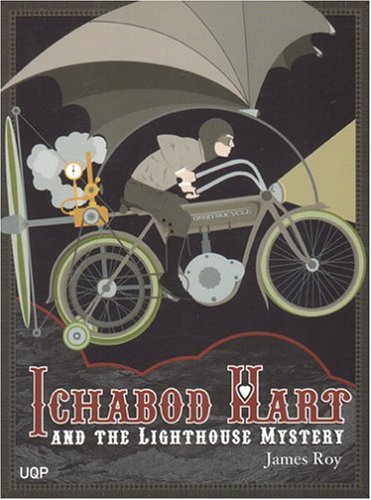
This book was written as children’s Australian steampunk, and it ticks a lot of boxes.
The rest of this review has been moved to Comfy Chair, where I get paid for it.
“Making Money” by Terry Pratchett
I married a man with a LARGE pile of books, and I’ve been happily reading through all his speculative fiction for the last two years. Terry Pratchett has written a LOT of books.
This book is about Moist von Lipwig (yes really), who is a probably-reformed conman whose fast-talking has saved the defunct post office. But now that the post office is saved, he is dying inside for lack of life-threatening terror. Luckily, the proudly tyrannical Lord Vetinari (who believes in keeping his citizens alive, since a live customer is worth more than a dead customer), steps in to give him another impossible task and a whole new crop of deadly enemies. The other main character is Adora Belle Dearheart, an understandably angry woman who devotes herself to the rights of the city’s many golems.
This is a Discworld novel, which means it is set in a disc-shaped world that rests on the backs of four elephants standing on the shell of a giant turtle swimming through space. Most of the action takes place in Ankh-Morpork, which is a little like London but greedier and dirtier. It’s also more bureaucratic, with more hazardous sausages and more screams in the night.
Pratchett’s world is certainly fantasy, with a variety of mystical species and wizards. It is also humour; a mix of groanworthy puns and biting satire (in this case, the thrust of the satire is about the banking system – which, when you think about it, is one giant con).
I’ve discovered in my reading that I don’t actually like humour as a genre – I want to take my heroes seriously. I especially dislike any humour based on puns or other self-aware language jokes (because they pull me out of the story), and I hate overdone accents with a fiery passion. There are a LOT of overdone accents in Pratchett books.
However, he is the master of his world, and none of his imitators are as good. If you like him, you’ll probably like Jasper Fforde, Douglas Adams, and “Splashdown Silver” by Tansy Rainer Roberts.
Rating: I think G for everything Pratchett. Naughty things are implied sometimes, but very carefully not said. Some people die but it’s generally comical, and never truly frightening.
“[Moist] was not naturally at ease in the presence of skulls. Humans have been genetically programmed not to be ever since monkey times, because a) whatever turned that skull into a skull might still be around and you should head for a tree now, and b) skulls look like they’re having a laugh at one’s expense.”
“Heroes of the Valley” by Jonathan Stroud
This book is about Halli, a midwinter’s child who grows up on the epic tales of his ancestors. He is sick of the peaceful political haggling of his village, and longs to be a hero. He runs into Aud, a daughter of another House, who is even more trouble than he is. When a man is killed, Halli seeks vengeance – but heroism isn’t what it’s cracked up to be. When people start telling stories about him, he realises stories have a life of their own. (This paragraph focuses on the theme, which I find fascinating – but probably doesn’t do justice to the book’s many other qualities.)
This book has great characters, great scary action, and it’s very very funny. But the most extraordinary thing is Stroud’s voice. It is clear on every single page that no-one else could have written this book. The unique flavour is fantastic, and I want more.
Like “Larklight” by Philip Reeve, this is a book where I could literally open at any page and give you a brilliant quote. But Katla is one of my favourite characters ever, so I had to include her:
When he was older, Halli’s nurse, Katla, drew his attentions to the date of his arrival in the world. She clucked and whistled through her nose at the sinister implications. “It is a dangerous day, midwinter,” she said as she tucked him tightly into his cot. “Brats born then have an affinity with dark and secret things, with witchcraft and the promptings of the moon. You must be careful not to listen to this side of your nature, else it will lead without fail to your death and the destruction of your loved ones. Aside from that, dear Halli, there is nothing to worry about. Sleep well.”
“Soulless” by Gail Carriger: hilarious steampunk
I promised to review a book that I really liked, and this is it.
It stands alone, but is the first of many Alexia books by the delectable Gail Carriger.
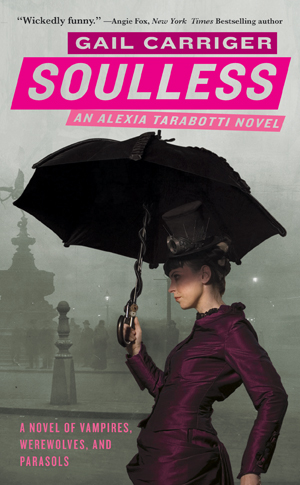
This review has been moved to Comfy Chair, where I get paid for it.
A steampunk series (that’s actually dieselpunk fantasy)
For CJ’s birthday, I bought him “The Laws of Magic: Hour of Need” by Michael Pryor. I was pleasantly surprised to discover it’s the last book in the series (most writers who get past three books can’t seem to stop).

The series is about Aubrey FitzWilliam, son of the PM in an alternate reality where an evil sorceror aims to start World War 1. Aubrey is very magically gifted, brave, and loyal to his (rather excellent) parents.
First of all, the important questions when a series ends:
1. Did it really end – are all loose ends tied up as well as they should be? Yes.
2. Is it satisfying/does it have the feeling of an end? Yes.
3. Did the writer get sick of their series and rush through when they glimpsed the end of all that work? Maaaayyybe, a little. This should be the strongest (or second-strongest, after book 1), and in my opinion it’s only okay (although the series as a whole is pretty good, so that’s in context).
Backing up slightly, what do I think of the steampunk-ness of the series?
I like it. Steampunk often has a strong bent towards technology, which I tend to find a little dull compared to magic. This series has a unique and effective magic system. It’s rare when a book manages to “show, not tell” that the hero is magically gifted (because first you have to educate the reader on how it works), but these books absolutely do. It’s instantly understandable, and instantly impressive – with no list of “This is what this array of magical devices does”.
The world itself has a sense of honour and courage which I always enjoy. Plus, airships. The plots are exciting and I particularly loved a large plot about the consequences of Aubrey’s inexperience early on in the series – which continues to have an impact in the very end.
How about the characters?
I hate them. Hate them, hate them, hate them. Especially Aubrey. And his best friend (very much a “Watson” type character). Oh, and the love interest.
They’re just sooooooo, soooooooo irritating. Specifically, they’re pompous – Aubrey worst of all. (In addition to being a sexist idiot – which, given the strength of his mum and female friends, can’t be excused by the historical period.) Even the neutral narrator is pompous. The entire “voice” of the series irritates me.
It took me quite a while to get into the books, because they work really hard at being funny. I almost never like that (even Terry Pratchett, who I know intellectually is a genius, feels like an amateur to me – humour has that effect on me when it’s written down). Then I got into them, and found them funny. Then irritating again. Then mildly amusing.
CJ likes the books better than I do, but often stops dead as Aubrey does something especially stupid. He leaves it for several weeks or months, then grits his teeth and jumps back in.
I’ve read the whole series, and no-one made me do it – but I was relieved to finally be finished with it. I doubt I’ll read Michael Pryor again – but you never know.
(Next time I review a book, I’ll pick one I actually like 🙂 ).
“Grimsdon” by Debora Abela
Generally when I go to a writing con, I try to read as many of the participants’ books as possible before I go. I didn’t read any of Debora Abela‘s books pre-con, because she’s best known for “Max Remy Super-Spy”, which is too young even for me (my reading level is about 9 and up 🙂 ).
But then she opened her comments by saying, “All kids’ writers face the problem of what to do with the parents. In Grimsdon it was very simple – I killed them.”
Naturally, that meant I had to read it. As a bonus, it’s set in a flooded city, and is written for a slightly older age group than her other books.
I was right to be excited: the world is haunting and brilliant (I especially loved the underwater scenes), and the obvious Global Warming theme is brought up without massive preaching.
The characters and writing style are great too, with plenty of tension between the young protagonists.
There’s just one problem: the plot. The book survives on the Rule of Cool – implausibility in fiction is fine as long as it creates a truly awesome situation or world – but the resolution completely backs off from coolness to good sense. Worst of all, it makes 90% of what the characters have been through utterly pointless.
I think non-writers would be a lot less sensitive to this flaw – at worst, they’d feel mildly disappointed by the ending. But it was a real shame all the same.
The book is winning a whole bunch of awards all the same.
Right now I’m re-re-re-reading one of the “Samurai Kids” series by Sandy Fussell, which is aimed at around 9-year olds while simultaneously being one of the best (even the most literary*) series I have ever read.
*without ever being boring.
Eurovision Party
Eurovision: The world’s greatest drinking game*. You drink every time you see white pants, three or more nonsense syllables in a row (eg la, la, la), a dramatic key change, an on-stage costume alteration, lyrics that are in English (but barely recognisable as such), and so on.
Eurovision is a massive international contest for up and coming musicians. All Europe (and several other countries) competes, the finals run for several nights, and then the 25 best songs are performed in one massive night, followed by a LOT of voting. Abba first became famous at Eurovision.
Sounds sane, doesn’t it? I assure you it is not. The thing that makes Eurovision special is the astonishing array of poor singing, apalling songs, and sheer exuberance. I dressed up for the occasion, and so did a few others:

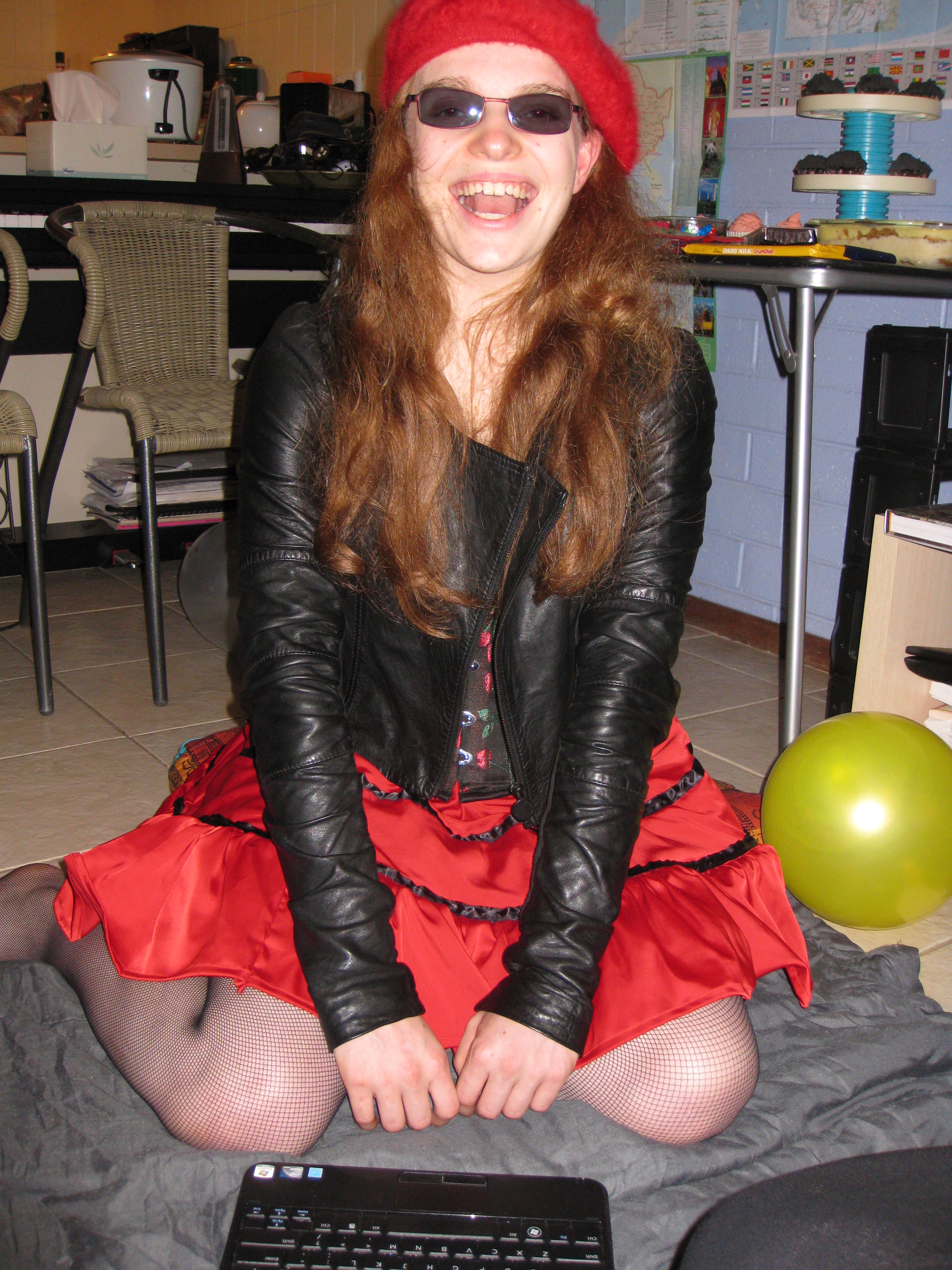
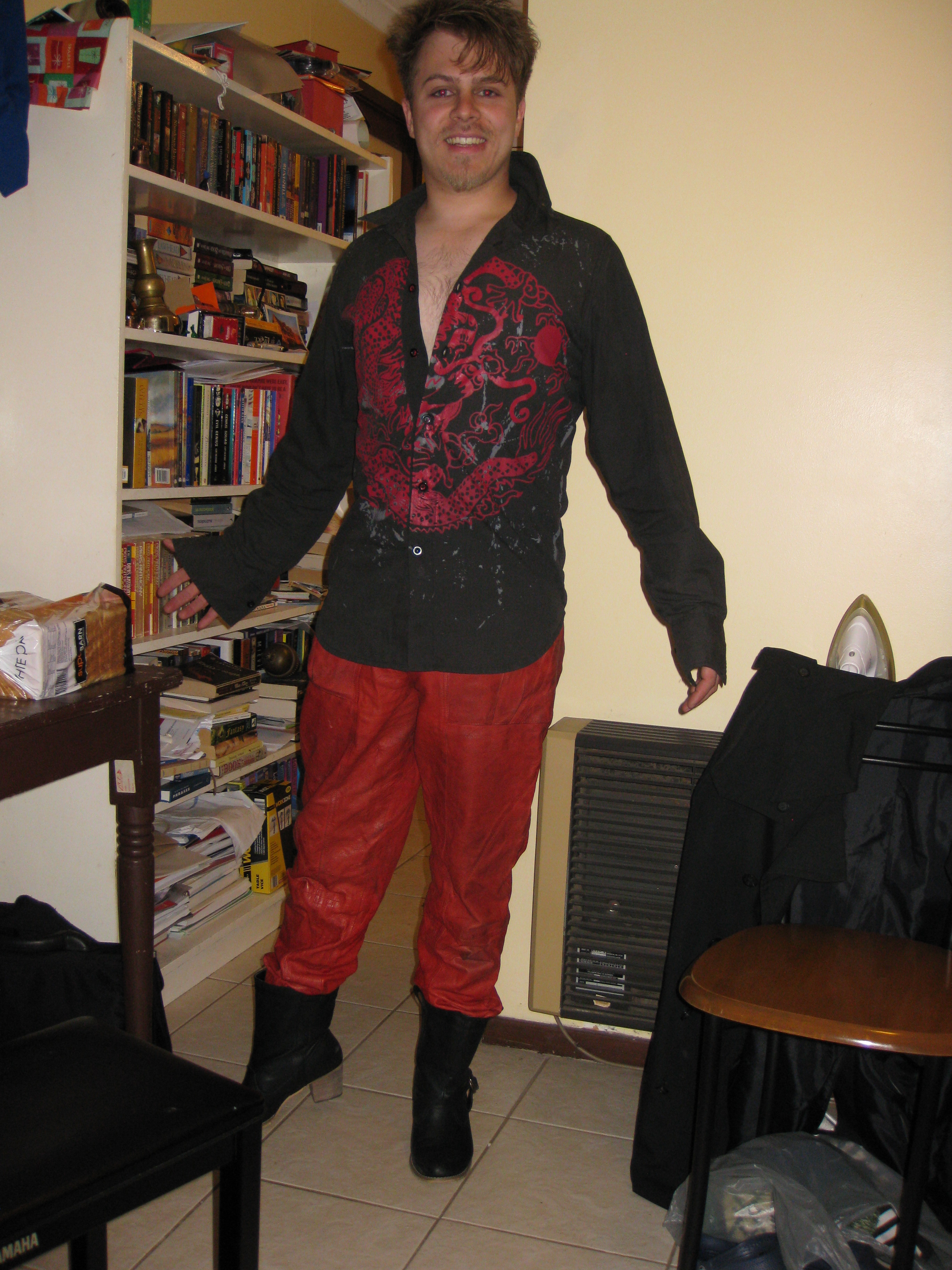
Last year a German woman named Lena won the contest. The opening number celebrating her 2010 song featured sixteen synchonised male dancers dressed all in white (that’s sixteen drinks), then (I kid you not) twenty-four fake Lenas in little black dresses and wigs, singing and dancing together with the flags of the twenty-five finalists (Lena was representing Germany again this year, so she was among them).
All my doubts about Eurovision 2011 (could it be as spectacularly wrong as previous years?) were banished at once.
I was a little disappointed that only one lady (Lithuania, if memory serves) showed massive cleavage, and not a single girl ripped off an item of clothing at an opportune moment.
Ah well. 2011 was all about boy bands, magic, and hoop skirts.
One of the early gentlemen had hair that looked like he’d stuck his hand in an electrical socket, but even he was outdone by Ireland, who had a pair of male lead singers with five-inch high hair on top and giant dice-shaped shoulder pads. Oh, and they were twins, too.
My picks for the top three:
1. France’s tousle-haired opera singer.
2. Italy’s soft jazz.
3. Finland’s oh-so-subtle environmental pop, “Da Da Dum” (that’s three nonsense syllables, by the way).
The host of our Eurovision party assigned each person their own country. Austria was mine – a lady with six-inch heels apparently welded in palce (to a podium in an inpenetrable sea of fog from which several backup singers appeared). It was rather dull in Eurovision terms – nothing but a few hundred sequins flashing on her dress. . . which turned out to be real diamonds. Yikes.
Ukraine stood out. She had a cool dress and the song was fine (again, Eurovision standards apply). The REALLY cool thing was that she had a sand artist on stage, making brilliant pictures that appeared on the giant screen as they were formed. And so it was that the Ukraine was upstaged by sand. Badly.
The best part about Lena’s triumphant re-entry into the contest was her interview, when she replied to the question, “Why compete again?” with “Because I am an egotist” and to the question, “Are you nervous?” with “My legs are shaking and my breasts are ready to BCHOOO!” (With mime of exploding breasts). Her song (along with two others) was terribly derivative of last year’s winning offering – although this time her backup dancers were dressed in hooded silver unitards.
Because it’s Eurovision, that’s why.
Serbia’s song had a pleasantly psychedelic 60s vibe (with a charming lack of actual dancing ability), but my heart will always belong to Moldova.
Every single person on stage wore a 2.5-foot cone-shaped hat on their head through the entire song. Just when I thought it couldn’t get any better, a fairy (also in a giant cone-shaped hat) rode onto stage on a unicycle, wearing a short hoop skirt with bells all around the hem, and carrying a two-foot long fake trumpet. At the last moment, the lead singer produced and wore a monocle.
Don’t believe me? Want to see it for yourself? Okay.
I’m sad to report that none of my favourites won. The winner was Azerbaijan, with a harmonious and catchy song about – ah, whatever. I don’t care. Probably love.
*Those of us working the next day tend to play the drinking game with M&Ms/smartes/skittes/pods/etc.
#285: Tropfest 2011
On Sunday afternoon, I decided to go to Tropfest – Australia’s biggest short film festival. I sat on picnic chairs with friends in front of the overflow screen, eating chilli and sour cream Doritos and drinking fruit juice. The air was full of the smells of KFC chicken and chips, and popcorn from the nearby food tents.
Read the missing chunk of this article at Weekend Notes.
Fortunately the festival wasn’t all artsy tears.

The first finalist was “The Applicant” starring Pete Rosethorn as an alien attempting to get through a job interview. It was very funny, and I don’t think anyone in the world could have done better than Pete Rosethorn. His physicality and style is perfectly suited to the role, with lines like, “Oh! Yes! I want to eat children *pause* TEACH children.” And there was a nice added dimension at the end.
The second finalist was “Silencer” starring Frank Woodley talking about the very serious dangers of mime. It was also funny, but not as funny as “The Applicant”.
The third was “Flight”, a strangely haunting story about hope in poverty, featuring a skateboarder who isn’t part of the local skateboarding crowd, and who privately attempts to fly. There was literally half a word of dialogue. I thought it was beautifully acted and filmed, saturated with hope against a crummy backdrop, and the mix of skateboarding with naiive hope and grace was an excellent choice.
The fourth was about Sven the Swedish astronaut – I wasn’t able to get the title and I missed large sections of dialogue because I wasn’t able to read the subtitles. It was charmingly retro and funny all the same. The best part was that during the film HUNDREDS OF FRIGGIN BATS swooped directly overhead, flapping their silhouette wings so jerkily it was as if they were made of black cardboard cutouts and string. Excellent! I’ll include a short video of THEM at the end of this entry.
I missed the title of the fifth one, too, and found the plot slightly confusing (CJ explained it to me later). The main actress was red-headed and beautiful, and the peculiar dialogue all made sense at the end.
The sixth was another hilarious one, a mockumentary called “Y2Gay” about a redneck fool building a fallout shelter to avoid the increasing gayness of the outside world. As humour, it was exquisite. As a message, the message was clear but the humour weakened it (because – and yes I’ve heard of Glenn Beck – no-one in the real world is that stupid).
The seventh was “Missing Her” about a Thai boy adopted by Australian parents after his mother’s death. It was sad and awkward and tragic, and the boy’s acting was brilliant. The ending was hopeful, but weakened by the fact that I’d thought of it as a possibility (although I think most people wouldn’t).
The eighth was “Monkeys” a passionate tale of bogan drama in the burbs starring Joel Edgerton. I could see why people would like it, but for me it wasn’t that exciting.
The moon was out, and looked far more stunning than this pic can convey:
There was a break in which I managed to meet my friend who I hadn’t seen since she went to Japan. Aieee! We were so excited (and also cold) that we spent ages standing and dancing at each other.
The ninth film, “The Unspoken” was a monologue to a dying father from his son (because no-one hears their own eulogy). It was quite beautiful and heartfelt, but also a bit wrong. Either it was fiction (in which case it was quite a gimmick, and I found the shots of the “dad” a little too “Oh, look at the skinny sad dying guy”) or it was non-fiction (in which case the sentiments feel a little exploitative because of being part of a film festival).
The tenth film, “Maestro” was about a homeless man conducting the music in his head; a squeegee; Luna Park; and the ocean. It was stunningly acted, stunningly filmed, and the music was good. Since we heard (and saw) the music he heard, it was either a tragic insight into a madman’s head – or it was a joyful exploration of a world we rarely see. It felt uplifting to me.
After that was “A Family Affair” which was another mockumentary, this time on an incestuous couple. It was way, way too gross for me.
The twelth film was “Animal Beat Box”, a childishly fun and strangely hilarious beat box animation song done with animal names and pictures.
“Focus” (from South Africa) was an elegant black and white film, with fine acting (including a brief and carefully-filmed sex scene) but the story was utterly ordinary. The ordinariness was the point I think, but ultimately I found it dull (excluding the visuals, which were exquisite). During that film, a group of people were dancing around one of the tall lights. That was cool.
After that was “A Desperate Deed” which had an interesting, ominous and original story with a twist in the tail.
Film fifteen was “Transparency” about the choice an artist made to exploit the worst moment of his girlfriend’s life. It was well done.
The last film (the famous audience choice film, narrated by Russell Crowe) was called “Bird Therapy” and had a support group of people dressed in seriously ridiculous bird costumes, talking passionately about their various disorders – the pigeon who lost his mate to a jet engine, and so on. The acting must have been extremely difficult, but it was spot on. I couldn’t help wondering, though, what the point was (possibly it was just mocking all self-help groups). It was funny, and suited the seven minute time frame, but still not as funny as “The Applicant”.
So! Who do I reckon should have won?
I really loved “The Applicant” (the funniest, with fine acting and an extra kick at the end), “Flight” (brilliant juxtapositions and a sense of hope) “Y2Gay” (very funny and politically timely), “Missing Her” (for the exploration of a hard subject, and for the acting of the boy) and “Maestro” (for making all of Sydney into an orchestra of light and sound)- and “Animal Beat Box” really made me laugh (although with about as much originality as a clown slipping on a banana peel).
In my opinion, the gold goes to “Maestro”. “The Applicant” is the first runner-up, with “Y2Gay” getting bronze.
But the actual winner was, oddly, “Animal Beat Box”.
Note to self: Next time you go to Tropfest (there most certainly will be a next time) take: (1) a coat, (2) Aeroguard, and (3) your Batman outfit.
#274: Three books in three days
On Friday I received a wonderful prize from http://ripping-ozzie-reads.com/: The entire “King Rolen’s Kin” trilogy by Rowena Cory Daniells.
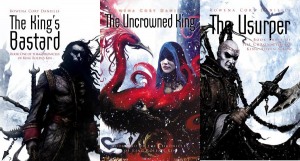
They’re beautiful, aren’t they?
They’re also – as you may have guessed from my title – utterly gripping. I usually avoid epic family histories (although I’ve enjoyed Jack Whyte and Robin Hobb in the past) but Daniells knows how to instantly and permanently make her reader care about her characters. The stress was almost unbearable – particularly since “King Rolen’s Kin” is six people, three of whom carry the story (although Byren Kingson is definitely the main character, and deservedly so).
I read hundreds of books each year, and not many grip me so tightly. Within a few pages, I knew I’d struck reading gold.
Last year I felt this same delighted flush of discovery over Sandy Fussell, Scott Westerfeld, and Pamela Freeman (who neatly but coincidentally fall into the categories of children’s, young adult, and adult reading – this trilogy is probably M-rated, but suitable for most young adults). Among hundreds of books, those three stood out head and shoulders above everyone else. This year Daniells is the first to give me that sweet shock of discovery.
Unfortunately Daniells has one big fault the others don’t have: the endings don’t work in the same intense emotional way as the beginnings and middles. After finishing the three books, I should feel enormously satisfied and at peace. Every time my mind throws up a reminder of all the worry I felt over the characters, I should feel either completely happy or completely sad (depending on how it all worked out). But the enormous payoff/catharsis I was expecting didn’t quite happen.
I know what happened to everyone who matters; I know the fate of the kingdom. But I don’t feel it the way I should.
Since this is something critiquers have said to me in the past, I know exactly what the problem is: reactions. When someone dies in a book, the other characters need to grieve (or sometimes celebrate). There are a lot of devastating losses in the book – and one extraordinarily tragic choice – but the vast majority of deaths are barely touched on emotionally. There are lots of blossoming romantic relationships, too, and as a reader I need to feel sure how it “ended” – with a first kiss, a marriage, his/her marriage to a rival, or a death. And a heartfelt reaction of sorrow, if the relationship is lost – not just a few sentences in passing.
J.K. Rowlings spent too much time on Harry Potter’s feelings in the later books of the series (making readers wish he’d just shut up and move on). Daniells has gone in the opposite direction, where her characters barely blink to lose people that should stop them in their tracks (even if it was only for a few seconds in real time – the great advantage of a book is that a few seconds can fill several pages).
Daniells is a genius in three ways: Tension, characters, and sensory detail (the world felt completely real). I know her a little bit in the online sense, and I’m willing to bet her next trilogy is even better than this one.
I’m going to go and read it – but not until I have three days free in a row.
 Felicity Banks