Narnia #5 of 7: “The Voyage of the Dawn Treader” by CS Lewis
Of all the Narnia books, excluding the clear death-and-resurrection tale of “The Lion, the Witch and the Wardrobe”, this is the most allegorical. Two of the familiar Pevensie children literally fall into Narnia with their (rather horrible) cousin. They are rescued by Caspian, who is journeying through unknown seas to find seven men loyal to him, who were exiled many years earlier. But he, along with others on board, hopes that the journey will culminate in finding the end of the world.
They have a series of adventures – slavers, dragons, a sea monster, and Deathwater Island – which can be enjoyed as adventures or as tales of hope and faith and compassion.

Free Sample (from the start):
There was a boy called Eustace Clarence Scrubb, and he almost deserved it. His parents called him Eustace Clarence and masters called him Scrubb. I can’t tell you how his friends spoke to him, for he had none.
Rating: PG. I’d call it absolutely G and safe for anyone, but one character is a close parallel to Jesus Christ (in one of the later books this character clearly states that he exists on Earth as well, is known by a different name there, and that the children have been brought into Narnia so that they can more easily recognise him on Earth), and some atheists have found that offensive. The books do focus on the adventures, rather than allegory about 95% of the time.
Narnia #4 of 7: “Prince Caspian” by CS Lewis
Narnia has long since been conquered by the Calormenes – a neighbouring country who are entirely unmagical and who loathe anything fantastic. Prince Caspian is an unlikely hero – a Calormene himself but a boy who loves the whispered tales of Old Narnia. His uncle and guardian, Miraz, is a vicious king who usurped the throne. When Miraz’s wife bears a baby boy, Caspian’s life is suddenly in grave danger. He falls in with the remnants of Narnia’s magical past, and uses a magical artifact to summon the legendary kings and queens of old – the four children readers know and love from “The Lion, the Witch and the Wardrobe”.
I truly love both the book and the movie of “Prince Caspian”. The book has all the excellent writing characteristics of the rest, but it opens with such eeriness as the children find themselves in a Narnia in which thousands of years have passed since their time. I love that. And I love the joyful explosion as magic comes alive in Narnia after years of stifling “civilisation” by the cynical and capitalistic Calormenes.

Free sample:
The first house they came to was a school: a girls’ school, where a lot of Narnian girls, with their hair done very tight and ugly tight collars around their necks and thick tickly stockings on their legs, were having a history lesson. The sort of “History” that was taught in Narnia under Miraz’s rule was duller than the truest history you ever read and less true than the most exciting adventure story.
“If you don’t attend, Gwendolen,” said the mistress, “and stop looking out the window, I shall have to give you an order-mark.”
“But please, Miss Prizzle –” began Gwendolen.
“Did you hear what I said, Gwendolen?” asked Miss Prizzle.
“But please, Miss Prizzle,” said Gwendolen, “there’s a LION!”
Rating: PG. I’d call it absolutely G and safe for anyone, but one character is a close parallel to Jesus Christ (in one of the later books this character clearly states that he exists on Earth as well, is known by a different name there, and that the children have been brought into Narnia so that they can more easily recognise him on Earth), and some atheists have found that offensive. The books do focus on the adventures, rather than allegory about 95% of the time.
Narnia #3 of 7: “The Horse and His Boy” by CS Lewis
This is a truly interesting book, because it takes place entirely within the world of Narnia and the surrounding lands – in fact the whole book technically takes place within a sentence from “The Lion, the Witch and the Wardrobe” – and the children from our world barely appear.

Shasta is a boy who overhears his father arranging to sell him to a passing lord – which is when he finds out his “father” found him, the only survivor of some seafaring disaster, and took him in (not out of compassion; Shasta is essentially a slave and his facial features show he is of Narnian birth). He considers running away, and is more than slightly surprised when the lord’s horse advises that he do so. The horse was taken from Narnia as a colt, and brought to a much more “civilised” world where he has been pretending to be a normal horse for most of his life.
And so the horse (Bree) steals the boy, and their escape to Narnia begins. They soon fall in with a second talking horse and a local girl who is fleeing an arranged marriage. The horses get along rather better than the humans do, since the local girl is rather high-class and Shasta is anything but.
There are lion attacks, breathless flights, haunted tombs, and our heroes accidentally discover a plot to take Narnia by force. It’s all very exciting J
Free sample:
The cloud was bigger and thicker than it had looked at first and soon the night grew very dark. Just as Shasta was saying to himself, “We must be nearly at the sandhills by now,” his heart leapt into his mouth because an appalling noise had suddenly risen up out of the darkness ahead; a long snarling roar, melancholy and utterly savage. Instantly Bree swerved round and began galloping inland again as fast as he could gallop.
“What is it?” gasped Shasta.
“Lions!” said Bree, without checking his pace or turning his head.
Rating: PG. I’d call it absolutely G and safe for anyone, but one character is a close parallel to Jesus Christ (in one of the later books this character clearly states that he exists on Earth as well, is known by a different name there, and that the children have been brought into Narnia so that they can more easily recognise him on Earth), and some atheists have found that offensive. The books do focus on the adventures, rather than allegory about 95% of the time.
“One of our Thursdays is Missing” by Jasper Fforde
It’s ten at night and I haven’t blogged yet, so here’s a book review I happened to have standing at the ready:
This is the fifth “Thursday Next” novel (that’s the name of the main character, a woman). I’ve read them all, but I don’t like them enough to reread them so this is the only one I’ll be reviewing.

Jasper Fforde is unlike anyone else you’ve ever read. He is so, so much more portmodern. He’s ALL about the fourth wall. Most of this series takes place inside “Bookworld” where fictional characters reside, playing the parts in various novels like live stage actors. It’s very difficult to explain these books, because there’s so much zany self-referentiality going on. And intrigue, action, and humour.
From the beginning of the series, I found Fforde lacking in depth – both characters and setting feel as if they’re made from cardboard (it’s painted cardboard, but still not “real). Part of this is because the books aren’t meant to feel real – they’re an in-joke between author and reader. Part of it is a genuine weakness on Fforde’s part, which his fans find irrelevant. I’m a pretty mild fan – enough to be saddened by the way he clearly suffers from sudden popularity syndrome. Fforde, like most truly original people (and I’m actually not talking about myself here), took quite a while to get published. He had two or three books under his belt that he’d been working on for years. Then he became a huge hit and was required to produce more books – the more the better, and the faster the better too. And so his later books, while still showing his genius, are simply not as good.
This is a later book. It still shows his genius, but it’s simply not at good. This one is about whether or not the real Thursday Next is missing, and our hero here is the fictional version of her. (It gets more confusing from there, but it turns out the confusion is a plot point. Note to self: Don’t make confusion a plot point.) The stuff on self-publishing was right on the money.
Sample (from when a new book is arriving in the Fantasy section): The first setting to be completed was a semi-ruined castle, then a mountain range, then a forest – with each tree, rabbit, unicorn and elf carefully unpacked from crates. Other sections soon followed, and within forty minutes the entire novel had been hauled in piecemeal from overhead, riveted down and attached to the telemetry lines and throughput conduits.
“It’s a good idea to be neighbourly,” I said [she’s training a standin for her character], “you never know when you might need to borrow a cupful of irony. Besides, you might find this interesting.”
We walked up the drive and across the drawbridge into the courtyard. Notices were pinned up everywhere that contained useful directions such as: “This way to the denouement” or “No boots to be worn in the backstory” and even “Do not feed the Ambiguity”.
Narnia #2 of 7: “The Lion, the Witch and the Wardrobe” by CS Lewis
This is by far the best-known of the Narnia books, and the recent movie was fairly successful (deservedly so, I think).

Four British children are sent to a rambling house in the country during the blitz. They are largely left alone, and the youngest stumbles through a wardrobe into the magical land of Narnia. Eventually, all four come to know Narnia very well – but it is a whole country where it is “always Winter, and never Christmas”. The White Witch rules over all, and already has an ally in one of the children, who unwittingly (or mostly unwittingly) sets out to betray his sisters and brother.
There are fantastical creatures galore, and the White Witch is a truly dire enemy who turns animals into stone out of spite. The writing is excellent once again, the characters realistic yet heroic, and the adventures thrilling.
Free sample:
“This must be a simply enormous wardrobe!” thought Lucy, going still further in and pushing the soft folds of the coats aside to make room for her. Then she noticed that there was something crunching under her feet. “I wonder is that more mothballs?” she thought, stooping down to feel it with herhand. But instead of feeling the hard, smooth wood of the floor of the wardrobe, she felt something soft and powdery and extremely cold. “This is very queer,” she said, and went on a step or two further.
Next moment she found that what was rubbing against her face and hands was no longer soft fur but something hard and rough and even prickly. “Why, it is just like branches of trees!” exclaimed Lucy. And then she saw that there was a light ahead of her; not a few inches away where the back of the wardrobe ought to have been, but a long way off. Something cold and soft was falling on her. A moment later she found that she was standing in the middle of a wood at night-time with snow under her feet and snowflakes falling through the air.
Rating: PG. I’d call it absolutely G and safe for anyone, but one character is a close parallel to Jesus Christ (in one of the later books this character clearly states that he exists on Earth as well, is known by a different name there, and that the children have been brought into Narnia so that they can more easily recognise him on Earth), and some atheists have found that offensive. The books do focus on the adventures, rather than allegory about 95% of the time.
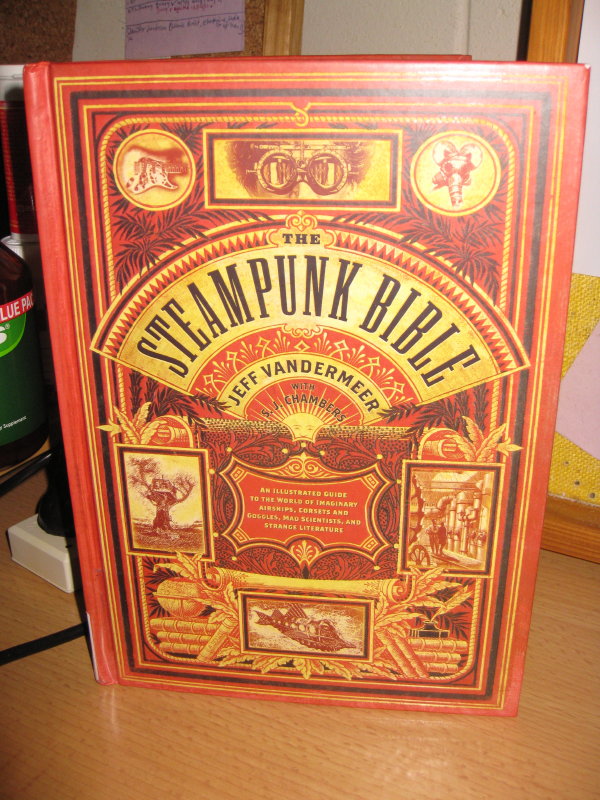
“The Steampunk Bible” by Jeff Vandermeer with SJ Chambers
This review is happening on a Sunday (rather than the usual book-review Friday) because it’s non-fiction.
“The Steampunk Bible” comes up in almost every Steampunk discussion, and it deserves it. For one thing, it was published this year – 2011 – so it’s one of the most up-to-date looks at the entire Steampunk subculture that you can find (away from the somewhat less reliable interwebs).
I’ve been deliberately looking into Steampunk for a while now (mainly the literature, but also the things that cause internet rants*), and in my opinion this book does a very good job of catching the biggest names (Moorcock, Carringer, Priest, Foglio, Westerfeld, etc – with the exception of Philip Reeve and Richard Harland) and the most influential trends – art, engineering, fashion. The authors have chosen to emphasise the inclusiveness of steampunk, which is of course a good thing.
If you want to know about as much as anyone does about steampunk, this is the place to start. Oh! And it’s illustrated throughout in full colour, so it’s a visual treat.
Free sample (interview with Scott Westerfeld):
What is your personal definition of Steampunk?
It’s partly a set of nostalgias – for handmade and human-scale technologies, baroque design, and elegant dress and manners – combined with the puerile pleasure of mussing up a very stuffy stage in history, bringing a flamethrower to a tea party, so to speak. And this flamethrower extends to the political and social as well as technological, because Steampunk creates a new set of Victorian stories. . .
*Definitions, particularly what is or is not Steampunk (and the countless subgenres sprouting like weeds). Whether Steampunk should be dark and/or political. The distinction between makers (who make functional items) and artists (who make beautiful things that hint at function but don’t actually possess it). The curious anger some people feel about the travesty of NON-FUNCTIONAL *gasp* goggles. Etc.
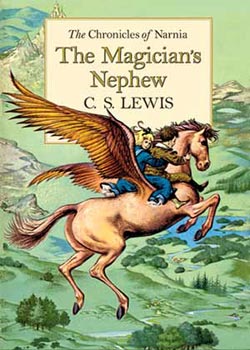
Narnia #1 of 7: “The Magician’s Nephew” by CS Lewis
This story is about two British children, Polly and Digory, who go exploring in the attic and find far more than they expected. Digory’s mad and magical uncle hurls them into another world, from which they travel to the ancient and dying world of Charn, and bring back an ancient (and very entertaining) evil by accident, who plunges London into delightful chaos before they manage to get her out of our world and into a brand new one. . . Narnia.
I grew up reading a variety of classics (and other books which were simply old, because they were on my parents’ bookshelves) and the difference in writing style between then and now is often painfully obvious. Older books have long passages of description (scenery, technology, people, situations) and a slower pace. Most older books – including many that are great – would never be published today.
Which is why the quality of CS Lewis’ writing was such a welcome surprise. I’d read the books before, but I assumed that I had seen them through the rose-coloured glasses of youth and familiarity. But they are seriously well written. CS Lewis has a brilliant grasp on the small, realistic details that make everything from talking animals to magic rings not just believable but as real and vivid and three-dimensional as London itself.
His young characters always do act and speak like children – but simultaneously show true courage and goodness. And his worlds are brilliantly realised – totally original and never lacking in imaginative power. He’s also often funny.
The book is particularly enjoyable as a prequel to “The Lion, the Witch, and the Wardrobe” – all seven Narnia books (which I’ll be reviewing each Friday for the next six weeks) stand alone in their own right, but have delightful connections to the rest. It’s also particularly enjoyable for Christians, who see layers of meaning beneath the adventures.
Free sample (The Magician, Uncle Andrew, has managed to convince himself that the talking animals can’t actually talk, and as a result there are certain communication difficulties as the animals attempt to figure out exactly what he is, and try their best to look after him):
The Donkey collected great piles of thistles and threw them in, but Uncle Andrew didn’t seem to care for them. The Squirrels bombarded him with volleys of nuts, but he only covered his head with his hands and tried to keep out of the way. Several birds flew back and forth diligently dropping worms on him. The Bear was especially kind. During the afternoon he found a wild bees’ nest and instead of eating it himself (which he would very much like to have done), this worthy creature brought it back to Uncle Andrew. But this was in fact the worst failure of all. The Bear lobbed the whole sticky mass over the top of the enclosure and unfortunately it hit Uncle Andrew slap in the face (not all the bees were dead). The Bear, who would not at all have minded being hit in the face by a honeycomb himself, could not understand why Uncle Andrew staggered back, slipped, and sat down. And it was sheer bad luck that he landed in the pile of thistles. . . . The cleverer ones were quite sure by now that some of the sounds which came out of his mouth had a meaning. They christened him Brandy because he made that noise so often.
Rating: PG. I’d call it absolutely G and safe for anyone, but one character is a close parallel to Jesus Christ (in one of the later books this character clearly states that he exists on Earth as well, is known by a different name there, and that the children have been brought into Narnia so that they can more easily recognise him on Earth), and some atheists have found that offensive. The books do focus on the adventures, rather than allegory about 95% of the time.
“Goliath” by Scott Westerfeld
Yes! I haz it at last!
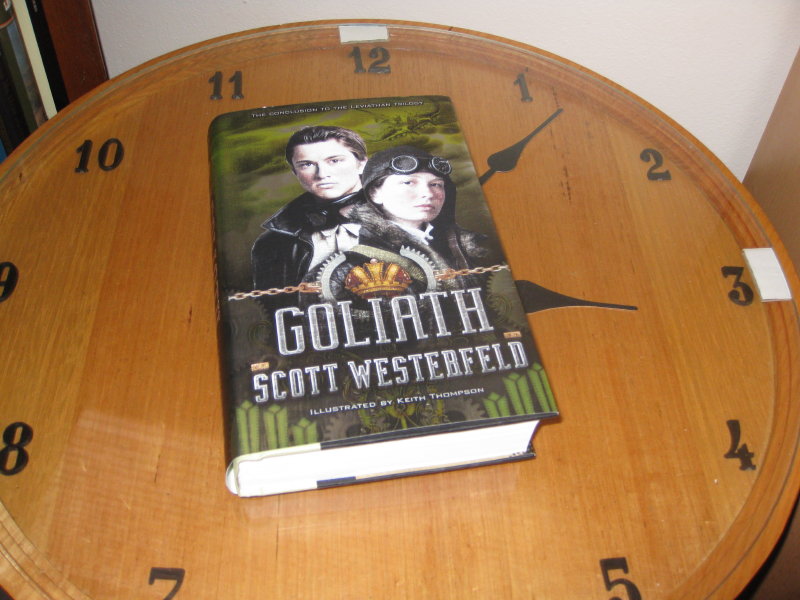
“Goliath” is the final book in Scott Westerfeld’s young adult steampunk trilogy (I reviewed the other two here). Since it’s set in the early days of World War One (a very alternate reality, in which “Clanker” technology – all metal and gears – is pitted against “Darwinist” technology – genetically altered beasts including the enormous flying airship “Leviathan”), it’s technically dieselpunk.
The rest of this review has been moved to Comfy Chair, where I get paid for it.
“Airborn” by Kenneth Oppel
“Goliath” is still en route to bookshops (maybe this week. . .) so here’s another steampunk review to keep you going:
“Airborn”
Definitely dieselpunk rather than steampunk, but still the first book I’ve found with a hot air balloon (which is reeled in by the crew of a zeppelin in the first scene).
The rest of this review has been moved to Comfy Chair, where I get paid for it.
“The Graveyard Book” by Neil Gaiman
I know, I know! I promised to review “Goliath” by Scott Westerfeld today. Sadly, it is late arriving in stores so I haven’t been able to get my pre-ordered copy yet. Fingers crossed for next week.
In the meantime: a treat.

Neil Gaiman (who, incidentally, is married to Amanda Palmer of “The Dresden Dolls” – they’re even touring together) is a brilliant writer – one of the world’s best. Sometimes he needs an edit, and sometimes he’s too dark for my taste. This is not one of those times.
THIS book (as you may have guessed from the title) has a wonderful macabre quality, but is nonetheless a great book for children. It never stops being fantastical (most of the characters are dead, for example) but it FEELS as down-to-earth as common sense. The main character is Bod, who we follow from the age of 18 months to adolescence (only Neil Gaiman could break the “keep your main character a similar age to the audience” and “use a short time span” rules so brilliantly; don’t try that at home). He is observant, intelligent, and good. I’d love to meet him.
There are other characters, too, who are instantly recognisable as the kind of people (not that that’s the right word for what they are) that will be remembered forever – Silas, Miss Lupescu, and the witch.
The story has a deceptively rambling quality, but the menace to Bod is clear from the first scene, and it never lets up. The climax shows that not a single scene was wasted. The theme is growing up – being alive – and it is perfectly developed.
Gaiman’s writing is exquisite. I hesitate to call it “literary” because that’s a by-word for “boring” to so many readers (including me) but when someone writes like Gaiman, you fall in love with the language without ever losing sight of the story. (Ursula leGuin and Sandy Fussell can pull it off, and very few others.)
It’s also beautifully (and eerily) illustrated.
Free sample (the beginning):
There was a hand in the darkness, and it held a knife. The knife had a handle of polished black bone, and a blade finer and sharper than any razor. If it sliced you, you might not even know you had been cut, not immediately.
The knife had done almost everything it was brought to that house to do, and both the blade and the handle were wet.
The street door was still open, just a little, where the knife and the man who held it had slipped in, and wisps of night-time mist slithered and twined into the house through the open door.
The man Jack paused on the landing. With his left hand he pulled a large white handkerchief from the pocket of his black coat, and with it he wiped off the knife and his gloved right hand which had been holding it; then he put the handkerchief away. The hunt was almost over. He had left the woman in her bed, the man on the bedroom floor, the older child in her brightly coloured bedroom, surrounded by toys and half-finished models. That only left the little one, a baby barely a toddler, to take care of.
Rating: PG, since it may scare some under-12 children.

 Felicity Banks