The Foldaway Office
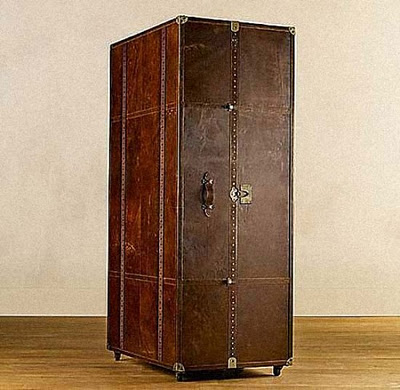
I’ve linked to Brass Bolts before. It always has the most gorgeous pictures. The most recent article is on the steampunk office. My personal favourite is this one, for reasons that I think are perfectly obvious:

First Electric Vehicle
The world’s first reasonably functional electric vehicle was made in 1881 – just over a year after Edison’s public unveiling of the electric light bulb. It travelled up to fourteen kilometres an hour.
You can read all about the new reverse-engineered model here. The opening paragraph:
As more and more mainstream car manufacturers join a new wave of electric vehicle development, it looks like we’re definitely headed for an electric transport future. While powering a car with an electric motor is not exactly a new innovation, you may be surprised to learn exactly how old the technology is. A team led by Horst Schultz – the director and founder of Germany’s Autovision Museum – has spent the last year or so painstakingly recreating the world’s first street-ready electric car, designed and created by English scientists William Ayrton and John Perry, and which first hit the streets in 1881.

Kaja Foglio on Steampunk
Phil and Kaja Foglio – or their creation, the Girl Genius online comics and graphic novels – come up quickly in almost every steampunk discussion (at least, all of the discussions that run along the, “Ooh! Such-and-such is SO COOL!” lines). I have mentioned them myself many a time; they are one of very gew graphic novels I truly love.

Here is an article written by Kaja herself. I’ve always been careful to mention that they call their genre “gaslamp fantasy” rather than steampunk, but it turns out they’re perfectly happy for observers to call them steampunk as much as we like – so I shall do so in an unfettered manner from now on. Here’s what Kaja actually said on the matter:
(Officially, I still use the term “gaslamp fantasy” to describe Girl Genius. This saves me some time and grief, since, like any subculture or artistic movement, we have our share of people happily fighting about “what it all REALLY means.” Not slapping “steampunk!” all over my books keeps me from having to argue with them about whether or not we’re “doing it right.” They may be having fun arguing about what is and isn’t “proper steampunk,” I’ve got a story to tell. If it doesn’t fit into someone else’s box, well, so what? It’s mine.)
Victorian Inventions: New Domestic Motor
This is the opening of a real patent application advertising a real product (pictured) in 1873 (taken from the book “Victorian Inventions” by Leonard de Vries):
The inventor of the device which we present not only employs the hitherto wasted female power to oscillate a cradle, but at one and the same time to vibrate the dasher of a churn. By this means, it will be observed, the hands of the fair operator are left free for darning stockings, sewing, or other light work while the entire individual is completely utilized. Fathers of large families of girls, Mormons, and others blessed with a superabundance of the gentler sex, are thus afforded an effective method of diverting the latent female energy, usually manifested in the pursuit of novels, beaux, embroidery, opera-boxes, and bonnets, into channels of useful and profitable labour.

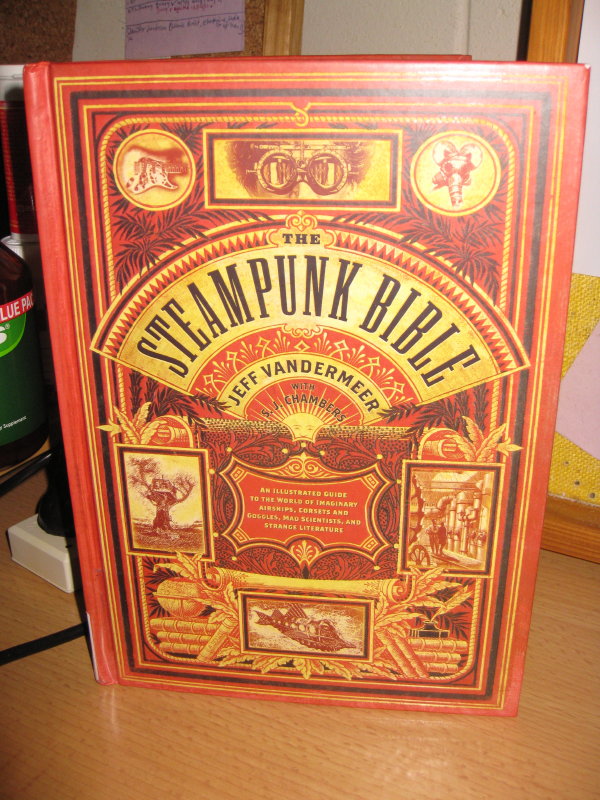
“The Steampunk Bible” by Jeff Vandermeer with SJ Chambers
This review is happening on a Sunday (rather than the usual book-review Friday) because it’s non-fiction.
“The Steampunk Bible” comes up in almost every Steampunk discussion, and it deserves it. For one thing, it was published this year – 2011 – so it’s one of the most up-to-date looks at the entire Steampunk subculture that you can find (away from the somewhat less reliable interwebs).
I’ve been deliberately looking into Steampunk for a while now (mainly the literature, but also the things that cause internet rants*), and in my opinion this book does a very good job of catching the biggest names (Moorcock, Carringer, Priest, Foglio, Westerfeld, etc – with the exception of Philip Reeve and Richard Harland) and the most influential trends – art, engineering, fashion. The authors have chosen to emphasise the inclusiveness of steampunk, which is of course a good thing.
If you want to know about as much as anyone does about steampunk, this is the place to start. Oh! And it’s illustrated throughout in full colour, so it’s a visual treat.
Free sample (interview with Scott Westerfeld):
What is your personal definition of Steampunk?
It’s partly a set of nostalgias – for handmade and human-scale technologies, baroque design, and elegant dress and manners – combined with the puerile pleasure of mussing up a very stuffy stage in history, bringing a flamethrower to a tea party, so to speak. And this flamethrower extends to the political and social as well as technological, because Steampunk creates a new set of Victorian stories. . .
*Definitions, particularly what is or is not Steampunk (and the countless subgenres sprouting like weeds). Whether Steampunk should be dark and/or political. The distinction between makers (who make functional items) and artists (who make beautiful things that hint at function but don’t actually possess it). The curious anger some people feel about the travesty of NON-FUNCTIONAL *gasp* goggles. Etc.
Steampunk weddings
Like many steampunks, I fell into the subculture because of the outfits (and stayed for the books). My own wedding had some minor steampunk characteristics – our wedding clothes were tailored by a friend of ours, and my dress had corset-style lacing added to the back. There were tophats and swords involved, too.
Other steampunks have gone all out and made amazing pictures. Here are two for your enjoyment:
http://blog.jadeandmatthew.com/?p=5862
And my friend Steff Metal:
http://offbeatbride.com/2009/10/new-zealand-halloween-wedding

“Goliath” by Scott Westerfeld
Yes! I haz it at last!
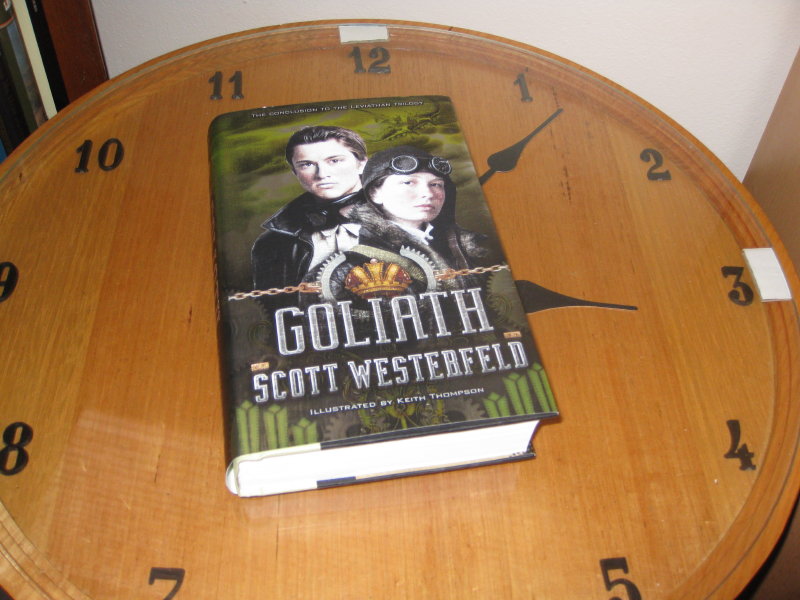
“Goliath” is the final book in Scott Westerfeld’s young adult steampunk trilogy (I reviewed the other two here). Since it’s set in the early days of World War One (a very alternate reality, in which “Clanker” technology – all metal and gears – is pitted against “Darwinist” technology – genetically altered beasts including the enormous flying airship “Leviathan”), it’s technically dieselpunk.
The rest of this review has been moved to Comfy Chair, where I get paid for it.
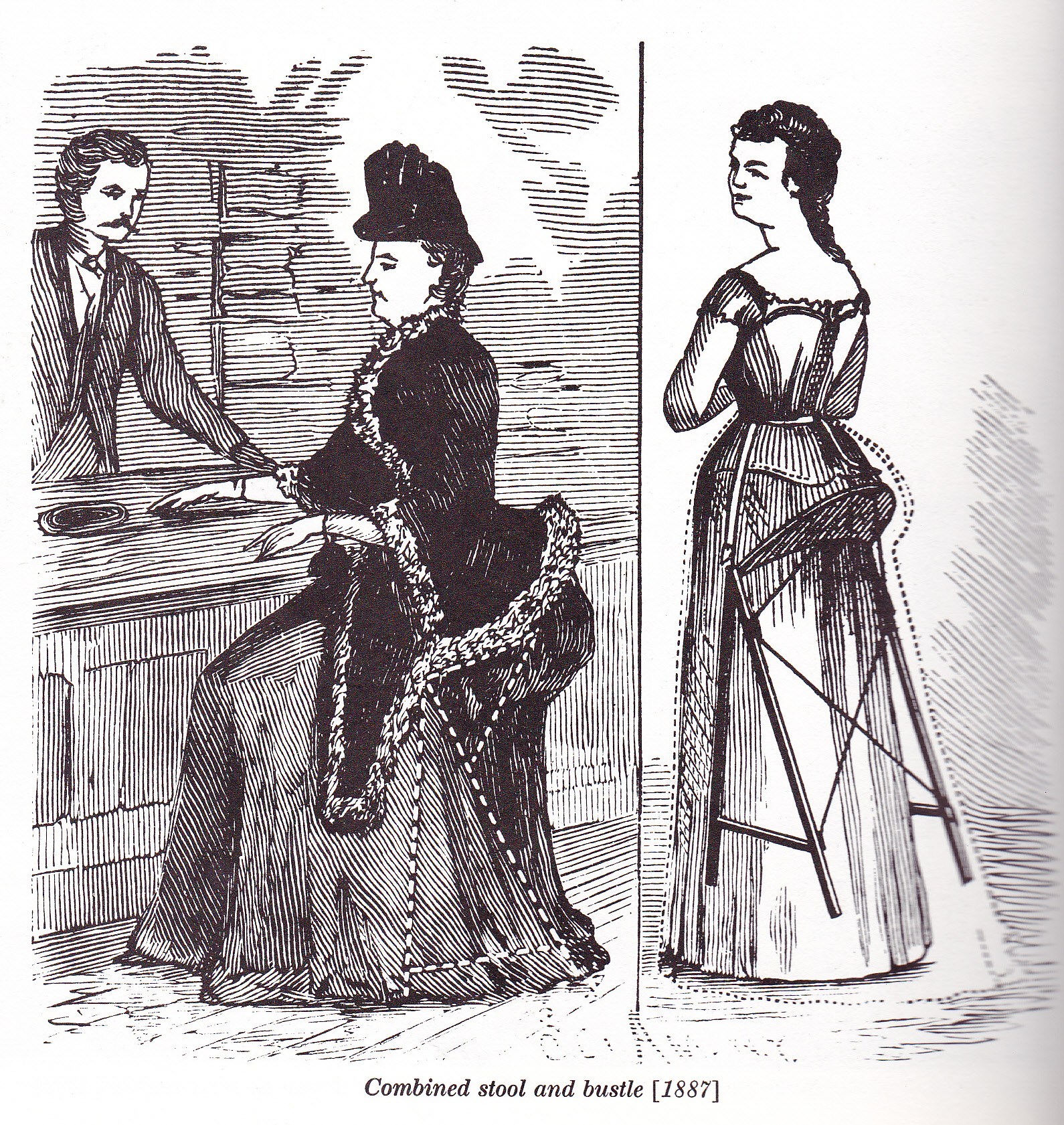
Victorian Invention: Combined Bustle and Stool
Time for a genuine news article taken from Leonard de Vries’ book “Victorian Inventions”.
COMFORT AND FASHION HAPPILY UNITED
So long as it is the fashion for ladies to wear bustles of the pronounced amplitude now favoured by so many of the fair sex, we do not see why the fact may not be turned to advantage to build into the bustle a device calculated to make it convenient for the wearer frequently to rest from the fatigue of long standing and walking. We are curious to know what other ingenious devices the inventors hold in store for making further use of this space which has been neglected up to now.
“Airborn” by Kenneth Oppel
“Goliath” is still en route to bookshops (maybe this week. . .) so here’s another steampunk review to keep you going:
“Airborn”
Definitely dieselpunk rather than steampunk, but still the first book I’ve found with a hot air balloon (which is reeled in by the crew of a zeppelin in the first scene).
The rest of this review has been moved to Comfy Chair, where I get paid for it.
Asian Steampunk
This is a seriously interesting article on real Asian history, and how awesomely it lends itself to a wide range of steampunk tropes and tales. Naturally, it’s from Tor.com.
This was an especially interesting read for me, because I haven’t stumbled across ANY Asian steampunk – the extent of my knowledge was knowing that steampunk is big in Japan (and that “Full Metal Alchemist” is very good).
The author is responding to a market he/she sees as limited to “samurai, geisha and ninja”. He/she gives numerous knowledgable and interesting examples of pirates, detectives, hard-boiled reporters and submarine captains. Here’s a delicious slice:
From the mid-17th century through the 1920s Chinese novels translated into Mongolian were in huge demand in Mongolia, and there was a flourishing trade in them. But the problem for the Mongolian bookbuyers and booksellers was not only the bidding wars which would break out with Russian, Mongolian, and Chinese buyers, but that getting the manuscripts back to Mongolia to sell was difficult because of the very real chance that those transporting the books would be attacked on the way back by bandits wanting to get the manuscripts and sell them for themselves. This resulted in decades of adventurous Mongolian book traders as skilled with sword and gun as they were at selling books.
I think the article could well have gone further – what about mad scientists, femme fatales, adventuring orphans, evil devices, and creepy clockwork (actually, I KNOW the latter existed)? I’m willing to bet Asia’s Victorian-era history is brimming with all of them.
I don’t currently have any plans to write Asian steampunk myself, but if you’re inclined that way, this article is a brilliant place to start your historical research.


 Felicity Banks