Australian Steampunk
Yesterday’s steampunk panel was loads of fun. Myself, Dawn Meredith and Jane Virgo discussed the definitions of steampunk, why we love steampunk, and the little Australian steampunk that is now available (namely, Richard Harland’s “Worldshaker” series, James Roy’s “Ichabod Hart and the Lighthouse Mystery”, Margo Lanagan’s short story “Machine Maid” and a new book none of us have read yet which is called “Wanted: One Scoundrel, Jenny Schwartz”).
An audience member pointed out that no single work of steampunk has truly hit the mainstream in a recognisable way, and we agreed. Which means the market is still a living, vibrant thing – and there for the taking.
Unable to wear my corset, I went for more of a dieselpunk look – and grabbed the best-dressed audience member for this photo:
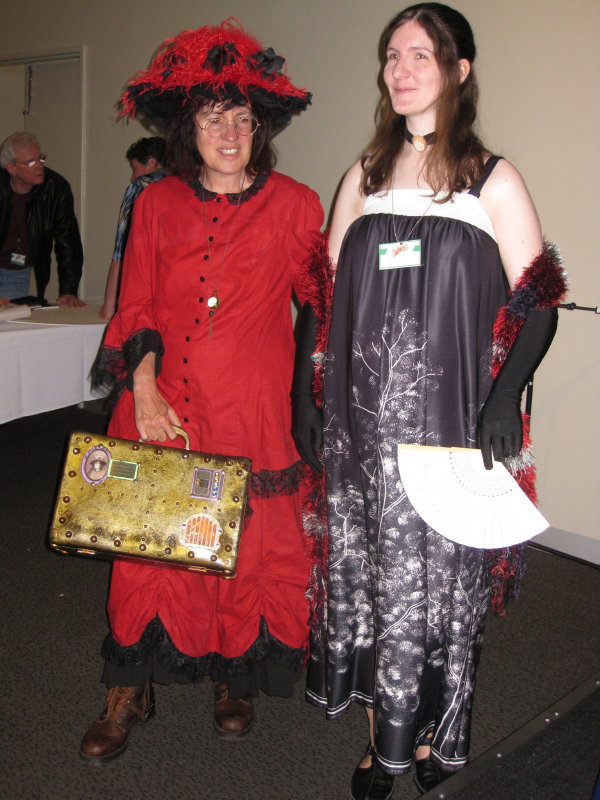
The audience member happened to be the renowned fantasy artist Marilyn Pride.
Conflux 7
Here is where I’ll be today, particularly at the steampunk panel at 2:30 (and there’s another steampunk panel on Monday). If you’re in Canberra, you can still come.
Versatile Blogger Award
I am, according to General Happenings in my House, hereby awarded a Versatile Blogger award! Thank you 🙂

My duties, upon receiving this much-coveted honour, are as follows:
1) Thank the awarder by linking back to their blog;
2) Pass on this award to 15 recently discovered blogs and let them know I have done so;
3) List 7 things about myself.
Here are some great blogs (in no particular order):
1) Ripping Ozzie Reads – an accomplished group of Australian specfic writers (including Richard Harland, Rowena Cory Daniells, and Margo Lanagan) share their know-how.
2) Pub Rants – pub as in “publishing”. This is the blog of a US agent – again, lots of great advice.
3) KT Literary blog – another US agent (in fact, she is friends with # 2).
4) Nathan Bransford – US ex-agent and children’s author (again with the advice). He also runs great forums.
5) The Intern – this time it’s a US ex-intern, but her advice is still excellent (more on writing, less on the industry).
6) Behler Blog – this time it’s a US editorial director giving free industry help.
7) Writer Beware – there are a LOT of scams out there designed to prey on writers. This blog investigates, then tells the horrible truth.
8) Call My Agent! – more industry advice, but this time from an anonymous Sydney agent.
9) Terrible Minds – advice, interviews, and very rude rants from author Chuck Wendig.
10) Slushpile Hell – when a writer needs a little more sarcasm in their day.
11) Brass Bolts – a steampunk writer blogs about steampunk (the pics are especially good).
12) Trial by Steam – steampunk articles and events.
13) Multiculturalism for Steampunk – a seriously excellent and well-researched steampunk niche blog.
14) Antipodean Steampunk Adventures – an Australian steampunk who actually builds his own stuff.
15) Blue Milk – a feminist blog on motherhood (not always safe for work).
Well! That list certainly answers the question, “So, Louise, what do you do all day?”
Now for seven things about myself:
1) Umm. . . I attempted my first novel when I was seven years old (it was about a family of cats – naturally).
2) My mum read the Narnia series in hospital after giving birth to me (I’m re-reading it at the moment).
3) I speak semi-fluent Indonesian, and once considered marrying an Indonesian man I was close to.
4) I leave the curtains open until dark most nights in case the sunset is pretty.
5) Only one of my grandparents is still alive, and he is not well.
6) I can juggle.
7) I have pre-ordered “Goliath” by Scott Westerfeld; the third book in his brilliant YA steampunk trilogy (“Leviathan” is the name of the first book).
Thank you and good evening!
Ballooning adventure
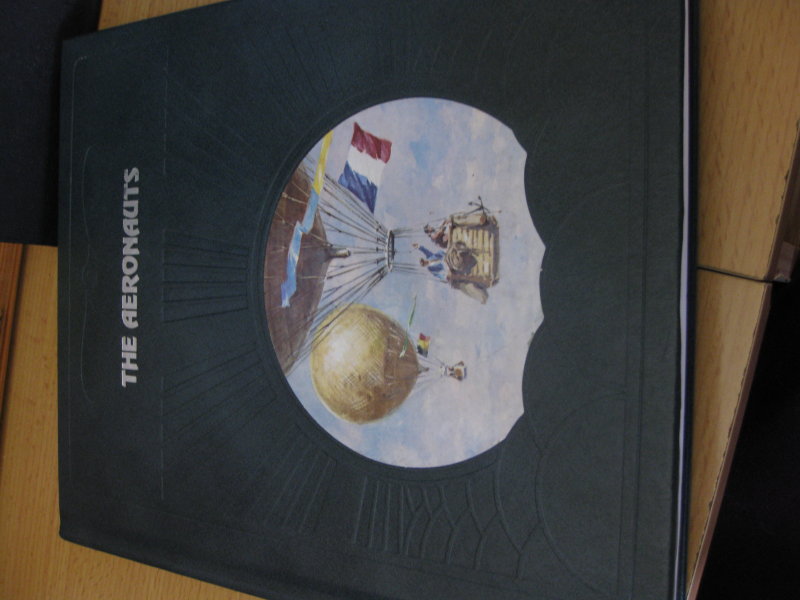
I have been re-reading “The Aeronauts” by Time/Life books. It is a stunning book with a padded cover and brilliant colour inside. Too lazy to open the lid of the scanner, I’ve photographed it:
The following is taken from a first-hand account of the first successful crossing of the English channel by air – somewhat before steampunk times, since it happened in 1784 (but entirely within the realm of clockpunk). It went well at first, but then the intrepid pair of adventurers realised they were losing altitude in a manner that could soon prove fatal. Like all balloonists, they responded by throwing things overboard (NB: Blanchard, the captain, was a very short man).
“My noble little captain gave orders, and set the example,” Jeffries wrote, “by beginning to outstrip our aerial car, first of our silk and finery.” Over the side went the oars, the propeller, and two anchors, “after which my little hero stripped and threw away his coat. On this I was compelled to follow his example. He next cast away his trousers. We put on our cork jackets and were, God knows how, as merry as grigs to think how we should spatter in the water.” But the lightened gondola now rose again, and at 3 p.m., “almost benumbed with cold,” they were thrilled to see the French shore beneath them.
A half hour later, the balloon again began to descend, this time threatening the balloonists with a crash landing in a forest about 12 miles inland. This time they threw out their cork life jackets. When that had little effect, Jeffries suggested an imaginative expedient: “From the recollection that we had drunk much at breakfast and not having had any evacuation,” he reported delicately, “an extra quantity had been secreted by the kidneys, which we might now avail ouselves of by discharging.” They did so, filling two containers and dropping them over the side. A couple of pounds lighter, the balloon cleared the edge of the woods and Blanchard landed it in a small clearing. We were “almost as naked as the trees,” wrote Jeffries, with “not an inch of cord or rope left, no anchor or anything to help us, nor a being within several miles.” The only objects that remained in the car were Jeffries’ thermometer and barometer, a bottle of brandy and a packet of letters; history’s first airmail had arrived in France.
Blanchard pulled on the valve line, venting enough gas to collapse the balloon. Then the scantily clad aeronauts settled back to await rescue – and fame.

This is an artist’s rendition of the aeronauts setting off from Dover. The sail at the back is entirely fictional, although the (non-useful) oars really did exist.
If you enjoyed this entry, you’ll probably enjoy this one even more – it has accounts of more adventures aloft, including my own.
“Pastworld” by Ian Beck
“Pastworld” by Ian Beck
If there’s one thing fantasy readers want – especially from steampunk tales – it’s sensory immersion. A flood of sights, sounds and smells that make us feel we’re living in another world. Ian Beck does that, in loving and exquisite detail. It is his greatest strength.

The rest of this review has been moved to Comfy Chair, where I get paid for it.
Fully preserved Victorian Kitchen
A British couple found an entire Victorian kitchen in their basement the other day. It probably dates from the 1830s, although it was used briefly as a shelter during World War 2.

It includes jelly moulds, a spit for roasting pigs, and an antique fire extinguisher. Also, bells for the servants.

For those who want a steam engine in your Steampunk Sunday, here’s a steam-powered bicycle. All I know about the source is that the maker is Finnish:

Astonishing Real Life Clockpunk
One of the things steampunks love is the sense of amazingly intricate (and highly improbable) technology combined with craftsmanship. Victorian times deliver time and time again with real inventions that are hardly believable (like the steam man of last Sunday’s entry).
Not to be outdone, pre-Victorian times brim with inventions that are, if anything, even more beautiful and even less plausible.
Like this doll – that has been described as the first computer because it could write ANY MESSAGE you gave it. And I do mean “write” – with its hands. Not bad for a watchmaker’s promotional tool dating from 1774!
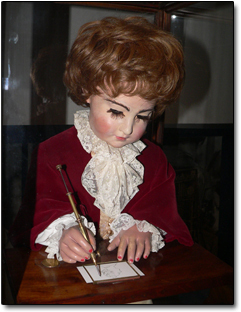
It had over 6,000 moving pieces. . . and it still works.
Read more – and watch the video – in a robot article on cracked. Believe me when I say this is just the beginning.
The steam powered man
One of the things steampunk fans love is a slightly insane invention (ideally powered by steam). One of the most wonderful aspects of Victorian times is that utterly serious inventors came up with literally thousands of bizarre and wonderful ideas.
This is one that genuinely worked, as written about in 1868 here: http://www.davidbuckley.net/DB/HistoryMakers/1868DederickSteamMan.htm
Mr. Zadock Deddrick1, a Newark machinist, has invented a man; one that, moved by steam, will perform some of the most important functions of humanity; that will, standing upright, walk or run as he is bid, in any direction, and at almost any rate of speed, drawing after him a load whose weight would tax the strength of three draught horses. . .
The man stands seven feet and nine inches high, the other dimensions of the body being correctly proportioned. . . He weighs five hundred pounds. Steam is generated in the body or trunk, which is nothing but a three-horse power engine, like those used in our steam fire engines. The legs which support it are complicated and wonderful.

What could possibly go wrong?
Sadly, it was too expensive for general use.
Victorian pulp scifi. . . is there anything more wonderful?
Here’s an i09 article (http://io9.com/5832671/how-science-fiction-cover-art-got-its-pulpy-sense-of-wonder?tag=pulps – links are still broken) on early pulp magazine covers. They are VERY special. . . see?

Here’s the bit you steampunks are probably most interested in:
The Victorian aesthetic appeared from 1820-1900 and is characterized by tons of ornamentation, both in imagery and typography. Most book and magazine covers escaped excessive imagery, but faltered under cluttered typography. Captions often accompanied images to narrate the moment of action rather than allowing the image to speak for itself. Images portrayed a single moment in the story meant to captivate passersby with feelings of adventure and excitement. Actions and poses were stiff and often awkward. Color was expensive, and not commonly seen until 1900.
You’ll want to scan through the pictures for yourself, so here’s that address again.
http://io9.com/5832671/how-science-fiction-cover-art-got-its-pulpy-sense-of-wonder?tag=pulps
Conflux 7: From here to there
Conflux 7 is a speculative fiction conference in my own home town – Canberra. The official program is here (and currently incorrect), but I’m guessing the bits you want to know are:


 Felicity Banks