Advice to Victorian Ladies
This is taken from a mid-book compilation by author Liza Picard, in Victorian London. Enjoy!
Advice to Ladies:
Most wind instruments are decidedly inelegant, they should be left to the gentlemen. Playing the violin-cello is of course out of the question, while the violin, while not so openly obscene, necessitates an awkward position of the head and neck which is not recommended. The piano-forte is an elegant woman’s best friend. There is room on a properly designed piano stool for two, in delightful proximity, when attempting pieces for four hands. Remember that if your companion stands up you may be deposited on the floor unless you stand at the same time. Pages need turning, by someone standing close behind you. This will be present to your mind when adjusting the neckline of your dress before a musical evening. Do not spare the application of perfume.
Never be in the company of an unmarried man alone, unless considerations such as the imminence of an acceptable proposal of marriage outweigh the normal rules. If about to faint with emotion, make sure there is a convenient sopha on which to subside. Not all gentlemen can be relied upon to catch a falling female in time.
When other peoples’ children are presented to you, express delight and admiration, no matter how unprepossessing the infants. Resist any temptation to call attention to their running noses, wet pantaloons, or digital nasal explorations. One can only hope that all these matters will be taken care of by some third party such as the nursemaid. Mothers are often blind to any imperfection in their offspring. Meanwhile try your utmost to avoid physical contact with them, combining an adroit management of your skirts with uninterrupted paeans of praise. Much the same applies to other peoples’ pets, with obvious amendments.
Needlessly Terrifying Machines
We visited cracked.com yesterday, so may as well visit them again today.
As I mentioned yesterday, this article is PG for swearing/crudity, but the site is MA.
The 7 Most Needlessly Terrifying Pieces of Heavy Machinery
If you never dreamed of driving a huge tank fitted with a giant chainsaw while growing up, then congratulations on having been a well-adjusted kid. As for the rest of us? Well, people like us grew up and built these machines for real. That’s why right this moment, somebody somewhere is behind the wheel of …
Read the rest (and see the pictures and videos) here.
A steampunk series (that’s actually dieselpunk fantasy)
For CJ’s birthday, I bought him “The Laws of Magic: Hour of Need” by Michael Pryor. I was pleasantly surprised to discover it’s the last book in the series (most writers who get past three books can’t seem to stop).

The series is about Aubrey FitzWilliam, son of the PM in an alternate reality where an evil sorceror aims to start World War 1. Aubrey is very magically gifted, brave, and loyal to his (rather excellent) parents.
First of all, the important questions when a series ends:
1. Did it really end – are all loose ends tied up as well as they should be? Yes.
2. Is it satisfying/does it have the feeling of an end? Yes.
3. Did the writer get sick of their series and rush through when they glimpsed the end of all that work? Maaaayyybe, a little. This should be the strongest (or second-strongest, after book 1), and in my opinion it’s only okay (although the series as a whole is pretty good, so that’s in context).
Backing up slightly, what do I think of the steampunk-ness of the series?
I like it. Steampunk often has a strong bent towards technology, which I tend to find a little dull compared to magic. This series has a unique and effective magic system. It’s rare when a book manages to “show, not tell” that the hero is magically gifted (because first you have to educate the reader on how it works), but these books absolutely do. It’s instantly understandable, and instantly impressive – with no list of “This is what this array of magical devices does”.
The world itself has a sense of honour and courage which I always enjoy. Plus, airships. The plots are exciting and I particularly loved a large plot about the consequences of Aubrey’s inexperience early on in the series – which continues to have an impact in the very end.
How about the characters?
I hate them. Hate them, hate them, hate them. Especially Aubrey. And his best friend (very much a “Watson” type character). Oh, and the love interest.
They’re just sooooooo, soooooooo irritating. Specifically, they’re pompous – Aubrey worst of all. (In addition to being a sexist idiot – which, given the strength of his mum and female friends, can’t be excused by the historical period.) Even the neutral narrator is pompous. The entire “voice” of the series irritates me.
It took me quite a while to get into the books, because they work really hard at being funny. I almost never like that (even Terry Pratchett, who I know intellectually is a genius, feels like an amateur to me – humour has that effect on me when it’s written down). Then I got into them, and found them funny. Then irritating again. Then mildly amusing.
CJ likes the books better than I do, but often stops dead as Aubrey does something especially stupid. He leaves it for several weeks or months, then grits his teeth and jumps back in.
I’ve read the whole series, and no-one made me do it – but I was relieved to finally be finished with it. I doubt I’ll read Michael Pryor again – but you never know.
(Next time I review a book, I’ll pick one I actually like 🙂 ).
Victorian London
http://www.victorianlondon.org/ is packed with wonderfully vivid primary sources. If you used a book like “Victorian London” by Liza Picard to get an overview, then read through the bits of this site that appealed, I think you’d have an excellent sense of the time and place.
Here’s what the site has on rain, for example:
He who has not seen it rain in London, has not seen London; and I had this pleasure the morning I went to see the Tunnel under the Thames. Then I understood how, in such weather, one can be seized with the temptation to give one’s self a pistol shot. The houses drip as if sweating; the water seems not only to descend from the heavens, but also to ooze from the walls and ground; the sombre colors of the buildings turn yet gloomier and take on an oleaginous look; the beginnings of the streets seem like entrances to grottos; everything seems foul, used up, mouldy, and sinister; the eye knows not whither to turn, not to meet something disagreeable; one feels shudderings, which have the effect of a sudden attack of misfortune; one feels an irksome sense of weariness, a disgust with everything, an inexpressible wish to go out like a lamp from this weary world.
Edmondo de Amicis Jottings about London (trans), 1883
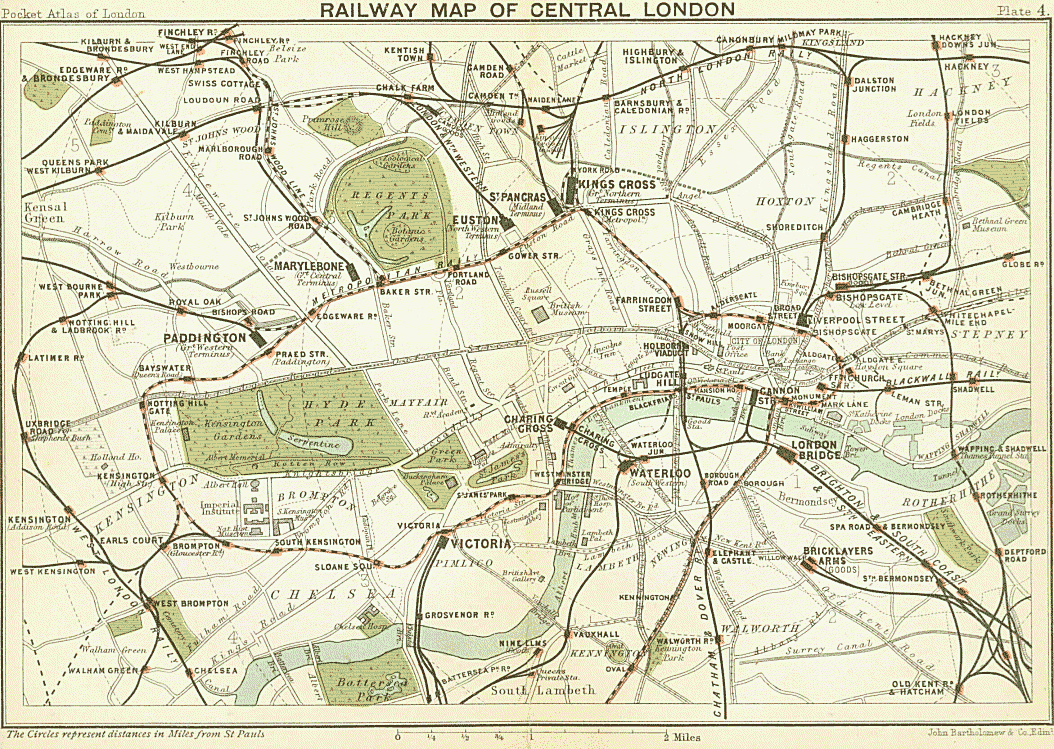
It also has plenty of maps like this one, from 1899:
This amused me
De Grandpre-de Pique (1808)
Monsieurs de Grandpre and de Pique discovered that their mistresses were actually singular, a Mademoiselle Tirevit cheating with both of them. Rather than kicking her to le curb they decided that honor – and sanity – both needed to be shot at. FROM THE SKY. They ascended to 2,000 feet in hot air balloons and started blasting at each other. De Pique managed to miss an entire hot air balloon with a blunderbuss and therefore deserved everything which came afterwards (de Granpire’s buckshot through his balloon and the ground through his everything.)
Read more: Dueling | Cracked.com http://www.cracked.com/funny-4231-dueling/#ixzz1JfeHk3u5
Be advised that although this article is pretty safe (PG for swearing and some amusing violence), the cracked.com site is often MA in both pics and words.
Ingenious Steam Machines
Hot air balloons were invented in the late 1700s – well before the Victorian era. Almost from the beginning, people attempted to give them the ability to steer – but it was only when diesel engines (half the weight of steam engines, because the process of creating power is more direct) were invented that airships really started happening.
There is one exception, however: Henri Giffard’s steam-powered dirigible was invented in 1852.
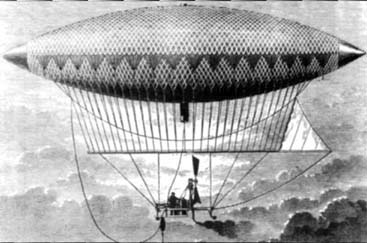
Today’s blog is all about a great article on peculiar steam inventions.
While manufacturers busied themselves with increasingly successful farm steam engines, inventors were experimenting with a host of steam machines many of them fascinating, some of them zany, and a few of them bizarre. Here is a look at some noteworthy steam devices culled from the pages of history.
THE GIFFARD STEAM DIRIGIBLE
On Sept. 24, 1852, French inventor Henri Giffard, using a steam engine for power, designed and flew the first full-size airship. His flight took him from a Paris racecourse to the small town of Trappes some 15 miles west at a speed of roughly 6 mph. Giffard’s airship consisted of a net surrounding a gas-filled, cigar-shaped balloon. A pole hung from the net, horizontally and in line with the balloon, and a gondola was suspended beneath the pole. The ship supported a boiler weighing 100 pounds and an engine weighing 250 pounds; relatively light, but still heavy for an airship. Aware of the potential for fire or explosion, Giffard surrounded the boiler’s stoke hole with wire gauze. He also pointed the boiler’s exhaust down and away from the balloon.
Giffard’s next experimental craft barely escaped disaster. Giffard tried to suspend a boiler and engine beneath what he hoped was an improved bag, but escaping gas caused the balloon to flatten. In turn, the gondola’s nose tilted upward, some lines broke and the balloon slipped from the net and burst. Giffard and a passenger miraculously survived with only minor injuries. Following this, Giffard planned a mammoth, steam-powered airship weighing 30 tons, but prohibitive costs caused him to scrap the project. Giffard is best known in the farm steam engine community as the inventor of the injector.
THE WINANS STEAM GUN
In 1861, Ross Winans, a locomotive builder in Baltimore, Md., manufactured a steam-powered gun invented by a Charles S. Dickenson. Winans welcomed novelty, a trait he was known for in his locomotive designs, and he applied his enthusiasm for innovation when he produced the steam gun that came to bear his name.
The idea behind the gun was to use steam to hurl a cannonball; his “gun” was supposedly capable of throwing 200 balls a minute (weight unknown) up to 2 miles, of projecting a 100-pound cannon ball and even of firing bullets. The Winans device could be considered an early machine gun, and certain writers have described it by that term. A hopper fed the pivoted gun barrel of the Winans gun, which itself ran on railroad tracks. Winans evidently hoped it might be used to bring the rapidly escalating Civil War to a quick conclusion.
Although born in Vernon, N.J., Winans was a Confederate sympathizer who was actively involved in Confederate politics. In May of 1861 Winans shipped his gun south from Baltimore to Harpers Ferry, Va., but on May 11, 1861, Colonel Edward F. Jones of the 6th Massachusetts Regiment under Brigadier General Benjamin F. Butler intercepted Winans’ gun. Three days later, Butler captured Winans in Baltimore. Had Secretary of State William H. Seward not interceded on behalf of the millionaire prisoner, Winans might have been hanged for treason. Instead, he was released, a fact that angered Butler for the rest of his life. Through the remainder of the war, the gun protected the Baltimore & Ohio Patuxent River Viaduct.
THE EBAUGH STEAM CIGAR BOAT
Nicknamed ‘Davids’ (with reference to the story of David and Goliath), these partially submerged Confederate cigar boats carried torpedoes. The moniker “cigar boat” describes the shape of the hull.
In 1863, David C. Ebaugh privately manufactured the first of these crafts at Charleston, S.C. Christened David, it was appropriated by the Confederate States Navy. On Oct. 5, 1863, David, steaming under the cloak of night, attacked the Union ship NewIronsides. Quite unexpectedly, however, David’s exploding torpedo set up a spray that extinguished the cigar boat’s fires, and a piece of shrapnel jammed David’s engine. Through the efforts of the engineer, however, the injured boat escaped. New Ironsides sustained damage but survived.
The following year, David saw additional action. . .
Read the rest (there’s plenty more) here.
Steampunk Art
Here‘s a site many of you will love – and here is why:

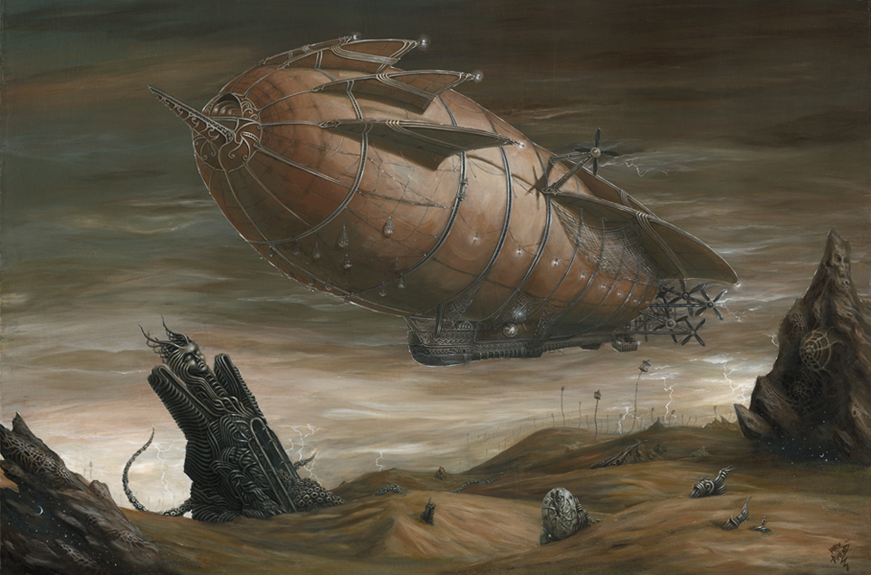

There are dozens of pictures, and each one is brilliant.
A Desperate Adventure at Sea
In honor of Doctor Who’s recent pirate episode, here’s a true Australian story that actually predates steampunk (the first picture is from a mini-series I haven’t seen, and the second is yours truly on the Young Endeavour tall ship).
From the appendices of “A Long Way Home” by Mike Walker ( the appendices are from James Martin’s memorandums):
[The convict James Martin escaped Botany Bay in a tiny boat and aimed for the Indonesian island of Timor, along with several other convict men, plus Mary Bryant and her two very young children. This is taken partway along the insane journey North, when the boat is already leaking and they hoped to make repairs on land]
Here we found aplenty of fresh water – hawld our Boat ashore her Bottom being very leaky they Better to pay her Bottom with some Beeswax and Rosin which we had a small Quantity Thereof – But on they Same night was drove off by they natives – which meant to Destroy us – we launched our Boat and Raod off in they stream Quite out of Reach of them – that being Sunday Morng. We Attempted to land when we found a place Convenient for to Repaid our Boat we accord. We put Some of our things – part being ashore there Came they natives in Vast Numbers with Speers and Shields etc we formed in parts one party of us Made towards them they better by signs to pacify them But they not taking the least notice accordingly we fired a musket thinking to afright them But they took not the least notice Thereof –
On perceiving them Rush more forward we were forced to take to our Boat and to get out of their reach as far as we Could – and what to Do we Could not tell But on Consulting with each other it was Determined for to row up they harbour which accordingly we rowed up they harbour 9 or 10 miles till we made a little white sandy isld. In they middle of they harbour – which land. Upon and hawled up our Boat and repair her Bottom with what little materials we had. [Soon they were using soap to minimise leaks, and bailing constantly. They did, however, make it safely to Timor – a voyage of 4000 miles – without a single death, and managed to pass themselves off as shipwrecked sailors. Their feat was one of the greatest maritime adventures of the age, and made Bligh jealous because he simply wasn’t as awesome as they were.]


Writing Historical Fiction
Depite its many gleeful anachronisms, steampunk is one form of historical fiction (which is why I wouldn’t recommend it to people who refuse to do research*) – so here’s a post by Glass Cases on doing it right.
The full article is here.
When You Should Go Back to the Future
The triumphs and struggles of human beings on a personal level transcends any decade. When deciding when to set your story, ask yourself if this story could be told just as easily in present-day. The Diary of Anne Frank, for example, cannot. The Vampire Diaries, however, can. It wouldn’t matter if Elena is a young hippie from the ’60s, a tech-crazy gamer in the ’90s, or (as it stands) fairly popular former cheerleader in present-day Mystic Falls. Likewise, it wouldn’t matter if Stefan and Damon were turned into vampires in the 1400s, 1800s, or last week. The plot is independent from personal attributes.

In the next VERY short while (within two weeks, I promise), I have three particularly cool awesomenesses planned:
1. Eurovision party
2. Steam train!
3. Something even more awesome than those two. . . but I’m not telling what it is!!**
*or writing in general, for that matter.
**I use two exclamation points wisely. This awesomeness is the biz, big time.
Why pickling isn’t a popular form of burial (PG horror)
From “Colonial Ladies” by Maggie Weidenhofer, here’s a horrifying true story of two ladies: one dead, and one disturbed.
Mrs Short had wanted her body taken back to England for burial. This account was written by the woman who sailed back with the corpse.
. . . the only way was to put her in a cask of pickle. . . had she reflected before her death what was really necessary to be Done—for the safety of all our Healths—I am sure poor soul she would much rather have consented to a Watery Grave. Should it please God to take my life on the Seas I shall not care what becomes of my Body provided it goes all together—but to be Mangled (as poor Soul, she was Done) is enough to frighten any Christian from Consenting to be served so. . .

 Felicity Banks