Steampunk Lego
Don’t say I never give you anything.
On Empire of Steam, there is an entire world of steampunk lego history (seriously):


Over here, there’s a whole range of lego items, including this steampunk toilet:

And weburbanist has gathered the best of the net together – here are my favourites (weburbanist discusses them, too):
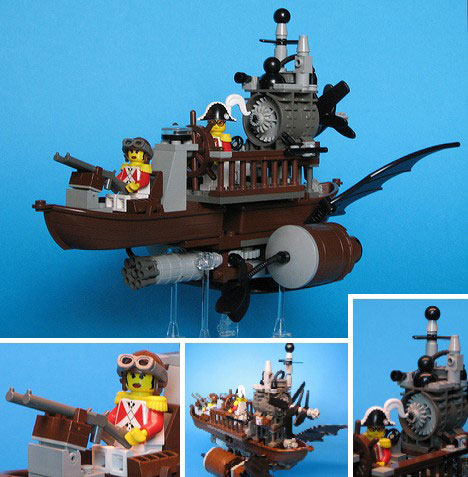
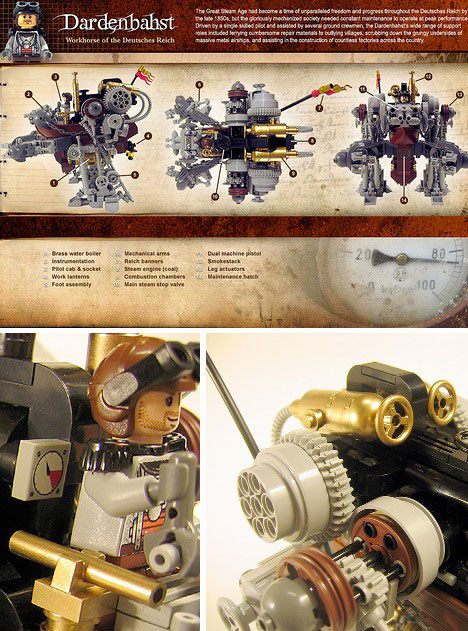

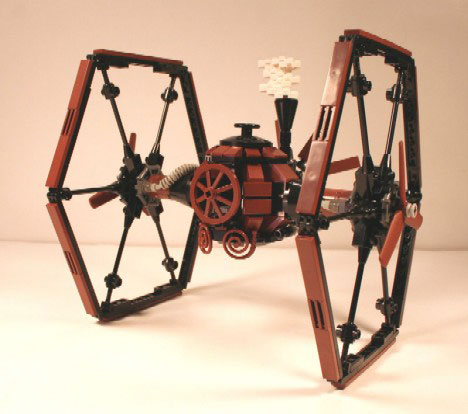
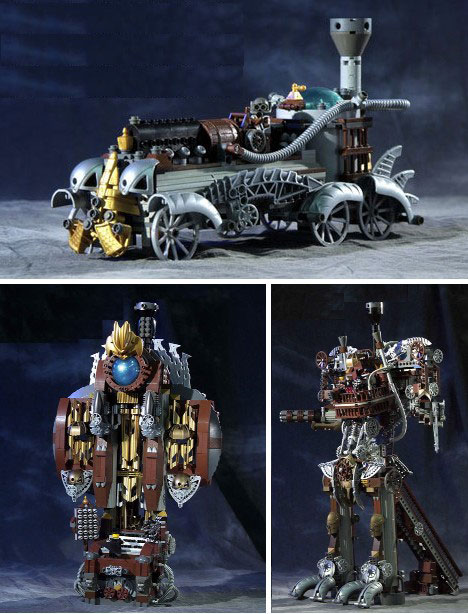
Talking the steampunk talk (PG)
The Victorian Era was a time of miasmic fog, elegant manners, and the criminal classes. The slang of the time was often colourful (to say the least).
I took most of the following list from “A Long Way Home” by Mike Walker (and the rest from “Victorian London” by Liza Picard and my own nautical days), choosing those that were fun and/or largely self-explanatory (so I could potentially use them in my book).
I left out three-quarters of the original words because they were too rude.
Most of these words are from cant, and others are unique to Australia.
All nations – a mix of drinks from unfinished bottles
Avast – stop
Bacon-faced – full-faced
Baked – exhausted
Bark at the moon – to agitate uselessly
Barrel fever – illness caused by excessive drinking
Beef-head – idiot
Belay that – hold on a bit
Bingo – brandy
Bit of red – a soldier
Black arse – kettle
Blashy – rainy weather (Irish)
Blue as a razor – very blue
Blue stocking – learned woman
Bollocks –testicles
Botany Bay – vagina
Chunder – to throw up
To have some guts in one’s brains – knowledgable
Brandy-face – drunkard
Brattery – nursery
Break-teeth words – hard to pronounce words
Gold bridge – easy and attractive way to escape
Broganeer – one with a strong irish accent
Canting crew – criminals
Caper – to be hanged
Cast up one’s accounts – to vomit
Cat-sticks – thin legs
Caterpillar – a soldier
Chalk – to strike someone’s face
Conveyance – a thief
Cove – fellow
Cully – fellow
Swear like a cutter – swear violently
Dangle in the sherrif’s picture frame – to be hanged
Deadly nevergreen – the gallows
Gone to the diet of worms – dead and buried
Dilly – a coach
Dim mort – pretty girl
Dip – pickpocket
Dog booby – an awkward lout
Empty the bag – to tell everything
Enough to make a dog laugh – very funny
Duke of limbs – a tall, awkward fellow
Eternity box – coffin
Step into eternity – hanged
Expended – killed
Fence – receiver of stolen goods
Fiddler’s money – all small change
Flash the gentleman – pretend to be a gentleman
Footpad – thief on foot, mugger
Fork – pick a pocket
Game – plucky
Gammon – nonsense
Gentleman in red – soldier
Glass-eyes – person wearing glasses
Glim – lantern
Groggified – tipsy
Gut-foundered – extremely hungry
Half seas over- half drunk
Hanged look – villainous appearance
To be under hatches – dead
Hog in armour – finely dressed lout
Irrigate – take a drink
Jack ketch – hangman
Jack of legs – very tall person
Jaw-me-down – talkative fellow
King’s Head Inn – Newgate
Knob – an officer
Lappy – drunk
Lift – shoplifting
Light-timbered – weak
Little house – a privy
Make – steal
Monster- huge (as in “The Monster School”)
Red-letter man – a catholic
Repository – jail
Ride as if fetching the midwife – to hurry
Rusty guts – a blunt, surly fellow
School of Venus – a brothel
Scragged – hanged
Shake a leg – wake up/get to work
Shiners – money
Smart as a carrot – very smartly dressed
Snail’s gallop – to move very slowly
Squeak – betray
Swag – shop
Tilter – a small sword
Tommy – lesbian
Whisk – an impertinent fellow
The sad part of discovering such wonderful words is most of them are too startling to work in a book. I cut most of them in editing, because they were simply too distracting. Any vaguely historical book (including medieval-style fantasy) has to find a balance between accurate historical language and comprehensibility to a modern audience. On the up side, some Victorian slang has trickled through to today (“fence” for example) – so that helps.
My advice: always use contractions (I’m, he’s, they’ve, haven’t), never use thees and thous (except in an actual poem – an unfortunate number of fantasy writers use them incorrectly, which is just embarrassing), avoid visual dialects like the plague they are (“‘Ave a good day ya fine chappy, wot wot?” – stick to an occasional verbal tick like “what what” if you must) and of course avoid all modern slang (“My fine fellow, your tale about that strumpet was seriously TMI.”)
I found my own steampunk voice by soaking in books and letters written by real people living in Victorian times – and then just writing what felt natural to me.
Some of the words stayed, however, and I’m glad.
Love in a time of corsetry
This is a true story that took place in Victorian-era Australia.
The “rather mature” man-servant, Mr Supple, asked permission to marry the “very young and pretty” servant-girl, Mary.
My husband thought, as she was so much the younger of the two, it was a pity for her to throw herself away, so he spoke to her.
“Mary,” said he, “what makes you think of marrying Supple, a man old enough to be your father – and such an ugly man, and you such a pretty girl?”
“Well, sir, John Supple is NOT a pretty man, but his manners! Oh! Sir, his manners!” said Mary.
We could say nothing to this, and manners carried the day.
-From “Colonial Ladies” by Maggie Weidenhofer.

Tomorrow: The top ten awesomenesses – that didn’t cost a cent.
Steampunk dress-ups
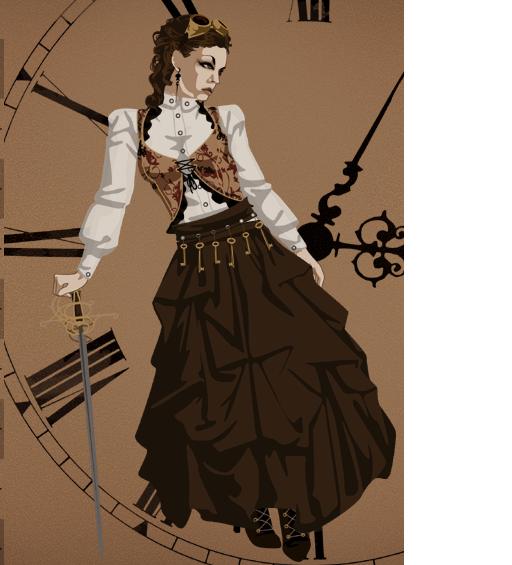
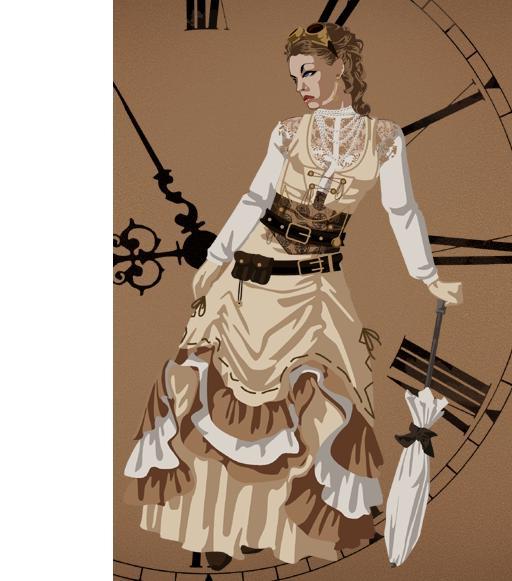
Ammotu has created a brilliant online game in which you take a model and dress her up in any one of hundreds of combinations of clothing and accessories. It’s so very very much fun, and it’s here.
This is my own fantasy outfit from the game:
And this (because there was no way on Earth I could resist) is roughly what my main character, Emmeline, is wearing in my steampunk book:
And here’s an outfit worn by my half-Koori character, Matilda (who will not exist in published form unless I am given permission by the relevent people group in the correct part of Australia):

Thank you Ammotu for your brilliant game!
Steampunk Archetypes
Today’s steampunk post is from here. Enjoy!
Today, I want to talk a little about Steampunk Archetypes.
Archetypes are stereotypes or epitomes of personalities, a generic or ideal personification if you will. They often serve as a basis for characters. Folklore has archetypes, art has archetypes, even Jung has archetypes.
Steampunk has archetypes as well. One trick to using archetypes in our story without making them seem too stereotypical or stale is to turn archetypes on their ear or even combine them (though not all characters will be based on these archetypes, and that’s okay. Original characters are just as fun).
Just a few archetypes sometimes found in Steampunk stories:
Air-Pirate – one of the quintessential Steampunk characters. Airpirates are bad, bold, and armed to the teeth.
Adventurer/Explorer—their reason for being is to boldly go where no one has gone before and to experience new things and discover new places.
Aviator—whether roguish or military, whether they’re flying a bi-plane, a zeppelin, or a space ship, they they’re tough, brave, and a can even be a bit gallant, especially in contrast to Air-Pirates.
Dandy/Femme Fatale—they use their wiles and charms to get what they want, sometimes at the expense of others.
Mad Scientist/Inventor—another quintessential Steampunk character, they embody the steam in steampunk, discovering new things, solving problems, and occasionally blowing things up
Add your own steampunk archetypes in the comments!
In other news, if you live in Melbourne, you’re in luck. Circus Oz has gone steampunk. Go here for info on a discount, or here for general Circus Oz stuff.

Australian Steampunk: Bushrangers
Steampunk often features tales of high adventure – which the Australian late 1800s have in abundance.
Here are two tales of the bushranger Captain Thunderbolt (yep, that’s really what he called himself), taken (without alteration to punctuation or spelling) from “Australian Bushrangers” by George Boxall (which is definitely not recommended for younger readers):
[Captain Thunderbolt] walked into the bar of the inn and asked if he could have something to eat. Mrs Byrne, the landlady, replied “Certainly” and went out to cut him some bread and meat. He sat down and waited, and on her return ate the bread and meat as if he was very hungry. When he had finished he asked “How much?” “Oh nothing,” replied Mrs Byrne, “we never charge for a little thing like that.” “Well,” said the robber, “I came here to stick you up, but as you’re so damned hospitable I won’t.” He then asked for a bottle of rum, paid for it, and went away.
. . . He stopped a number of other people during the afternoon, robbing some and letting others go, and in the evening went back. . . for tea. He chatted for some time with Mrs Byrne, telling her of his exploits.
Did you enjoy that? Here’s another:
One of the stories told about [Captain Thunderbolt] was that he stuck up a German band at Goonoo Goonoo Gap, and made the musicians play for him, besides giving him their money. The Germans pleaded hard. They said they were only poor men, and that their wives and children would suffer if they were robbed. Thunderbolt told them that he must have money. He was waiting for the principal winner at the Tamworth Races, he added, and he promised that if he caught him he would return the Germans their money. Ho took down their names and addresses. The Germans departed very sorrowful, never expecting to see their money again. Nevertheless, on their arrival at their home in Warwick, Queensland, they found a Post Office Order for 20 pounds awaiting them. They guessed, therefore, that Thunderbolt had captured the winner.

NB: Not pictured: the winning horse.
S#76: I am an aeronaut
I’ve written a shiny new guest blog (about ballooning and sailing a tall ship, from the perspective of a writer), all the details of which will be revealed very soon.
Today, finally, is the triumphant blog of riding in a hot air balloon. Here’s how it went:
The pilot released a large helium balloon with a light on it – for wind speed – then laid out the nylon envelope (with our help).
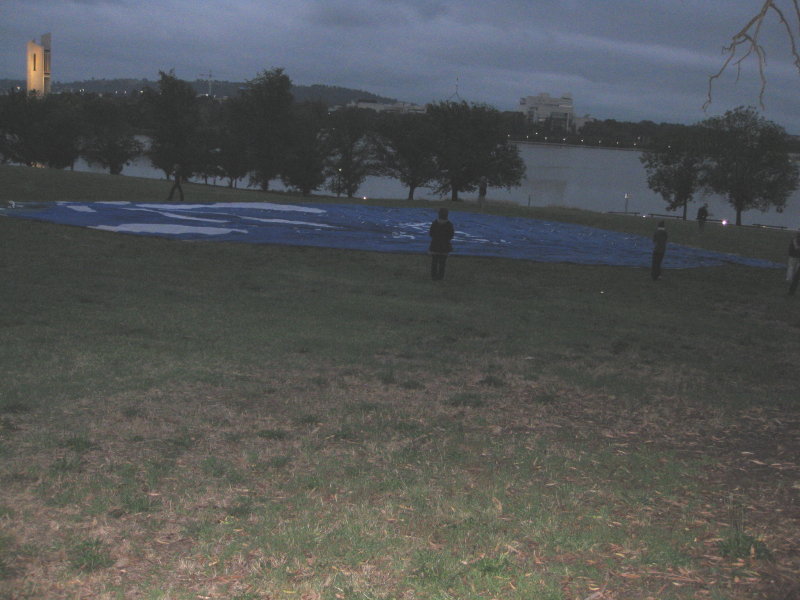
CJ and I held the envelope open while it was inflated with a powerful fan (only about half inflated, really). The pilot walked inside, checking the ropes to the vents on the top and side were lined up correctly.
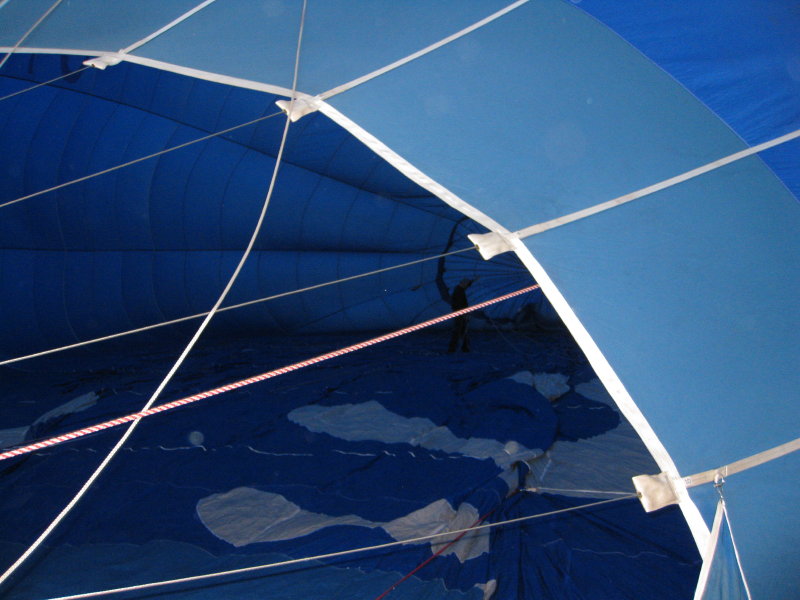
The top vent is mainly useful for descending – possibly very quickly – while the side vent/s change direction by venting air sideways (not actually steering).
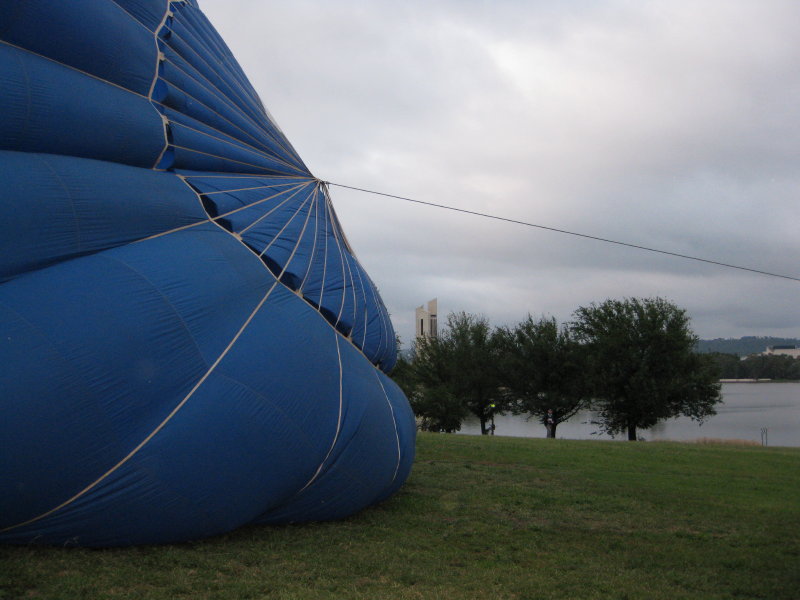
Fire! The air grew hotter and hotter until the balloon stood up, soon pulling the basket with it (with a little help from us). We climbed in over the sides. At this early stage, the burner was uncomfortably hot on the top of my head because it was on so much of the time.
And then we flew – so lightly and so high – like a feather blown off the ground that floats up so smoothly. The strangest part was how easy and natural it felt.
The flight part of this article is here, where I get paid for it 🙂
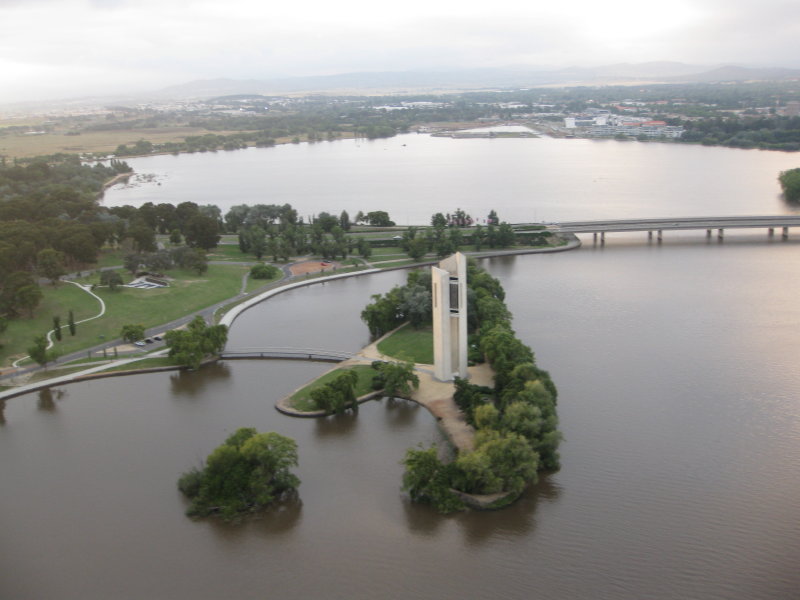


We overshot about four possible landing spots and ended up out of Canberra in a random farm (causing considerable difficulty for our follow vehicles). Turning in a circle, there were literally no man-made buildings in any direction. We were lost!
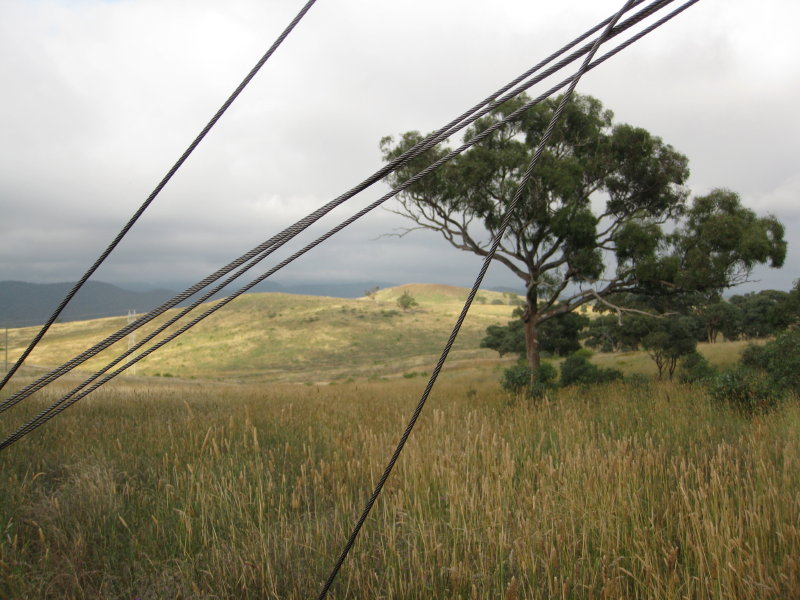
As we came in to land, it looked like we’d tip over – but we didn’t.
CJ stood on the envelope so it didn’t refill.

We pushed the envelope into a long sausage shape, which we later shoved willy-nilly into a large nylon bag.
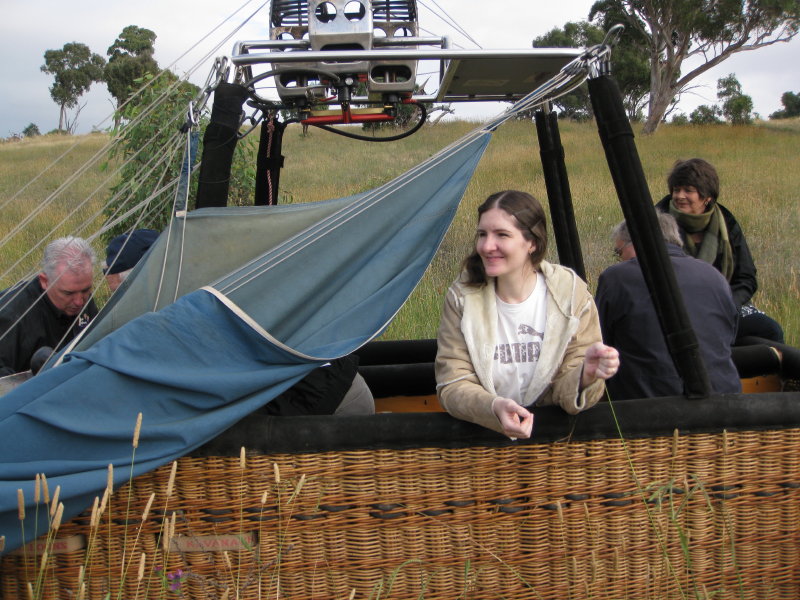
The pilot knew the pilot of the Melbourne flight that was on the news in January when it had overshot the beach and descended in the sea. The pilot had kept the balloon hovering just above the waves until a boat reached them. He tied the balloon to the boat, safely unloaded all the passengers, and then towed the balloon in to shore. The envelope was a new one, and cost $80,000.
Our pilot also lent me a fabulous Time/Life book called “The Aeronauts”, some sections of which are reproduced here:
After a long and terrifying flight from St Louis in 1859, four men were brought down by a storm over Lake Ontario.
One final squall hurled the balloon against a high tree, where it expired. The basket lodged in a fork about 20 feet up. Cautiously the men inspected themselves. LaMountain had suffered contusions on one hip; the other three were shaken but unhurt. Lowering themselves by ropes, they were greeted by a dumbfounded delegation of citizens from the nearby town of Henderson, New York. An elderly lady expressed surprise to see “so sensible-looking a party” debarking from “such an outlandish-looking vehicle”. She asked where they had come from. “St Louis,” Wise replied. The lady fixed him with the gimlet gaze of an experienced detector of humbugs. “That will do, now,” she said.
In the 1820s…
Green used all kinds of innovations to keep his performances lively. One of his earliest triumphs was an ascent on a pony attached by ropes to the balloon’s hoop; he calmed the animal by feeding it beans from his hand. A planned flight in the company of a tiger and its trainer was canceled when the authorities intervened.
In 1957, as part of his training for space, Major David G. Simons went aloft in a cylindrical capsule measuring just three by eight feet. He was in it for 43.5 hours in one stretch, wearing a pressurized space suit so snug he said it was like “being loved by an octopus.”
In 1906, a man called Butler took a group of dinner guests from London to Brighton in a balloon, stopping frequently to correct their direction. At one stage, with little idea where they were, they landed in a tree. They awoke a large number of birds, which then awoke the owner of the tree.
“Goodness gracious!” exclaimed the man, raising the window. “Who are you?”
“Balloonists, resting,” replied Butler. “Where are we?”
“Twelve miles from Brighton, going South. Are you stuck?”
“Oh, no, we’re very happy. You don’t mind us sitting on top of your tree, do you?”
“Not at all,” said the man, who then closed the window with a polite “Good night.”
#299: Steampunk Research
In January I decided to write a steampunk series. This was daunting, because I’m no historian. I decided to remedy my ignorance (to a very minor extent) by reading twenty nonfiction books (and of course spending time on wikipedia and elsewhere). I also took another look at the TV series “Worst Jobs in History”, visited the National Museum, and went horseriding – as well as reading several novels of the time (especially Marcus Clark’s “For the term of his natural life”), and every modern steampunk novel I could get my hands on.
Here for your convenience are my short reviews of the twenty books I read.
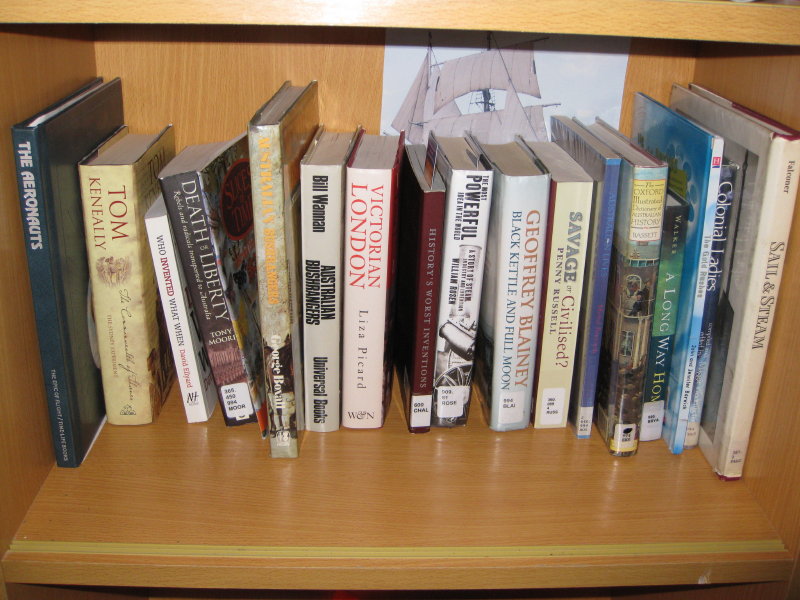
These are the top three, in my opinion.
1. “Victorian London” by Liza Picard (including colour illustrations).
If you’re going to read one book before writing steampunk, this is the one you want (and, as a bonus, it’s often hilarious). The first chapter is on smells. Need I say more?
2. “Who invented what when?” by David Ellyard.
This was brief and coherant enough that even I (a bit of a luddite myself) felt that I understood everything. It includes era-defining inventions such as the steam engine and life-changing inventions like toothbrushes. If you want to have an idea of where technology was at and how people lived, this is where you should start. The thing that makes it especially brilliant is that it’s in chronological order, so you can choose where to stop.
The other technology books I read were “History’s Worst Inventions” by Eric Chaline (which was very good, with a little more depth), “Technology in Australia 1788-1988” (which was intensely dry – I only read selected sections), “The Most Powerful Idea in the World: A story of steam” by William Rosen (which was good, but rather above the heads of non-engineers, and often focused on patent law rather than the more fictionally interesting bits of steam tech).
I also read “The Aeronauts” for balloon info, which was the single most entertaining book on this list – when I write about my own balloon ride I’ll add some quotes for all of you! Oh, and “Sail and Steam” by John Falconer, which I should have read with a dictionary in my other hand (do YOU know the different between a clipper, a cutter, and a tall ship?) but the stunning pictures were well worth it.
3. “Black Kettle and Full Moon” by Geoffrey Blainey.
Blainey is a very well-known Australian historian (I wasn’t able to get “Triumph of the Nomads”, which is a huge shame), and this book is all about everyday Australian lives – so of course it’s gold for writers.
The other books that were very good for everyday detail were “Australian Lives” by Michael Bosworth, “Colonial Ladies” (lots of brilliant and entertaining letter and diary fragments) by Maggie Weidenhofer, and “Slices of Time: Australian Family Life in 1838” by Joan M. Kenny.
For general Australian history I skimmed through “The Oxford Illustrated Encyclopedia of Australian History” (wikipedia was way more useful for getting a grounding in things) and “A History of Victoria” by Blainey (good, but not as relevant as the other one). I also read “The Gold Rushes” by John and Jennifer Barwick (a children’s book, which suited me fine).
For bushranging I read “Australian Bushrangers” by Bill Wannan, and “Australian Bushrangers” (yes, same title) by George Boxall. Both were fascinating – especially tales of bushranging chivalry – but they were also sometimes horrifying to read (especially the second one) because of the nature of crimes committed by certain bushrangers.
For better knowledge of the convict system, I read “Commonwealth of Thieves: The Sydney Experiment” (too historically early for steampunk, but a surprisingly gripping read. . . for a little while, despite all the odds, the two cultures had a chance to actually get on), “Death or Liberty” by Tony Moore (all about transported political prisoners. . . absolutely fascinating, and something Australians should be so proud of – the influence of those rebels is still felt in some of our best cultural attributes), and “A Long Way Home” by Mike Walker (a semifictional account of the convict Mary Bryant – packed with vivid detail and real-life desperate adventure – again, too early but still extremely useful).
Last but definitely not least, I read “Savage or Civilised” by Penny Russell (an examination of early Australian manners). Fascinating, and so relevant to steampunk attitudes! I’ll never think about handshakes the same way again.
So there you have it! Some of the best books for prospective steampunk authors to read, especially if you’re writing Australian steampunk (I know I’m not the only one!)
#112: Horseriding!
Dogs worship humans. Cats despise us. Horses will meet your eye as you approach, and make up their minds what they think of you (the results of which will be clear as you ride them).
This was my birthday present from CJ, and it was exactly as excellent as I remembered from distant childhood memories (I had friends with horses for a while). Also, it definitely counts as research for my steampunk book.
This was my horse – Max.
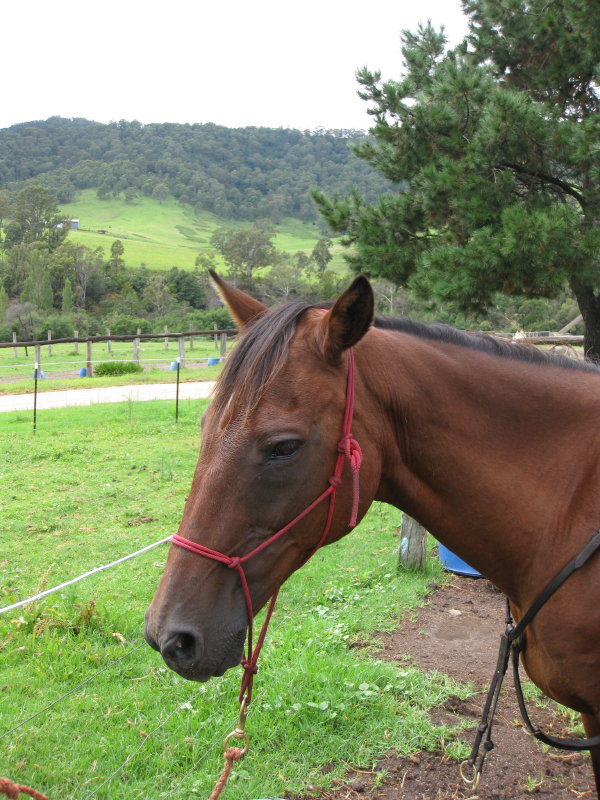
As you can see, we hit upon a simply stunning location – and the staff instantly became some of my favourite people. The main lady, Janice, is smart and sarcastic and I can’t imagine her anyplace not surrounded by ducks, cats, dogs and horses (it would be too much of a shame for the animals). Our riding companion was a real country boy (which to me is fantastically exotic). Both CJ and I know we are city folk through and through, and it was great to talk to someone who would be as sickened and uncomfortable in our lives as we would be in his. It was absolutely clear that the quality of our experience was a direct result of the competence and horse knowledge of the staff. These people are passionate about what they do (and so laid back we spent about three times as much time there as we expected – loving every minute).
This is not something I’ve been paid to endorse – it’s something too brilliant to keep to myself. (These guys are emphatically a different company to the Pender Lea operating at Thredbo.) It was about a half hour drive from Merimbula. Here are all their details:
Pender Lea Trail Rides
Kia-Ora Mia
Tantawanglo Lane, Candelo NSW 2550 (6km north of Candelo)
Phone: 02 6493 2862
Mobile: 0427 048 636
Web: www.penderleahorserides.com.au [which is having issues at the moment]
[Editorial note made in 2013: There is significant controversy about this company, including dozens of allegations of animal abuse as well as assaults on people – see comments for details.
Editorial note 2014: The owner has now been convicted of a long list of crimes against animals – see comments for details.]
Horses to suit all standards of riders. Some of the rides available:
- Twilight ride between 5:00pm to 7:00pm.
- Day rides available by booking only.
- Pony Rides for the little people in the family.
- Catering for families, small exclusive groups or large corporate groups.
Horses are visually stunning; a mix of calm and powerful, with daunting size (and bearing; cows are a similar size but no-one describes cows as “noble”) and very visible muscles beneath short fur. They tend to shuffle or stamp a foot periodically and/or swish their tail or shake their head. They snuffle, snort (especially in frustration), whinny (especially in greeting), and neigh. They are hotter than humans to touch, and soft like velvet.
The sensation of having them eat from one’s hand is quite dry and breathy. Their lips are giant and firm (unlike human lips, which are soft and mould to other objects). And they look mighty fine in water.

Walking on a horse is quite leisurely and comfortable, although the four-legged gait is just a little odd. If you fall asleep, you will fall off. Otherwise (unless your saddle is too loose) it is quite difficult to fall off. The reins are no good for balance – just steering. You grip with your knees – using unfamiliar muscles that made us both sore.
Riding a trotting horse is more difficult than any other step – it’s extremely bumpy. You need to get into the syncopated rhythm, and use the stirrups to go up and down with the horse.
A canter (or slow gallop) is exhilarating as well as being quite smooth. If you start to slide off (most likely due to attempting to turn the horse, or if the horse turns itself or leaps an obstacle), you probably won’t be able to correct yourself unless you’re moderately competent (my foot fell out of one stirrup, and that was fine). It feels wonderfully smooth (if you sit back in the saddle and flow with the steps) and fast – like flying, but with the exciting immediacy of being close to the ground.

Getting on a horse is a little like climbing into a tall vehicle while knowing it may or may not move, but a confident (and reasonably tall) person can get on first go using a stirrup. Falling off a horse generally involves a slide to one side or another, a brief trip downwards as the horse exits stage left – then a bruising hit on the shoulder, hip, or side (unless there are complications). Neither of us fell off (CJ had never ridden a horse before).

The strong smell of horse is about 10% Human Male Who Needs A Shower; 50% Leather; and 40% wet dog. It sticks to everything – clothing, humans, saddles, blankets – for days or years afterwards (depending how well they can be washed). So long as you’re outdoors, it smells wonderful (in much the way that freshly-cut grass smells good).

If you haven’t ridden a horse, you REALLY should. We rode for an hour and a half, and it cost $45 each.
Here’s a video that makes our canter look a lot slower than it really is:
Some awesomenesses that are fast approaching:
Karaoke (oh f–foccacia)
Hot air balloon
#262: Build a steam engine
One of the things that’s so wonderful about steampunk technology is that, given five minutes, anyone can understand how it all works. I took that five minutes yesterday, and felt so good about it that I decided to build one.
After some thought about which saucepans I wasn’t too fond of, and how I could weld something into a boiler shape, I decided to use paper instead of metal – which means no setting the house on fire this time *sigh*.
I messed around for a long while with paper, cardboard (from Lindt extreme orange packets, FYI), stickytape, paperclips, a metal skewer, and blue-tack (no time for glue! I’m inventing here!) and did make something capable of rolling (before I removed the back wheels, anyway).
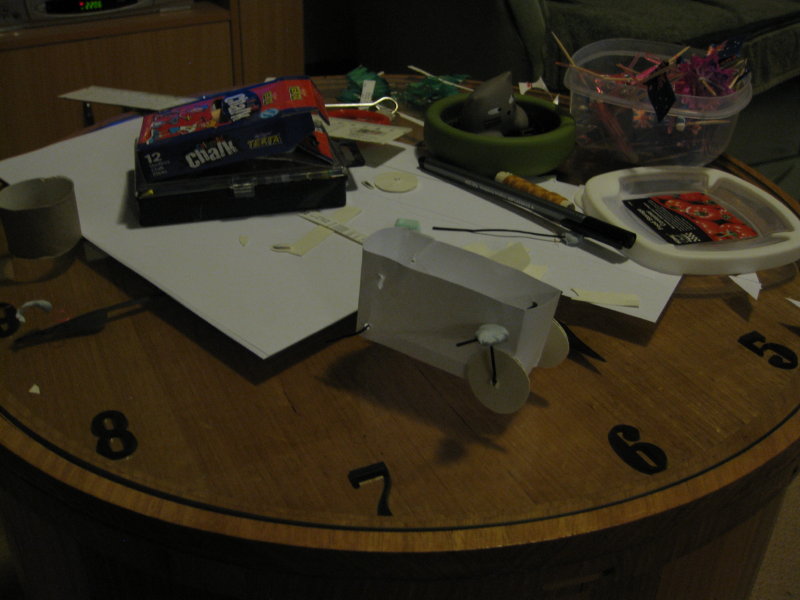
You’ll notice I used our clock table as a workspace – it honestly just happened that way.
I realised I needed better wheels, so I started over – using a sliced toilet paper roll and several mangled cocktail umbrellas to great effect.
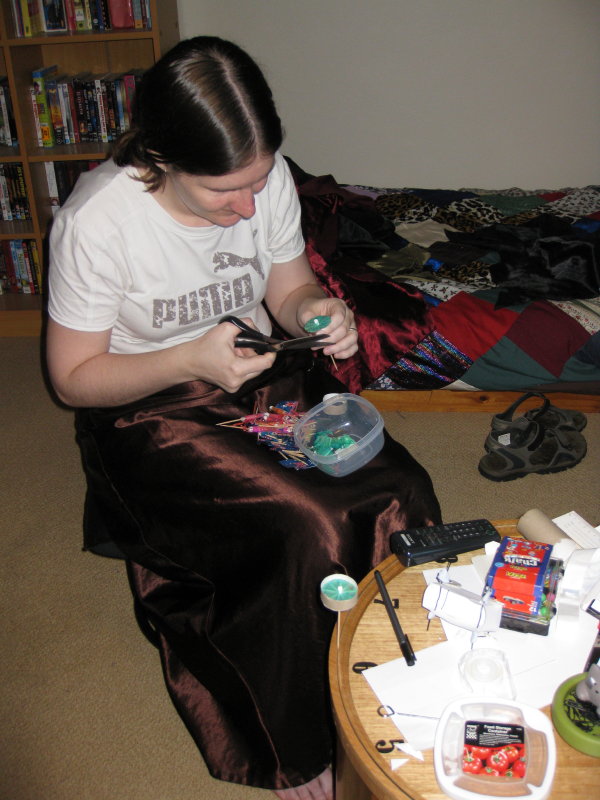

We had some friends drop by, who watched my “craft” with horrified fascination. It was quite embarrassing because I don’t know them all that well, and this was a VERY steep (and dodgy) learning curve.
But.
After learning a huge amount (particularly the importance of axle grease, and the joy of SCIENCE!!*), I had a semi-functional steam engine (minus the steam engine part, which is too heavy and too flammable – but I know where it goes, and what it would look like).
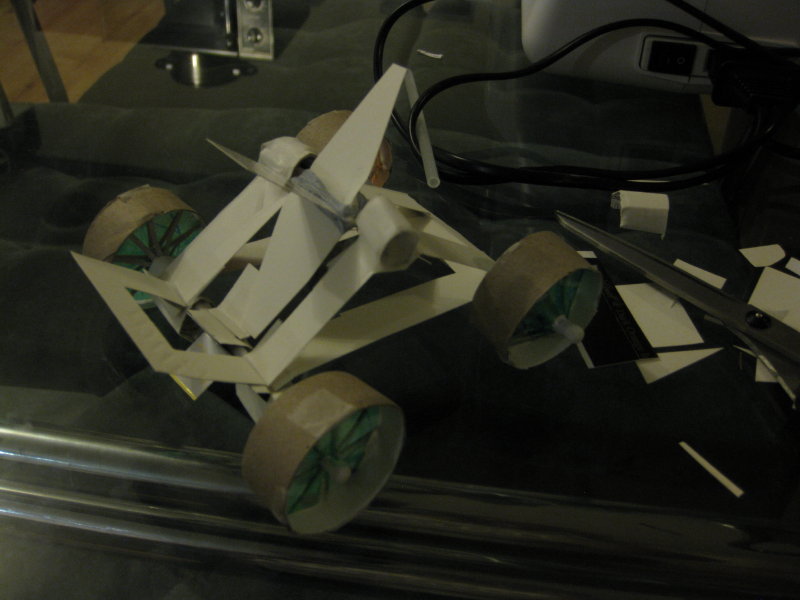
Basically, the steam engine sits on the back and blows steam onto the large cog, which turns the smaller cog at the front, which turns the front wheels (the back wheels are pulled along). To go forward, it blows steam downward onto the lower half of the big cog, and to go in reverse it blows steam up onto the higher part of the cog.
I expect I’ll build many more over the next few months.
In the meantime, here’s a general writerly-type interview I did for another blog:
http://www.katierunyon.com/phpBB3/myblog.php/2011/01/06/20-questions-louise-curtis/
*Those who read the Girl Genius graphic novels by Phil and Kaja Foglio will know what I mean. (Ditto for those who like cackling in basements while wearing welding goggles – which, if I’m not mistaken, is all of you.)

 Felicity Banks