Beginner’s Interactive Fiction, Part One: Twine in Five Minutes
Interactive fiction is any story that involves the reader in the story, usually by giving them choices along the way that change the text.
“Twine” is a tool that creates a story map as you write your story. It’s shockingly easy to use (speaking as a person who has major struggles operating her own phone).
STEP ONE: Go to Twinery.org, which looks like this:

If you can, download it as a desktop app. Otherwise, click on “Use it in your browser”. Press skip (or don’t press skip, and go through a quick tutorial that is better than this) and you’ll get to the screen that looks like this (if you are using the desktop app it won’t have the warning):

On the top left, click on “+New”. You can type in a title if you like, or leave it as “Untitled Story”.
Your new story looks like this:

Yay! You are now writing a story in Twine.
STEP TWO: Double click on the box in the middle of the blue space. Then your screen will look like this:

In the white box (aka a bigger version of the little blue box), type the first few sentences of your story.
Writing tip: In interactive fiction, most readers want you to get to a choice as quickly as possible, ideally within 300 words. This applies to every choice!
I am starting with two useful story hooks: An interesting setting, and an interesting problem.
Writing tip: Interactive fiction is usually a game (even when there are no sounds or pictures or animations), so using tropes is a VERY GOOD thing eg. Dirty violent pirates; dangerous nature; femme fatales or mad scientists. Try to think of your story as a game. If you were writing a pirate game, you would definitely want fighting, alcohol, historical weapons, and danger—so make sure those things are present in your story. When I wrote “Scarlet Sails” I started with a list of every pirate trope I could think of: betrayal, rum, ambition, gold, evil mermaids, treasure, sea monster, storms. Then I made a plot that linked them all. That is my most successful story.

STEP THREE: Make at least two choices (you can make as many as you like, but it will get out of control extremely quickly, so I recommend starting with two).
I have chosen:
- Take Redbeard’s sword and challenge his friend to a fight to show how fierce you are.
- Sneak up the other ladder and dive overboard—perhaps you can swim the rest of the way.
In order to tell the computer that I want them to be choices, I type them up like this, with double square brackets at the beginning and end.
[[Take Redbeard’s sword and challenge his friend to a fight to show how fierce you are.]]
[[Sneak up the other ladder and dive overboard—perhaps you can swim the rest of the way.]]
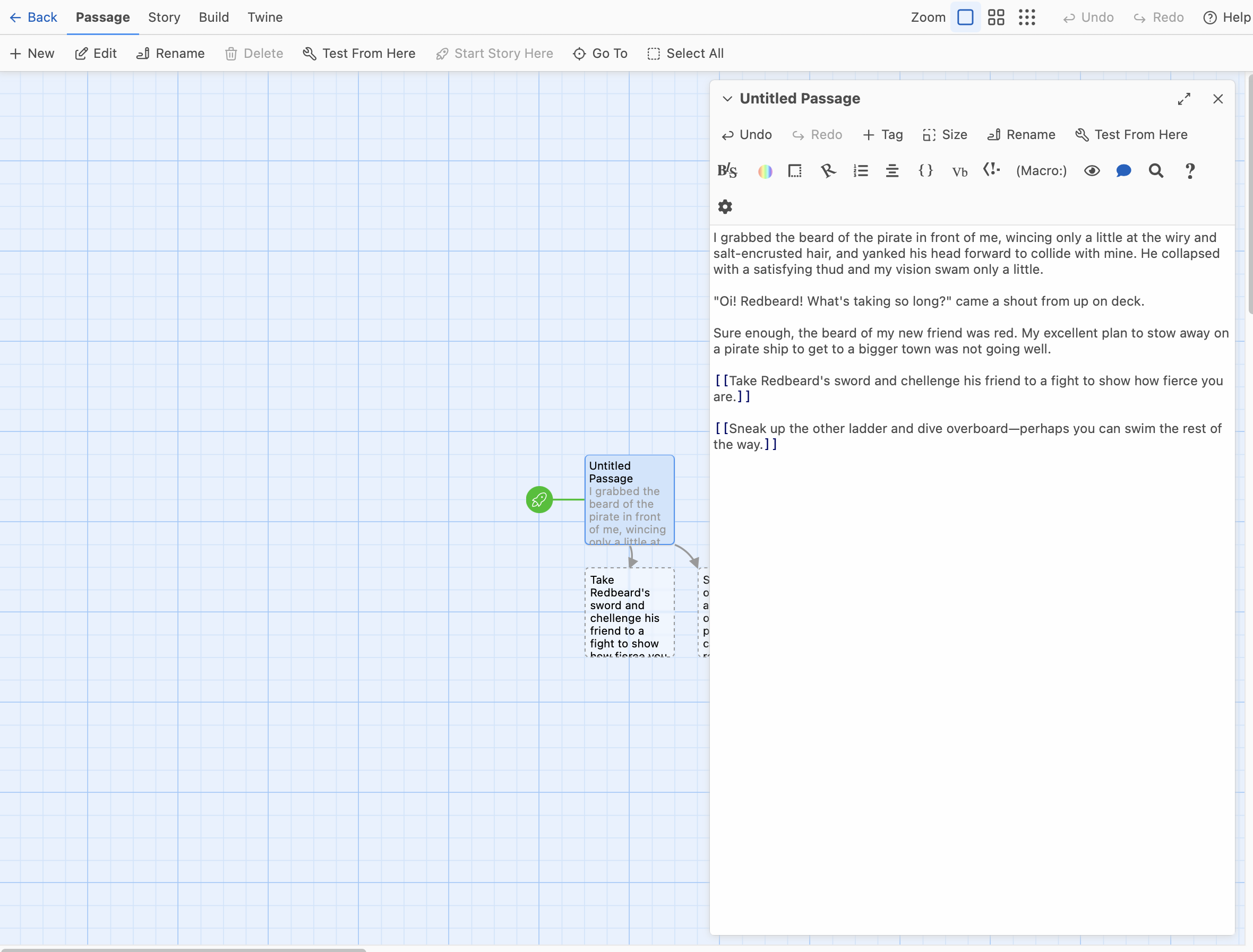
Twine instantly creates two new boxes; one for each choice. You can rearrange the boxes by clicking on them and dragging them around. Here’s the same page after I’ve rearranged them so I can see everything better:

To write the next sections, I double-click on either box and start typing the next bit of the story. Here I’ve written a bit of story and another pair of choices. Because I used [[ and ]] again, Twine has made two more boxes for me.
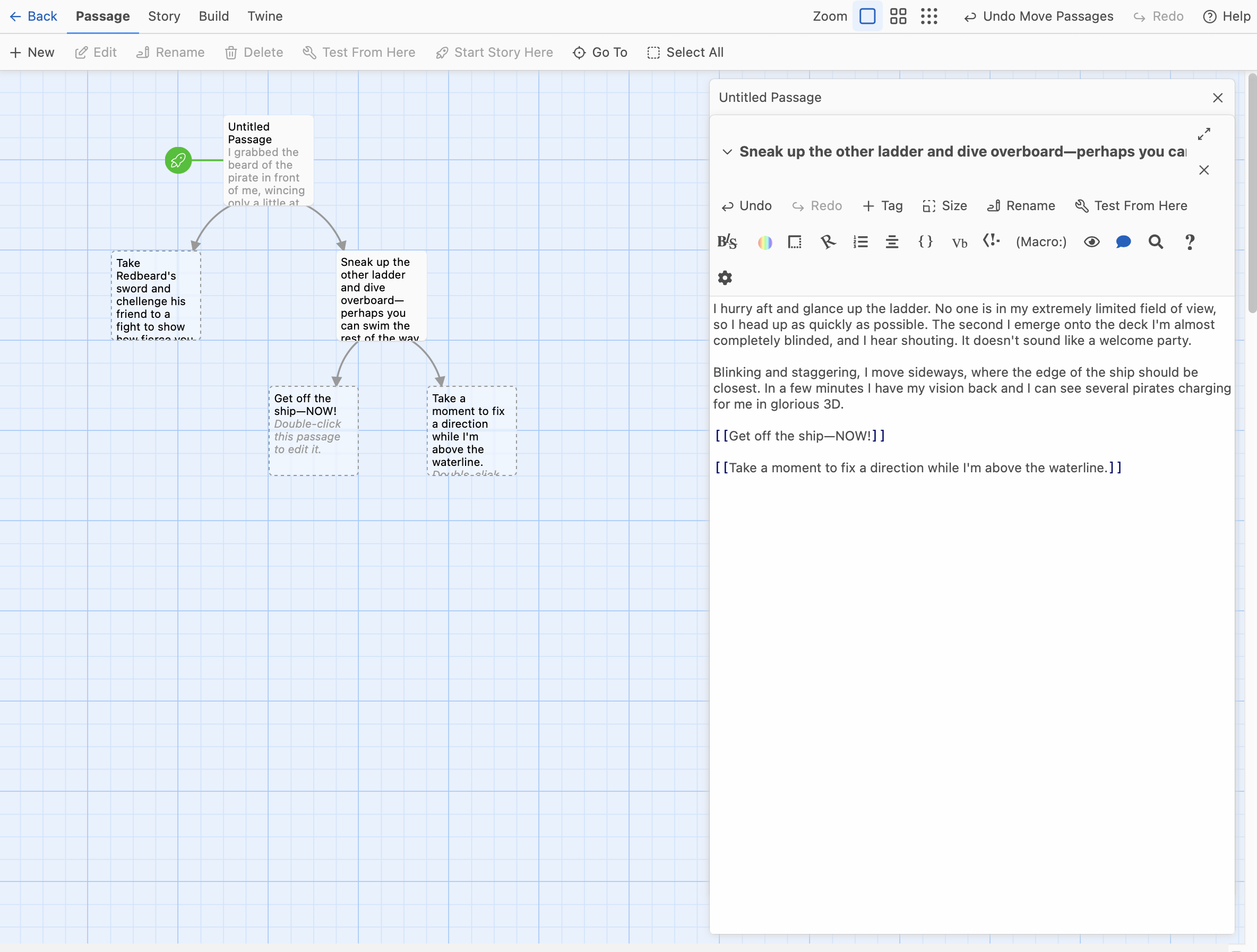
And the story is up and running!
Let’s stop here and see how it looks for a reader. Click once to highlight the original box (the one with your title or “Untitled Passage”) then go up to the menu and click on “Test from here”. It will automatically open a new window.
The choices are in bright text, and I can click on either of them. I choose the second choice.
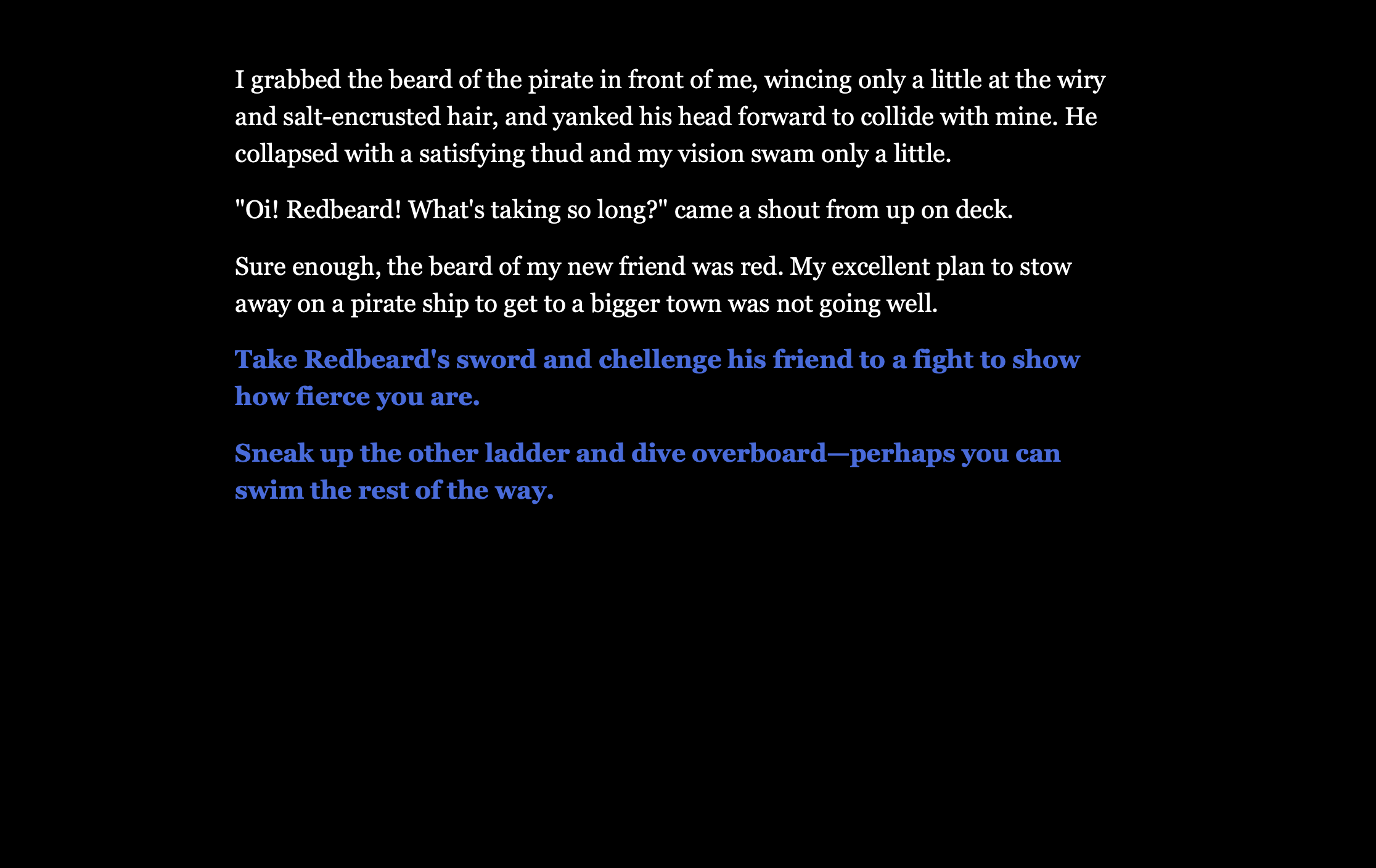

If I click on either of these choices I get a blank screen, because I haven’t written them yet.
Note the “back” arrow on the top left of the black screen. If the reader changes their mind about a choice, they can go back.
Aaaand that’s it! That’s how you write a story in Twine! Congratulations! Here’s a kitten picture to celebrate.

BUT if you used your browser, you MUST save after each session, because if you don’t touch your story for seven days it will be deleted.
STEP FOUR: Saving your story.
Close your ‘testing’ browser window so you’re back to your usual blue screen. Click on “Build” in the upper menu, then “Publish to file” on the menu that appears below it.
Your story file will go to your downloads folder, and if you open it, it will look exactly like it does when you test it online (but it will not require an internet connection to open). You can email it to friends to read.
Writing Tip: Did you notice the typo in the very first choice in this story? “chellenge” should be “challenge”. The easiest way to fix it is in the very first box, here, where the choice is written:
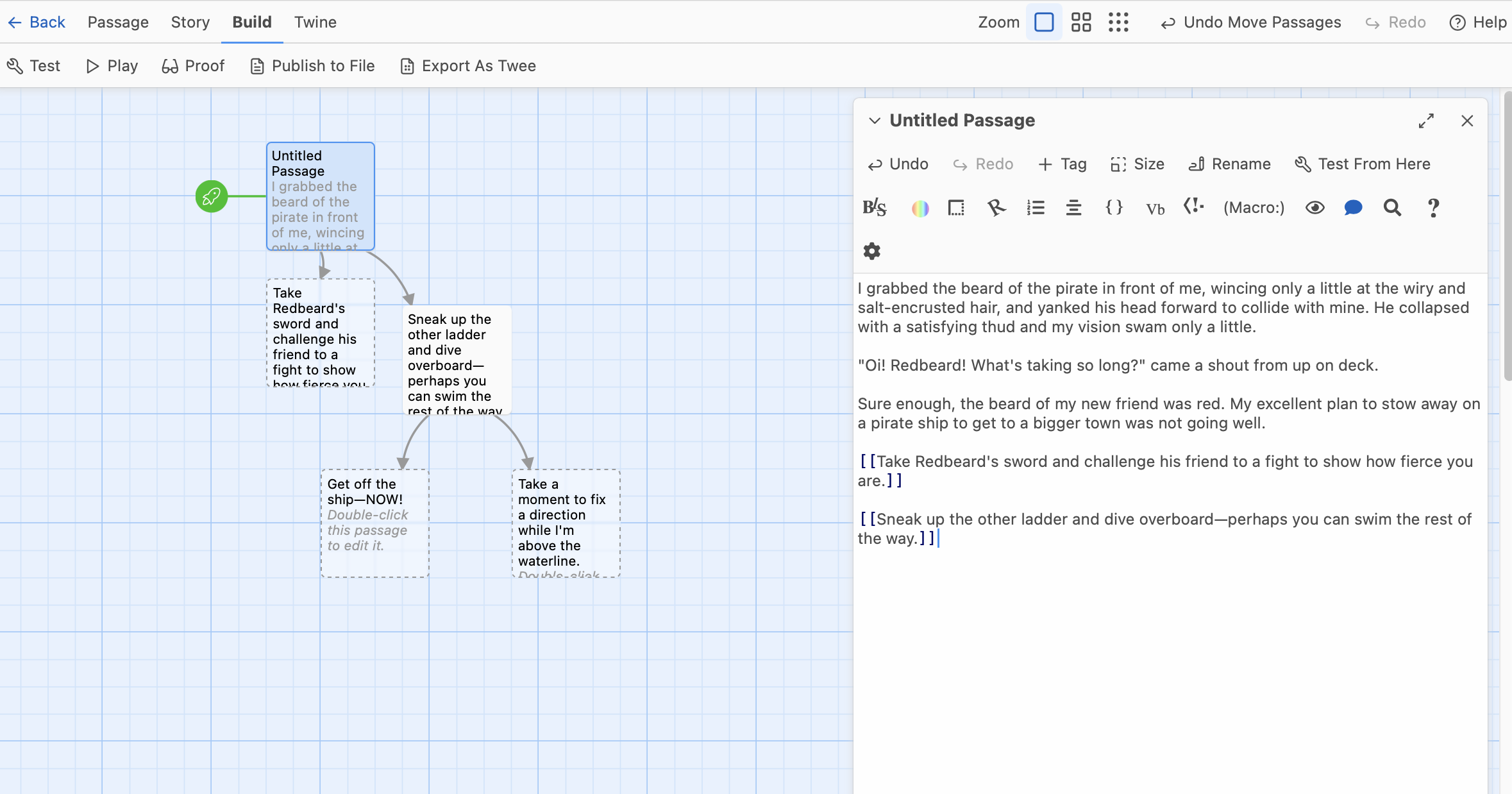
It will automatically fix the typo in the title of the next box.
STEP FIVE: When you’re ready to learn more, go back to Twinery.org and pay attention to this section:

There are great articles for beginners on the left.
And, Twine comes in four “flavours”: Chapbook, Harlowe, Snowman, and SugarCube. Once you’re getting better at Twine, you’ll need to pick which one or ones suits you best. Use the “Twine Cookbook” to decide which one you want to try, then use the online guide on the right.
STEP SIX: Time to join the community.
The interactive fiction community is pretty great. It is usually very inclusive (especially of women and LGBTIQA+ people). One of the places people hang out is https://intfiction.org and it is definitely worth signing up and having a look around, then joining in the conversations. (They’re getting a lot of spam at the moment, so it may take a little while to prove you’re human.)
Welcome, and enjoy!
The next lessons will include writing with ChoiceScript (which is better than Twine at book-length stories), the Choice of Games forum (for users of ChoiceScript), and how to keep your many many branches under control.
The income of the full-time author
Many years ago, I learned that the average full-time writer in Australia earns $12,000 per year (that is, considerably less than minimum wage).
Here’s what I earned over the last three years:
$20,000.
-$10,000.
$5000.
Soooo…. this year was better than last year. Yay?
The main reason I lost so much money last financial year was that I accidentally started a small business—”Murder in the Mail” and “Magic in the Mail”. Starting a small business is even more expensive than writing for a living—and yes, I’m still very behind financially on those stories (which, in small business terms, is perfectly normal).
Don’t start a small business, kids. (I mean, unless it’s what you really want to do, and you’ve saved up a huge pile of money to invest.)
As you can imagine, all this puts a huge strain on our finances. Which in turn puts a huge stress on my already-teetering mental health. Not to mention physical health (as a relatively minor example, I currently need a CPAP machine to treat my sleep apnea—that’s been on the ‘to-do’ list for about a year so far).
I’m relatively lucky, by writer standards. Weirdly enough, the main reason I’m able to write full time is that I’m not well enough to do anything else (so our finances would suck whether I wrote or not). And I also have a husband who works full-time. It’s a dirty secret that most full-time writers have a spouse who’s paying most of the bills.
The positive side of this is that writing doesn’t have to be expensive. You got a computer? at least one finger? Internet? That’s all you need. (Yes, it’s a good idea to do professional development and networking and so on, but you genuinely don’t need to bother until you’ve written and polished at least one novel, which most people will never do.)
(Yes, writing takes time. If you care about it, you find time. If not, then why fight it? Watch TV instead, or garden, or whatever.)
If you want to write, write. But remember that every dream has a cost.

Say what??
This weekend is the Canberra Writers Festival, and I have not one but TWO book launches.
Saturday is the official launch of MURDER IN THE MAIL: A BLOODY BIRTHDAY (complete with a week-long art installation) at The Front cafe & gallery (Lyneham shops, 3:30-5pm). It’s not officially connected to the Canberra Writers Festival at all, just happening on the same weekend.
Sunday is the official launch of ANTIPODEAN QUEEN 3: IRON LIGHTS at Kings Hall in Old Parliament House (2:45-3:15pm).
Here’s where it gets interesting.
The organiser told me that Kings Hall had standing room only for up to fifty people, and no catering available.
This is a pic of Kings Hall from the Museum of Australian Democracy (aka Old Parliament House) web site:

So it looks like there may have been a typo in the organiser’s info. Just a zero. Nothing much.
The space is suitable for FIVE HUNDRED PEOPLE.
From the MOAD web site: “The bronze statue of King George V in the regalia of the Order of the Garter has been a central feature of the hall since the opening of the building in 1927. Open to the public from the earliest days and situated between the House of Representatives and Senate Chambers, it was a busy crossroads. During parliamentary sittings King’s Hall was a hive of activity swarming with members and senators, officers, journalists, secretaries, public servants, lobbyists and tourists.”
It’s really just a foyer/hallway. But WHAT a foyer (from the same web site).

Since then I’ve spoken to the organiser again, who assured me there’s lots of other stuff going on, and that his description of “standing room only for 50 people” was accurate.
So, in conclusion, the space is SOMEWHERE between tiny and enormous. We may or may not have a microphone. We may have all of Old Parliament House mostly to ourselves, or we may be cramped behind a column in the foyer. Anything could happen!
See you Sunday?
Book Week activity for pre-school to Year 4 kids
Last year, I wrote a story with my daughter’s Kindy class. This year I’m going one better (or at least noisier) and writing a story with my son’s pre-school class. This is a fairly fancy* pre-school, so even in pre-school the kids are encouraged to write their own names, and most can write the first letter.
I start off the class by saying that I’m a writer, and waving a book around—perhaps one of mine; perhaps one from their shelf (pointing out the author name in either case).
Optional parts of the opening (for older kids):
-Talking about how a lot of books have both an author/writer and artist/illustrator.
-Talking about how books can be true stories or made-up stories (fiction and non-fiction), keeping in mind that younger kids genuinely can’t distinguish between reality and fiction in the same way older kids can.
-Talking about how writers send their words to a publisher, who arranges printing and sends the books to a shop.
-Reading a book to the class.
The central message of the opening spiel:
I have written a book but it’s not finished and I need your help! There are no names in the book, and no pictures!
Preparation:
-A binder with lots of those clear plastic sheets inside, like these.

-A title page and beginning to the story, an end, and a lot of pages that are complete (and interchangeable) except for requiring a name.
Eg. For pre-schoolers:
Title Page:
1R [or whatever the class is called] Story
Page 1:
One day there was a pre-school class with lots of friends.
Middle (many copies of each):
______ is clever.
______ is kind.
______ is strong.
______ is funny.
Final page: What a great class! The End
I explained that there were four describing words and that all of the kids were all of those four things, but they needed to pick their favourite (and I also had four people—my two kids, and two teachers) stand in different parts of the room to gather their groups (the kind group, the strong group, the clever group, and the funny group). I was quite pleased with how gender-diverse the results were (although of course one boy said “[Girlname] isn’t strong!” and I said, “Yes she is!” and moved on).
Then I handed out the piles to each group, and had the kids write their names and draw a picture on their page, giving them back to me when they finished.
I put them back into the folder in random order, checked it was all legible, and then when everyone was done I gathered them back on the mat and read the finished story. Then I let the class have the finished story. (The teachers can photocopy it and email copies to all the parents if they want.)

Feel free to use and adapt this lesson as much as you like.
If you feel grateful, buy one of my books from my store. The Monster Apprentice is suitable for 8+ (it’s like Narnia with pirates) and the Antipodean Queen steampunk fantasy books are suitable for 13+ (with bonus bits of much-mangled Aussie history). In both cases, advanced kids can go ahead and read them at a younger age. I read The Monster Apprentice aloud to Louisette when she was 5, but skipped a couple of scary bits.
*debate the merits of early literacy training in the comments!
Author Photo
Every so often I get asked for an author photo. Here are some that I use pretty often:

Nice and steampunky, but WILDLY out of date.

Amusing – captured just as the whistle blew, scaring the crap out of me. I’m actually (just barely) pregnant with Louisette in this photo.
Generally author pics want to see one’s face in perilous close-up, however.

A fairly nice pic… but of course having a kid in an author pic is a no-no for anyone who’s not writing picture books. So this is what I use:

These two were taken by Cat Sparks at Conflux 2017. I had makeup on and everythink. Cat Sparks must be acknowledged by anyone who uses these (which is sometimes awkward).
Selfie taken on a miniature train.

Selfie taken in the mirror, in costume, after my operation.

What would you use if these were your choices, and you were an author trying to look super interesting and absolutely worth reading?
I think my favourite is the miniature train selfie. I look happy, and pretty nice despite the lack of makeup. Good hair and background, and looking away implies imagination.
I always take pics of myself at appearances (when I’m Properly Dressed) but so far they’ve never turned out well. Usually the lighting is bad, and I’ve begged a random passer-by to take the picture. Plus they’re generally full length, so even if my face is looking good it’s not high enough quality for an author photo.
UPDATE: The brilliant Cat Sparks (yes, her again!) took a billion photos of me at my latest book launch. These are the best, and I think the one that I accidentally posted twice is the absolute winner.


Murder for Kick(starter)
Last Saturday at midnight, my first ever Kickstarter Campaign ended, raising funds via pre-orders (and special rewards) for “Murder in the Mail: A Bloody Birthday”.
Mistakes were made.
One of my main mistakes was that, after looking at the Australia Post web site, I thought an A4 envelope thinner than 2cm would cost $1.
Turns out they cost $2.
Ouch.
Another was that I sent out my review copies too late. Only one actually arrived in time to get a review during the campaign (and that was mainly because I literally delivered it to her door here in Canberra). You can read that review here, and listen to her interview here.
Other review copies went elsewhere in Australia, to New Zealand, the US, and Canada. Last I’ve heard, NONE of them have been fully received yet. I do know that the first envelope took almost a month to reach Canada.

(Review copies ready to get their postage on – John Scalzi is on top because his address is public.)
So, as I mentioned, the Kickstarter is over now.
I mentioned “Murder in the Mail” on a few forums when the Kickstarter began (int-fiction and choiceofgames.com, which I’m fond of), and there was a clear bump in US sales as a result, and a little bit of conversation in those forums.
But asking $40 for a thing that doesn’t technically exist yet is a lot! Even though this is dramatically cheaper than anything else similar.

(That pic is review copies getting put together)
I also didn’t realise in my planning that Kickstarter’s maximum time for a campaign is 60 days. I’d been planning a three-month campaign (which included Melbourne Supanova, as well as giving the writing team more time to get certain bits and pieces done in time for those review copies). So that was… unhelpful.
I also named an extra-high amount because… oh, I can’t even remember properly. I need to sell around 100 copies to break even, but there are so many tiny expenses (seed envelopes, special pens, etc) that I would have to audit myself to figure out the actual cost (as opposed to the estimated cost).
That’s not quite true. I’ve been careful to record everything over about $2, and I do know how much I’ve spent. I’ve just ordered a bunch of stuff printed in batches of 100, so after that invoice comes in I’ll know what the actual total cost per 100 turned out to be (approximately; I bought larger quantities of some of the items because it was cheaper that way). Plus I know Kickstarter can take up to 10% (depending on… stuff I don’t understand enough to calculate) so I figured 100 x $40 = $4000; eh, let’s make it $5000. It all seemed so shiny and easy back then. NB: I don’t have to sell 100 copies during the Kickstarter to break even. Didn’t remember that at the time.

(Louisette and I making up hand-written packets of sunflowers that we harvested from our own garden. If the reader plants them in late Spring/early Summer, I think they’ll actually grow.)
Ultimately (and very much saved by the loving support of extremely trusting parents and in-laws) the Kickstarter was a success.
I am VERY relieved, as you can imagine! Kickstarter has a rather exciting rule that if you’re not fully funded by the end of the campaign period, you get nothing. All the pledges already made simply vanish into thin air!
So that didn’t happen, but my parents & in-laws are unlikely to save the day so dramatically in future.
So…..
There WILL be a new story. This one will be fantasy, called “Magic in the Mail: Feuding Fae”. It will have 3 parcels instead of 8, and although it’ll have a Kickstarter Campaign the goal will be much smaller.
I’ll also be selling special boxes/folders of “Murder in the Mail: A Bloody Birthday” at all the conferences I attend this year.

(An array of pretty containers for the story.)
Specifically, these:
Melbourne Supanova (April) in the Artist Alley stall “Aussie Spec Fic”
Nimmitabel Steampunk Fair (May)
Sydney Supanova (June) in the Artist Alley stall “Publisher Obscura”
GammaCon Canberra (August) in Artist Alley
Canberra Launch (probably as part of the Canberra Writers’ Festival) August
Conflux Canberra (September-October)
Goulburn Waterworks Steampunk and Victoriana Fair (October)
There will be limited quantities of the packaged version, so email me in advance if you’d like to reserve one.
You can of course also give me money pretty much whenever (at conferences or online) to get a copy posted to you over the normal 8 week period (or in a single parcel if you absolutely insist).
There will be one “lot” posted out in June-July, another in September-October, and then… more mail-outs sometime after that 🙂
“Murder in the Mail: A Bloody Birthday” will be officially launched in August 2018, and will be available to buy until September 2019.
“Magic in the Mail: Feuding Fae” won’t be finished until 2019, although if you specifically want to order THAT story then just make it clear when you email me (and/or email MagicintheMailStories@gmail.com). Keeping in mind it MIGHT be cheaper than $40. I’ll probably have a price in a couple of months. I already have some REALLY COOL STUFF AND ART AND THINGS.
The simplest way to get the story is to email me at MurderintheMailStories@gmail.com with your ADDRESS, EMAIL (in case things go wrong), and PAYMENT DETAILS (eg “I just deposited the full payment into your account/PayPal, under the name “Bob Flibbertigibbet”).
Make sure to label your payments with something unique to you (your name and/or the name of the recipient). Labelling things “Murder in the Mail” will NOT be helpful.
PayPal: MurderintheMailStories@gmail.com
Bank details:
Commonwealth Bank (Australia)
06 2692
3320 8197
And here’s a spot the difference game. If you’re very familiar with the Odyssey list, you’ll be able to tell which author was recruited at the last minute from these two pictures.


Many many thanks go to Shauna O’Meara, the artist, for altering that pic more than once after it was finished. And to A Certain Writer for enthusiastically jumping on board when one of the other writers had to drop out.
Both will most definitely be involved in the next story!
(PS I don’t think anyone actually will solve this picture. There’s a LOT of stuff in it.)
Dear Star Wars: Here is Your Script
I don’t often write fan fiction.
So this kind of happened as I wrote my thoughts after seeing “Star Wars: The Last Jedi” (I had so many feels it took me days to write and is 3000 words long.) It’s a VERY interesting film for writers, and so of course I analysed it in that vein.
The full (very spoiler-y) article is here, on a shiny new forum I’ve set up for the “Murder in the Mail” series. You can read the article immediately, but you need to register to comment. (If you register, you’ll get about three emails a year about the “Murder in the Mail” series, unless you unsubscribe.)
The “Murder in the Mail” series is a set of cozy mystery stories (one story so far, to be released in August/September 2018) told entirely through letters, postcards, objects, and art posted to the reader over the course of eight weeks. The forum is for fun (discussing things like Star Wars, and so on), and also for readers to talk amongst themselves and try to figure out the identity of the murderer before the final letter arrives.
There is (arguably) a VERY mild general character-based Star Wars spoiler below.
Basically I figured out the One True Way to resolve all the possible romances of the current Star Wars trilogy. Because I am a genius.
Insert anti-spoiler kitty!

Rose: *Takes Rey to a storage area where they can talk privately* So you’re a big hero, just like Finn. I guess you guys are… you know…
Rey: Um. *blushes furiously* Well I might sort of kind of think of him a little tiny bit that way. Maybe.
Finn: *Emerges bleary-eyed and shirtless from under canvas, and clutches it around his hips so the girls don’t see EVERYTHING* Rose? Rey? What are you doing here?
Rose and Rey: *wide-eyed panic*
Rey: You. . . heard us talking?
Finn: Me? Nope. Nuh-uh. Didn’t hear a thing. *Accidentally-on-purpose jabs his elbow into the canvas*
Poe: *Emerges bleary-eyed and shirtless from under canvas, clutching canvas around his hips, and hastily donning That Jacket* Oh, hi Rose. Hi Rey.
Rose and Rey: Ohhhhh! Er, we’ll just be going now.
Rose and Rey: *become best friends*
Finn and Poe: *adopt half a dozen children and live on a porg farm forever*
What I earned this year
Full-time writers in Australia have an average income of around $12,000 (I know, yikes). In Canberra, which has a lot of good public service jobs, the average income is around $52,000.
I just did my taxes, and worked out that I earned just under $20,000 last financial year while working full-time. 100% of that came from writing (the vast majority from interactive fiction). So depending on one’s perspective, that’s either really impressively awesome, or shockingly awful.
If I was healthy and single and childless, I could probably survive on $20,000 a year. It wouldn’t be easy, but I’ve lived on the edge before. (I once spent $5/week on food for several months—but that was certainly not sustainable, even for a young and healthy person during friendly weather.) On the other hand, if I’d been babysitting for the same number of hours I spent writing, I’d have earned at least twice as much.
So, again, whether it’s awesomely good or awesomely bad is a matter of perspective.
It should be noted that I’m not healthy, or single, or childless. I keep a complicated house running fairly smoothly, and I look after two little people (and, in some respects, Chris—he is my carer in many ways, and I am his in some ways too). I am overwhelmingly not a healthy person, and some days I barely function at all.
So. $20,000. It’s both a huge and a tiny amount, and it’s $20,000 more than I earned for most of my writing career. Plus I can say “writing career” without sarcastic quotes these days.
It’s in my nature to always push myself for more. I’m sure that if I earned $100,000 last financial year I’d be looking for ways to earn more, or work less, or something. A lot of creative people look at others and think, “Wow. If my career was where theirs is, I’d be so satisfied!” I definitely remember specifically aiming for the impossible amount of $20,000/year at some point—a point at which $20,000 was as laughable as $100,000 is now.
I also have a book published—two, in fact, and at least four more on the way. I’m so famous that people seek me out at conferences, waiting for my latest book. I get fan mail quite often. I get people—quite a few people—saying “This is the best story I’ve ever read”. I even get actual reputable game companies emailing me to offer me work (I have two REALLY COOL projects on the go at the moment that I can’t talk about). My income doesn’t even cover our mortgage (or the medical expenses of this year), but why should it? I’m the closest thing to a stay at home parent our household has, so I’m doing a bunch of important and often difficult work before I earn a cent.
Have I convinced you that I’m not just messing around with this writing thing (after more than twenty years of devoting myself to the craft)? More importantly, have I convinced myself? Maybe a little bit. Certainly it’s time to pause and celebrate how far I’ve come, and to shift some of my pile of insecurities into the “irrational” pile.
So, yay. Much yay. And I suspect this financial year will be even better!

Artist’s impression of a life of leisure.
Conflux 13: Day 3 (& ChoiceScript)
Today, Sunday, was my Big Day. Not only did I have a Book Launch at 2pm…

…but I also ran a three-hour interactive fiction workshop in the morning.
Which was seriously awesome. (So was the Book Launch. If you haven’t seen the trailer, it’s here.)
The workshop was very biased, naturally, since it is all about my own notions regarding interactive fiction. This article, which I wrote last year, is an excellent summary of the IF scene (as I see it, having stumbled across it very recently).
This article focuses on the different elements of writing interactive novels as opposed to regular novels.
Today’s workshop was brimming with people who’d already written novels, which was quite different to last year. Last year we focused on Twine, the free tool that makes a useful map as you write and is the most user-friendly tool ever. This year we focused on ChoiceScript, which is a lovely elegant engine, also designed for non-programmers, made by Choice of Games. It’s easier to write longer works with ChoiceScript, because it’s set up for that (you can write longer pieces on Twine, but it’s trickier to do anything clever). More on that in a bit. FYI I’m not associated or affiliated with Choice of Games in any way.
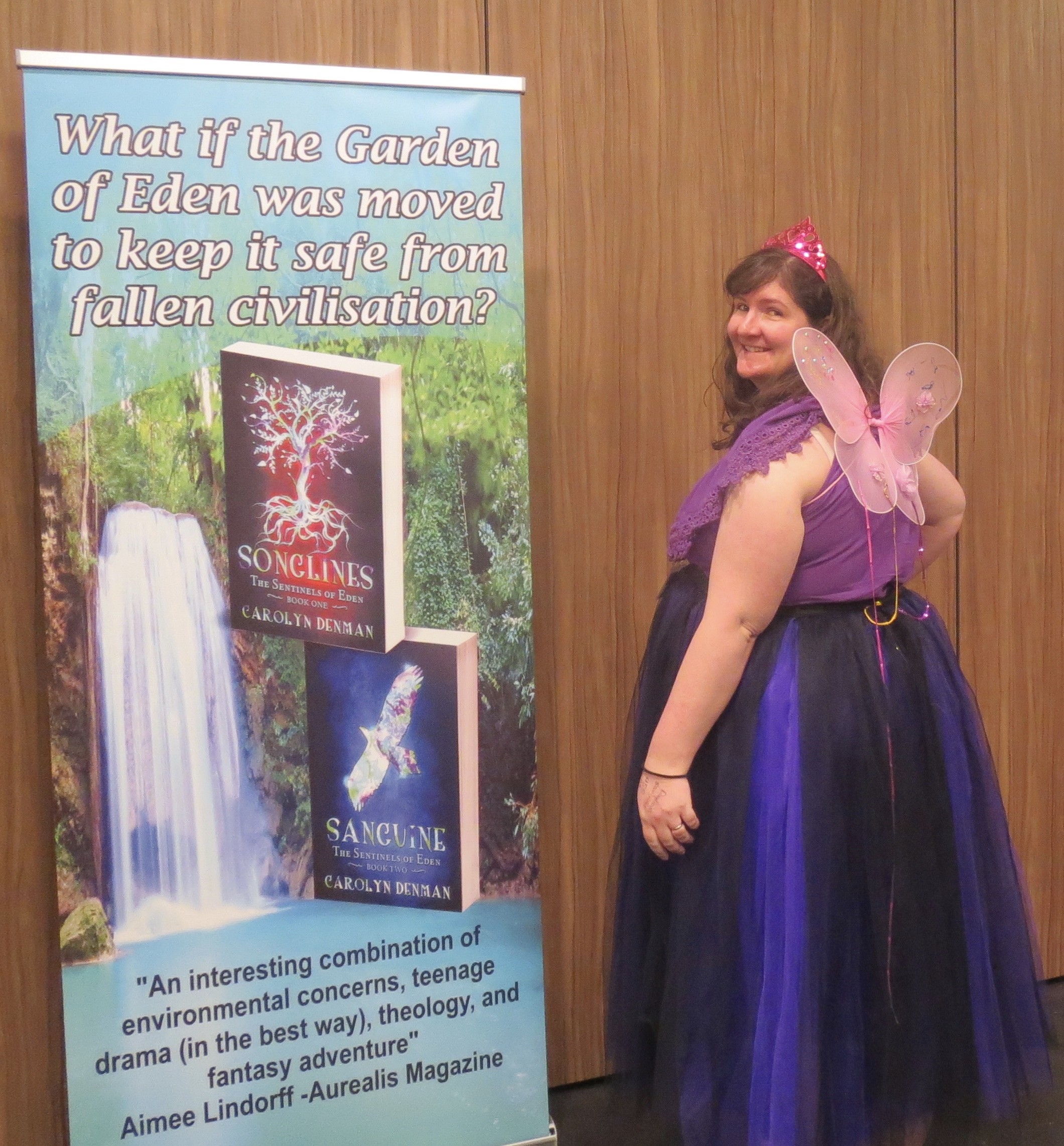
I believe I promised a pic of yesterday’s outfit. Here it is (next to an ad for the excellent “Sentinels of Eden” series which I also mentioned yesterday).
I’ve spent the rest of the day in Conflux mode… that is, hanging around talking to interesting people. My love for the venue is only growing with greater familiarity. Apart from anything else, they DO have special free conference wifi. And SO many power points, just everywhere *swoon*. The staff continue to be absolutely excellent. The food is pretty good but expensive and the menu is fairly limited. Huge portions.
A lot of local people are unhappy Conflux is at the airport, which isn’t great for most Canberrans (especially those who rely on buses—the special shuttle to or from Civic has been helpful). Next year’s venue is TBA. Parking underneath the hotel costs $6 for up to two hours but over $20 for a full day. For people that validated their ticket at reception, a whole day costs $14. There was plenty of space.
People like me (ie with a disability card) can park in a funny little 2-hour carpark that’s on the right as you drive around the hotel on your way to the front door. There are no designated disabled spots but with a card you can use public 2-hour parking for a full day for free. So the key to Conflux parking is to have a disability card but still be able to drive. For me, it was a breeze, and much much nicer than anywhere in civic.
And it’s pretty.
There’s a moment at sunset when everyone in the foyer suddenly has a golden halo. When the moment passes, the brass lamps all come on (not these ones; other ones). It’s quite lovely.

The banquet was suitably glorious, and a very fine evening. Each item on the menu was linked to fairy tales. I ate a Goose’s Golden Egg for dessert (filled with panna cotta).

There’s a Trivia Night tonight, but I shall be going home to sleep.
Thus endeth today’s Conflux Report.
I promised to write out a few very useful bits of code for those who are learning ChoiceScript. This is reinventing the wheel to a large extent, since the official ChoiceScript guides, including a free link to download it, are excellent.
So is the wiki, which has had many years to be refined and expanded. The Twine documents are improving, but they’re newer and trickier, and there are significant changes from Twine1 to Twine2.
When you download ChoiceScript, it has some very basic intro scenes, choices, and statistics set up for you. When you want to start writing, you can just delete a bit and begin.
HOW TO WRITE A CHOICE:
To “play” the example game, follow this path (it works on PC or Mac):

It works best with Firefox, but most browsers are fine (other than, oddly, Google Chrome).
It’s fairly ordinary-looking visually, but it is immediately obvious how to progress the story (Click on a choice, then click on ‘Next’). Your text will be different to this image, because I’ve long since replaced the example with my own.

To see the code behind the story, follow this path (using a text editing program—I recommend Notepad++ for PC and Sublime for Macs):
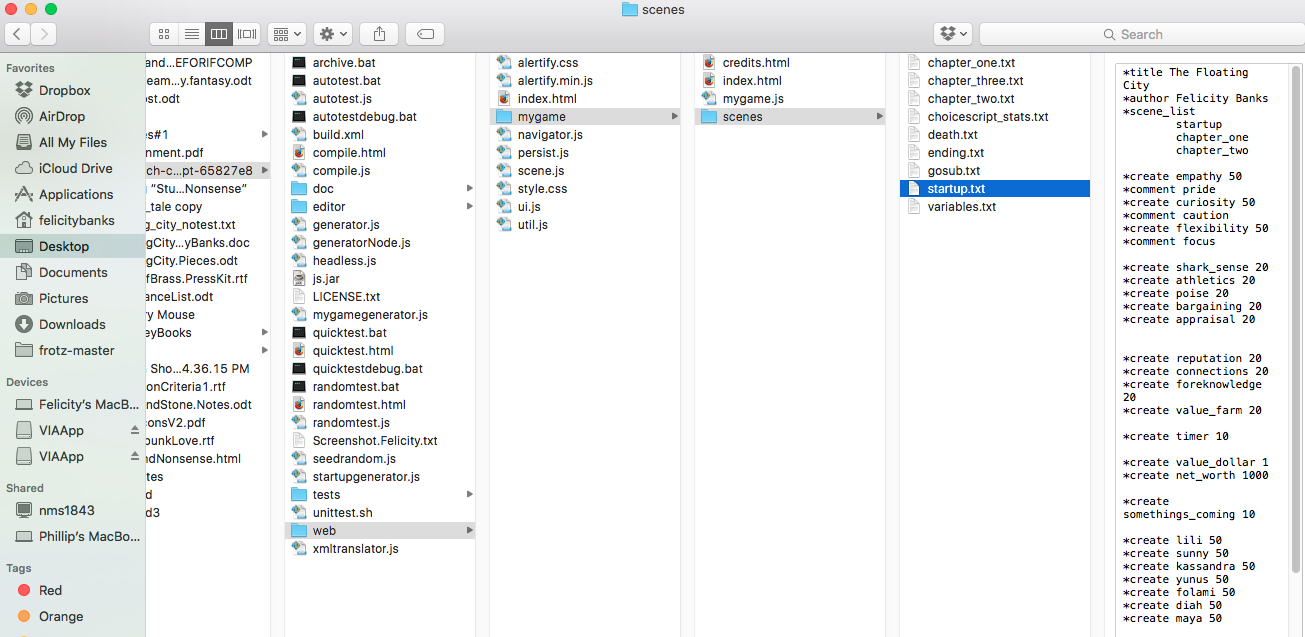
The right-hand column above shows the startup file for the story I’m currently writing (so nobody look, okay?)
Don’t panic when you see a bunch of words and symbols. It will be okay.
NB: Each chapter of your book will be in a separate text file. You can name them whatever you like.
You can switch between the browser and the text file to see how the text file alters the story that you’re reading in the browser. The best thing to do is to just put your own words in, and you’ll be able to see them immediately fit the playable ChoiceScript format.
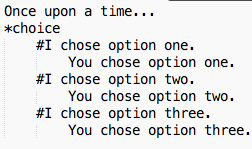
So if you write exactly this (at the END of the startup file, replacing the kingdom bit):
Then you go back to the index.html file, it will look like:
The * and # symbols are vital, and so is the spacing at the beginning of your lines. You can use either tab or spacebar to indent what needs indenting, but you have to pick one and stick to it or the game will break. Those three keys are the heart of your writing from now on.
If the reader picks “I choose option one” above, the line of text will appear, saying, “You chose option one.” Your story works—but so far you haven’t told the program what to do next (thus, the game will break immediately after that line).
Some structural info:
Many stories have a “branch and bottleneck” structure. Choices (often a whole series of nested choices) branch off in different directions, then different directions again… and then there’a a point at which they all come together, and then the choices branch out again from there. Here’s a diagram example using twine:

As a writer, the hard part isn’t branching your story; it’s bringing things back to bottlenecks (so you don’t end up with literally millions of utterly different stories). One handy way is with time, eg:
“The sun is setting. Enough mucking around. It’s time to…”
“Mucking around” is non-specific enough to cover all the possible adventures the character might just have experienced. Or you can leave out that sentence altogether.
Back to your basic ChoiceScript thing:
A lot of choices within a story bottleneck immediately, which is written as:
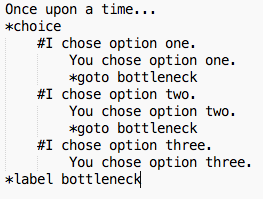
You can name your label whatever you like. Use lower case, avoid special characters, and remember each label must be different.
This is a simple choice structure that works. You don’t actually require the “goto” and “label” stuff unless you’re nesting choices, so a lot of the time it’s even simpler.
Whatever you write after “*label bottleneck” will be seen by all the readers, no matter what choice they made beforehand.
Anything that’s on a line marked with an * will not be seen by the reader.
If you want, you can write an entire story like this. The lines of unique text above (“You chose option one/two/three.”) are only seen by the readers that chose that option. Those lines can be expanded into literally any length, and can have other nested choices inside. ChoiceScript authors don’t have a wall diagram with string going everywhere; they have a ludicrous number of indentations as they write choices within choices within choices.
But you can also just bottleneck after each choice. That’s what smart authors do (for most of the choices, but not all of them—after all, you want your reader to have a unique experience). That’s how authors stay sane.
But how to make the choices matter in a deeper way?
[Tired? Breandead? Stop here and write some scenes. Come back later. This is where I stopped for a day when I was learning ChoiceScript.]
Choices have long-term consequences because of stats. Stats don’t create work; they are a brilliant and cumulative way of making hundreds of choices matter without writing a million-page book.
The two main types of statistics are personality based and skill based. So as your player makes their choices and has their adventures, you’re also noting what kind of character they are creating (think of them as a co-writer who’s in charge of the main character’s personality), as well as building their skill set (for later challenges that can be won or lost).
In ChoiceScript, you make your own unique statistics. The more unique the better!
One of the most distinctive & fun things about the ChoiceScript tool is that it often uses opposed statistics—so for example, you might have ‘Tactfulness’ versus ‘Straight Talker’. If a player chooses to be tactful, their tactfulness stat will go up and their ‘straight talker’ stat will go down.
HOW TO DO STATS:
First, go into the startup file. After the *scene_list but before the story begins, write this:
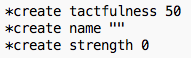
You can set any number of (single, lowercase) words as beginning stats.
Your Tactfulness versus Straight Talker opposed statistic will all be expressed (code-wise) as + or – tactfulness.
Your name stat will be a one-off choice (and the players can enter their own; instructions here).
Your strength starts at 0. It will grow with strength-based choices, and it will be tested at later choices.
The “show stats” button on the browser version of the story (that the players see) appears automatically.
To make the stats page look good, go into the choicescript_stats file (which you already have in the same “scenes” folder as the “startup” file), and write this:
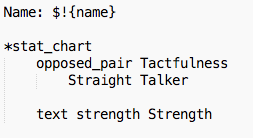
It will look like this to the player:

The numerical values will change as the player makes choices.
The ! makes sure that a word is capitalised (it’s also useful for pronouns—which we’ll talk about next—when they’re at the beginning of a sentence).
Here’s your first-choice example, with stats added:
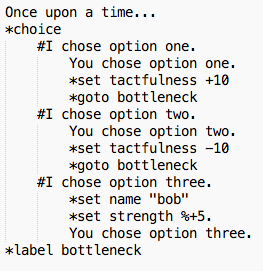
Now players who choose Option One have Tactfulness 60% (and Straight Talking 40%).
Players who choose Option Two have Straight Talking 60% (and Tactfulness 40%).
Behind the scenes, opposed stats are really just recording one stat going up or down, but they’re displayed with a red/blue bar for the player.
If the player chose Option Three, then “Bob” will appear after “Name:” in the player’s stat screen, AND their strength will be 5.
In the line “*set strength %+5” the % symbol is the key to avoiding maths. I have your attention now, don’t I? Long story short, if you use “%+” and “%-” for your stats, you will never get under 0% or over 100%. Is good.
Congratulations! You’ve written a functional choice that doesn’t break the game and that makes a difference to your statistics.
HOW TO DO GENDER:
In your startup file, write:

Then have a choice (early on) like this:
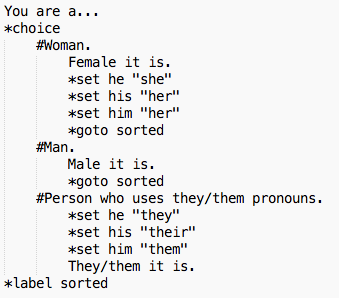
As you may have noticed above, you can put the stats and the text in any order. Since the player doesn’t see the stats (until they click on the button to see the stat page), it doesn’t make a difference. But consistency is a good idea.
Once you’ve done that, you can use pronouns, like so:
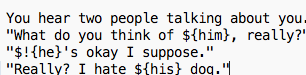
This text will appear normal to the player, but will have the right pronouns, eg:
You hear two people talking about you.
“What do you think of them, really?”
“They’s okay I suppose.”
“Really? I hate their dog.”
There are two important things to note here. (Okay, three.)
-You can write an entire novel without player-character (PC) pronouns if you’re determined (as I’ve done for “Choices That Matter” stories on iOS and Google Play via Tin Man Games).
-‘They’ is grammatically distinct. You probably noticed the painfully incorrect “They’s okay” above. If you include they/them pronouns, you will need to be very careful to avoid a similar grammar fail. But it’s worth it. The IF (Interactive Fiction) community works hard to be inclusive, especially with gender and sexuality.
-Using he/his/him as your “base stat” in the startup file works well because the three forms are distinct (unlike for she/her/her).
Erm, it’s just occurring to me that it might work better to use they/their/them as your base. I’m not smart enough to check the idea is sound without writing a novel to check, but I THINK it’ll help a bunch with both Point #3 and the Point #2.
WELL that was a long blog entry. Are you still here, dear reader? I’m off to eat dinner and have a lie down.
PS Guess what! It’s October! Who knew?
More Conflux tomorrow!
PS Two more super-useful sites for when you’ve finished that brilliant interactive fiction game.
Dashingdon hosts ChoiceScript games, and Philime.la hosts Twine games. Both are free, and both allow you to show your game to a select few (editors) before uploading/publishing a finished version.
Novels Versus Interactive Novels
This is a post written for Games Versus Play.
I write both novels and interactive novels, and I’m fascinated by the style differences between the two.
(This is how fascinated I am.)
When I write novels, I often write in first person (“I don’t deliberately make things explode”), and sometimes third person (“She doesn’t deliberately make things explode”). It is extremely rare to find a published novel written in second person (“You don’t deliberately make things explode”). Most people find second person very jarring. The famous exception is “Choose Your Own Adventure” novels, and I’ve seen a couple of modern children’s books written in second person.
The great thing about first person is that it’s easy to use a quirky writing style, and to see inside the main character’s head. In my opinion, it’s particularly good for young adult or crossover writing, when internal thoughts are often an important part of the plot. On the down side, you can’t see the thought processes of other characters, or any information the main character doesn’t know (such as, there is a bushfire coming).
Second person is favoured by a lot of interactive fiction, because it emphasises the reader’s involvement in the story.
It’s also common to have a different style for the text of the choices themselves. For example, Choice of Games uses second person for the main text, and first person for the choices (which is reversed in the Tin Man Games “Choices That Matter” serial story app).

The overwhelming majority of novels use past tense (“Quit it!” said Bob), but quite a few interactive novels use present tense (“Quit it!” says Bob). When I’m writing a first draft, regardless of the form, I tend to switch back and forth between the two, which is always the most obvious thing I have to fix when I edit. It’s never okay to release a story like that.
This blog entry is in present tense. It feels more immediate to the reader—more like a face to face conversation. That’s useful for interactive fiction, which is a more conversational reading experience than novels. Quite a lot of writers fall into present tense in a first draft (whether they mean to or not) because they’re watching their own story as it happens in their head.
A story in its simplest form involves an interesting character with a serious problem who faces obstacles and then either succeeds or fails in solving their problem. The crucial structural elements are:
- How to make a character interesting. Flaws? Features? Quirks? Relate-ability? Pain (physical and/or emotional)? Unusual skills? Danger?
- What is the problem? It needs to be serious to the character, so it can be as simple as being thirsty or as complicated as saving the universe.
- What are the obstacles? They need to appear unsurmountable, and costly. The most difficult part is often having the character attempt to solve the problem in a way that should work (so the character doesn’t come across as an idiot) but instead backfires (raising the tension in the story). It’s a tricky balance.
- An ending must feel satisfying, even if the character fails or the problem has grown worse.
There are plenty of other elements to the story—worldbuilding, themes, scenery, subplots, etc etc—and of course other characters.
The greatest difference between a novel and an interactive novel is #1. The main character of a book is entirely under the writers’ control. They grow and change during the story. A crucial issue for any interactive fiction writer is how to make an interesting main character while also giving the reader control over the story. Often the solution is to make the main character a “Blank Slate”, an effect that works very much like a prototypical “Mary Sue”. That is, the reader can project their own personality onto the character.
Companies like Choice of Games work hard to allow the reader to fill in the blanks—choosing their own gender, sexuality, personality, and even the type of story. A single story with the same general ending can tell multiple stories eg a story ending with a prom can be a romance (the main character gets the girl/guy), horror (Carrie), action (Buffy), or tragedy (the main character doesn’t get the girl/guy) depending largely on the climactic scene. This means the writer needs to be able to think of their own main character and plot in several contradictory ways, and write their scenes accordingly.
A good interactive story writer also needs to think about the tangled fictional ethics of non-player characters. This is especially true in stories with a romance. Most interactive stories offer several romantic options, which immediately begs the question, “How are so many different people all attracted to one person? And is everybody bi?” NPCs really ARE just pieces on a board designed to make the player feel good, but good writing makes them feel like living, breathing individuals.
In the “Dream Daddy Dating Simulator” one of the potential romances is doomed no matter what the player does. This is frustrating to experience, but also makes the game more satisfying, because—as the creators point out—not all romances end well.
Some writers use statistics to block or allow romance, eg Kevin is only attracted to players who have shown high levels of empathy. Others have different sexuality for different NPCs, eg Kevin can only fall for male characters. That can be problematic, because far too much entertainment is pitched to a straight male setting. In my opinion, it’s better to have all bisexual NPCs than to give players less choices based on their gender.
The other tricky style element of interactive fiction is the dreaded “block of text”. In general, interactive fiction writers often aim for less than 300 words between choices. That means long passages of description or dialogue are a no-no. There are always exceptions to the rule, but in general readers want a LOT of choices, and will get bored with lengthy prose (no matter how beautiful or profound). IF can be beautiful and profound, but it needs to use less words to do so (or to use the same number of words, but break up paragraphs with choices).
The experience of reading an interactive novel is both more and less involving than reading a book. As an interactive fiction reader, you can have a huge amount of control over the story—who to love, who to kill, what to learn and how to use your skills—but you are also constantly breaking the fourth wall as you pause to consider your choices along the way. I tend to read non-interactive novels at night, because the decision-making process of reading IF is too stressful.
Whether you’re writing, reading, or playing… good luck!

 Felicity Banks