S#20: Inexpensive Pampering (and, setting)
First, for those attempting to learn writing, a really interesting article on setting.
http://blog.nathanbransford.com/2010/05/what-makes-great-setting.html
Personally, my advice is to make sure you have an opening chapter that doesn’t require pages of explanation (but does have some fantasy element/s, so people have some idea what they’re getting into). As your plot develops, your setting can do so too. But the first conflict must be simple.
Also, when you name places and people, make them (a) pronouncable (b) different – especially the first letter, and (c) generally, not too long. Otherwise readers will feel confused.
Ditto if you introduce more than about three names in the first chapter (which is where titles like “Ratu Island” or “Captain Sol” come in handy, because the name tells you who or what they are).
And, of course, go nuts on the sensory detail (something that I generally do in the second draft, after the story is fairly solid).
Today’s awesomeness mission was: “Go to one of those hippy shops and buy yourself something weird – a homeopath treatment, or some incense or a dreamcatcher or a reiki massage or whatever.”*
I ventured into “The Body Shop” for one simple reason: The smell. I like just walking past that shop, with its cloud of soap and candles and pretend-fruit perfume.

Instinct drew me unerringly to the free samples of body butter (scented moisturiser). Oh heck yeah. There were about twenty different OPEN pots for me to sample. I sniffed the shea butter, having always wondered what it smells like. (The answer: nothing.) I carefully avoided the chocolate scented one (why taunt myself?) and gleefully settled on “dark cherry”.
Don’t you love adjectives? We don’t paint our houses orange, but we might just paint them “burnt peach”. We don’t wear puce, but we’re tempted by “wild maroon”. We don’t even eat just icing-sugar filled chocolate, we eat “vanilla surprise”.
But I digress.
I discovered after generously lathering my hands with dark cherry that it smelled like cheap red lollies. Oh well. Imagine my disappointment when I then discovered the hemp-smelling body butter and my hands were already so packed with flavour I’d missed my chance to smell like pot.
I wasn’t that disappointed, actually. The hemp didn’t smell nearly as nice as pot does.
And on that note, we end today’s entry.
But wait – there’s more!
Yesterday I received some extremely exciting, highly unexpected news. I will tell you what it is on Sunday, but right now you may as well know that (a) I’m not pregnant (nor trying to be), and (b) it wasn’t anything to do with any of my books.
But it was huge. Giggle-hysterically-for-several-days kind of huge. It has even momentarily taken my mind of chocolate.
And, from http://25.media.tumblr.com/tumblr_l2i1u42hR31qby2jko1_400.jpg, something wonderful:

*I confused this post with #12: Healing Stones, which is where this quote is from. Today’s actual mission – the one I did – was “Go to a shop like Lush and spend some time smelling everything. Then buy yourself a little treat.”
#12 is still to come.
Writing tips for when the book is written
Today’s awesomeness is getting given a GIANT CANISTER OF LOLLIES AND CHOCOLATE at the end of my final lesson with a student who just finished Year Twelve.

It was high quality, too – jelly belly jelly beans, liquer chocolates and other wonderfulness. All the wrapped chocolates had their labels on them, which shows extraordinary thoughtfulness of the part of my student and her mum. (In case you’re wondering, features included “Tuscan dream”, “peanut brittle”, “raspberry cream”, “Hazelnut and honey”, and many more.) Truly, epic awesomeness was had. (In unrelated news, my stomach hurts.)
Here’s three extremely relevent articles for when your book is all done and all edited. The second is funny, and every writer should read it. (That, and the equally funny entirety of http://slushpilehell.tumblr.com/.)
http://cba-ramblings.blogspot.com/2010/09/11-questions-for-crafting-pitch.html
http://cba-ramblings.blogspot.com/2010/09/10-ways-to-annoy-literary-agent.html
http://cba-ramblings.blogspot.com/2010/09/why-oh-why-did-i-get-rejected.html
And, in a seamlink join between today’s writing links and October’s steampunk theme, here’s a great list of common steampunk motifs.
http://www.writing.com/main/view_item/item_id/1249132-SteamPunk-A-List-of-Themes
What publishers do with your book
Today’s awesomeness is #209: Share your knowledge. Which I’m doing by posting this.
First, let’s make something very clear: Publishers do a lot of work. They might earn a steadier income than you or I (there’s perhaps a dozen in Australia genuinely doing well), but they work just as hard and love books just as much.
You think your novel is the best novel ever written, but so do 90% of the other 300 people sending a novel to the same publisher as you this week. So settle down, and prepare yourself for a long wait. A month is a lightning-fast response time – it often means they didn’t have to think hard about rejecting you. Don’t ever contact the publisher unless at least 3-6 months have passed since you sent your stuff. (Agents are similar – and neither group will be pleased if you resubmit a book, so make sure it really is the best it can be FIRST.)
The book process goes a little like this in Australia (In Britain and America, you pretty much need an agent – in Australia it’s optional at this stage):
1. You send the first three chapters of a finished book, plus a short cover letter and one-page synopsis – or whatever the web site says you should send (and done in standard manuscript format – usually courier new size 12, double spaced with one-inch margins on all sides and a header with the novel title, author name and page number. The very first page is a cover page with the author name, address, email and phone on the top left and the total word count on the top right, then the title and author pen-name in the middle of the page, with lots of white space all around).
2. The book waits on a slushpile for weeks or months – not because the publishers are lazy, but because they get hundreds of manuscripts every week (and pay staff hundreds of dollars each week to sort through them all). The initial read is generally given to editors and/or interns.
To have an idea of their life, go to an online critique group, pick someone at random and volunteer to read their novel. Read it and edit it that day (you need to think of good points as well as bad points). Now imagine doing that every single day of the week (including, often, your weekends and holidays).
Once you’ve read twenty or thirty unpublished novels (go on, I dare you) you’ll realise that three chapters is far more than you need to tell if someone is good at writing or not. Random House in Australia asks for just 250 words (and replies within two weeks – genuinely!) They’ve often requested my full MS (manuscript) based on that little, so it’s clearly not a ploy to get out of reading the slushpile.
Also, any reader who picked up your book in a bookshop would read perhaps two sentences before making their choice. So if you can’t grab a publisher RIGHT AWAY – how can you expect to grab a reader, who is expected to financially invest in you from their own wallet? (Side note: when’s the last time you read and/or bought a book? Hopefully less than a week. If you won’t, who will?)
3. After 3-6 months (closer to six, despite the charming optimism of publisher estimates on their web sites and/or the rare “yes we have received it; we’ll get back to you soon” responses), you will get a one-line reply saying either, “Your book does not suit our list at this time” (which is particularly true if you were stupid enough to send a cookbook to a scifi imprint) or “Please send the full manuscript.”
That form reply of “Please send more” means you’re in the top 5% of unsubmitted manuscripts. Time to celebrate – a little.
The form rejection usually means your manuscript needs more work (or perhaps you need to write a new book from scratch – but I wouldn’t assume the latter from a single rejection. More than six rejections, maybe). Since it’s probably been at least a month since you last edited (if you never edited it, you’re a moron and a waste of publisher time), now is a great time to have a different look at your book, realising for real this time that it’s not an instant classic after all. You may want to eat a kilo or so of chocolate before you start, especially if this is your first rejection. But above all, don’t say a word to the publisher who rejected you – not even a dignified thank you. It’s unprofessional, and can be career suicide.
4. If your full book was requested, you may have time for an edit and then you send it off, with an extremely brief cover letter saying, “You asked for it; here it is.” Resend the synopsis, too. Send the full book, not just chapter four onward. And then wait for another 3-6 months (at least; as I write one of my full-MS books has been with a publisher 17 months). Meanwhile. . .
5. Your book is read by anywhere between one and a dozen different people. Some of them include more editors/editorial interns, publishers (who are often also editors), readers (who may belong to the publisher, or be hired as contractors), and acquisitions editors. At every stage, people are looking for reasons to either reject your book (saving the company a lot of time) or believe in it (so perhaps they might someday make money off you). If everyone along the way thinks a section of the general public will like your book, your book gets to an acquisitions meeting. Everyone present will have read at least an outline of the book (very possibly your own synopsis, so make sure the synopsis reveals your style, and what the book is like – humour if it’s humour, philosophical if it’s questioning, or whatever). There will be one or two people who are the champion of your book, and they will argue for you. Of all the books that are requested by publishers (say twenty a week), one or two will go to the fortnightly acquisitions meeting.
This is a hilarious example of roughly what that meeting looks like (horrifying, though, if you don’t already know the process):
http://cba-ramblings.blogspot.com/2010/09/behind-scenes.html
6. At some point during #5, you will get a reply. It will almost certainly be a form rejection, even if they’ve taken an astonishingly long time to reply. In about 25 rejections of full novels, I’ve had personal comments twice (excluding the publishers I’d actually met, who knew I and my books were at a professional standard – and therefore gave comments).
Be professional, and don’t respond. Be wary of blogging, tweeting, or facebooking about your experiences, too. Never, ever burn a bridge with anyone. In Australia, all the major publishers are friends. Many are married to each other.
Don’t be rude to ordinary people, either, because (a) You never know who they are, and (b) They might someday be a fan of yours – maybe even the extra-special kind who buys your books, and (c) It’s rude.
7. Your book is accepted! Awesome! Deals do sometimes fall through (especially with small publishers), but that’s rare. So break out the champagne. And – brace yourself. Over the next couple of months you will be doing a lot of painful editing work. Your royalty is usually paid in three installments – one when the contract is signed, one when the book is ACTUALLY ready, and one when it’s released. The whole process takes about a year (if the book is illustrated, it’s more like a year and a half). Incidentally, if your publisher charges you money – they are a scam (ditto for agents).
This is a great time to get an agent to make sure everything is in order, and that the contract is beneficial to you. Large publishers often buy world rights – but don’t sell them (which means they’ve just prevented you from making two or three or seven times as much money by selling your book to other places for similar advances). Others don’t understand e-books (which, to be fair, is true of the entire human population, since the current e-book system is extremely clunky and user-unfriendly at present).
You don’t want a super large advance, because that can backfire. Your advance will be between $3000 and $10,000, based on predicted sales. Most of the time, the publisher doesn’t actually sell the predicted number (sad but true). You get to keep your advance, but it may be difficult to sell them your second book if they’ve just gambled on you and lost (which happens 9 times out of ten). However, with a smaller advance you may look good.
If your advance is $3000 (based on 1000 books) and you sell 2000 books, you look like a hero.
If your advance is $10,000 (based on selling 3000 books) and you sell 2000 books, you look like a failure.
Publishers make a loss on MOST of the books they produce, so (a) Be kind to them when they reject you, and (b) Promote yourself like crazy if you’re published (but remain polite – eg no spamming).
You probably won’t get much input into the cover design, unless you’ve already sold several books successfully to the general public. Publishers know more about the public than you do, so let them do their thing.
8. Books are usually given to booksellers on a “sale or return” basis, which means that even if the bookshop lets your publisher send them twenty copies, they can all be sent back after a few months if they don’t sell. Publishers have a LOT of warehouses full of unsold books. “Firm sale” means smaller profits, but the bookshop has to keep them (you know those bargain bin $1 books? They’re firm sales that the shop just wants to burn for the shelf space.)
9. Promotion happens for about two months before and after the release date. You can expect to travel a lot. Get used to being a commodity, and dealing with people insulting you. (As soon as you publish, you’re public property, and people will feel free to mention how much they hated your most precious characters – often to your face.) You will also have a web site made, and possibly start (or continue) a blog. The average attendance for a book signing in the USA is four people, so call in every favor you’re owed to rent a series of crowds. Personally, I recommend getting a whole lot of helium balloons with faces drawn on.
10. Your promotion period soon ends (for better or worse). You’ve probably already written and edited another book, so hopefully you’re already accepted and gearing up to next promotion season. Most writers produce a book a year working full-time (probably financially supported by someone else), and publishers rarely want more than that.
There are a lot of gaps in my knowledge, but that’s the general gist of things as far as I’m aware.
Remember: Be patient, be polite, and work hard (before, during, and after publication). As always, my most important piece of advice is – if you don’t enjoy writing for writing’s sake, don’t do it. Why punish yourself?
Click on this for a mildly-naughty comic series (language, and otherwise fine as far as my extremely limited knowledge goes) – the first refers to Isambard Kingdom Brunel*, a heroic engineer of a time when engineers were. . . well, heroic.
My friend Will says, “Some Hark! A Vagrant does have sexual references. I give it PG to M, depending on the person. But it’s soooooo worth reading.”
For some reason, you need to scroll down quite a bit. Do it; it’s worth it.
http://beatonna.livejournal.com/135788.html
*Real name. Yep, I know. Awesome.
How to Write Steampunk
So, you wanna write a steampunk tale? I recommend you start by researching Victorian times – my favourite book is “Victorian London” by Liza Picard. Her section on bathing is hilarious.
You can also go here, for some of the most beloved bits and bobs of steampunk compositions: http://www.writing.com/main/view_item/item_id/1249132-SteamPunk-A-List-of-Themes
You can read Richard Harland’s “Worldshaker”, “Girl Genius” online comics, or anything by Philip Reeve (keeping in mind that “Larklight” is G-rated and hilarious, but his Mortal Engines series is MA). The genre is flexible enough that the Girl Genius creators and Philip Reeve both say they’re not steampunk. (Whatever. . .)
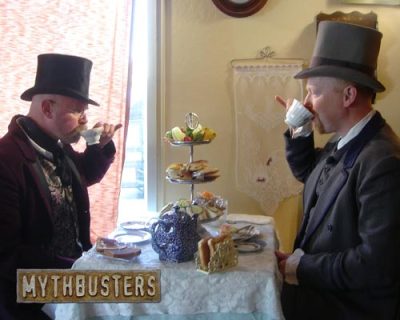
Here are some examples of people who dressed a little steampunk by accident (one is from a wedding, and the other a pirate ball). Note the vests and/or cravat.


Today’s awesomeness is S#47: Participate in Operation Beautiful. You can find details at operationbeautiful.com. I posted these notes on my mum’s bathroom mirror:
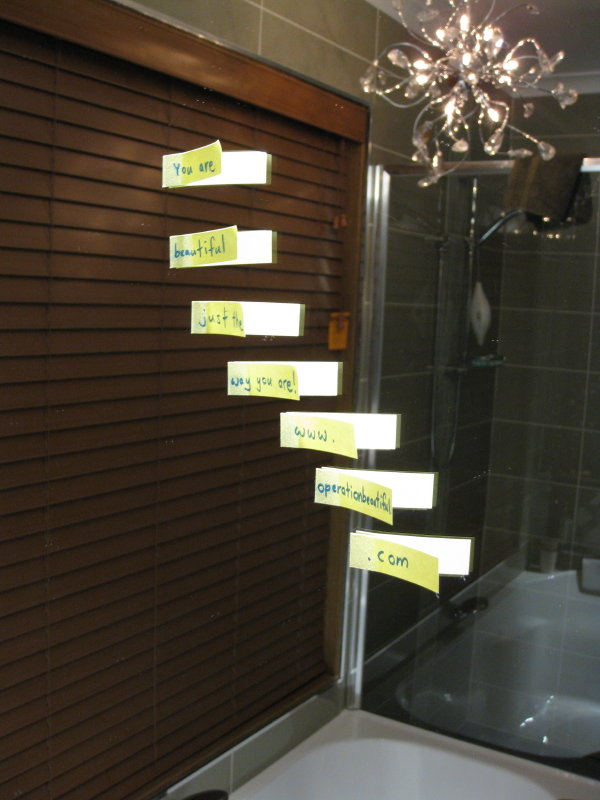
This time it’s super easy to play along at home. (Although I don’t recommend gentlemen readers post anything in ladies’ bathrooms.)
Three Things You Need to Begin a Novel
Some people believe you should write an outline of every scene before you begin. Others believe you should flow with the tale as it happens. I think that plot is important enough to deserve conscious thought – but I also believe that almost anything can be fixed by editing. And if you’re writing your first novel (or any novel), too much thought will kill you*.
There are only three decisions you actually need to make before you start.
1. If you’re writing for children or young adults, your main character needs to be a couple of years older than your target audience – and they need to stay roughly that age throughout the book. So your ten-year old won’t be driving a car, and your sixteen-year old won’t be getting married. Not if you want to one day sell the book. You also need to keep your themes relevent to the age group – so redemption isn’t a good theme for a ten-year old, and dealing with old age isn’t a go either.
2. If you’re writing for children or young adults, your length is relatively restricted – Ages 9-14 tend to read books around 30,000 words, and young adults read books around 60,000 words. More importantly, those are the lengths publishers buy. Give or take 5000 words, so don’t worry TOO much. Here’s a great post on word length by genre (including YA and children): http://theswivet.blogspot.com/2008/03/on-word-counts-and-novel-length.html
3. You’ll need to choose if you’re writing in first person (“I saw the duck. . .”) or third person (“She saw the duck. . .”). You probably do it automatically one way or the other. First person is much better for getting into the main character’s voice and head (or the narrator’s head, if he/she is a different person**), and for preserving a mystery (if the narrator doesn’t know something, neither does the reader – but it’s cheating to make the narrator not tell the reader what they know). Third person is less personal, but more flexible.
And that’s all you really need! Everything else can be fixed in editing.
But it’s useful to keep basic story structure in mind.
Basic Story Structure: An interesting character has a serious problem/goal and attempts to overcome it. It gets worse despite their efforts, and finally there is a crucial action-packed moment in the book when all is decided (for better or worse).
Fantasy example: An interesting character (Harry Potter, an orphan with magic powers) has a serious problem (defeating Voldemort, who killed his parents) and after many fights and more deaths and pain. . . he does.
Romance example: An interesting character (a charmingly quirky Sandra Bullock or Meg Ryan or similar) is lonely, and meets a guy (probably Hugh Grant). Her serious goal is to get the guy (it’s serious because it changes their lives). After feeling her loneliness more keenly than ever and having at least one major fight or embarrassment, the pair get together.
In order to get words on paper (that’s the hard part about first drafts), I recommend you treat each chapter as a short story that is relevant to the main plot (ditto your sub-plots, but you can always put them in later).
For example, if your main goal is to destroy an evil ring, some of your chapters could involve walking across a field and meeting more characters, running away from evil wraiths that want the ring, pausing to get advice from Cate Blanchett, and fighting a Balrog while taking a short cut. Each one of these has its own tension (will the farmer/wraiths/Balrog get them? Is the elf also evil/turned evil because of the ring?) and resolution (one step closer to the goal – but the main characters have a more complex or vulnerable situation to go on with, eg their powerful guide is dead or we have a greater understanding of the ring’s evil).
Here’s a funnier version of how to write a novel:
http://stiryourtea.blogspot.com/2010/09/how-to-write-novel.html
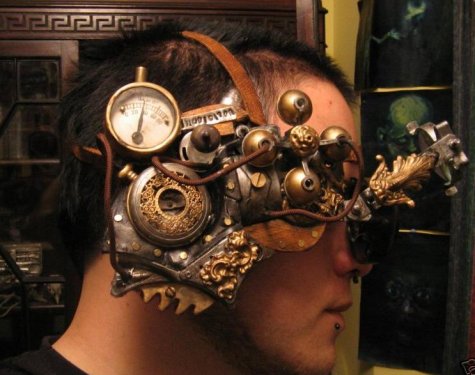
And since it’s Steampunk Earth Day later this month, here’s a pretty steampunk picture for you (from friedpost.com):
*Er. . . your novel. Whatever.
**Not recommended for your first book. Why makes things harder for yourself? Don’t challenge the establishment until AFTER you’ve proved you can write within the rules (say, after you’ve sold your first book to a major publisher).
Advice for Beginning Novelists
I’ve decided to start posting writing advice whenever I feel like it. Here’s the beginning:
1. Successful writers generally make around $10,000 a year (see #2).
2. Around 1 in 10,000 slushpile manuscripts get published (at a conference recently, I discovered that a large publisher hadn’t accepted a single slushpile book in three years – and they receive hundreds every week). Meeting someone at a conference and using their name/email changes the odds to about 1 in 200. (You still need to write a brilliant and polished book – unless you’re famous, of course.) On several occasions I’ve walked up to a publisher at a conference and said exactly this: “Hi, my name’s Louise Curtis and I’d love to send my children’s adventure fantasy book to the right person at [name of that person’s company]. Could you help me?” It works every time – all they want to know is length, genre, and age group – not the fact that I had the idea in the bath or that I really like their hair. When I write to the contact person, I mention the meeting – so they can either remember me, or talk to someone who does (proof of personal hygiene is worth a lot).
3. Publishers. . .
(a) are all friends with each other, so don’t ever be rude to/about anyone.
(b) actually make a loss on 90% of the books they DO produce, so cut them some slack.
(c) usually take 3-6 months to reply to the opening chapters, and just as long again for the full book. The longest I’ve heard of is four years, and the longest I’ve experienced is 18 months (and counting).
(d) are quaintly optimistic about their response times (if they were realists, they’d quit and get a better job).
(e) are nice – but they don’t like being hassled. So wait at least three months before contacting anyone, ever – and don’t be surprised if they haven’t started reading your book yet.
(f) will not work with someone who is too lazy to read their submission instructions and/or use decent English. http://shootingthrough.net/2010/10/28/how-to-talk-english-like-more-gooder/
4. If an agent or publisher charges you money, they’re a scam.
5. Manuscript assessors are useful, especially when you’re starting out, but their recommendations of your work are worth only slightly more than the fact that your mum thought it was super good.
6. For kids and young adults, your protagonist should be a couple of years older than your target audience, and your length needs to be right (check a publisher web site for length details BEFORE you write). Your characters won’t get married or raise kids, because your readers won’t be interested in that experience (not while they’re still at the age they started reading your book, anyway). Other than that, you can do almost anything – see # 8.
7. It generally takes around 10,000 hours of focused practise to get good at writing. Most writers throw away several books before they get good enough to be published (I’ve thrown away three and rewritten three others – so far).
8. Reading books in your genre is essential. If you don’t read, why do you think anyone will read you? How do you know what your market likes?
9. If you get published, you still need to sell the book to the public. This means travelling, interviews, etc. You definitely need to rent a crowd wherever possible – the average number of participants at book readings in the USA is four.
So, in conclusion, don’t write unless you enjoy writing for its own sake.
PS Some funny posts on writers (and how unpleasant we are, mainly because of stuff outlined above) – be warned, there are naughty words and one adult joke.
http://terribleminds.com/ramble/2010/10/12/beware-of-writer/
http://www.rebeccarosenblum.com/2010/10/07/why-date-a-writer/
PPS
The best way to cope with rejection is to already have another book happening (ideally a stand-alone book in case you later find out the first has fatal flaws).
Also, chocolate.
Also, writing forums.
Also, getting another job – one where you’re paid by the hour. It sounds cold, but it’s the most useful thing you can do to stay afloat psychologically (and financially).
Here’s a list of 50 well-known writers who faced plenty of rejection:
http://www.onlinecollege.org/2010/05/17/50-iconic-writers-who-were-repeatedly-rejected/
And here’s a conversation that will make you laugh, think, or both (in Australia, you don’t necessarily have to have an agent):
S#52: Have some delicious delivered to your house
Food is good. Food at home is better. Food at home with no dishes is one of the great pleasures of the modern age. I had Chinese this time.
Mmm. . . duck and mushroom sauce. . .
Here’s a link to a short story I wrote called “The Misbehaving Mountain”:
http://www.onthepremises.com/issue_05/story_05_4.html
And here’s a link to my other blog, where I talked about the four greatest modern books for children (trying to figure out how the writers made their work so awesome in order to improve mine):
https://felicitybloomfield.wordpress.com/2010/08/03/the-first-ten-pages/
In other news this month’s twittertale, “Peace Hostage” is set in a real historical setting – warring tribes in West Papua (now called Irian Jaya). Papua has literally hundreds of distinct languages, so some Christians have decided to live with various tribes (assuming the tribes want them there), learn their language, and write an alphabet for it. They then teach people to read and write, and they translate the New Testament into that language.
One particular translator, Don Richardson, believes that every culture in the world has redemption analogies – echoes of the Jesus story – hidden inside it. He worked with the Sawi tribe, who valued deceit as a virtue, and was horrified when he translated the bit in the Bible about Judas betraying Jesus through friendship. All the Sawi cheered at such a great act of deception. He tried to talk to them about the idea that deception ruins friendships, but they were unimpressed.
In the meantime, the Sawi fought with other tribes in the area, and the violence was worsening. Don asked the chief repeatedly to stop the fighting, but the chief said Don didn’t know what he was asking.
At last it became so risky that Don and his family decided to leave the area. The chief stopped him, and said he would stop the fighting. That was when Don learned the price of peace – the chief’s son.
Each of the chiefs involved gave up their first-born son into the other chief’s custody. This was the only way to ensure peace. The child was called the peace child. If the peace was broken, the child would be killed.
As a Christian, Don immediately saw the peace child as an analogy for Jesus – God’s son coming to live with us, so we could be reconciled to God. When he said as much to the Sawi, they were shocked.
They understood exactly what such a sacrifice meant – and the absolute worst thing a person could do as a Sawi person was to deceive or kill a peace child.
The Sawi tribe is now 70% Christian.
I first heard that story when I was ten years old.

This picture is from Flickr.com

 Felicity Banks