Introduction to Interactive Fiction
I thought I’d better write an entry today in case someone is a-googling after hearing my interactive fiction interview on 666 ABC Canberra at 7:25am this morning (wheeee!)
Hello and welcome.
I write both novels and interactive novels. Other people find interactive fiction via the gaming community, so there are usually elements of game play (for example, skill bonuses that are tested later). You can “read” an interactive “book” or “play” an interactive “game”. I use the terms interchangeably.
Within interactive fiction, there are two main forms: Choice-based interactive fiction (the reader makes choices from set options) and Parser interactive fiction (the reader types commands to move the story forward and/or solve puzzles). I’m strictly on the choice-based side, which is definitely more accessible for newbies. The list below will make it immediately obvious that I was drawn to interactive fiction via Choice of Games. It’s not a bad place to start. This is what games always look like on the inside:

You pick one of the options, and click next. Easy!
Interactive fiction is almost always digital (the obvious exceptions are “Choose Your Own Adventure” novels, and the Windhammer Prize), and almost always released as a phone app on the itunes and android stores (and more, for Choice of Games).
If you’re curious about interactive fiction (IF), here are some good places to start learning more:
To learn by playing
Interactive Fiction Data Base This link takes you directly to my page, which has links to all of my games. My games are usually accessible to newbies, since I am one myself. There are a LOT of games and reviews on IFDB, and you can find lists (such as “Games for new players”) to sort through the mountain of stories.
The Interactive Fiction Comp is hugely popular, and all the games are free to play. Judging season is in October and the first half of November each year (right now!!) Usually about half the games are Parser games. Some games are a lot easier to download than others so if you get stuck just move on.
Birdland came fourth in the IF Comp 2015, and is a funny game using Twine. Free.
Choice of Games (CoG) is an extremely successful company with a clear in-house style.
Choice of Broadsides is a short CoG game that’s a perfect introduction.
Choice of Robots is an excellent scifi CoG story.
Community College Hero is an excellent teen superhero CoG story (Pt 1). It’s not an official CoG game, but is released through their Hosted Games label.
Creatures Such as We has a more literary style than most CoG games. It’s also free, and placed second the IF Comp in 2014.
My own CoG Hosted Games (I’m not associated or affiliated with CoG in any way) are the Australian steampunk adventure Attack of the Clockwork Army, the piratical romp Scarlet Sails (which also placed 7th in the IF Comp 2015; this version was improved after the competition which is why it’s not free like the original version). I also wrote and edited for the retro scifi comedy Starship Adventures, which has a bunch of behind-the-scenes special features.
Cape is a beautifully written Superhero origin story, where you can add detail by choice. It’s a hypertext story, meaning that you click on bolded words rather than choosing choices from a list. It placed fifth in the 2015 IF Comp, and is free.
Tin Man Games releases what they call “Gamebook Adventures”. They range from the mostly-text scifi serial story “Choices: And The Sun Went Out” app on itunes or android (the European steampunk tale “Choices: And Their Souls Were Eaten” is the second story inside that app; I’m a co-writer on #1 and writer on #2) to the recent Warlock of Firetop Mountain which takes the famous Steve Jackson & Ian Livingstone novel and turns it into a video game (including a fight system). They are internationally respected and an Australian company.
To learn by reading the blogs of reviewers (who also write games and talk about stuff)
To learn by joining a community
Be aware that the IF community is a small, welcoming, diverse, and kind group. Don’t be a troll. Don’t write when someone (especially a reviewer who is adding to the community with their comments and not getting paid for it) has made you feel angry.
Embrace different genders, sexualities, abilities, and nationalities.
The Interactive Fiction Forum is very lively during IF Comp season (October/November).
An excellent book on Twine and writing, pitched for beginners to both
Writing Interactive Fiction with Twine by Melissa Ford
If you’re quick, you can probably catch me at Conflux today between when-I-get-there and 1:30 (when my workshop starts – it’s booked out already, but just email fellissimo@hotmail.com if you want to arrange something else workshop-ish). I’ll most likely be in the dealer room, since my publisher has a table (the publicist is actually hiding in this shot – can you see her elbow?)

To learn by writing
Twine is certainly the easiest; it actually automatically builds an (adjustable) map for you. It takes about thirty seconds to learn, or ten minutes on your own.
There are LOTS of online resources, including lists here and here about finding the authoring tool that works for you. You certainly don’t need to be a computer programmer!
To get paid
Choice of Games pays advances of up to $10,000 for novel-length stories based on an approved outline and written with their tool, ChoiceScript. I know from personal experience that a story written for their less-exclusive “Hosted Games” label earns a respectable amount purely through royalties. Mine have earned around $1000 each, but there are no guarantees (and no limits!)
Sub-Q magazine pays for short fiction (they can be quite literary).
itch.io is a vibrant community that’s specifically designed to let indie creators sell their games on their own terms. It has loads of game jams that you can join, and some jams are competitive (which is a handy low-stakes way to see if your writing is appealing to others.
Contests pay a little (often not in money) but are hugely important to the community and to gaming companies, who sometimes even approach entrants to offer paid work. All the contests are publicly reviewed and judged, which is an intense emotional experience for any writer. Don’t ever interact with reviewers until after the competition is finished (and even then, always thank them regardless of what they said—every review is a precious gift, and the harsh ones are often the most useful).
Your stories must not be published, and they must be publicly available after the contest for free. Although the judging is public, they are NOT popularity contests, but based on judges being as neutral as possible in their ratings.
IF Comp is the biggest and best, but it’s NOT for beginners. Reviewers can be harsh in order to be more entertaining, or due to assuming you’re trolling the contest).
Windhammer Comp is printable (and short, and Australian) and high-status. First prize is $300, within runner-up prizes of $50. Not bad for a short story that doesn’t require learning a new tool!
IntroComp (for games that aren’t even finished)
Spring Thing (called the Fall Fooferal if you’re in the Southern Hemisphere) is particularly welcoming to newbies, including a “Back Garden” where you can indicate that you’re new and reviewers should take that into account. It’s deliberately placed in a part of the year when the IF Comp is far away.
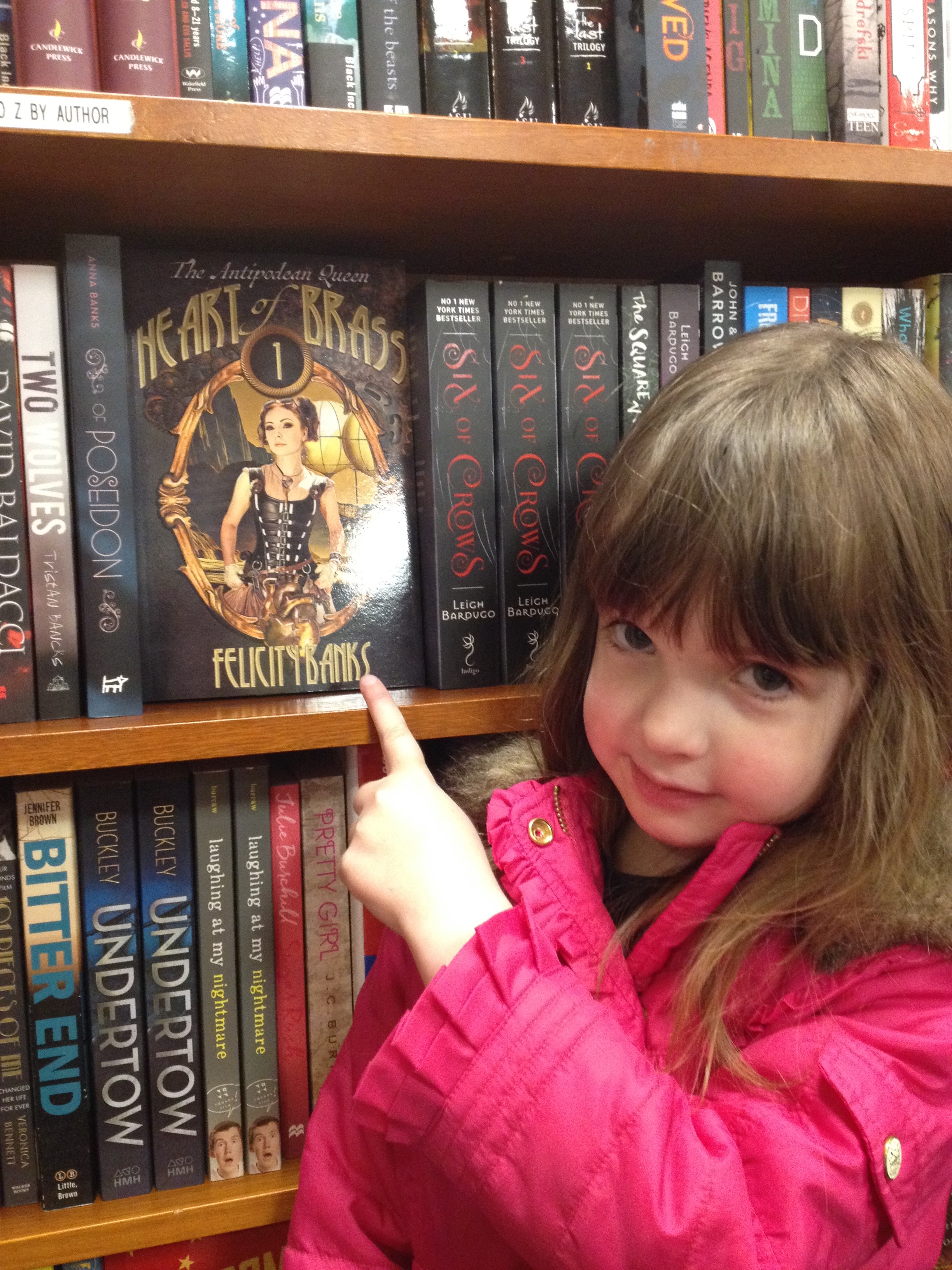
I won the Windhammer Prize in 2015, and my publisher included that story with my novel:
Full disclosure: I have some kind of connection to pretty much everyone on this list, but every single connection is through reading their work and liking it.
Emily Short has a fantastic Intro to IF here.
Weak Words
I haven’t posted any writing advice in a while, possibly because a lot of my work is out there now and anything I say is likely to be hypocritical and I’m scared of people pointing that out.
But here is a great, simple, well-explained infographic on words that should be dragged out and shot. Take a look!
Choices: And Their Souls Were Eaten
I’ve been working very hard on this story app for Tin Man Games all this year, and I’m incredibly proud of it.
The beginning is free, and the rest costs a few dollars (or a LOT of ads if you choose that option on Android).
It’s a subscription story that releases a new section each week. There are between 2 and 7 strands happening at any one time, with both delayed and instant branching.
Some of you are already subscribed to the award-winning “Choices: And the Sun Went Out” (I’m a co-writer there). In that case, you’re already subscribed to “Choices: And Their Souls Were Eaten”. (Congratulations!)
The original story, the near-future scifi game “Choices: And The Sun Went Out” will end in December this year. The second story, “Choices: And Their Souls Were Eaten” will be “medium-length”. Ultimately it’ll work out to be around half a million words.

On Apple, a subscription to either story gets you a subscription to both.
You can choose to have certain character/s speak to you through your apple watch, if you have one. (That, the music, and the sound effects can all be switched on or off – I like the music off but the sound effects on.)
On Android, you can buy (or earn by watching a LOT of ads) Story Passes, which can be spent on either story.
“Choices: And Their Souls Were Eaten” is my project from the start; a steampunk adventure set in 1830s Europe when Queen Victoria was a teen princess and strange monsters roamed Europe. It uses the same magical steampunk universe as my novel “Heart of Brass2” and the ChoiceScript game “Attack of the Clockwork Army” but there aren’t any spoilers.
One of the features of the subscription system is that the writers (I have paid editors who happen to be excellent writers as well, and I encourage them to add cool bits) can adjust the story based on suggestions from readers. I’ve been known to add pirates, name characters after fans, and so on—all based on what people seem to like.
Place your random requests here, if you like!
Dancing, Duelling, Delicious: The official book launch for HEART OF BRASS
You know what’s cool? Nurofen tablets are sugar coated.
*
HEART OF BRASS had her official Book Launch yesterday as part of the inaugural Canberra Writers Festival, an absolutely huge event. I was written about (with a cover image) in Canberra Weekly magazine (96,000 readers!) and in the Canberra Times, as well as various other places.
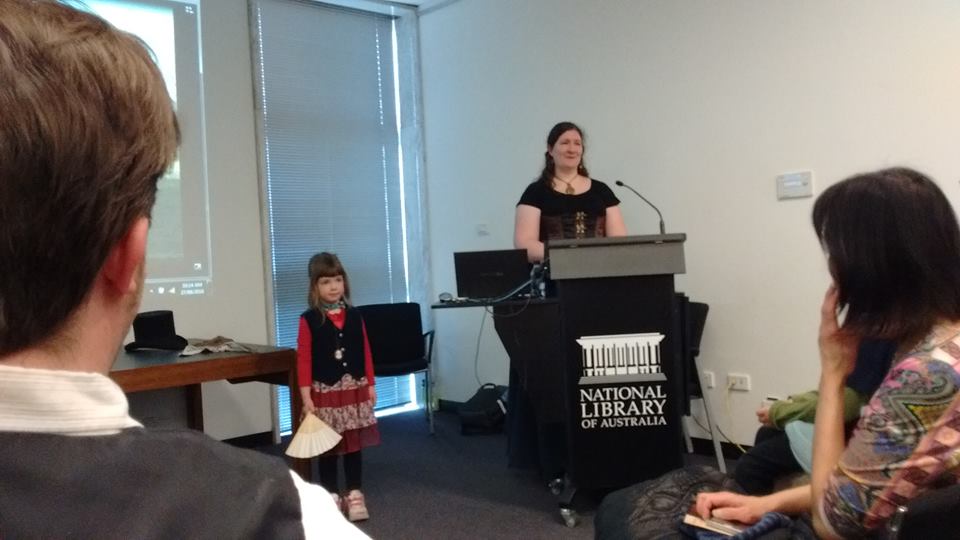
The launch took place in the National Library of Australia (pictured behind the kids and I), in the Ferguson Room. The Ferguson Room overlooks the foyer of the National Library, which gives it a grand air and means one can watch guests coming in. That was particularly fun for me, since I’d encouraged steampunk/historical garb and was well rewarded for my efforts. My kids loved it too. Louisette got to talk into the microphone before anyone else showed up, and she imitated my own test speech by saying, “I wrote a book”—which in her case is quite true (if you haven’t read “The Adventures of Pirate Captain Louisette”, just scroll down a couple of entries).
I’m usually a very confident public speaker, but I was intensely nervous (enough to have patches of time when I was breathing funny) before this event, even though I was rationally confident it would go well.
The best and most important thing is people.
I was very lucky in that regard. The Ferguson Room is meant to seat forty people, which is rather a lot for a debut author—but within a day of setting up the facebook page (and SMSing and emailing various people to invite them personally), I knew I had at least twenty people. The phrase “book launch” is haunted by the horrifying spectre of a desperately awkward room of four people sitting in a sea of chairs and wishing fervently that they were elsewhere (none more miserably than the author). By the time the big day rolled around I was slightly nervous that the room would be unpleasantly crowded or that we’d run out of books for people to buy (what wonderful issues to have!) I estimated 50-60 guests beforehand, and I was exactly on the money. Someone had added a few more chairs to the room, which was useful. We sold a very healthy number of books without selling out altogether (my publisher and I both had extra stashes of books just in case). I would have liked to sell more, but this means that the National Library bookshop still has copies on the shelf (excellent promotion in itself).
50-60 people is a lot. That’s a larger number than any event I’ve hosted before (with the exception of my wedding), and it was in a location I didn’t know well.
I get panicky in new places. The National Library as a whole is somewhere I’ve been to many times, and I visited the room before the launch to get a sense of the space, but the technical equipment was new on the day. It all worked well (strange but true), including the book trailer and the dancing music. I really enjoyed the location and I wish I could start over so I could have that confidence from the beginning. Bring on Book 2!
Robbie Matthews is a friend, a writer, and a generally charming and funny person who’s well known to the Canberra writing community. He was MC at my wedding, and I was very pleased with myself for thinking of him again for the launch (especially as it prevented me from haranguing other authors who I don’t know as well).
At my wedding reception one of the tables was “the minion table”—full of people who’d helped decorate, give lifts, take photos, etc. As MC Robbie was on that table and he made friends. Then he made a highly memorable speech about the wide range of colourful threats I’d made to all my sweet innocent minions in order to let them know what would happen if they didn’t do their assigned jobs. I vividly recollect how impressed I was at the time that I’d subconsciously tailored original threats to each person.
As the book launch drew closer I wondered what Robbie would say about me, since I hadn’t threatened anybody this time. He got up and explained how we’d met: We did Live Action Role Playing (LARPing is like a play where all the players have a general character and plot outline and then improvise to amuse one another), and I was his fictional daughter. “By the end,” Robbie explained, “she was wearing my spine as a necklace.”
Oh yeah… I’d forgotten about that. (To be fair, my character was under a lot of stress at the time.) One may draw one’s own conclusions about my general mental health…
A lot of book launches are introduced by the writer’s publisher. It’s a very neat way to do things, but I always felt it was a bit sad since the author and publisher are the people who are the most desperate to sell the book. Having Robbie meant that we had a disinterested party recommending the book (which he read before the launch). That made me feel much less like a grasping novice.

I realised belatedly that the reason I was so nervous was that I was, in the most literal sense of the phrase, “selling something” (and to an audience that was trapped for the duration, too). It’s impossible for a writer to truly know if a book is good or not (although being published certainly helps) and that’s why I always find book launch speeches so horrifying. I acquitted myself well enough, I think.
I’d described the launch to Louisette in advance, and she said she wanted to help with my speech, so when I got up I summoned her as well. She is an adorable child and was adorably serious about the entire process—but she stood bravely (by herself, because I needed to stay near the podium microphone). She was very pleased afterwards with her own courage. Hopefully this will lead her to be a confident public speaker, rather than turn her into a full-time writer (creative jobs have a high personal cost that I wouldn’t wish on anyone).
Clothing is tricky while I’m still waiting for my stomach muscles to be put back together (not helped by weird sensory overstimulation stuff that tends to give me panic attacks if I wear new clothes), but I’d had an idea (on Friday) to adjust a favourite skirt, and that very much improved things for me.
My other main panic was that I’d simply forget to bring something essential. I started putting things in the car last Thursday, and although there were certain things I meant to do and didn’t, all the important pieces (such as a copy of the book to give away to the best costume, and having my kindle prepped on the podium for my reading) were in place.
This was all very much complicated by the fact that I’d gotten overenthusiastic and decided to write and run a Live Action Role Play game inside Questacon after the launch. But that’ll need its own entry 🙂
The tea duelling and catering was complicated by the fact that no outside food was allowed, and no food was allowed in the room. That meant paying a huge sum to the cafe (which reserved tables for us and did a great job from beginning to end) and having biscuits that were fresh and delicious but not the right kind for duelling. Although the cafe staff were excellent and the location classy, the lack of ability to bring in a pack of plain dry biscuits was annoying. Still, it was entertaining and it looks great in pictures (useful for media coverage, which is useful for selling books, which is the point). And even though we under-catered, most people were so distracted by the duelling that they didn’t eat or drink at all.

The waltzing was a huge highlight. I had one couple primed to lead the way, and Louisette is an enthusiastic amateur. I figured I’d waltz with Louisette while my dancers hopefully lured a couple or two to join them over the course of the piece.
Actually, I danced with Chris the second the music started, and several other couples willingly took to the floor in an instant. The space was perfect (everyone moved the chairs back); roomy enough to dance without feeling either crowded or lonely.
It’s been a long time since Chris and I waltzed, and it was a lovely moment for both of us. I found out later that one of the other people dancing was stepping out (invited by a nearby acquaintance because Canberra is like that) for the first time since major surgery, and it made her realise she might be healthy enough to dance regularly again soon.

Adrenalin does wonders in carrying my wreck of a body through things (in fact that’s probably part of why I do things like this—for a while, I feel normal). My muscles were freaking out last night as the adrenalin wore off, and today I’m weirdly sore in a dozen places (hence the nurofen). Luckily I’m not involved in the rest of the Canberra Writers Festival so I don’t need to do anything more strenuous than writing and napping for the rest of the day.
I still can’t quite believe how many people came.

The launch was as close to perfect as it could be. The festival, venue, and volunteers were all top notch. Ultimately I wouldn’t change a thing.
“Worst one I’ve played”: Reviewing the Reviewers

Or you can play directly through the publisher’s web site, here. That’s the simplest if you’re not tech savvy (although you’ll need a credit/debit card there).
On most sites, it LOOKS like the game is free, and has in-app purchases. This is just a backwards way of saying, “You can read the first bit before you pay for the rest.” It’s a one-off $5 payment.
I’ve started up a facebook page just for this specific gamebook (discussion, reviews and steampunk/Victorian-era fun), at https://www.facebook.com/attackoftheclockworkarmy/
My love affair with the em dash
I love using dashes – as I’m sure you’re already aware – and my level of addiction only hit me when I had to alter the style in a 60,000-word document. I was able to use find/change but had to check each one.
Wow. There were a lot.
And then I read this article about using less dashes. It makes a lot of good points, but I still use a lot of dashes. Hopefully I can cut back.
Where do your ideas come from?
Any writer will tell you – everywhere.
In 2015 I plan to write slowly – that is, to drastically alter my usual style (I generally finish a book within a month – whether writing for NaNoWriMo or not).
Now that I’ve finished another draft of “Flight of Fancy” (inspired by my daughter’s first fictional story – I literally took her few sentences and made them into a novel) I’m raring to go.
I’m going to STOP and prepare for at least two months, including research and a detailed outline. But I’ve been waiting for inspiration to strike and haven’t had anything to research yet.
The first “hit” was when I was re-watching this video: http://vimeo.com/111547854
I had the idea of having a blind girl nick-named “Cat” because she loves to bask in sunshine. A while ago I read a sad true story of a mum who badly burned her child with spilled coffee because she’d been awake over 24 hours (hence the coffee) and when you’re that tired accidents happen. Although it was clearly not her fault, she had never forgiven herself. I’m fascinated by stories of redemption, so I thought I’d write about Cat’s mother after she’d accidentally blinded her child. I’m also fascinated by blindness, but I try not to write too many blind characters (I have several) because I write in first person and it’s beyond my skill to describe things really well for sighted readers without using visual detail. (Reflecting on my actual capabilities is a definite plus of slow writing – I can spot fatal flaws before the first word is written, and then change them before it’s too late.) So I looked into recovery from blindness. It’s amazing scientifically (http://discovermagazine.com/galleries/zen-photo/b/blindness) and socially (http://io9.com/the-world-that-only-formerly-blind-people-can-see-476400679).
I wondered at this point if I was writing a book for adults, since I could definitely write as a guilt-ridden Mum (writing for adults is unusual for me. . . apart from anything else, the length is quite different and I’m not sure I have a good sense of either the rhythm or the market) and/or something set entirely in the real world (without any fantasy elements).
Neither seemed like a good idea for me (plus it seemed too dark and sad for my liking), so I decided the blindness and recovery had a magical basis. I knew Cat was grateful for her blindness – partly because it changed who she hung out with, but also because it enriched her life in some other way too. I decided that her recovery would be something she kept a secret, in order to appear more mystically impressive than she was (“Wow! It’s like she’s not even blind at all!”) So Cat became a sorceress – a cheerful, smart, sorceress with a flair for drama that could easily make her very powerful.
I still didn’t feel confident about writing as a blind person, even a fake blind person, so I figured (and still figure) Cat would be friends with my hero. . . whoever she is. (Yes, “she”. I’m a girl, which is one good reason, and the world needs more female heroes, which is another.)
I left my complete lack of a main character on the back burner while I thought about the setting. Having a sorceress immediately feels like a quasi-medieval story. There are WAY too many of those – plus, to do a decent job I’d need to do a scary amount of research (and it would still feel incredibly derivative, because there’s just too much quasi-medieval stuff out there – including “Flight of Fancy” although that world is more “fairyland” than regular medieval). It would confuse me utterly to do another steampunk world. So as I was thinking about where to start I decided it should be something future-y. NOT something all computer-y, because I find that very dull. Some other kind of future – something new and interesting and different.
Last night I read Psalm 95, including this bit:
For the Lord is the great God,
the great King above all gods.
In his hand are the depths of the earth,
and the mountain peaks belong to him. (NIV)
I finished reading and lay down to go to sleep, but I felt something in the back of my mind telling me I’d missed some vital hook. I got up and re-read it, and the line about “depths of the earth” inspired the idea of enormous epic underground tunnel systems (with windows in the top so Cat had her sunshine). I liked that, and thought about it some more – what would make humanity move underground? Since dirt is a brilliant insulator, I figured it was heat. Australia is the driest continent – more desert than not – so that made sense.
In my thoughts of the future, I’d forgotten about the obvious – global warming. In itself, global warming is a cliché – but it all depends how its handled (for one thing, it’d be nice if it WASN’T post-apocalyptic. . . just different). I figured tunnelling underground was one way to cope with major temperature change. Another was reclaiming land like in Holland or Hong Kong. Another was to adjust existing dwellings – sealing gaps, designing ventilation shafts – which would be delightfully ad hoc – or build new dwellings designed to stay on the sea floor. Still another was to have floating cities – which could be so beautiful, especially if glass and/or spheres were liberally used (to utilise solar power? To float more easily? As a suspension system to deal with wild waves and weather?) And some people would try hard to stay on land – just moving higher and higher up the nearest mountain (which would get easier to live on as it grew warmer).
I’d read something somewhere about buildings deliberately designed to float, and I know there are islands already getting taken over by the sea – plus I’ve seen Hong Kong’s man-made land extension for myself. I had a huge and fascinating place to start my research – laying in magic where I found it best.
I came up with the idea that medieval-style magic really existed in the Middle Ages, and something triggered its return. Don’t know what yet, especially since when we talk “medieval” we’re really talking about Great Britain – and I want to think on a more global scale.
There will of course be major issues with food and water (water might be easy – our ocean is salty because of minerals getting left in there during normal rain cycles. If we melted Antarctica, it would be diluted and might even become drinkable, or close to it), so I’d need to think hard about that too.
I believe human nature is fundamentally stupid in a lot of ways. Here in Australia one government put into place an unpopular “carbon tax”. It was a brave and necessary thing to do. Then the government switched sides, and the new lot threw it out. Arg!
So it will take a LOT before we change the habits that are causing us to head towards potential global crisis environment-wise (I’m writing on my laptop with the AC on, for example). But I think humans also have amazing ingenuity, and when bad stuff DOES happen, we will most likely come up with new ways to deal with it. A lot of those new ways have already been thought of, on the fringes of engineering and science. I’ll look into it and see what makes the best story. I really liked the film “Waterworld” so I’ll have to keep an eye on myself to make sure I’m not stealing from that.
And then there’s the social side of this new world, which will be huge.
Regular readers will know how appalled I am at Australia’s treatment of asylum seekers. Unfortunately human history shows that people are generally awful towards refugees (with many beautiful exceptions – including modern-day Germany). . . and if the world changes drastically, refugees will definitely suffer for it.
The likely place for them is on floating cities – literally drifting without a place to call home, and from which they can be rejected from every corner of the globe (while possibly also being the cutting-edge of scientific stuff, due to travel and personal experience). But it occurred to me that if certain weather events trigger major change (I’ve heard of global warming “tipping points” where gradual change becomes sudden change in a heartbeat), a floating city might suddenly be the only form of sustainable life – in which case the refugees would suddenly be the ones with beggars at their door (and they might or might not let them in).
So that’s likely to be some kind of climax, in a world where there is already major tension from both the environment and between the different groups. And something going on for my myserious heroine, too.
I think Cat’s real name will be “Cassandra” and she’ll be the one who first “sees” the next tipping point coming. But she’ll still be a cheerful, relaxed sort of person.
Feel free to help with my research by directing me to theories about what will happen to the Earth physically (and when), and what kind of food/water/housing solutions people are talking about/inventing so far.
Pitch Me A Pitch
Conflux is Canberra’s annual speculative fiction conference. I’m there most years, one way or another – wandering around in garb (see pic at right), going to sessions, leading sessions (!), and of course pitching.
Pitching is when writers get five or ten minutes one-on-one with a publisher or agent to try to convince them to read their novel. Usually the writers are required to send in their first three chapters, synopsis, and bio beforehand (so those who want to pitch can be whittled down into a reasonable number, and sometimes so that the publisher/agent gets an idea of the book beforehand).
The first time I ever pitched was in New Zealand – I literally flew to New Zealand for that ten minutes (then the exact same publisher came to Conflux the next year!) The worst pitch I ever did was to someone who had read the first chapters and thought the entire book was all a dream because there were pirates in it, and pirates are apparently all imaginary (what the. . . ?!)
Quite a few people who let writers pitch novels to them will read all the opening chapters they’re offered during the pitch (including, luckily, the one in New Zealand). Others will pick one beforehand, and read only that one. Still others are genuinely making up their minds in the moment.
This year, no-one read our opening chapters, so I didn’t have my usual advantage (a LOT of beginning writers are truly terrible, so among unpublished authors my writing usually looks pretty good). Without quite naming anyone, here’s what pitching was like this year (I literally pitched a book to everyone – got a bit excited after being too sick to write for so long due to pregnancy).
Pitch # 1: An Agent
I pitched my newest book (YA fantasy, “Flight of Fancy”) to her, on the basis that if she was shocked that it actually wasn’t polished enough to send, at least I hadn’t looked unprofessional directly to a publisher. In truth, I used her as motivation to finish the book – and she was extremely useful for that!
I’d actually never pitched to an agent before. In Australia, agents aren’t essential to the publishing process. Also, they are just as hard-working and underpaid as publishers, and tend not to take risks. Some Australians only use an agent AFTER receiving an offer for publication (so the agent can look at the contract and negotiate terms), and I may well end up using her for that some day.
She was extremely friendly (a common phenomenon in pitches) and after I described the plot she said how much she loved fantasy’s ability to talk about real-life problems such as mental illness in a different way. That is also one of my favourite things about fantasy, and I felt like we really connected. She was more than happy to look at “Flight of Fancy” when it’s ready, and I blurted out a bit about my steampunk YA novel because it’s ready to go and seems really well suited to her – but it’s already done the rounds of quite a few publishers (which is bad for agents, because publishers won’t look at something twice). She said slushpile rejections are fine, so I should send it to her with a detailed submission history.
I finished the post-TJ edit of the YA steampunk that day, and sent it to her. I’m quite excited by the idea of having an agent in my corner, but she said up front she takes ages to read things. . . so we’ll just see. I’ll send her “Flight of Fancy” late this year – probably before she finishes the YA steampunk.
Still, that’s two “yes” answers from one pitch – a good start!
One of the most interesting things about that pitch was that she said most publishers are dead-set against anything labelled “steampunk” (as my daughter would say, “NOOOO!!!! WHYYYYYYY?????????”). Readers still like it, so steampunk sells as “gaslight fantasy”, “Victorian paranormal”, “Urban fantasy”, “Alternate history” etc.
She also said about “Flight of Fancy” – “Can you make it a bit longer?” Which I can – especially when there’s so much editing to do. Hopefully an extra 5000 words qualifies as “a bit” (when I emailed her the YA steampunk I asked if it was).
Pitch #2
This was the pitch that was the most important to me, because the publisher (what I call a “medium” publisher because they’re certainly not one of Australia’s six biggest publishers, but I’ve read several of their authors) really likes Australian female fiction and “things other publishers wouldn’t dare take on”. My YA steampunk has a female protagonist (like most of my books), is set in Australia, and has a major character who turns out to be gay.
The person was unusual in her manner – thoughtful rather than friendly (not that she was UNfriendly, but she wasn’t going out of her way to put me at ease – and I could tell she wasn’t going to read the book just to be nice, which was scary at the time).
When I explained the plot of the book her face lit up. It turned out she doesn’t usually like steampunk (despite the fact it was specifically mentioned online as something this publisher will accept!) because of the upper-class stuff – but because my series is all about dismantling the so-called superiority of the higher classes, it sounded great. Could I please send it to her? (Yes – but not until December, because it happens to be in a contest-type thing and I can’t send it elsewhere until the results are announced. She understood perfectly.)
That was a close-run thing, and all the more satisfying as a result. It’ll be interesting to see how she likes it when she reads it.
Pitch # 3
This was a large publisher – or at least, large enough that any writer would have heard of them. It was a slightly-awkward pitch because the actual person listening to pitches represents the adult fantasy section, and I was pitching my YA steampunk novel (I called it “YA alternate history” based on the agent’s advice – and it seemed to work).
This was another publisher who was making up her mind as she went along. She was very friendly, and even stopped to chat to us outside afterwards (brave, since she’d said no to at least one person in the room).
I was very clear it was a young adult book. . . but she said it sounded so good she hoped to be able to keep it for the adult department. This was a huge and pleasant surprise (I’ve actually had VERY slow responses from that exact publisher in the past, so I didn’t expect enthusiasm at all). It’ll be interesting to see if she is still enthusiastic when I actually send it to her (in December, because of that contest – again, she understood the situation perfectly and didn’t mind at all).
Pitch # 4
This publisher is small – I recognise the name of one of their authors, but haven’t read his books – and has an incredibly enthusiastic vibe, so I felt very confident they’d just say yes to everyone who pitched. I met several of the staff in the dealer’s room the previous day, so that gave me a bit of a sense of them too.
Being aware that small publishers tend not to pay advances (unfortunately, most books make a LOSS for most publishers – they’re kept afloat by the rare successes – but a small publisher can’t take financial risks like that), I chose a book that has been rejected very thoroughly in a lot of places.
It was a pretty friendly pitch, and they gave me a card and said to send them the whole thing. There were two unusual things – first, there was a second person in the room. To this day, I don’t know what her position in the company is (and I promptly forgot her name in the general nervousness, so I can’t even google her). Secondly, they asked, “Why are you pitching this book to us instead of someone else?” Instead of saying, “Well, everyone on Earth other than you has already rejected it” I chose the other honest reply – that they’re a vibrant, exciting, fast-moving publisher, and it seemed like fun. And of course mentioned that I’d written a book since TJ was born, and can produce books pretty quick if required. And that the YA fantasy book I was pitching was the first in a trilogy (which was written, but needed to be re-written), that was linked by the setting to a kids’ trilogy which is entirely finished and polished (I didn’t even realise until later that they also publish kids’ books).
Oh! The other unusual thing: At their book launch the previous night, the publisher had been chatting to someone and told them to come pitch their book (I met her in the waiting room, and declared that we’d be their children’s line). So, like I said, enthusiastic.
They requested the full manuscript. I hadn’t looked at it for a long time, so I gave it an extremely hasty edit and emailed it to them about midnight that very night (since I’d said how cool it was that they were fast-moving, it seemed wrong to not send it on the day). I was very pleasantly surprised by how good my book is after all this time – perhaps I shouldn’t have been, because a lot of the people who rejected it gave me great advice on fixing it, and I took it all.
Pitch # 5
Another medium publisher – and another person I’d met in the dealer’s room.
She also asked, “Why this publisher?” and I gave what amounted to a general “why a medium publisher?” answer – that is, they’re willing to take risks (with unusual writing, I mean) and they tend to like stuff set in Australia. The book I was pitching was a YA realist novel (set among a group of geeks), mainly because it was the best book that wasn’t earmarked for anyone else, or actually sitting on someone’s desk waiting for a reply.
It was actually HER first time pitching, which was funny to me (having spent much of my day in a room of deeply nervous writers). She gave me a piece of paper with instructions on how to send the first three chapters – ie she was clearly going to read everyone’s opening chapters. Which suits me fine. It was a relief NOT to send the whole book, because I’ve done two manic edits in the last week – plus a bunch of manic writing lately on “Flight of Fancy” – so all I had to do was check over the first three chapters and send it.
In the email, I made it clear that I usually write YA fantasy, so if the writing seems good but the book doesn’t suit them, I’d very happily send them something else (once it’s free). I’m not sure I made the right choice of novel, but I’m still grateful that she gave me the benefit of the doubt.
The book is so unusual that there may not ever be a publisher who likes it – I suppose it deserves one last chance at publication before I give up on it. The manuscript assessor I hired adored it, and I think the opening won $75 in a contest, too. But neither of those means much when it comes to publication.
All in all, an extremely exciting weekend. It’s fun to be back in the saddle writing-wise, and sad to realise that I’ve been excited so many times before, and never got a publishing contract out of it.
My lack of health is frightening at the moment. I can write, but almost everything else is hazardous or impossible. It would be nice if life was like fiction – if you work hard enough, follow your dreams, and have a desperate need to succeed – you will.
But I’ll keep working on my health, and hopefully I’ll be able to do some properly paid work early next year. In the meantime, at least I can write.
Less and More
From next week, I’ll be reducing this blog to two days a week – Miscellaneous Mondays (anything from a rant on equal rights to a picture of a cat) and Louisette Wednesdays. I’m hoping this will result in an increase in quality. Either way, I’ve been blogging faithfully for many years as I wait for a book deal to come my way – knowing all the while that it could happen at any moment.
But it hasn’t, so far, and I finally have something better (hint: see Wednesdays) to do. Literally for the first time in my life. So I’m powering down the writing obsession, and delightedly replacing it with the (far healthier and more rewarding) obsession of looking after a little person (that I MADE) – combined with the heady excitement of actually having paid, moderately reliable work. It is the simplest thing in the world to power back up my writing career at a moment’s notice – right now, my best shot is the steampunk novel, which is currently sitting on the desks of three large Australian publishers, all of whom are reading it in full already.
As I power down, the famous slushwrangler “The Intern” has a real actual book coming out. Her blog is now “Real Actual Hilary” and it’s better than ever. In this entry, she writes about the final edit of her precious book. I definitely understand the obsessive joy of writing. And the pain of it, too.
“In my determination to put everything I had into this last chance, I lost my sense of taste and smell. If you asked me which clothes I was wearing, I wouldn’t have been able to tell you. If you asked me which plants had blossomed by the back door I barged in and out of several times a day, I wouldn’t have been able to guess. My body hurt, and by the eighth or ninth day a profound exhaustion made it harder to work for longer than an hour at a time, although I was wary of straying more than a few feet from the stack of paper on my desk.”

 Felicity Banks