Conflict
Lynn Price of the Behler Blog wrote a great article on conflict, beginning with: “Day in and day out, I reject queries because they have no discernible conflict. Conflict is what keeps readers turning the pages.”
She then went on to talk about writers who think they’ve got conflict – but don’t. Read the article and get better at writing.
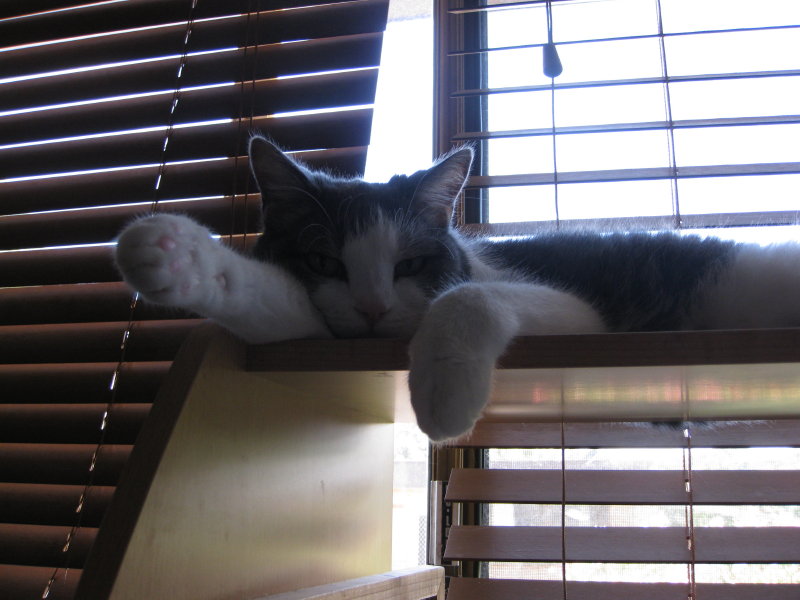
Or just gaze at a sleeping cat*. Whatever.

*Which is, technically, how I’m spending my weekend. But CJ and I are both sick, so we have an excuse.
National Novel Writing Month (PG mild swearing)
National Novel Writing Month (generally called NaNoWriMo – and of course it’s international, not national) happens in November each year. It is a heady and caffeinated time when thousands of writers around the world attempt to write an entire novel (or at least the first 50,000 words) in one month. That requires an average rate of over 1600 words a day.
I’ve done it myself, more than once – successfully, I might add – and I don’t think the resulting novels were any worse than the rest of my books (make of that what you will). But it is important to note that the massive emotional high of the winners (if you complete your 50,000 words, you win) has led to many headaches for agents and publishers around the world.
Kids, do NaNoWriMo. It’s awesome. But for the love of all that is pure and good in the world, don’t send it anywhere in December. Or January. Or February. Maybe by March (especially if you do National Novel Editing Month – fifty hours of editing in the month of March each year) it will be okay. MAYBE.
Never forget: Your odds of publishing your finished book with a reputable publisher are about 1 in 10,000. Don’t be such a moron that you think finishing a first draft means you’re some kind of genius and can defy the odds without any more work. NaNoWriMo is mostly good for giving you a sense of how long 50,000 words is (NB: a lot shorter than most books, unless it’s for children) – so you have a better sense of what you’re doing next time. It happens to work well for me, because I already spend 90% of my writing time editing. THINK about how many hours that 90% is, and you’ll have an idea of how unfinished your “finished” book is on December 1st.
Here‘s an article by the M-rated Chuck Wendig (who has a wicked way with words). And here’s the bit that I think is the most important:
The one flaw in NaNoWriMo (and why it sometimes earns the ire of professional writers) is that it kind of floods the marketplace a little bit. November 30th rolls around and suddenly you have a world with thousands of new novels birthed screaming into an unkind world, and while that remains a truly sublime act of creation, it also means that you have a lot of writers who don’t have the sense of a tree grub, and these writers decide to abdicate their own sense of work and responsibility by throwing their unformed fetal drafts into the world. They choke the inboxes of agents and editors with their protoplasmic snot-waffle novels and they think, “Gee golly gosh, I’m a real writer now!” Except, they’re not. They’re rosy-cheeked, empty-eyed shitheads. Don’t be that shithead. Don’t just loose your garbage onto an unsuspecting world (which creates more work for agents and editors who already have a hard time finding diamonds in a sewage tank). Take time. Polish your work. Give it six months. Give it a year. Give the novel the air it needs to breathe. Give yourself, as a self-serious novelist, time to realize when this book is ready to roll or (a bigger and more mature revelation) that this book just isn’t “the one” — and that it’s time to write another better book, a book that doesn’t beg to be written only from November 1st to November 30th, a book that can be written whenever your fluttering wordmonkey heart so desires.

The myth of self-publishing success
Hollywood and the media feed us a lot of rubbish. Every school classroom (particularly in a rough area) is full of world-class singers/dancers who simply don’t realise how amazing they are until a teacher inspires them to follow their dreams. Every socially awkward girl is actually stunningly beautiful after a haircut and some contact lenses. Every nerdy kid is actually a mathematical genius. . . and so on.
I’m sorry, but it’s just not true. You are almost certainly not a misunderstood genius. Even with a whole lot of hard work, you probably won’t win gold at the Olympics (you’d be amazed how many people don’t). And even if you spend a year – or five years, or even ten years – working on a book (or ten books) – you may not be very good.
I fully understand how hard it is to accept one’s own lack of writing talent – particularly after a lot of hard work towards a goal that other people seem to achieve so easily. A LOT of people don’t accept it – and so they blame mainstream publishing.
And thus is born the extremely powerful myth that self-publishing is the road to success. The few tales of actual self-publishing success are given a huge amount of media time, because they make a great story. The reason they make a great story is because they’re extremely, extremely rare.
Here‘s one of many true and rational articles standing up against the tidal wave of “believe in yourself and self-publish your way to fame and fortune” articles that we’ve all seen.
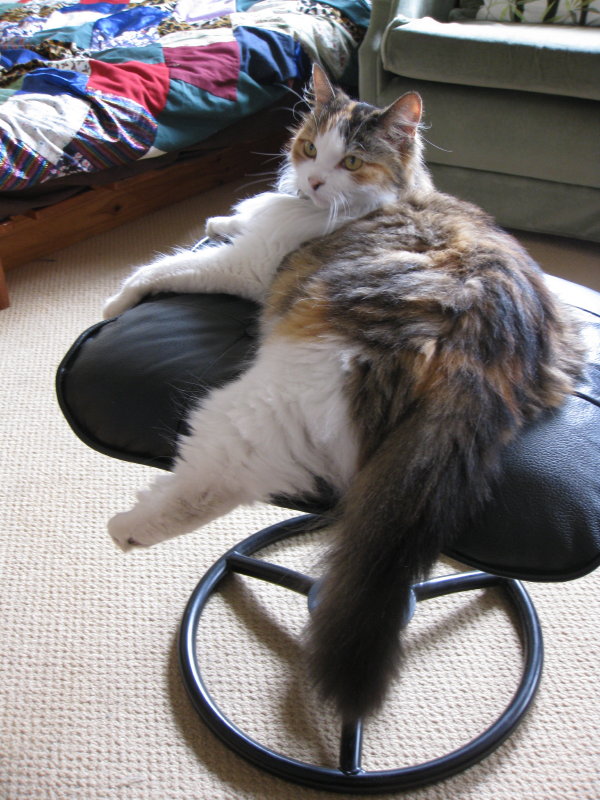
And here’s my cat, showing us a far likelier road to happiness:

Show and Tell
One of the best pieces of writing advice is “Show, don’t tell”. For a tiny example, here is telling:
Bob was sad.
And showing:
Bob swallowed hard, but the tears spilled over all the same.
The second shows character (he is trying to resist crying, and failing) and is unique to Bob. That makes it more interesting. It also draws in the reader with sensory detail (we see the tears).
The same principle applies on a much grander scale. Some examples of bad writing include:
Bob was tough. (No! Show him being tough with an entire scene. And then again whenever a situation is likely to bring out his toughness.)
Bob grew up poor. (Generally this is best shown by his actions – does he always carefully count and recount his change? Does he wear his Armani suits until they literally wear out?)
And so on.
You’ll notice “show, don’t tell” ups your word count by a huge amount (it’s very much something you fix in editing, rather than stopping every three seconds in your first draft to ask, “But HOW is he sad?”)
It IS possible, however, to show too much. It’s unlikely anyone cares exactly what colour your heroine’s hair is (you can say “mousy” instead of “brown” if you like – or leave the hair colour to the imagination), especially if you’ve just spent a paragraph each on the exact shade of her eyes and the exact shade of her dress. It’s very unlikely anyone cares about the history of the taxi driver who takes her to the airport (unless he’s integral to the plot, interesting, AND the taxi conversation shows the heroine’s character or brings up a central conflict).
Today’s article link is to Lynn Price at the Behler blog, who writes:
The biggest problem I see is authors who don’t know when and how to use show. There are plenty of times when a character can simply cross a room without it taking up five paragraphs. Same for the piece of cake. The trick is to utilize show at the right time…when the scene allows for it.
Punishing Publishers
I say it over and over, but it’s worth repeating: Publishers are not mighty conglomerates run by white men getting fat off authors and laughing gleefully as they reject new work. They’re businesses that rely on an extremely unpredictable market, and sometimes even the giants fall. Also, they’re run mainly by women.
So please, let go of the myth of the major publisher as a baddie. That just makes new writers more vulnerable to scams and foolish decisions.
Some readers also try to punish publishers by boycotting certain books. John Scalzi says please don’t.
A writing scam? For ME?!?!
A few days ago, I received my first ever personalised writing scam via email. Here is the full text of that email:
Dear Ms Curtis,
I am writing on behalf of a new international publishing house, JustFiction! Edition.
In the course of a web-research I came across a reference of your manuscript Worse Things Happen at Sea and it has caught my attention.
We are a publisher recognized worldwide, whose aim it is to help talented but international yet unknown authors to publish their manuscripts supported by our experience of publishing and to make their writing available to a wider audience.
JustFiction! Edition would be especially interested in publishing your manuscript as an e-book and in the form of a printed book and all this at no cost to you, of course.
If you are interested in a co-operation I would be glad to send you an e-mail with further information in an attachment.
I look forward to hearing from you.
Kind regards
Evelyn Davis
Acquisition Editor
Just Fiction! Edition is a trademark of:
LAP LAMBERT Academic Publishing GmbH & Co. KG
Dudweiler Landstr. 99
66123 Saarbrücken
Germany
Phone: +49 681 3720-310
Fax: +49 681 3720-3109
Email: e.davis@justfiction-edition.com
http://www.justfiction-edition.com
Register court/number: Handelsregister Amtsgericht Saarbrücken HRA 10752 Identification Number (Verkehrsnummer): 12917
Partner with unlimited liability/Persönlich haftende Gesellschafterin: VDM Management GmbH
Register court/number: Handelsregister Amtsgericht Saarbrücken HRB 18918
Managing directors/Geschäftsführer: Dr. Wolfgang Philipp Müller, Christoph Schulligen, Esther von Krosigk
This is a fairly simple scam. They don’t charge money up front, but will presumably gain that cash by offering me copies of the book – probably at a reduced rate. The sales of that book to the author are probably the only sales that will ever happen. Interestingly, the first book in their “catalogue” was “published” less than a month ago. (Never publish with a company less than two years old and/or one that has no successful titles.)
It is clear from the email above that not only do they not bother with editing, they don’t actually bother READING the books they represent. In fact, my “manuscript” Worse Things Happen at Sea is a twitter tale – all of about 1000 words. They list a large number of distributors (many of which are probably actually wholesalers, meaning that they STORE books, not sell them – I strongly doubt any actually “distribute” books to bookshops). One of the American distributors sounded familiar, so I searched Writer Beware and found this excerpt about it:
Now, one of the tricky things in this industry is that one of the major players, Ingram, is both a distributor and wholesaler. They have separate arms to handle each. But, per the descriptions above, there’s a vast difference on what they do if you pay them to be your distributor, versus merely having a listing with them in their wholesale catalog.
Unfortunately, a lot of small presses and POD self-publishing companies try to make you believe they have the distributor relationship when, in fact, they have the wholesale relationship. Since Ingram won’t reveal its client list, it’s hard to know which is which. However, I believe that right now, Ingram requires that a publisher that’s a distribution client must have about $20K+ of income from Ingram in order to qualify. If you think logically, would even PublishAmerica, the powerhouse of POD presses, qualify? Probably not. PA has the titles, but not the sales.
Kids, here’s the take-home message: There are a lot of scams out there (plus, to make things worse, some helplessly naiive publishers who simply don’t have the business sense to function). Never forget that. If someone approaches you with a wonderful shiny offer, they have a reason, and – I’m sorry – it’s very rarely because your writing is as good as your dreams. Often people are dodgy even when it’s you approaching them (setting up a web site isn’t difficult). If their books aren’t on shelves at your bookshop, they’re not actually getting sold – and yours won’t be sold to the public either.
Asian Steampunk
This is a seriously interesting article on real Asian history, and how awesomely it lends itself to a wide range of steampunk tropes and tales. Naturally, it’s from Tor.com.
This was an especially interesting read for me, because I haven’t stumbled across ANY Asian steampunk – the extent of my knowledge was knowing that steampunk is big in Japan (and that “Full Metal Alchemist” is very good).
The author is responding to a market he/she sees as limited to “samurai, geisha and ninja”. He/she gives numerous knowledgable and interesting examples of pirates, detectives, hard-boiled reporters and submarine captains. Here’s a delicious slice:
From the mid-17th century through the 1920s Chinese novels translated into Mongolian were in huge demand in Mongolia, and there was a flourishing trade in them. But the problem for the Mongolian bookbuyers and booksellers was not only the bidding wars which would break out with Russian, Mongolian, and Chinese buyers, but that getting the manuscripts back to Mongolia to sell was difficult because of the very real chance that those transporting the books would be attacked on the way back by bandits wanting to get the manuscripts and sell them for themselves. This resulted in decades of adventurous Mongolian book traders as skilled with sword and gun as they were at selling books.
I think the article could well have gone further – what about mad scientists, femme fatales, adventuring orphans, evil devices, and creepy clockwork (actually, I KNOW the latter existed)? I’m willing to bet Asia’s Victorian-era history is brimming with all of them.
I don’t currently have any plans to write Asian steampunk myself, but if you’re inclined that way, this article is a brilliant place to start your historical research.

Conflux 7
Here is where I’ll be today, particularly at the steampunk panel at 2:30 (and there’s another steampunk panel on Monday). If you’re in Canberra, you can still come.
Versatile Blogger Award
I am, according to General Happenings in my House, hereby awarded a Versatile Blogger award! Thank you 🙂

My duties, upon receiving this much-coveted honour, are as follows:
1) Thank the awarder by linking back to their blog;
2) Pass on this award to 15 recently discovered blogs and let them know I have done so;
3) List 7 things about myself.
Here are some great blogs (in no particular order):
1) Ripping Ozzie Reads – an accomplished group of Australian specfic writers (including Richard Harland, Rowena Cory Daniells, and Margo Lanagan) share their know-how.
2) Pub Rants – pub as in “publishing”. This is the blog of a US agent – again, lots of great advice.
3) KT Literary blog – another US agent (in fact, she is friends with # 2).
4) Nathan Bransford – US ex-agent and children’s author (again with the advice). He also runs great forums.
5) The Intern – this time it’s a US ex-intern, but her advice is still excellent (more on writing, less on the industry).
6) Behler Blog – this time it’s a US editorial director giving free industry help.
7) Writer Beware – there are a LOT of scams out there designed to prey on writers. This blog investigates, then tells the horrible truth.
8) Call My Agent! – more industry advice, but this time from an anonymous Sydney agent.
9) Terrible Minds – advice, interviews, and very rude rants from author Chuck Wendig.
10) Slushpile Hell – when a writer needs a little more sarcasm in their day.
11) Brass Bolts – a steampunk writer blogs about steampunk (the pics are especially good).
12) Trial by Steam – steampunk articles and events.
13) Multiculturalism for Steampunk – a seriously excellent and well-researched steampunk niche blog.
14) Antipodean Steampunk Adventures – an Australian steampunk who actually builds his own stuff.
15) Blue Milk – a feminist blog on motherhood (not always safe for work).
Well! That list certainly answers the question, “So, Louise, what do you do all day?”
Now for seven things about myself:
1) Umm. . . I attempted my first novel when I was seven years old (it was about a family of cats – naturally).
2) My mum read the Narnia series in hospital after giving birth to me (I’m re-reading it at the moment).
3) I speak semi-fluent Indonesian, and once considered marrying an Indonesian man I was close to.
4) I leave the curtains open until dark most nights in case the sunset is pretty.
5) Only one of my grandparents is still alive, and he is not well.
6) I can juggle.
7) I have pre-ordered “Goliath” by Scott Westerfeld; the third book in his brilliant YA steampunk trilogy (“Leviathan” is the name of the first book).
Thank you and good evening!
Make me care
A story needs two things: An interesting character, and a serious problem.
“Interesting” and “serious” are where it gets more complicated.
Here is an article on how to make your reader care about your characters (by giving them a reason to care before the action explodes on the page). If they don’t care, they won’t read on.
Some other day I’ll talk about how to make readers care FAST – before you lose them. I reckon you’re lucky if you get two hundred words.


 Felicity Banks