My 2017: No wonder I need a lie down
What an epic year. I spent over 15 years of my life writing novels that nobody would touch, and now that it’s started to rain it’s pouring (which is a wonderful thing).
I spent vast amounts of time on the Tin Man Games “Choices That Matter” app (Google Play and iOS). It’s a story hub for serial interactive tales and it has over a million downloads of the free sample sections. The three stories so far are:
“And The Sun Went Out”
A near-future scifi which I co-wrote with KG Tan and Alyce Potter. It had 60 updates over 15 months, and clocked in at just over 600,000 words (longer than “War and Peace”). Each read-through is about 150,000 words.
“And Their Souls Were Eaten”
I wrote all of this one (edited by Phill Berrie and KG Tan), set in the same steampunk universe as my Antipodean Queen novels, but with a completely distinct magical problem (and taking place in Europe). The finished tale is 400,000 words long, and after that I had a nice lie down.
“And Their Heroes Were Lost”
Phill Berrie is writing, and KG and I are editing (oh how the tables are turned, hey Phill?) This is also sci-fi, but I don’t want to give away any more than that! Phill is still working on this story, and his fans are clamouring for each new update.

I also wrote, edited, and published the novel “Antipodean Queen 2: Silver and Stone“, and will be finishing that trilogy in 2018 with “Antipodean Queen 3: Iron Lights” (that’s right: the title has changed since Book 2 was published).
AND my actually-rather-good pirate fantasy trilogy for kids (like Narnia, but with pirates) that I wrote many years ago has been accepted for publication and shall begin release with a free pirate mini-ball (live music, prizes, costumes, and everything!!) on Saturday February 17th.
“The Monster Apprentice” is the first book. And it’ll be illustrated, too! Plus (shh don’t tell) one of my very very very favourite Aussie authors is going to read it and give me a cover quote!
And I have three other very exciting projects coming out in 2018! One I can’t talk about yet, one will be published on the premium label at Choice of Games (they pay VERY well for books that make the premium grade), and one is called “Murder in the Mail: A Bloody Birthday” and is a murder mystery told entirely through postcards, letters, objects, and art. That link is to the shiny new forum where readers will be able to talk to one another about who they think is the killer, and how much they love all the art I chose!
2017 was a great year for my writing, and 2018 is going to be even better.
I is happy.

Things are looking up.
Sad, Bad, Mad: Cat Person
The New York Times published a short story, “Cat Person” and people have gone a bit nuts over it. Including me.
Minor things first:
*Trigger warning: This article might bring up traumatic memories for some people.
*Cats are awesome and cat people are awesome. Cats are not the point of the story. (But some of us will lie awake wondering about them all the same. Are they real? Am I? Are you?)
*The cats are definitely not real. I’m sure of it now. Cats feign disinterest but would definitely come to investigate the smells of a new person in their territory. Which means Robert’s creepiness factor just went up to eleven. Fake cats? That’s bonkers.
*There’s a fascinating interview with the author here.
*Yeah, that excessive close-up photo that goes with the story is super gross. I have to put my hand up to my screen to block it out whenever it comes up.

#fixedit
*Also, the story gets really into fat-shaming Robert, which is cheap and gross and suggests immaturity on the part of the writer (as well as, of course, the character). The writing clearly mocks the viewpoint character for her various delusions, but Margot’s disgust at Robert’s extra weight is written about non-critically. It’s about as deep as having an evil ugly witch who is baaaad.
*Yes, gay folks are most welcome to have a “Lol, you poor sad heteros!” moment. Because although a lot of the story does apply to anyone attempting to negotiate dating, the deepest, scariest level of the story is absolutely about what women face when dating men.
*A lot of men feel disturbed and defensive about the story, or simply feel that it’s stupid. Although all art is subjective, most of the men that dislike the story are missing that deep, scary level of the tale. I’ll address the valid points of negative male reactions later.
*It is deeply saddening for speculative fiction lovers that no one in the story turns out to be even slightly feline. Agreed.
*The main characters’ names, Margot and Robert, make me think of Margot Robbie. This is never a bad thing.
Summary (including spoilers)
Margot meets a guy who is pretty average but witty in text form. They eventually have a kind-of date with very bad sex and then Margot texts him (technically her room-mate texts him) to end things, and he calls her a whore.
The deep, scary bit that hurts to think about
There is an underlying tension to the story that a straight female reader (or anyone in a non-male body who has dated a man) has a visceral response to: While on the surface the relationship is mundane (and in the thoughts of the main character it varies as she judges and re-judges the situation), the third layer is the knowledge that Robert has the physical power to rape or kill Margot at virtually any time (and could probably get away with it too).
Women
live
with
this
knowledge
every
day.
Here’s the worst part, the part the story doesn’t even touch on: When a women is a victim of violence, it is almost always at the hands of someone she knows. Someone she trusts. Someone she isn’t afraid of; not any more. Should I live in fear of Chris, my Chris, father of my kids and love of my life?
Of course not!
Except, statistically, yes.
Women live in a world where half the people we know are bigger and stronger than us. We are taught from birth to be careful. Don’t go to certain places after dark. Don’t go to certain places at all. Carry mace. Keep your eyes open. Don’t wear certain clothes. Don’t drink too much. Learn self-defence. Don’t show weakness. Don’t drop your guard.
Then at the same time we’re taught how to survive in the living world: Be nice. Don’t say ‘no’. Flirt. Wear heels and makeup. Marry a breadwinner. Have a private bank account. Don’t have a shrill voice. Don’t complain. Don’t be a feminist. Don’t be loud. Don’t be unlikable. Don’t get angry. Don’t cry in public. Don’t show weakness. Don’t drop your guard.
I am an innocent, partly because I choose to be and largely because my privilege allows me to be. I am white; I grew up thinking I was straight; until recently I was able-bodied.
One of my fictional characters (in a deleted novel) leaves her shoes above the high tide line of a beach while she wanders along the water. Her friend asks if she’s concerned about them getting stolen, and she admits that sometimes they are in fact stolen, but she’d rather have to buy new shoes sometimes than to constantly worry about her possessions.
At a certain point, women have to accept that we might get murdered—and then we befriend men anyway.
I met a man online who lives in Adelaide (I live in Canberra). We got to know one another online (as much as anyone can). Daniel visited Canberra, and we began dating. Then it was my turn to visit Adelaide. He picked me up from the airport and drove me back to his house.
Like a lot of Australian cities, Adelaide has sections of well-established bushland, many of them bisecting the city itself. Daniel and I had already joked about how one of us was most likely an axe-murderer, and as we passed through an unlit section of what appeared to be virgin bushland I felt my heart beat faster.
I didn’t rehearse in my head how to throw myself out of the car, or carefully recollect exactly where my phone was in case I needed to call the police. Instead I tried very hard to pretend I wasn’t afraid. Because when it comes to priorities, men’s feelings almost always come above women’s safety.
Now, spoiler alert, I wasn’t murdered. So I was arguably right to be polite. But that knee-jerk reaction to Be Nice At All Costs isn’t just manners—it’s another type of fear. What if Daniel had noticed and been offended that I’d thought such a thing of him, even just for a moment? What if he’d been so offended that he threw me out of the car, or punched me? That instinct to Be Nice—Or Else is hugely powerful and damaging. That right there is the reason women are frozen in terror when a man masturbates in front of them. He’s already crossed so many boundaries that trying to get away might just be the catalyst that leads to him doing so much more. It also applies to so, so many other awful situations: getting groped, getting overlooked for a deserved promotion, getting interrupted mid-sentence. Women’s default setting is less powerful, and the imbalance gets wider in a thousand different interactions every day. Because men don’t want to give up power, and they push back against women who try to change things.
It’s difficult for men to understand what it’s like from the other side of the gender divide. It’s not a fun think to think about. Quite often, a man will suddenly have a light turn on in their head when they have a daughter: Suddenly they understand the terrifying vulnerability of women from a position where it matters to them.

I asked my mother once if she was scared of being raped. “I used to be,” she said, “then I had daughters. So now I’m afraid of my daughters being raped.”
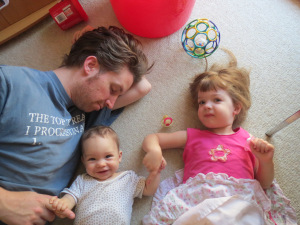
I hesitated to include a picture of my daughter in this article. You all know why. Yet I didn’t pause for even a second when including a picture of my son. Of course not.
Back to the story. . .
The story plays with the conventions of three different genres, keeping the reader guessing since those genres have very different endings.
One is a romance. I felt myself give that little ‘Aww’ smile as certain beats were hit: The cute meet over Red Vines; the nearly-missed-it moment when the girl doesn’t really know why she gave the boy her number; the tension at silly misunderstandings. Margot gives Robert several chances, and for all her flaws I admire her for that. That genre always ends with a critical romantic moment (a wedding, or meeting the parents, or a first kiss) that indicates that the pair will live happily ever after.
As it turns out, this is not a romance.
The second genre is comedy; there is clearly a slightly dark, wry, self-deprecating humour as Margot’s expectations and opinions about Robert shift and change from moment to moment, only to be ultimately let down by the reality. This layer of the story is expertly done, highlighting the self-delusions and awkwardness of dating in a way that made millions of readers say, “That is the truest story I’ve ever read.” The comedy genre climaxes (oh, lolz) with the awkward horror of the sex scene.
The third genre is horror. When it becomes clear that it’s not a romance, the reader is left not knowing if this is a comedy or a cautionary tale. The horror genre ends with violence, usually with a sense that the protagonist has somehow brought it on herself by her foolish decisions. Margot risks her safety by giving Robert a chance—doubly so by going to his house, and any sexually active female (fictional or otherwise) is guilty for the purposes of fictional denouement. A story is sometimes sympathetic to the sexually active heroine, but it will still kill her for putting out. Stories understand, consciously or otherwise, that sex is dangerous for women and not so much for men.
But refusing sex, as Margot wishes she could do? That’s even more dangerous. Because the last thing you want to do is make a man angry. She’s very conscious of the need to soothe and console Robert (before, during, and after their ‘date’) and is sufficiently aware of her own vulnerability that she finds herself unable to figure out how to break up with Robert, even though she knows she must do it.
Is she promiscuous for sleeping with a man she doesn’t want to? Or is she a victim, unable to extract herself safely from a threat? Or is Robert a victim, lead on and discarded by a powerful (better educated, more attractive) woman?
In my opinion, only one of the above interpretations is a ‘yes’ according to the story—but it’s written well enough that the other questions are allowed to be asked.
Angry men on the internet
There’s a twitter handle set up just to repost men’s reactions to the story, mainly because a lot of men don’t understand the fear Margot feels, and/or they relate to Robert as the victim but feel he is portrayed as a monster.

Margot is not a good person. Nor is she a bad person. She is vain, certainly. She lets her imagination run away with her as she tries to figure out what kind of person Robert really is. She flirts at work (an activity that is harmless, but could hypothetically lead to mildly hurt feelings).
This article is getting ridiculously long, so I’ll be brief: Yes, being a man (especially a straight white man) is the lowest difficulty setting in this game we call life (as written about by straight white male John Scalzi, here, including several follow-ups, one of which is here). And, as John Scalzi and others have stated loudly and repeatedly, that definitely does not not not mean that the lives of straight white men aren’t hard or don’t suck. Life has times of suckitude for everyone, and many lives just suck from beginning to end, and it hurts to be in a sucky place and feel like others are telling you:
- Stop whining. My sucky place is suckier than your sucky place.
- Give some of the tiny scraps you have away to others.
- A lot of what is bad in the world is the fault of you and people like you.
All those three things are true of me and my privilege as well. My methods of coping are:
- Trying not to compare my pain to anyone else. That never ends well.
- Giving away a little (money, time, and mental energy) when I can, and trying to be aware of barriers that other people face and I don’t. This also means consciously supporting minorities when I can, and continuing to learn painful truths for the rest of my life. It’s not easy, but it is rewarding.
- Pretty much the only way to deal with this is #2.
Is Robert a baddie?
I. . . I wasn’t sure, but then I reread the story.
The first hint of a red flag is when Robert steps back from Margot’s very mild flirtation “as though to make her lean toward him, try a little harder”. If someone stepped back from me, I would assume they were not into me and nothing more. It probably wouldn’t even be a conscious thought on my part. It’s unclear if Margot is interpreting him this way or if the story is. It’s a very very subtle form of negging.
He calls her ‘Concession-stand girl’ which is either cute or insulting. Could go either way.
He plays it a bit cool with texting, letting her choose whether to keep texting or not. That’s more of a positive sign than negative, and their sharp humour is the one real connection they have. Another good sign.
He kisses her on the forehead “as if she was something precious” which charms Margot but also suggests fetishisation of the big man/little woman dynamic. In both directions.
The silly scenario they play out via their cats involves jealousy and tension. Is that because Robert is the jealous or possessive type?
He sends a heart-eyed smiley at the mention of her parents, which is a good sign.
Then he acts strange and cold after spring break. A red flag on its own, and even more so when it turns out he is jealous of an entirely fictional potential ex (although it certainly shows that he and Margot have imaginative portrayals of one another in common).
It takes longer than it should for him to stop being unpleasant and weird, and it also seems he’s trying to impress her due to feeling insecure about her higher education and youth.
(There are plenty of red flags about Margot, too—particularly the way his grouchy behaviour makes her feel honoured by his vulnerability. That kind of attitude puts her at high risk of an abusive relationship.)
When she begins to cry during the humiliating ID incident, he kisses her for the first time—like her, he is emboldened by vulnerability, even or especially as a flaw. This is a two-way red flag. Vulnerability is good, certainly, but both Margot and Robert are genuinely turned on by it. It’s not intimacy they crave, but power. That’s messed up.
I’ll stop there rather than pick apart the story line by line. Men who hate the story see Margot as more powerful: She is young and beautiful; she is the viewpoint character; she is more educated than Robert.
But is the risk of rejection as bad as the risk of being murdered?
Of course not.
But. . . is the 90% certainty of being rejected as bad as the .001% likelihood of being murdered?
I don’t know.
There are two more points worth making. First, Robert is 34 and Margot is 20. Once again, that gives Robert power. It’s also a big red flag. (Margot guessed he was in his mid-twenties and was off by a decade so this one’s all on him.) There are loads of thirty-something single women, so why isn’t Robert dating one of them? At best it suggests he prefers younger, prettier woman. Given the rest of the story, it strongly suggests he likes all the power he can get—needs it, because he is so insecure he doesn’t stand up straight.
The age difference could be just coincidence (after all, Robert doesn’t realise she can’t get into a carded bar, and is horrified she might be a virgin) except then Robert appears in the same student bar that he earlier mocked. What is he doing there? There are three possible answers. If one is extremely charitable, one could argue he has decided to study (why not? He’s smart—except it’s clearly in the middle of the semester, so no). It’s far more likely he’s looking for a new twenty-something to hook up with. Or, worse, he is looking for Margot. Either way, this is the moment we know for certain that something is definitely truly off about Robert, and while the Secret Service-style exit of Margot and her friends is needlessly dramatic, she is also genuinely afraid. And at this point, that is not being dramatic. Her friends know it, and they know what all women know: there is safety in numbers. That is the only safety women can draw on.
One of my friends was attacked at a bar because her friend was too drunk to protect her. I feel disgust at the men, but I have a burning fury at the woman who abandoned my friend.
Women protect each other. That is the law. That is how we survive.
Here’s an interesting fact: not all that many people are attracted to me. (That’s not the interesting bit.) Of the dozen or so people that ever confessed attraction to me, three were more than a decade older than me.
One of those men I never knew well. The other two both have a very clear pattern of dating younger women. One prefers women who are sexually inexperienced (not necessarily virgins, but women who lack the confidence of a past healthy romantic relationship they can use to spot his patterns of abuse). The other’s self-esteem is strongly based on being helpful, so he tends to be attracted to people who are needy in some way (usually mentally ill, or those who have been abused, or both). When I dated him, I found myself acting depressed and unhappy when actually I felt fine. It took me a very long time to figure out that I was unconsciously adapting to what he wanted in a relationship.
So again, you have older men grasping for power of various kinds over a younger woman. (Dating suuuuuuucks!)
There’s one final red flag about Robert: When they spot one another in public later he sends Margot a series of texts. They start friendly and then get harsher and more jealous, ending with the final word: “Whore.”
It is a punch of an ending, revealing the true character of the man who seemed harmless and sweet.
But (say male readers) it’s just a word.
Robert insults Margot with time-honoured sexism, condemning her as the baddie with a blithe unawareness of the irony of condemning her sex act when he was there and participating at the time. He condemns her sexual activity, when it was her fear of his anger that caused her to have that sex at all. (No, it wasn’t assault. . . but it wasn’t an empowered choice either.)
The story ends there, but does it?
In real life, would Margot ever feel safe on campus again? He literally knows where she lives, not to mention where she works and where she eats and drinks.
He is angry. The beast of legend, the monster Margot had sex to pacify, has awoken.
Margot could never possibly know if his anger was “harmlessly” spent by insulting her via text, or if he will begin/continue to stalk her. Or if he’ll get drunk one night, three months from now, and break into her dorm and shoot her.
No woman ever quite knows. She only knows that if he wants to hurt her, he can.
Murder in the Mail
I wrote a guest post here about how I fell in love with steampunk. And it’s part of a series by a bunch of steampunky types.
I’m working on a new story called “Murder in the Mail: A Bloody Birthday” which will be released by Publisher Obscura, Odyssey’s imprint for “beautiful and unusual novelty and gift books by Australian and New Zealand authors and artists”.
The fundamental concept is that it’s a cozy murder mystery that is told entirely through letters, postcards, objects, and art prints—all of which are physically posted to the reader through the mail. There are seven writers altogether (one for each character, including the victim) and six artists (five from Canberra, one from Obscura who lives in Brisbane). The story runs for about eight weeks, and I chose (or in some cases commissioned) art that was both beautiful AND something that helped tell the story.
Yes, some vital clues are hidden inside the artwork itself!
The objects are also clues about the murder (or other secrets), and chosen to be small enough to post but also to engage the senses—hearing, smell, touch, and even taste. Obviously the art is somewhat visual.
I’m deliriously excited about this project, which will probably come together bit by bit over the next 6-12 months.
Here’s one of the pictures that will be in the story (as a physical A4 print):

This is one of the pieces of art from the story, which means everyone who buys the story gets a high-quality print of this (and seven other pieces in a range of materials). In real life, the photographer is Adam Lee. His website is here.
Update: The tentative release date is August/September 2018, and before then we’ll run a Kickstarter (which will have lots of fun & unique items, and will increase the advance given to all the contributors). And there will be a forum for people to talk murder, mystery, and art. Stay tuned!
Update: The story is well and truly up and running, with the main details here.
There are also Magic in the Mail stories!
What I earned this year
Full-time writers in Australia have an average income of around $12,000 (I know, yikes). In Canberra, which has a lot of good public service jobs, the average income is around $52,000.
I just did my taxes, and worked out that I earned just under $20,000 last financial year while working full-time. 100% of that came from writing (the vast majority from interactive fiction). So depending on one’s perspective, that’s either really impressively awesome, or shockingly awful.
If I was healthy and single and childless, I could probably survive on $20,000 a year. It wouldn’t be easy, but I’ve lived on the edge before. (I once spent $5/week on food for several months—but that was certainly not sustainable, even for a young and healthy person during friendly weather.) On the other hand, if I’d been babysitting for the same number of hours I spent writing, I’d have earned at least twice as much.
So, again, whether it’s awesomely good or awesomely bad is a matter of perspective.
It should be noted that I’m not healthy, or single, or childless. I keep a complicated house running fairly smoothly, and I look after two little people (and, in some respects, Chris—he is my carer in many ways, and I am his in some ways too). I am overwhelmingly not a healthy person, and some days I barely function at all.
So. $20,000. It’s both a huge and a tiny amount, and it’s $20,000 more than I earned for most of my writing career. Plus I can say “writing career” without sarcastic quotes these days.
It’s in my nature to always push myself for more. I’m sure that if I earned $100,000 last financial year I’d be looking for ways to earn more, or work less, or something. A lot of creative people look at others and think, “Wow. If my career was where theirs is, I’d be so satisfied!” I definitely remember specifically aiming for the impossible amount of $20,000/year at some point—a point at which $20,000 was as laughable as $100,000 is now.
I also have a book published—two, in fact, and at least four more on the way. I’m so famous that people seek me out at conferences, waiting for my latest book. I get fan mail quite often. I get people—quite a few people—saying “This is the best story I’ve ever read”. I even get actual reputable game companies emailing me to offer me work (I have two REALLY COOL projects on the go at the moment that I can’t talk about). My income doesn’t even cover our mortgage (or the medical expenses of this year), but why should it? I’m the closest thing to a stay at home parent our household has, so I’m doing a bunch of important and often difficult work before I earn a cent.
Have I convinced you that I’m not just messing around with this writing thing (after more than twenty years of devoting myself to the craft)? More importantly, have I convinced myself? Maybe a little bit. Certainly it’s time to pause and celebrate how far I’ve come, and to shift some of my pile of insecurities into the “irrational” pile.
So, yay. Much yay. And I suspect this financial year will be even better!

Artist’s impression of a life of leisure.
Procrastination Technique #452: Reviews
I’ve written about reviews before, and I’m always fascinated, whether the review is positive or. . . not so much.
The Tin Man Games app “Choices: And The Sun Went Out” (including the second story, my steampunk fantasy, “Choices: And Their Souls Were Eaten”) has just under a hundred reviews (mostly just stars) on itunes and has just passed 600 reviews on Android.
Android apps have a cool feature where they say how many people have installed an app, and this app, our app, has been installed over 50,000 times! It boggles my mind that so many people are reading words that I write, and it makes me evil laugh when I read the desperate pleas of addicted readers hanging out for their weekly story fix:
Mario Zalout wrote:
Love it It’s hard for me to find games like this. I constantly crave the story, wanting more. However, I’ve caught up with And Their Souls Were Eaten about 3 times, and I always hate the break I have to take in between. And The Sun Went Out helps with that though, and since I know it’s considerably longer I work at it whenever Souls needs an update.
Theresa Budd wrote:
Great game but… This is a really great game but I wish they would update the bear version. I was having so much fun playing it and now I’ve got as far as can but they need to update it so I can finish the story please.
Zachery Fitzpatrick wrote:
You’ll love the story …..untill you get a nice distance in…. then the book shuts itself on your fingers and then throws itself into a fire and tells you wait for a update.
Trevor Veltema wrote:
So good Honestly the best game I’ve played, I was on it from 12am to 7 am, it’s very addicting
Johannes Haler wrote:
UPDATE MORE PLEASE The story And The Sun Went Out is easily one of THE best stories I’ve ever read. The plot about how the sun disappesring and stuff is just amazing! Please, I’ve reached the part where update is needed and I NEED MORE! Thank you Tin Man Games, for making reading fun, and making one of the best books I’ve read!

There’s a whole sub-group who are angry that you have to pay (or watch ads) to read the whole story. Since I know exactly how much I earn (hint: not an enormous amount), I’m not entirely sympathetic to these:
Alper Can Buyuk wrote:
Ad-fest So you need “choice-tickets” to make decisions and progress the story. The only way to get these is either purchasing them, or buying a pass which allows you to progress through the app. The other option is watching a 30 second ad for a measly 3 tickets, completely breaking the immersion. Shouldn’t be a free app in the first place if this is the way the devs are gonna go about it.
Franz Airyl Sapit wrote:
TOO PRICEY. NOT WORTH IT. In my local currency, two Story Pass (needed to play this,”pay to play”) of this game is worth as much as Dragon Age Origins, a PC game. Imagine that.
Kaneki Ken wrote:
Money-grubbing morons. Whoever is the developer(s) of this game is seriously an annoying one. Not only do you deem it, unfavourable to have a narrator. To continue the story, you force us to give you money? How cheap is that of a practice! You don’t deserve money of you’re too lazy to have a voice actor!
In their defence, ebooks are sold in a much simpler system. There’s a big yellow button that says “free sample” and it’s easy to understand that the free sample is specifically designed to suck you into buying the book. These story apps are exactly the same thing, but app stores list them as “free, with in-app purchases” which isn’t deliberately misleading but it feels like it is.
Sadly, there are sometimes bugs and those reviews are always awful. The only up side is that bug-fixing horrors are someone else’s job to fix. Yay?
I love it when reviewers give useful information (and even more when they rebut the “I don’t want to pay/watch ads” reviewers).
DERPING Dubstep wrote:
Worth the read Don’t expect this to be an adventure game with managing inventory and fight enemies. If your looking for that you better off getting something else but don’t let that deter you from this experience. Like it is described by the developers the story is really choice based. I noticed how different the story was when i looked at the screen shots and compared it to mine, i was surprised. (And their souls were eaten seems really interesting hope we get an update soon)
Kat Hargis:
Amazing Currently reading The Sun Went Out- and the story is compelling and leaves me craving more. It is definitely worth to purchase the Story Tickets pass or whatever it’s called. Not only does it support the creative geniuses behind the story, but it also keeps me satisfied with long reads rather than short ones. Compared to other choice-based novels, this one is probably my top pick, beating even TellTale games. Once again, definitely worth that I initially spent. Looking forward to the updates on the story!
krazykidfox wrote:
Fantastic I’ve read both stories up to date. They’re both fantastic, and I’m eagerly waiting for more content. Pick this game up, hands down. While yes, you do have to either watch ads or buy tickets to progress through the stories, it’s honestly a very fair and generous system that stands out from all of the Free-To-Pay mobile games out there. Props to you, devs. Get this, you won’t be let down.
I don’t have a name wrote:
Awesome (Currently reading “And The Sun Went Out”)Intriguing, mysterious, smart and a bit dangerous. I love the fact that, although the choices you have are both natural and logical and not extremely different from each other, any choice you make has a huge impact on the story, changing it in major but still subtle ways. The only downside, in my opinion is the fact that you can’t redo a choice. You have the option to start the whole story from the beginning but I don’t want to repeat everything just for one mistake

I really love that people are passionate about the stories!
The first story has been running over 14 months and is well over 500,000 words altogether (although each read-through would be about 100,000 words – the length of a regular book).
The person known as “I don’t have a name” is going to love the stuff that happens towards the end of the first story, when literally hundreds of seemingly insignificant choices have the power to save the world. . . or doom it forever.
The final final final piece of the story will be released roughly on Christmas Day. If you want to read the whole story from beginning to end—possibly several times, so you get different experiences—then this is your moment to jump on board!!
Conflux 2016
Conflux is Canberra’s speculative fiction conference. It happens every year on the October long weekend (even when that means starting in September, like in 2016 and 2017).
Each year features guests of honour from around Australia and the world; panels on a variety of topics (including deliciously blatant fanfests); workshops; book launches; pitching sessions; a dealer room; and opportunities to hang out with like-minded people (some of whom happen to be authors with varying degrees of fame). A few people do cosplay, which is always fun.
The reason I’m able to handle conferences when I can barely handle dropping my kids at school is simple: adrenaline. I’m generally moderately with it as long as I feel like I’m performing.
In 2014 TJ was a teensy baby and I had a sudden thought: I hadn’t finished a full original novel since Louisette was born in 2012. Had I lost the knack?
At around the same time I noticed there were five possible pitching sessions at Conflux: A large publisher, three smaller publishers, and an agent. I decided to pitch to every single one with a different book. That meant writing a brand new book in a couple of months (which I pitched to the agent, so I had time to edit it before any publishers saw it). That book is “Flight of Fancy.”
Satalyte accepted my pirate young adult fantasy novel “Stormhunter”. For various reasons it hasn’t been published yet, but it’s going to be published eventually. I love doing pitching sessions with publishers, because they’re always nice people and they like meeting authors.
In 2015 I pitched “Flight of Fancy” and “Heart of Brass”. Odyssey Books ultimately accepted “Heart of Brass”, which meant that this year I FINALLY had a book to actually sell to people!
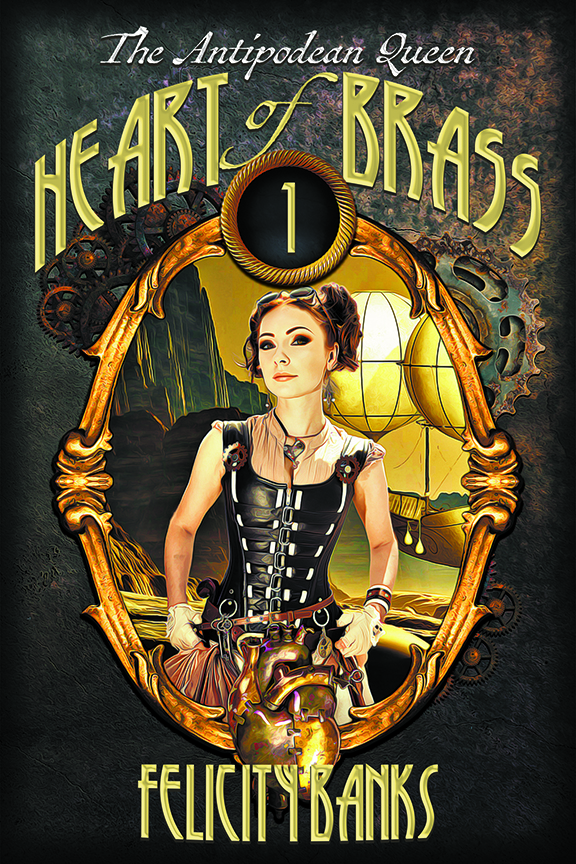
This year at Conflux I ran an interactive fiction workshop (lots of writers attend the conference every year), assisted with several panels (especially the steampunk ones), actually attended one session (very rare for me, since I get sore sitting in chairs without masses of adrenaline helping me out), and spent hours hanging out in the dealer room (mostly on the Canberra Speculative Fiction Guild (CSFG) table rather than the Odyssey table, because there were four other Odyssey people there and it was crowded). The familiar tension of, “Why am I talking on a panel when I don’t even have a novel published?” was gone (it’s worth pointing out that I haven’t gotten any smarter or more interesting than last year – panellists should be readers, but their writing life is almost always irrelevant), and I enjoyed the new tension of, “I’m absolutely trying to sell my book here”.
Our family car died suddenly the day before Conflux, so travel was complicated (especially with the uncharacteristically vicious weather), which complicated matters. My interview on interactive fiction at the local ABC 666 radio station was an unexpected bonus.
It was definitely fun chilling out with friends (Odyssey, Satalyte, CSFG, and others) and I think I recognised about 60% of the people. Conflux is my “home” conference, and the CSFG (which runs it) is a truly excellent group of people.
I enjoyed taking stupid pictures of my book, too.
This year people walked past the bar/restaurant on the way to the conference, so there was plenty of hanging out over food/drinks which was really excellent too.
This Saturday I’ll be at the Book Expo in Parramatta (Sydney), which I’ve never been to before. It’ll be interesting to see what it’s like!
Dancing, Duelling, Delicious: The official book launch for HEART OF BRASS
You know what’s cool? Nurofen tablets are sugar coated.
*
HEART OF BRASS had her official Book Launch yesterday as part of the inaugural Canberra Writers Festival, an absolutely huge event. I was written about (with a cover image) in Canberra Weekly magazine (96,000 readers!) and in the Canberra Times, as well as various other places.
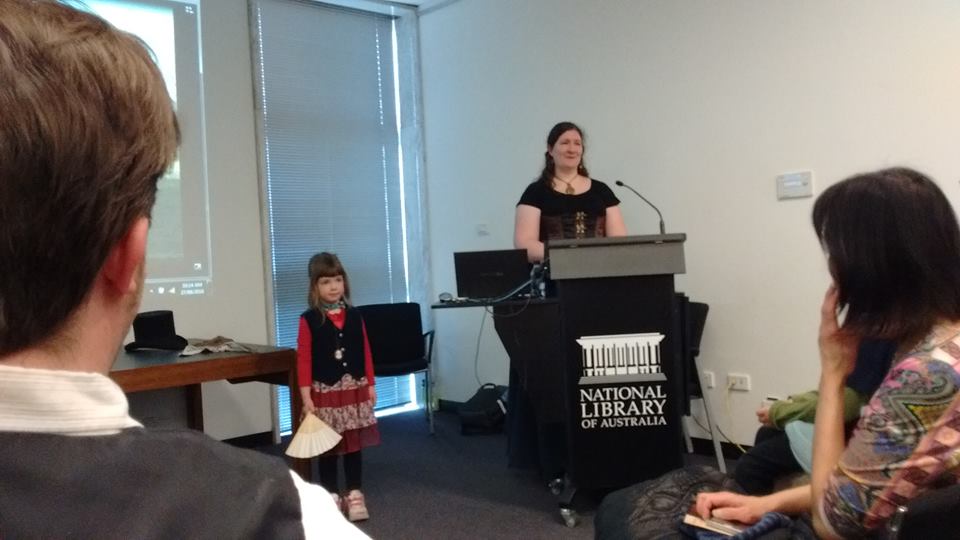
The launch took place in the National Library of Australia (pictured behind the kids and I), in the Ferguson Room. The Ferguson Room overlooks the foyer of the National Library, which gives it a grand air and means one can watch guests coming in. That was particularly fun for me, since I’d encouraged steampunk/historical garb and was well rewarded for my efforts. My kids loved it too. Louisette got to talk into the microphone before anyone else showed up, and she imitated my own test speech by saying, “I wrote a book”—which in her case is quite true (if you haven’t read “The Adventures of Pirate Captain Louisette”, just scroll down a couple of entries).
I’m usually a very confident public speaker, but I was intensely nervous (enough to have patches of time when I was breathing funny) before this event, even though I was rationally confident it would go well.
The best and most important thing is people.
I was very lucky in that regard. The Ferguson Room is meant to seat forty people, which is rather a lot for a debut author—but within a day of setting up the facebook page (and SMSing and emailing various people to invite them personally), I knew I had at least twenty people. The phrase “book launch” is haunted by the horrifying spectre of a desperately awkward room of four people sitting in a sea of chairs and wishing fervently that they were elsewhere (none more miserably than the author). By the time the big day rolled around I was slightly nervous that the room would be unpleasantly crowded or that we’d run out of books for people to buy (what wonderful issues to have!) I estimated 50-60 guests beforehand, and I was exactly on the money. Someone had added a few more chairs to the room, which was useful. We sold a very healthy number of books without selling out altogether (my publisher and I both had extra stashes of books just in case). I would have liked to sell more, but this means that the National Library bookshop still has copies on the shelf (excellent promotion in itself).
50-60 people is a lot. That’s a larger number than any event I’ve hosted before (with the exception of my wedding), and it was in a location I didn’t know well.
I get panicky in new places. The National Library as a whole is somewhere I’ve been to many times, and I visited the room before the launch to get a sense of the space, but the technical equipment was new on the day. It all worked well (strange but true), including the book trailer and the dancing music. I really enjoyed the location and I wish I could start over so I could have that confidence from the beginning. Bring on Book 2!
Robbie Matthews is a friend, a writer, and a generally charming and funny person who’s well known to the Canberra writing community. He was MC at my wedding, and I was very pleased with myself for thinking of him again for the launch (especially as it prevented me from haranguing other authors who I don’t know as well).
At my wedding reception one of the tables was “the minion table”—full of people who’d helped decorate, give lifts, take photos, etc. As MC Robbie was on that table and he made friends. Then he made a highly memorable speech about the wide range of colourful threats I’d made to all my sweet innocent minions in order to let them know what would happen if they didn’t do their assigned jobs. I vividly recollect how impressed I was at the time that I’d subconsciously tailored original threats to each person.
As the book launch drew closer I wondered what Robbie would say about me, since I hadn’t threatened anybody this time. He got up and explained how we’d met: We did Live Action Role Playing (LARPing is like a play where all the players have a general character and plot outline and then improvise to amuse one another), and I was his fictional daughter. “By the end,” Robbie explained, “she was wearing my spine as a necklace.”
Oh yeah… I’d forgotten about that. (To be fair, my character was under a lot of stress at the time.) One may draw one’s own conclusions about my general mental health…
A lot of book launches are introduced by the writer’s publisher. It’s a very neat way to do things, but I always felt it was a bit sad since the author and publisher are the people who are the most desperate to sell the book. Having Robbie meant that we had a disinterested party recommending the book (which he read before the launch). That made me feel much less like a grasping novice.

I realised belatedly that the reason I was so nervous was that I was, in the most literal sense of the phrase, “selling something” (and to an audience that was trapped for the duration, too). It’s impossible for a writer to truly know if a book is good or not (although being published certainly helps) and that’s why I always find book launch speeches so horrifying. I acquitted myself well enough, I think.
I’d described the launch to Louisette in advance, and she said she wanted to help with my speech, so when I got up I summoned her as well. She is an adorable child and was adorably serious about the entire process—but she stood bravely (by herself, because I needed to stay near the podium microphone). She was very pleased afterwards with her own courage. Hopefully this will lead her to be a confident public speaker, rather than turn her into a full-time writer (creative jobs have a high personal cost that I wouldn’t wish on anyone).
Clothing is tricky while I’m still waiting for my stomach muscles to be put back together (not helped by weird sensory overstimulation stuff that tends to give me panic attacks if I wear new clothes), but I’d had an idea (on Friday) to adjust a favourite skirt, and that very much improved things for me.
My other main panic was that I’d simply forget to bring something essential. I started putting things in the car last Thursday, and although there were certain things I meant to do and didn’t, all the important pieces (such as a copy of the book to give away to the best costume, and having my kindle prepped on the podium for my reading) were in place.
This was all very much complicated by the fact that I’d gotten overenthusiastic and decided to write and run a Live Action Role Play game inside Questacon after the launch. But that’ll need its own entry 🙂
The tea duelling and catering was complicated by the fact that no outside food was allowed, and no food was allowed in the room. That meant paying a huge sum to the cafe (which reserved tables for us and did a great job from beginning to end) and having biscuits that were fresh and delicious but not the right kind for duelling. Although the cafe staff were excellent and the location classy, the lack of ability to bring in a pack of plain dry biscuits was annoying. Still, it was entertaining and it looks great in pictures (useful for media coverage, which is useful for selling books, which is the point). And even though we under-catered, most people were so distracted by the duelling that they didn’t eat or drink at all.

The waltzing was a huge highlight. I had one couple primed to lead the way, and Louisette is an enthusiastic amateur. I figured I’d waltz with Louisette while my dancers hopefully lured a couple or two to join them over the course of the piece.
Actually, I danced with Chris the second the music started, and several other couples willingly took to the floor in an instant. The space was perfect (everyone moved the chairs back); roomy enough to dance without feeling either crowded or lonely.
It’s been a long time since Chris and I waltzed, and it was a lovely moment for both of us. I found out later that one of the other people dancing was stepping out (invited by a nearby acquaintance because Canberra is like that) for the first time since major surgery, and it made her realise she might be healthy enough to dance regularly again soon.

Adrenalin does wonders in carrying my wreck of a body through things (in fact that’s probably part of why I do things like this—for a while, I feel normal). My muscles were freaking out last night as the adrenalin wore off, and today I’m weirdly sore in a dozen places (hence the nurofen). Luckily I’m not involved in the rest of the Canberra Writers Festival so I don’t need to do anything more strenuous than writing and napping for the rest of the day.
I still can’t quite believe how many people came.

The launch was as close to perfect as it could be. The festival, venue, and volunteers were all top notch. Ultimately I wouldn’t change a thing.
Deadlines
I love deadlines.
That’s not sarcasm. The writing life consists largely of sitting alone in a room (or worse, sitting in the same room as young kids who I desperately hope are sufficiently distracted by the blaring TV) scowling at a screen as I invent worlds and people that absolutely no-one cares about except myself. Deadlines give me a sense of urgency and excitement that is sometimes sorely lacking. When a deadline is approaching I feel stressed, but (unless something else comes up and sends me hurtling over the edge) it also gives the sense that someone is waiting for that piece of writing – and that it matters.
Whether writing “matters” or not is a can of snakes that I won’t get into today. But, I do like deadlines.
At the moment I have four and a half deadlines coming up in the next month. Wheeeee!
One is for a novel submission that I promised someone I’d send in September (ish); two are for interactive fiction contests that are ending soon; and the other one and a half are for collaborative interactive fiction pieces (one of which I’m running, and the other of which I’m mostly acting as cheerleader while also writing a significant section).
Before I stumbled across the glorious cornucopia of interactive fiction (think “Choose Your Own Adventure” stories but better), I was going to make 2015 the year that I wrote a novel slowly. It would be an experiment in writing against my usual nature, and perhaps discovering that my writing was much better if I was less manic about it. Then I found interactive fiction, and by the end of September my total IF word count will be around the 150,000 mark (two large pieces, two medium, and two collaborations). So I’m not exactly writing slowly, particularly since that’s roughly three times my usual annual output.
A funny side effect happened due to the fact that when Choice of Games – absolutely my favourite IF engine and company (and they pay well too) – is considering taking on a project for its premier label, they require a detailed outline first. Those outlines always run over 5000 words, including loads of choices and their consequences. To put that in perspective, the last book I wrote was based on a story told to me by my then 2-year old. I did some googling, scrawled a map and a chapter outline (maybe 200 words) and was writing the book within three days. I finished it a few weeks later.
But the interactive piece I’m working on most at the moment – a fantastical pirate adventure called SCARLET SAILS – has a proper Choice of Games outline. And because I was waiting to hear back about a different project, I had to let it sit for a long time – which also meant I could discuss the basic plot with some intelligent people and discover major plot issues BEFORE I’d written a 50,000-word novel. So interactive fiction distracted me from slow writing, then brought me back to it.
The other interesting side effect of IF is that suddenly I’m collaborating. I’ve done that exactly once before, when I wrote a one-page play in high school. It barely counts as collaborating, since my (undying, I’m sure) prose wasn’t edited in any way except by the nature of performance. (I do remember one friend saying, “So I’m playing God? Mm’kay.” which was most definitely a positive comment on my casting choices.) I write because I LIKE sitting alone in a room inventing worlds and people out of nothing… and I like being the international expert and ultimate authority on every single aspect of my work. Like my actor friend, what I really want is God-like powers and unquestioning obedience.
But I also love a deadline. (I may have mentioned that.) So when someone on the IF forums at Choice of Games suggested some kind of game-writing jam, I leapt at the chance. I specifically said that I thought collaborations were a bad idea, and so naturally a few days after that I volunteered to lead what ended up being a cheesy 50s-style space adventure collaboration (and then someone asked me to whip their multi-genre bookshop collaboration into shape, and I gleefully did so).
And it is so. much. fun. It helps that everyone involved seems to have figured out that I will work very very hard to earn ultimate power, and so they say things like, “Go ahead and edit my bit however you like” which I’m pretty sure means I just became a benevolent dictator (and I LOVE it).
I will of course post an easy-to-play link here when the game is ready. It’s turning out surprisingly well (and the editor is fantastic). But here’s the front cover just to tease you.

Credit for the space background: http://palnk.deviantart.com
Supanova Sydney
Oh, wow. All the wows.
It got me when I found out Nathan Fillion would be there.
It got me when I found out Dr Karl would be there.
It got me when I saw a pack of medieval cosplayers, with enormous weapons, at Sydney Central.
It got me when I asked at Central how to get to Olympic Park, and the guy said, “For Supanova, you go to… ”
It got me when a fairy and a sith lord recognised each other from online photos, and started chatting on the train.
It got me when I saw the line: a thousand strong when I arrived on a weekday, moving quickly due to clever organisation, and more entertaining to watch than a marching band.
It got me when I saw faces coming out of a man’s chest.
It got me when I saw two people riding dinosaurs.
It got me when the automatic announcement said that weapons check-in was next to first aid.
It got me when I saw Weta Workshop’s Gollum-with-his-fish.
It got me when I couldn’t actually see the other end of the dealer room.
It got me when I saw the Tardis.
It got me when a pint-sized Wonder Woman got to meet a perfect Queen Elsa.
It got me when I ran into Keri Arthur, and Tracy M. Joyce, and Kevin J. Anderson, and Donna Maree Hanson.
It got me when the pink Deadpools started dancing.
It got me when a lady who custom-makes corsets for Gallery Serpentine said she’d love to host an event for my book in Melbourne.
It got me when male Loki bowed to female Loki.
It got me when I saw the weapons booths.
It got me in Artist Alley.
It got me when I saw Kaylee in overalls.
It got me when I saw Kaylee in That Dress from “Shindig”, sweeping the floor as she came.
It got me when Darth Vader and Queen Elsa wandered by, chatting.
It got me when John Jarratt hung out in the booth across from mine (my booth is 133 with Satalyte Publishing).
It got me when my publisher wandered off with the intern and left me to run the booth solo.
It got me when I bought a drink and they called me “Jack Sparrow”.
Oh, Supanova, how I love thee.
Saturday begins in an hour and a half! It’s super cheap to just show up!!
Tally Ho! etc
TJ’s year of daily photos is done and dusted, and I have a real live book coming out in 2016. So what happens to the blog now?
I expect to blunder about a bit this year as I find my blogerly voice once more. I know a few things:
Reading over my book reviews from back in the day made me realise they were pretty good, and I should do more. If you have a young adult fantasy novel coming out (that doesn’t have graphic or violent sex), email me at fellissimo at hotmail dot com – but be warned, I can be harsh. I prefer books on kindle, so providing a review copy is nice and cheap.
As I might have mentioned, I have a real live book coming out. That means there’ll be blog stuff about pirates, writing stuff, and conference stuff.
The kids are likely to pop up every so often, because kids. Also I’ll write about whatever’s in my head, as always – mental illness, basic human rights for refugees, sweet delicious chocolate, and so on.
And there’s another big twist in my writing career soon to be announced. . . stay tuned!

 Felicity Banks