Done and done
Want to know the most stupid movie cliché?
It’s the whimsical writer character who’s secretly poured their heart and soul into a book* that they’re too afraid to let anyone read. As the movie plods towards its happy ending, the writer finally finds the courage they need to send their book to a publisher**. They are instantly published.
If someone told me they’d peed on one of my cats, it could hardly be more offensive.
Writing needs editing – by you, by an HONEST friend (who tells you it has enormous flaws – because it always does), and by a professional.
Writing a good book takes time and practice. This almost always means THROWING AWAY that first, treasured book. Personally, I’ve thrown away several. Most people take five to ten years to get vaguely competent at writing – which seems crazy, because any literate human can, technically, write a book. The problem is that you can’t measure good writing, so people tend to vastly overestimate their own skill – hence the need for real editors.
Getting a good book published isn’t a given either. You need a little bit of luck to hit the market at the right time and place (which includes learning the stylistic writing fashions of the day – which are constantly changing, hence the need to read modern books in your genre). In practice, this means writing more than one book.
I’ve said it before and I’ll say it again: The average book has a 1 in 10,000 chance of getting published. If you really love writing for the experience of writing, that’s no problem at all.
Which leads me on to what I’m actually celebrating today. Two months ago, an industry person asked to read the full manuscript of my YA steampunk novel. Unfortunately I needed to write an extra scene – something that would normally take me a day or two. I was too sick to sit up for more than a few minutes at a time, so I was forced to put off the industry person. . . for two months. If I’d been well at the time, I’d know her answer by now (argh!) – she is one of the rare people that replies when she says she will (in this case, within two months).
But.
YesterdayI finally reached the point where the book was good to go (and I used my extra time to also have CJ check it over from cover to cover and make several suggestions, some of them quite large – that’s the best kind of editorial suggestion), and I sent it off yesterday.
I happen to know my chances of an “I want to work with you” response are now 1 in 10 – which is a huge improvement. On the other hand, that also means there’s a 90% chance she’ll say, “Thanks, but no thanks.”
It doesn’t particularly matter. The thing that excites me most of all is the pride I feel in knowing I’ve written a really good book – because I’ve been writing for so long, I actually CAN tell that the writing is good (the whole “requesting of the full manuscript from the first person who saw it” is also a handy clue).
Since early this year, my writing area has been slowly spreading and overflowing with information on duelling guns, historical architecture, steam engines, character sheets, and clockwork rats. Since the book is now polished to a shine, I can FINALLY tidy all the notes and pictures away for a rainy day – which is to say, the next round of editing.
I can’t wait.

*often written by hand or by typewriter, which is even more offensive – because it means they’ve done no editing whatsoever.
**sometimes after showing the book to a close friend, who tells them exactly how wonderful it is.
Getting Published in 5 Steps (PG swearing)
At this location one writer describes his journey to publication. The home site is cracked.com, which is MA, and I think this article is PG/M.
How to Become an Author, in 5 Incredibly Difficult Steps
A while back, I wrote a non-fiction book about the apocalypse. Since publishing the book, the question I get asked the most has to be: “What are you doing in my toolshed?” Second place goes to “Is that my wife’s cocktail dress?” The third is- well, let’s skip ahead to questions not relating to a highly illegal fetish revolving around forbidden sheds and stolen evening wear. People usually ask me: “How did you get your book published?” Everybody wants to know how the process works, because they think that if they can just get the steps for this secret dance memorized, it’s all plaid jackets and [naughty bit removed] from that point forward. There are a lot of questions and answers for new authors out there on the Internet, but they always seem to skirt the subject in the name of preserving some sort of artistic mystique. As is the case with all nice things, I would like to ruin that tradition. I’ll talk to you about the publishing process honestly and unflinchingly, even when it makes the whole thing (and by extension, me) look kind of shitty.
Fair warning: This is not going to help you.
I didn’t actually initiate contact with a publisher of any kind. In fact, I didn’t even have a book to pitch when contact was first made. Somebody at the publishing house contacted me, out of the blue. And her email was caught by my spam filter.
Read the rest here.
#1 is extremely interesting, since – well firstly because of his legitimate point that an “advance” is almost certainly “all you’ll ever get” (which is why you NEVER sign a contract based on royalties only – any publisher that can’t afford an advance probably also can’t afford distribution, which means your book won’t get to shops, which means it won’t sell a single copy).
Secondly because the not-that-big figure he names as an advance is between three and ten times more than fiction writers get.
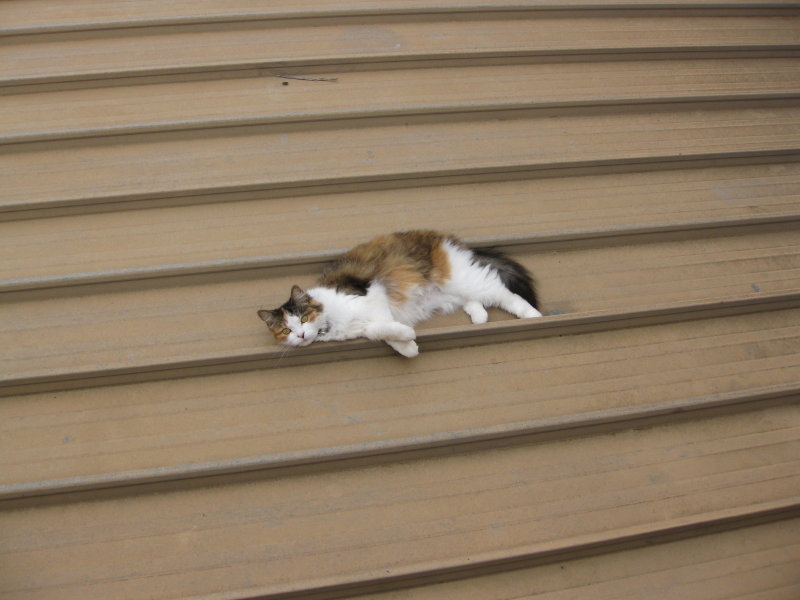
And here’s a consoling picture of a cat on a hot tin roof:
Writing Binge
Guess what I did yesterday?
I slept in, then did some writing.
I rode my exercise bike, then did some writing.
I went shopping, then did some writing.
I did a load of washing, then did some writing.
I cooked dinner, then did some writing.
I saw friends, then did some writing.
Due to the vagaries of my tutoring schedule, I have absolutely no work – not a single hour – for the next two weeks. So from my absolute lack of lemons, I’m making lemonade.
The Easter Weekend is pretty busy, but before and after that I’m doing almost nothing but write.
Today, for example, is just like yesterday except without the shopping and the friends coming over. Instead I’m vacuuming the house and getting the car blinker fixed.
Tomorrow is similar, except I may dust. Or not. And I may have a job interview (for reasons that I think are pretty clear). Or not.
On Thursday I’ll emerge blinking into the non-fictional world. Until then, I’ll be wearing my pajamas and having a ball.
And, as always, discussing the finer points of grammar with my paperweight, Indah:

Writers and their poisons
I don’t care how good your writing is – if you have a drug habit it’s stupid and needs to be stopped.
But I do understand the situation – a little.
A few weeks ago I began writing a steampunk novel. It’s loads of fun, but also requires about 100 times more research than anything else I’ve ever written. The character arrives at a house – is it brick or wood or sandstone or mud? What are the curtains made of? Does her gentleman companion remove his hat? Where does he put it?
Even worse, I’ve used several real buildings including the 1853 Governor’s residence in Melbourne (which you’d think would be the historic Government House – but it wasn’t built yet*). It’s incredibly daunting – more daunting than unwritten books already are, considering the failure statistics I know about.
Usually when I write a first draft I write it at lightning speed – generally within three weeks, and once in three days. I’m deliberately trying not to do that – although for me it’s psychologically devastating when I write nothing at all for a whole day.
Yesterday I was really struggling, and I bought booze to boost my mojo. It helped tremendously. I wrote a quite long and complicated escape sequence, and then today I wrote another important scene. I’m now over the 20,000 word mark, and feeling good again – it’s probably about a third of the first draft.
I’ve used booze (and, more usually, huge amounts of chocolate) a few times, and so far it works remarkably well. On the one hand, it’s a little worrying. On the other, it’s hardly a habit (and even if it was, all it takes is a single drink to get me going).
A couple of you are writers, and others are students (or public servants). Have you ever turned to drink, and how did it work out for you?
*In 1853, it was an Italianate building in Toorak, which is now a Swedish church. I heart google.
#303: Start a novel
As you know, I’ve been researching and planning a steampunk book for most of this year. Now, finally, it has begun, and I’m having a fabulous time.
Here are some of my research notes, and plot and character planning (this scene occured after getting CJ’s permission to take over the kitchen and living room):
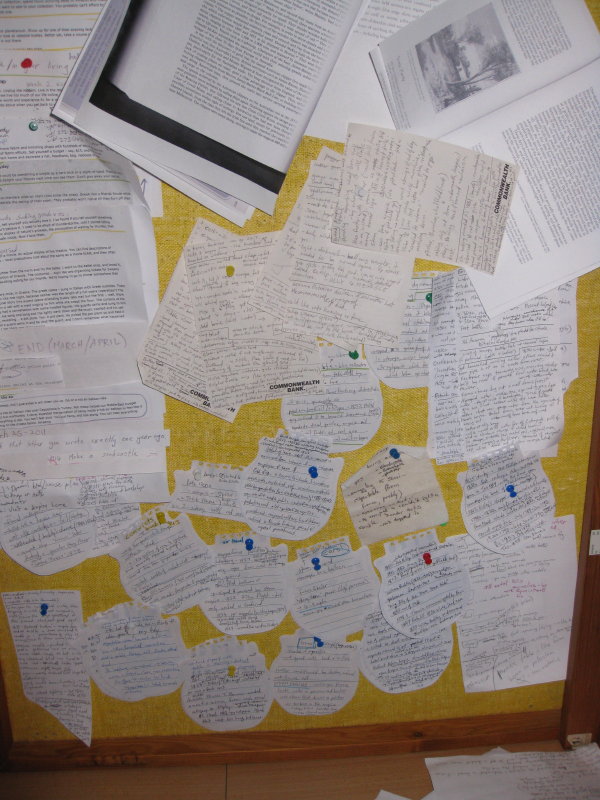
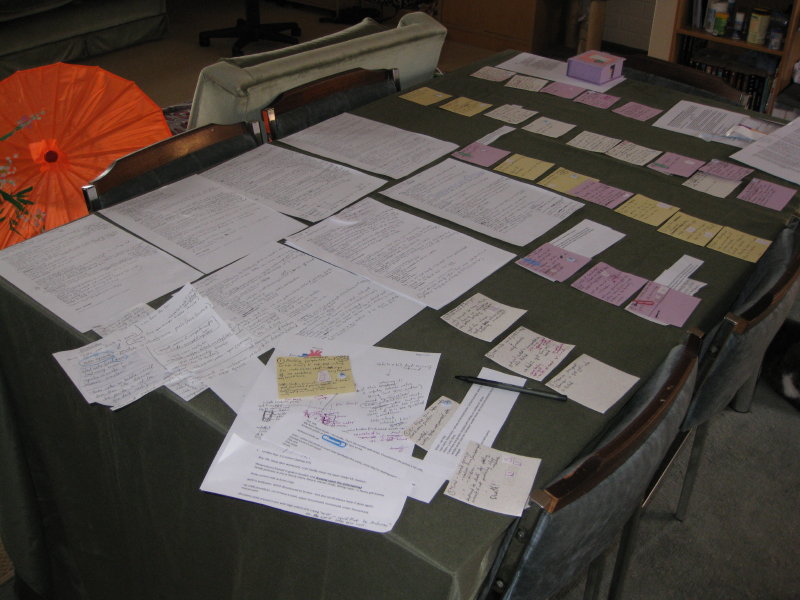
The title is so excellent, so essential to the plot, and so easy to copy that I’m not saying it online (ooh, mysterious!) I will say that the book is about a London girl transported to Australia – and Australia is where most of the action takes place. We were a British colony at the time (1853-4), after all.
The book opens as Miss Miller (aka our hero) is attempting to rescue her family’s faltering riches by marrying well. Her potential suitor, Ambrose Dawes, is about to pay a crucial social call with his mother. Here’s a first-draft sample, taken from when Miss Miller uses magic to eavesdrop on their conversation at her front door:
“One way or another,” said Mrs Dawes, “this family has a reputation for peculiarity.”
“I hope it’s deserved.”
She took several agitated breaths. “Do be serious, Ambrose. And try not to be distracted by Miss Miller’s famous blue eyes. Blue eyes are not at all a suitable reason to marry.”
“I managed to remain calm when I saw them at the royal ball last year. Very distracted blue eyes – until I mentioned my admiration of Hungerford Bridge. Then they were razors.”
“Did you bore her with your engineering talk? You know you mustn’t talk about all that rubbish in proper society.”
“I didn’t have the chance. She danced on. I did, however, notice she possessed a very finely-engineered ankle.”
“Well!” Mrs Dawes cut off further conversation by knocking at our door.
Halfway. Ish.
Not long ago, I wrote that I was planning to write a steampunk novel, but I wasn’t letting myself just dive straight in. Not this time.
First I had to:
1. Read at least twenty relevant history/technology books.
2. Write all my twittertales for 2011.
3. Write all my monthly short-short stories (there’s an email list – and yes, you can get on it) for 2011.
4. Take a break between the reading and the writing, so I don’t get overly excited and start lecturing readers on historical dates and/or how to build a steam engine (don’t you hate it when writers show off how much research they’ve done?)
About five seconds ago, I finished #3 with a murder mystery. Yay!!
#2 is one-quarter done, but I can do plenty more during #4.
I’m halfway through # 1.
These are the books I’ve read so far:
“Australian Bushrangers” by Bill Wannan – which also has a short but very useful section on guns.
“History’s Worst Inventions” by Eric Chaline
“Savage or Civilised” by Penny Russell
“Australian Lives” by Michael Bosworth -more on the 1900s than the 1800s, but still very good detail.
“Oxford Illustrated Dictionary of Australian History” by Jan Basset
“Black Kettle and Full Moon” by Geoffrey Blainey – again, focused on the everyday details that are so important for writing.
“A History of Victoria” by Geoffrey Blainey – good, but not as good as the above.
“The Most Powerful Idea in the World” by William Rosen – good, but the most useful bits were above my head.
“Commonwealth of Thieves: The Sydney Experiment” by Thomas Keneally – heartbreaking and enthralling reading.
“The Aeronauts” by Time/Life Books – SO much fun.
I’m also reading all the modern steampunk I can find that I haven’t already read, and I plan to read some 1800s fiction (which I have ready to go), but right now my non-fiction to-read pile is ridiculously big. So I’m going to stop procratinating and go start on “Technology in Australia 1788-1988”.
Being a twit
I’m currently planning a steampunk novel (and, shockingly, it’s already turned into a trilogy), but I don’t feel I know enough about the 1800s. So I’m not going to let myself start the writing until:
-I’ve read at least twenty books in full (so far I’ve read one on bushrangers, one on “History’s Worst Inventions” and one on early Australian manners, called “Savage or Civilised” – my story is set mainly in Victoria)
-I’ve written all my twittertales for this year, and twelve flash stories (I have an email list that gets a flash tale at the beginning of each month).
So far I have about 5000 words of notes, and every so often I have another brilliant idea for some scene or moment or invention – and I resist my urge to begin, and instead write it down for later. The suspense is fantastic. And my twittertales are happening much, much faster than usual.
I’m excited to be doing this book “properly” and I’ll have a good long (honest) look at the outline before I let myself rush into things that will be problematic later.
My main character is Emmeline, a convict from London.
*zips lip*
Here’s a random steampunk picture, from http://brassbolts.blogspot.com/

You’re welcome.
#262: Build a steam engine
One of the things that’s so wonderful about steampunk technology is that, given five minutes, anyone can understand how it all works. I took that five minutes yesterday, and felt so good about it that I decided to build one.
After some thought about which saucepans I wasn’t too fond of, and how I could weld something into a boiler shape, I decided to use paper instead of metal – which means no setting the house on fire this time *sigh*.
I messed around for a long while with paper, cardboard (from Lindt extreme orange packets, FYI), stickytape, paperclips, a metal skewer, and blue-tack (no time for glue! I’m inventing here!) and did make something capable of rolling (before I removed the back wheels, anyway).
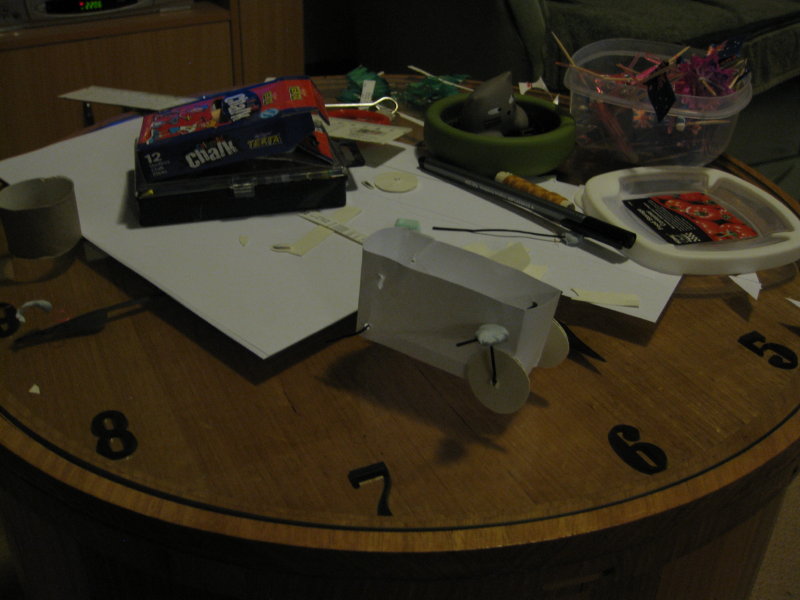
You’ll notice I used our clock table as a workspace – it honestly just happened that way.
I realised I needed better wheels, so I started over – using a sliced toilet paper roll and several mangled cocktail umbrellas to great effect.
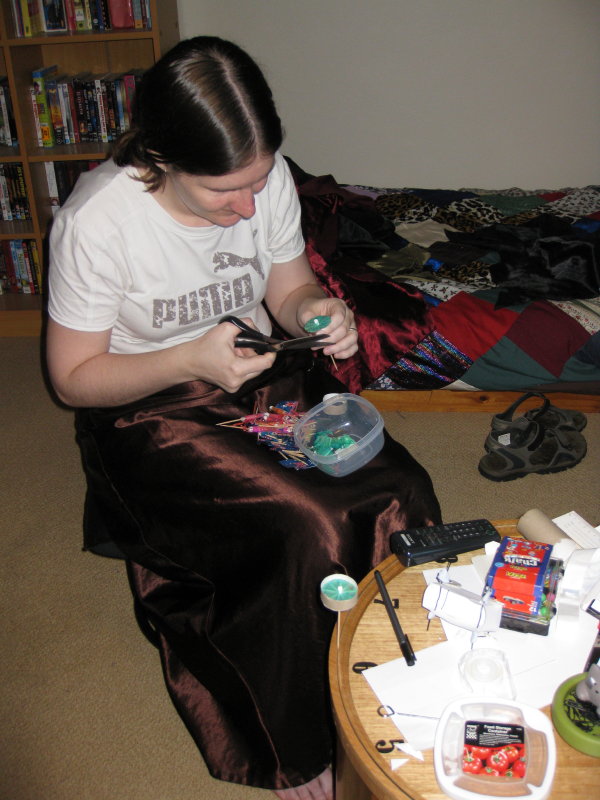

We had some friends drop by, who watched my “craft” with horrified fascination. It was quite embarrassing because I don’t know them all that well, and this was a VERY steep (and dodgy) learning curve.
But.
After learning a huge amount (particularly the importance of axle grease, and the joy of SCIENCE!!*), I had a semi-functional steam engine (minus the steam engine part, which is too heavy and too flammable – but I know where it goes, and what it would look like).
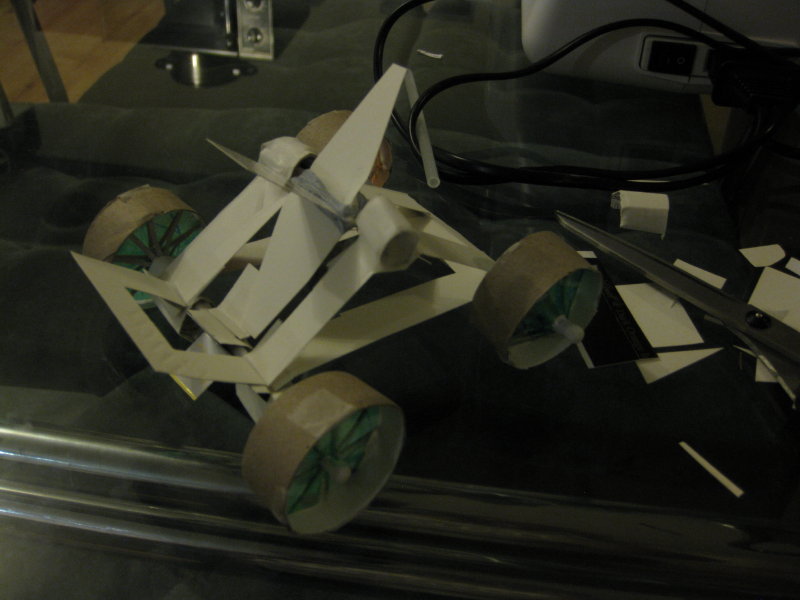
Basically, the steam engine sits on the back and blows steam onto the large cog, which turns the smaller cog at the front, which turns the front wheels (the back wheels are pulled along). To go forward, it blows steam downward onto the lower half of the big cog, and to go in reverse it blows steam up onto the higher part of the cog.
I expect I’ll build many more over the next few months.
In the meantime, here’s a general writerly-type interview I did for another blog:
http://www.katierunyon.com/phpBB3/myblog.php/2011/01/06/20-questions-louise-curtis/
*Those who read the Girl Genius graphic novels by Phil and Kaja Foglio will know what I mean. (Ditto for those who like cackling in basements while wearing welding goggles – which, if I’m not mistaken, is all of you.)
Critique
If you’re a writer, or (alternatively) if you enjoy shredding innocent souls, you might like to register for critique circle, one of the writing communities I frequent. http://www.critiquecircle.com/
Now is an especially good time, since I just put the prologue and first two chapter of my 09 naNo novel up for critiques. They’re under the title “See Through” and the name Louise Curtis (or possible Louisec).
Just saying.
godlike powers
I woke up happy this morning.
Yesterday’s writing gave me such a high. No other job has ever had that effect – and I’ve always enjoyed my paid work. So, in a shocking twist, I won’t be giving up writing anytime soon.
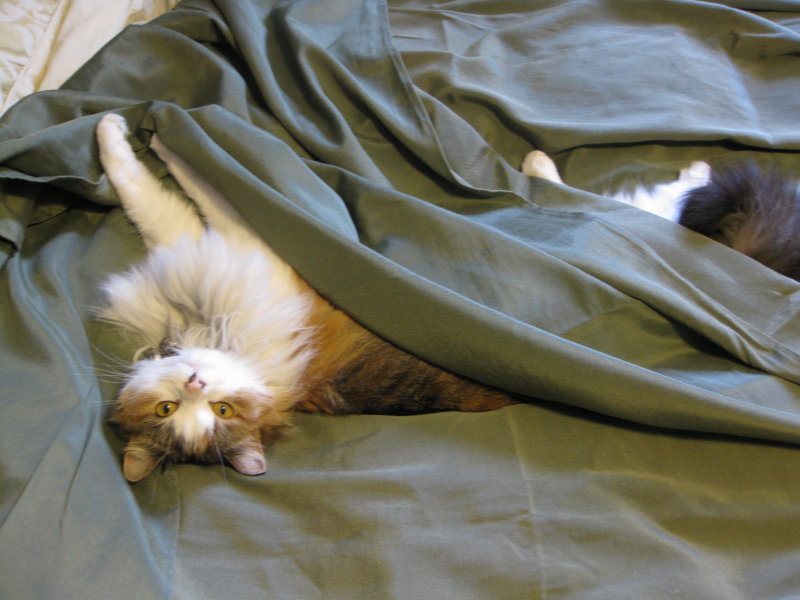
And here’s a picture of my cat Ana. (Why not?)

 Felicity Banks