Things
Hello hello.
This morning I weighed in at 80.2 kilos, so with one week left of my six weeks without chocolate, things are looking good (I’ve lost 6.4 kilos). I’m desperately hungry, lethargic, and faint – but there’s a very good chance I’ll be back in the healthy weight range by the end of the year (yes, despite Christmas).
In the last couple of weeks I’ve received two rejections with comments from two different small publishers. It’s very rare to get comments (from Publisher F especially, who was the first) so that’s both useful and encouraging (without actually being technically useful at all).
Tomorrow marks two months exactly since Publisher B (the one who’s had one of my books for a year, and another for a year and a half) said they’d sent my books to an independent reader. Who knows? They might reply.
Without chocolate, my day-to-day goal has been to simply survive – do my work, pass the hours until another day has gone, and try real hard not to have a psychotic attack (I lost my head twice, and on one of those occasions broke our car door).
I’ve done very little writing, and barely missed it. So I wander down a familiar philosophical path, trying to figure out a way to quit writing once and for all. I think it’s theoretically possible, except what do I have left to get up for? TV can’t keep me awake forever, and I’m not able to do more than three hours of real work in a day.
I’m not the type of person who bases their entire life around a spouse – so that’s not an option either. And I know chocolate doesn’t really satisfy, no matter how much I eat.
So I’ll keep writing. May as well.
I’m about to enter a free competition with a $20,000 prize. It seems pathetic to even bother entering, but maybe I can meditate on the role luck plays in publishing until I think I actually have a shot.
Go team?
#220: Recognised by a Stranger
As I wandered innocently through the Steampunk 21st Party of yesterday’s post, I was accosted by this man:

He addressed me with the infamous phrase, “Hey, aren’t you. . . ?” and proceeded to tell me my full name and, “You write those twittertales, right?”
I’ve never seen him before in my life. He’s never seen me before. Yet he knew me well enough to know what I do, and how excited I’d be.
That’s right, people. I was recognised. . . because of the internet.
My plan for world domination is totally working. Eeeeexceelllent.
And here’s some photos of my cat in a washing basket.


Tomorrow (if all goes well): Bubbles!
No news on the individual jewellery values yet. . . but soon!
And here’s your steampunk moment for the day – a timeline by Tor. Do you have an outfit for Steampunk Earth Day* yet?
http://www.tor.com/blogs/2010/10/the-great-steampunk-timeline#more
*Steampunk Earth Day is THIS Saturday! http://www.facebook.com/event.php?eid=150654784970718
PS Here’s something Rachelle Gardner posted today. It’s a real response to the book by a real person – which, hopefully, will help you deal with your own experiences of writerly rejection:
The Lion, The Witch and the Wardrobe by C.S. Lewis
“I bought these books to have something nice to read to my grandkids. I had to stop, however, because the books are nothing more than advertisements for “Turkish Delight,” a candy popular in the U.K. The whole point of buying books for my grandkids was to give them a break from advertising, and here (throughout) are ads for this “Turkish Delight”! How much money is this Mr. Lewis getting from the Cadbury’s chocolate company anyway? This man must be laughing to the bank.”
Writing Advice
I just published this over at twittertales. It bears repeating. (In other news, Publisher D inadvertently requested “The Monster Apprentice” so I sent it to them. Publisher B, meanwhile, just let me know that both my books are with one of their readers – ie, progress is happening at last.)
I’d love to know what you guys wish someone had told you when you were working on your first novel.
Here’s mine:
1. Successful writers generally make around $10,000 a year (see #2).
2. Around 1 in 10,000 slushpile manuscripts get published (at a conference recently, I discovered that a large publisher hadn’t accepted a single book in three years – and they get hundreds every week). Meeting someone at a conference and using their name/email changes the odds to about 1 in 200. (You still need to write a brilliant book – unless you’re famous, of course.)
3. Publishers. . .
(a) are all friends with each other, so don’t ever be rude to/about anyone.
(b) actually make a loss on 90% of the books they DO produce, so cut them some slack.
(c) usually take 3-6 months to reply to the opening chapters, and just as long again for the full book. The longest I’ve heard of is four years, and the longest I’ve experienced is 16 months (and counting).
(d) are quaintly optimistic about their response times (if they were realists, they’d quit and get a better job).
(e) will not work with someone who is too lazy to read their submission instructions.
(f) are nice – but they don’t like being hassled.
4. If an agent or publisher charges you money, they’re a scam.
5. Manuscript assessors are useful, especially when you’re starting out, but their recommendations of your work are worth only slightly more than the fact that your mum thought it was super good.
6. For kids and young adults, your protagonist should be a couple of years older than your target audience, and your length needs to be right (check a publisher web site for length details BEFORE you write). Your characters won’t get married or raise kids, because your readers won’t be interested in that experience (not while they’re still at the age they started reading your book, anyway).
7. It generally takes around 10,000 hours of focused practise to get good at writing. Most writers throw away several books before they get good enough to be published.
8. Reading books in your genre is essential. If you don’t read, why do you think anyone will read you?
So, in conclusion, don’t write unless you enjoy writing for its own sake. And keep your day job.
Even if I’d known all of that (and I knew some of it), I’d still be a writer.
Advice for Beginning Novelists
I’ve decided to start posting writing advice whenever I feel like it. Here’s the beginning:
1. Successful writers generally make around $10,000 a year (see #2).
2. Around 1 in 10,000 slushpile manuscripts get published (at a conference recently, I discovered that a large publisher hadn’t accepted a single slushpile book in three years – and they receive hundreds every week). Meeting someone at a conference and using their name/email changes the odds to about 1 in 200. (You still need to write a brilliant and polished book – unless you’re famous, of course.) On several occasions I’ve walked up to a publisher at a conference and said exactly this: “Hi, my name’s Louise Curtis and I’d love to send my children’s adventure fantasy book to the right person at [name of that person’s company]. Could you help me?” It works every time – all they want to know is length, genre, and age group – not the fact that I had the idea in the bath or that I really like their hair. When I write to the contact person, I mention the meeting – so they can either remember me, or talk to someone who does (proof of personal hygiene is worth a lot).
3. Publishers. . .
(a) are all friends with each other, so don’t ever be rude to/about anyone.
(b) actually make a loss on 90% of the books they DO produce, so cut them some slack.
(c) usually take 3-6 months to reply to the opening chapters, and just as long again for the full book. The longest I’ve heard of is four years, and the longest I’ve experienced is 18 months (and counting).
(d) are quaintly optimistic about their response times (if they were realists, they’d quit and get a better job).
(e) are nice – but they don’t like being hassled. So wait at least three months before contacting anyone, ever – and don’t be surprised if they haven’t started reading your book yet.
(f) will not work with someone who is too lazy to read their submission instructions and/or use decent English. http://shootingthrough.net/2010/10/28/how-to-talk-english-like-more-gooder/
4. If an agent or publisher charges you money, they’re a scam.
5. Manuscript assessors are useful, especially when you’re starting out, but their recommendations of your work are worth only slightly more than the fact that your mum thought it was super good.
6. For kids and young adults, your protagonist should be a couple of years older than your target audience, and your length needs to be right (check a publisher web site for length details BEFORE you write). Your characters won’t get married or raise kids, because your readers won’t be interested in that experience (not while they’re still at the age they started reading your book, anyway). Other than that, you can do almost anything – see # 8.
7. It generally takes around 10,000 hours of focused practise to get good at writing. Most writers throw away several books before they get good enough to be published (I’ve thrown away three and rewritten three others – so far).
8. Reading books in your genre is essential. If you don’t read, why do you think anyone will read you? How do you know what your market likes?
9. If you get published, you still need to sell the book to the public. This means travelling, interviews, etc. You definitely need to rent a crowd wherever possible – the average number of participants at book readings in the USA is four.
So, in conclusion, don’t write unless you enjoy writing for its own sake.
PS Some funny posts on writers (and how unpleasant we are, mainly because of stuff outlined above) – be warned, there are naughty words and one adult joke.
http://terribleminds.com/ramble/2010/10/12/beware-of-writer/
http://www.rebeccarosenblum.com/2010/10/07/why-date-a-writer/
PPS
The best way to cope with rejection is to already have another book happening (ideally a stand-alone book in case you later find out the first has fatal flaws).
Also, chocolate.
Also, writing forums.
Also, getting another job – one where you’re paid by the hour. It sounds cold, but it’s the most useful thing you can do to stay afloat psychologically (and financially).
Here’s a list of 50 well-known writers who faced plenty of rejection:
http://www.onlinecollege.org/2010/05/17/50-iconic-writers-who-were-repeatedly-rejected/
And here’s a conversation that will make you laugh, think, or both (in Australia, you don’t necessarily have to have an agent):
S#100: Hug someone
This one’s definitely recommended for playing along at home. Hugging and eating chocolate do have similarly relaxing results, so yay for that.
In writing terms, this week has been thrillingly exciting.
No, nothing actually happened. This is the writing life we’re talking about.
The high-octane action adventure began as I received an email from Publisher D (my shiny new contact, who just received the beginning of book 2 of my kids’ trilogy). She said she’d received it, and she’d let me know when she’d read it. She also asked where I’d published the first book (having misinterpreted something I’d said).
I wrote back and said the first book was on Publisher B’s slushpile, and had been for nine months. I added that although they were fine with me sending it elsewhere, I valued their comments and chose to wait – and besides, Publisher D had requested and rejected an earlier draft of the first book a few years ago.
She wrote back and said that she could only read the first book in a series, so she wouldn’t read anything until the first book was ready.
I took the permission she’d technically granted, and sent her the beginning of book 1. Zap! Pow!
All this happened in lightning speed during a single afternoon.
So what, kemosabe, does it all mean?
It means:
a) I’ve been given permission to resend book 1 to Publisher D (which is, I think, a better book – and of course my own natural choice for first book to reach publication) – and I’ve sent it. I won’t hear a final answer for 6-12 months.
b) Book 2 is now free for a smaller publisher – like Publisher I, who I wanted to send something to after hearing them speak in Melbourne.
c) I have an excuse to not only write to Publisher B (again), but to sound good when I do, since Publisher D did technically request it (which implies they’re the same publisher I pitched to in Brisbane, which is not at all the case since I was horribly rejected in Brisbane).
So! I took my good-sounding excuse and wrote to Publisher B (this time cc-ing the email to my original contact) – precisely one hour ago.
My original contact is on holiday, as her autobot informed me.
My usual contact just replied (yay!) and said that both books are now with independent readers for further evaluation.
This is GREAT news. It is the second-last rung of the ladder (the last rung is the aquisitions meetings). The independent reader will be fresh (a boon for two re-submitted novels), and their job is READING, which means they’ll be a whole lot faster than a publisher or editor (who often only actually have about two hours of reading time a week, since it’s not their main job).
In fact, “Stormhunter” was once “unconditionally recommended” by a freelance reader for Publisher A. My contact there (an editor) was so excited that she emailed me to let me know it was with “the aquisitions editor”. Two weeks later, I had my answer. It was a no, sadly – but the reason it was rejected was because of an unmarketable plotline which I’ve since removed.
So! It’s moved up. Progress! I’m pretty confident freelance readers will like what they see (whether they’re blown away is another matter), and I know my twittertales and blogging and so forth do help at acquisitions meetings (plus I’ve already met at least one of the people who’ll be sitting at that table – which means they know I’m not visibly deranged*).
The down side is that December is coming, and everything slows down then. I reckon I’ll hear back in either November or February/March next year – since it’s two books, next year is more likely. I won’t email again until at least January. Apart from anything else, it’s no longer in the tarry hands of my main Publisher B contact.
I’m too excited to go find a picture at present (also, I need to go to work, STAT!) but I will tell you that the story beginning on October 1 is called “Zeppelin Jack and the Deadly Dueller.” Yep, it’s steampunk time.
Still, here’s a link to a fan-made transformers movie that looked like it had robots in it (I don’t know what the rating is):
http://www.geekologie.com/2010/09/russian_fanmade_transformers_m.php
*I’ve been to writing conferences and met other writers, and believe me – writers, hobos and serial killers are indistinguishable.
S#42: Exercise
Yesterday, I went for a 1-k swim for the first time in about a month. It hurt (not the swimming, the physically getting into my swimmers part), but I did it. I’m on my way back into the healthy weight range lost to me when I decided to schmoozequest.
I wish I could figure out why chocolate is such a big deal. Why can’t CJ – or better yet, God – be the reason I get up in the morning? CJ is way nicer than chocolate.
I guess it’s the self-destruction aspect of chocolate that CJ lacks. So once again my thoughts circle and circle and end up at the dead end of mental illness.
I’m still glad to be eating healthily, despite the feeling of utter futility it brings on. Chocolate doesn’t erase the futility, it just gives a brief illusion of pleasure and/or the false anticipation of pleasure. But even the sane despair when faced with dieting. For a crazy person, I’m doing marvellously. I’m sure I weigh less (for my height) than the average Australian woman my age. Which means I still suck, but not as much as others do.
In other news, I’ve just finished re-reading “Heroes of the Valley” by Jonathan Stroud. It’s young adult adventure fantasy, and it is excellent.
There are three main elements of every story – characters, plot and theme. The two main characters in this tale are Halli and Aud. Halli is a rather stumpily-built second son of the local Arbiter, who longs to be like the mighty heroes of old, who slew the ferocious Trow and laughed at danger and death. Too bad he lives in a time of peace – and isn’t much of a fighter, either. Aud’s fate is to be married off, and she’d rather be eaten by a Trow (not that she believes they exist). She’s smart, brave, and can even appear to be well-bred when she chooses.
I won’t talk about the plot, because it’s best to just read the book. Trust me: it’s exciting and surprising. The theme is heroism – what it looks like from afar, and what it looks like up close. I was bound to love the book for the theme, if not for the excellent writing.
It’s also very, very funny – the heroic tales each chapter are not just a highlight, but part of the ongoing tale. It’s wonderfully macabre – Halli’s nurse tells him blood-chilling tales just before telling him to go to sleep, and there are hundreds of brilliant one-liners, too.
Recommended for: Anyone who can handle fairly mild horror (say, Buffy level). Especially storytellers, or people like me with a secret longing to be a hero.
Rating: PG for violence and horror violence
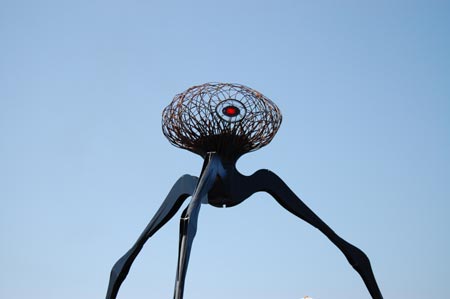
Speaking of horror and violence, here’s another geekologie robot pic (unfortunately, yes it IS real):
S#101: Talk to Steff
Today is Tuesday. That means Publisher B might reply. It’d sure be nice, since they have two of my books – one of which they’ve had for sixteen months. (3-6 months is a normal response time – although two other big publishers have taken 9 months just for the first few chapters – which, by the way, they rejected without requesting more and without giving comments).
For most of this year, I’ve sent a polite email to Publisher B just once every three months, and my contact person has replied within 24 hours with vague (but nonetheless useful) assurances that the books are, indeed, still under consideration. In August I emailed as usual – no response. Two weeks ago I emailed again – still no response.
Steff Metal and I originally met because of a mutual connection to Publisher B, so I wrote to her with my woes, hoping she’d have some insight. She wrote back. What follows is her response, but with chunks taken out and names changed. And I admit, I feel hugely better. This email says a whole lot about the writing life that I wish wannabe writers knew BEFORE they started writing novels (that, and the news that successful full-time writers tend to earn around $10,000 a year – non-successful writers tend to earn negative amounts).
Hiya!
Urgh – that’s a very awfully long time. I’ve never gone through [the specific person].
I think they’ve lost your email somehow, if they don’t reply. I would email after two weeks, because it’s out of their pattern and you have a history with them. Just a polite email saying you sent an email before but you don’t think they received it.
[Details of various frustrating things happening with her steampunk novel, including a very vague rejection – their advice was to write another book – and another publisher not replying to her emails.]
We haven’t been emailing much, have we! I think it’s cuz we read each other’s blogs so we kinda feel caught up. The writers conference sounds amazing. I need to go to more of those – more networking. Swooning with jealousy at all those contacts you made – you were so brave! I’m gonna start when we move to Germany – there’s huge conferences in the UK.
Why do we do this to ourselves, again?
xx
Steff
————–
And here’s a picture of my new favourite cat EVER

How much do YOU love the internet?
Ubergeeks John Scalzi and Wil Weaton have done something wonderful. This:

Other than writing stuff themselves, they had various other (in)famous people contribute, plus they ran a competition (based on the picture). Which I didn’t win.
The book itself is, technically, free. You can go read it at http://unicornpegasuskitten.com/. But since the whole point of the thing is to raise money for lupus sufferers (Wil and John paid for everything out of their own pockets), see if you can donate $5. Or maybe more.
Because sometimes, it is lupus.
However, here’s the story I wrote. All things being equal, the stories from the book are better than this. So go click on the link and enjoy.
“Kitten Spit”
I woke as my face was scraped raw by warm sandpaper coated in slime. Something monstrous had found me, and its spit dissolved my skin. I opened my eyes to a view of needle-sharp teeth, and gagged at the stench of salmon as the thing yawned.
“Good kitty,” I croaked.
It was taller than me, even without the wings spreading from its shoulders. Since my cave had a prudently small opening, only its head could fit inside – if it angled itself so the horn on its forehead didn’t scrape the roof. I scrambled back before it could lick me a second time. Blood dripped down my neck. I healed myself by magic before the thing attacked again.
“Where did you come from?” I said aloud.
“Well,” came a voice from outside, “when a unicorn and a pegasus and a cat all love each other very much –”
“No I meant—oh actually, that does answer one question. May I ask who you both are, and what you and your – er, noble steed – are doing here?”
“Are you the orc magician?” The voice was curiously flat, as if the man was mortally exhausted.
My heart sank. Even among other magicians, that question always led to an awkward conversation followed by an even more irritating battle. I had thought living on an active volcano would discourage further inquiry. “Just because I have green skin, pointy ears, and incredibly well-developed muscles doesn’t mean I’m going to kill you.” Under my breath I added, “Like all the others.”
The kitten retreated as someone tugged on its reins. Not for the first time, I was glad I slept in full armor.
A human stood by the lava river outside my cave. Other than his sweater, he was unarmed.
I took an involuntary step backward and hit stone. “That’s –”
“Yes,” he said, looking away. “The clown sweater. I need you to kill me.”
I looked at his young face and saw the deep worry lines of a man possessed by the most diabolical fiend of our time. “But. . . you’re immune. And besides, we’ve just met.”
“I’m Wil.”
“John. But –”
“I’m not immune.”
“Then how?”
“Sometimes, it sleeps.”
“Can you take it off?” I asked. “Can someone take it off you?”
His eyes glittered, but he held himself together. “I used to have three brothers.”
“Ah. So I’m dead then.”
“No! Kill me first and save your life. And she’s not a monster. She’s Petunia, and she just likes to play.” He pulled down a golden spear from her back. “Take it!”
“Don’t make me do this. Killing people is so. . .”
All colour fled his face, silencing me. “It’s waking up. The clown. It’s coming! Help me!” I saw his eyes turn mad just before he leapt onto Petunia’s back. He lifted the spear and smiled the serene smile of the deranged.
The awkward-conversation part of our friendship was at an end.
I grabbed my axe and shield and ran outside. Wil seemed decent. The least I could do was sever his head from his body.
Petunia leapt into the air and bore down on me with her claws splayed. Magic filled me, sparking from my fingertips. I jumped straight into Wil and we both tumbled to the rocks. Petunia crouched to watch us, switching her horse’s tail from side to side in excitement.
“Unicorns,” I thought frantically, searching for a weakness. “Good for looking picturesque with virgins. Not helpful right at the moment.”
Wil leapt at me, drooling with fury. I parried and his spear clashed against my armored shoulder.
“Pegasuses,” I thought. “Pegasi? Good for traveling long distances fast. But flighty.”
Petunia’s eyes glowed with mad kitten joy. Her pupils darkened and she waggled her rear end, ready to spring.
Wil spun with impossible speed and I ducked just in time. His foot connected with my head, but I magically dismissed the bright stars of concussion before they got me killed.
“Kittens,” I thought. “Nice to look at, if you like that sort of thing. Attracted to shiny things. Also a source of pure, unadulterated evil.” I blinked, and knew what to do.
Luckily for us, Petunia was already in the mood to play.
Wil lunged for my throat and I didn’t have time to dodge naturally. My magical defenses shot me fifty feet into the air. I had time to look down as I fell, curious to see if gravity would get a chance to kill me before the rest. Or perhaps I’d think of some further magical brilliance. Either way, I looked forward to finding out what happened next.
Petunia sprang at me. She batted me sideways in mid-air, knocking me into my cave. I landed on nice soft armor and watched with quiet surprise as magical sparks healed my broken legs. With one hand, I pointed to Wil. Pretty blue sparks danced an irresistible pattern on the clown’s red nose.
Petunia took the bait. She pounced and pinned Wil to the rock with one paw, biting into his sparkly chest as he screamed in pain and rage.
She spat something white and red and grinning into the lava river, where it dissolved. Then she sat on Wil’s legs and licked the hole that used to be his chest.
I staggered outside, dragging up what magic I had to try and heal him. Sparks flew off me into him, building new organs, growing new skin, and filling him with new blood.
It was no use. Petunia’s saliva ate through him faster than I could build him back
Wil didn’t move.
“The sweater is dead,” I said, falling on my knees beside him. “Long live the sweater.”
Petunia yawned emphatically and touched him with the tip of her horn. “Unicorns,” I thought. “Handy for fixing poison. Does that include kitten spit?”
THE END
PS This piece of awesomeness comes free of charge. Your regular schedule of Daily Awesomeness will continue tomorrow.
PPS Please do spread the word about this book. If you’ve ever had a disease of the immune system or known someone who has, you’ll understand why.
#200: Documentary
I’m still working my way through Ben’s suggestions of awesomeness. I’ve chosen to interpret this one as requiring any visual media – not necessarily film. So I have created the following two pictures, which I call: “The Writing Life”. It really tells you everything about my daily life.
1. Morning.
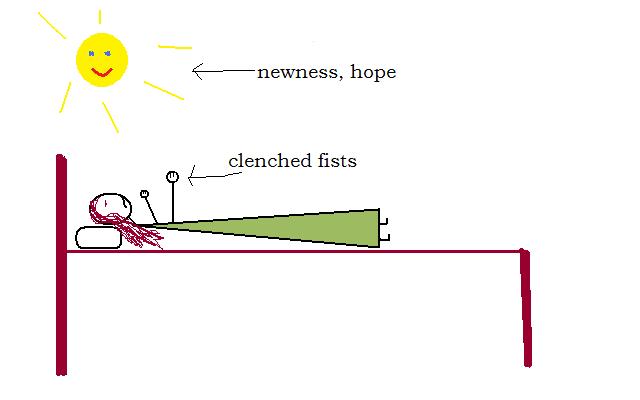
2. Afternoon/Evening.

In other news, I’m almost ready to send “The Princess and the Pirate” to Publisher D, which means I have no urgent writing to do (I estimate they’ll give their final yes or no in 6-12 months, given I’m only sending the first chapters). My only polished book not on someone’s desk is “Farting My ABCs” and the publisher I want – H – is currently closed to submissions. So I can slack off now, if I want to.
It’s been almost two weeks since I arrived back from the recent schmoozefests, so I’m pretty well recovered. From tomorrow, I’ll be eating properly again. It’s good timing in terms of my womanly cycle, how much stuff is happening with work and family and friends (ie not much), and my writing (I write MUCH less without chocolate). I’ll be visiting my extremely pregnant sister in early October, so that’ll ruin everything, but fluctuating weight is better than a continuing increase.
I rarely get nightmares from my writing (one reason I don’t write much horror). But I had one the other night about a giant Japanese robot spider. Then Ben sent me this, from http://xeai.com/public/wp-content/uploads/2009/02/l08_5072.jpg

Nixed
For those who don’t want to look at the nuts and bolts of writing, here’s a funny and informative look at an acquisitions meeting (I LOVE this blog entry): http://cba-ramblings.blogspot.com/2010/09/behind-scenes.html
Also, here’s a random picture of a bird on a train:

There are some very mild spoilers in the following (spoilers on theme and on the first few chapters only).
I just started reading “Sabriel” by Garth Nix for the second time this week, analysing it like crazy to understand how a master of storytelling weaves his spell. It’s a little odd to be studying “Sabriel” (400 pages for young adults) while editing “The Princess and the Pirate” (40 pages for kids) but some principles do transfer.
I’ll ignore the prologue in this analysis, having talked about it two days ago. It’s interesting to note, however, that the first paragraph of the prologue isn’t action – it’s setting. It’s a “slow burn” opening, which is the right choice because (a) having used a prologue, the chapter one opening must be involving from the first sentence, which means a “slow burn” opening will no longer be an option, (b) the setting is quite difficult to grasp – two completely distinct lands exist side by side – one magical, and one more like 1920s England. So it needs to be mentioned up front, and re-mentioned several times in the next few chapters. (And of course, that one paragraph of description sets the mood for that scene.) And even though Sabriel is barely born in that scene, she is still the centre of it – she even manages to be an active character.
And on with the first chapters.
The very first paragraph is a truly eerie image of a white pet rabbit, freshly bathed – and freshly killed. The dichotomy of innocence and horror is a constant throughout the book (Sabriel is 18 – literally a schoolgirl). Sabriel raises the rabbit from the dead before its young owner arrives. TV tropes has a section on “pat the dog” – establishing a hero’s goodness by their kindness to an animal. This scene is a fantastically macabre (and frightening) “pat the dog” – with a twist. The twist is that Sabriel’s calling is to make sure the dead (including this rabbit) stay dead – her compassion is a flaw.
This ties in to the main plot, not only because the school (and its innocence) becomes important later, but because Sabriel faces a similar temptation at the climax.
It also makes us love her instantly – that is the primary function of the scene (the character hook is her compassion, plus her own fear of her frighteningly creepy job, plus the unique pain of compassion being a flaw). And it shows us a little more of the mechanics of her job (which are important many times in the book – the realm of Death has its own rules and challenges).
After that there are 3 pages of quite straightforward exposition – by now we care enough to find it all interesting.
Then a literal incursion of horror into a dorm filled with 11-year old girls (girls Sabriel is responsible for). A dead thing enters, and Sabriel runs to fight it (we see she’s brave, but also see her authority over the dead – even the Magistrix of the school clearly sees Sabriel as the most competent person to deal with it). It is a terrifying scene – but that’s not the primary purpose. The primary purpose is to deliver a message from Sabriel’s father (aka Mr Macguffin) – effectively saying a garbled, “Help!” It’s a brilliantly dramatic way to deliver a message, and also shows more about Death that is important later.
And the plot is set: Sabriel must find her father (who may or may not be beyond help). The plot later builds to become, “Sabriel must find her father and save the kingdom” but the emotional heart is exactly the same.
Now that the plot and character are established, chapter two and three are relatively action-free (except for a brief misunderstanding – that, admittedly, could have gotten Sabriel killed if it had gone the wrong way). There’s a lot of setting detail, more info on the stakes (including a 14-day ticking clock for tension), and more on Sabriel (mainly: she shows humanity as she struggles to carry a load of skis and stocks and backpack, she shows off cheekily to an annoying beaurocrat, and a father figure is deeply concerned for her dangerous voyage, but respects her enough to help her on her way).
Chapters 4-7 are an epic and terrifying journey, with quite a bit of setting detail (journeys are handy for that, particularly since Sabriel hasn’t travelled that path since she was 4), some bad news on the big bad (via a pile of corpses), and a brief moment of joy when Sabriel meets her dead mother’s spirit (which just makes us more sympathetic, since her mother is dead and rarely reachable – even this meeting is cut short). Sabriel kills a dead thing, but flees from another – which shows her competence, while also showing that This Is Serious Now.
And then there’s a period of physical and mental recuperation before she continues on her way – this time, with a Mysterious Companion (who is sort of evil, but also extremely helpful, and a great source of humour throughout the book).
Here’s the way Garth Nix deals with the challenges of opening a novel:
1. Instant hook: The image of the rabbit is compelling.
2. Setting: He describes Sabriel’s school uniform (including her prefect’s badge), and the iron school gate, which says “established in 1652 for Young Ladies of Quality”. That tells us everything we need to know about her boarding school, and thus all necessay setting for the first two scenes. (The dichotomy of this “country” with the magical one 40 miles away is also mentioned – not for the first or last time. Chapter two and three are set entirely in the area between the two locations.)
3. Characterisation: The fast hook is her compassion, magic, and that her compassion is a flaw. We then quickly see her courage and intelligence – reinforced by the way both children and adults come to her for help.
4: Instant action: Within a page, we have a problem (the Bunny’s young owner is fast approaching), and Sabriel goes into the risky world of Death to do something about it.
5: Plot hooks: It’s not until the dorm room scene that we know the main plot.
a. Finding her father, who may or may not be dead.
b. Sabriel needs to get better at her job (keeping the dead dead). Will she turn evil?
c. In chapter two, it becomes clear that more lives are at stake because of her father’s helplessness.
d. After the big action sequence, Sabriel keeps a wary eye on her companion (and soon gets another, who is also mysterious – and has several private conversations with the first). Each companion is utterly vital at the climax, and their secrets are relevant.
6: What characters look like: Since it’s in third person, everything is described in a fairly straightforward manner.
7. How the magic system works: As in “The Princess and the Pirate”, the basics are shown by immediate action, and more is revealed as it becomes relevent (again, through action).
8: Link to prologue: We all know Sabriel is the infant of the prologue – and the plot soon makes it very clear that a character we love (Sabriel’s dad) is in mortal danger. (And, since he’s not the main character, we know he really could die – causing pain to Sabriel, who has suffered enough.)
So that’s how it’s done: Exciting stories within the greater, more exciting story.
I’ll be sending off “The Princess and the Pirate” in the next few days (unless CJ spots a fatal flaw when he reads it tonight). I recently met three people from Publisher D (two of them the most relevant two people I could have hoped for). Publisher J specifically recommended Publisher D, so this is my shining new hope. Sadly, I’m only sending the first three chapters, so I won’t have a final answer for 6-12 months (and that’s assuming they’re prompter than the silent Publisher B).
The main lessons I’ve learnt from Nix this week are:
1. A Mr Macguffin needs a prologue – but your chapter one opening has to be a killer.
2. Some character-establishing exposition is fine, once you’ve earned it.
3. Repeat, repeat, repeat your main plot – all the way through the book (and the other plots/motivations too).

 Felicity Banks
