How to get published
Rachelle Gardner is an American Christian literary agent with a great blog. She wrote a post on how to get published, which is an excellent summary of the American system.
Australia is similar to the USA, except you don’t necessarily need an agent to get published (some choose to get an agent after having an offer for publication – agents are at their most useful when dealing with contracts), and the place to look for impartial advice is the Australian Society of Authors.

Narnia #5 of 7: “The Voyage of the Dawn Treader” by CS Lewis
Of all the Narnia books, excluding the clear death-and-resurrection tale of “The Lion, the Witch and the Wardrobe”, this is the most allegorical. Two of the familiar Pevensie children literally fall into Narnia with their (rather horrible) cousin. They are rescued by Caspian, who is journeying through unknown seas to find seven men loyal to him, who were exiled many years earlier. But he, along with others on board, hopes that the journey will culminate in finding the end of the world.
They have a series of adventures – slavers, dragons, a sea monster, and Deathwater Island – which can be enjoyed as adventures or as tales of hope and faith and compassion.

Free Sample (from the start):
There was a boy called Eustace Clarence Scrubb, and he almost deserved it. His parents called him Eustace Clarence and masters called him Scrubb. I can’t tell you how his friends spoke to him, for he had none.
Rating: PG. I’d call it absolutely G and safe for anyone, but one character is a close parallel to Jesus Christ (in one of the later books this character clearly states that he exists on Earth as well, is known by a different name there, and that the children have been brought into Narnia so that they can more easily recognise him on Earth), and some atheists have found that offensive. The books do focus on the adventures, rather than allegory about 95% of the time.
Experimentation
In over two and a half years of marriage, CJ and I have never once eaten tofu. Every so often I make a dodgy fried rice with whatever is in the fridge – usually ham and eggs, with sugar and soy sauce for flavouring. This week I tried something new. I cooked coconut-flavoured rice by adding a cup of coconut milk to the uncooked rice instead of water (then stirring it a few times as it cooked, rather than just letting it go). It tastes brilliant. I fried the results with Chinese-style honey soy tofu (a pack of it from a supermarket shelf – in the same aisle as cold meats and cheese), and topped it with boiled eggs. We then added soy sauce to taste.
This is a great vegetarian meal, and without the eggs it’s even vegan.

The future of awesome
This week has been a lot better physically than last week, and I’m feeling good as I count down the weeks (eight to go).
I did have a peculiar incident yesterday. When I woke up, I stretched – like a mad fool. The muscles in my left leg snapped into a bad cramp – and after the initial severe pain wore off it stuck around (in fact it’s not entirely gone now). I literally crawled to the bathroom and was able to limp back. Unfortunately, lying down made it much worse and when I tried to get up an hour later CJ had to come and massage me before I could turn over (somewhat necessary in order to get my legs to the floor). I limped severely all day, but luckily I didn’t need to drive anywhere. Although it was painful, it had plenty of novelty value so I kind of enjoyed it.
It’s probably caused by a lack of magnesium (that or calcium, but since I drink almost a litre of milk a day it’s pretty obviously not that).
Louisette has started hiccuping, and was kind enough to hiccup while CJ was home last week, so he could feel the movement.
And on to today’s official topic! Here, in no particular order, are some of the plans CJ and I are looking forward to doing with our future children (and yes, there are some significant differences in the costs or age-relevence of these items):
Take the kids to the zoo.
Buy a house with a yard (but make the kids share a room – if we can all stand it).
Take the kids to Questacon, especially in Winter.
Play with plasticine, and playdough, and make potato stencils.
Buy primary-school popularity for the kids by having a pool.
Expand the house (or shove CJ out of his study) so the kids get their own rooms around the onset of puberty.
Have a granny flat so the kids can be “neighbours” for a while between living at home and moving out. Charge rent based on their income, until it reaches market value.
Play with frisbees.
Fly a kite.
Take them to Canberra’s best playgrounds (the castle, and the snake playground).
Go camping with my brother and his family.
Lots of cousin time! (My sister and her family might even be living in Canberra, which would mean all my direct siblings are here in one city!!)
Go paddle boating.
Rent a four-person bike.
When the kids are old enough, teach them how to look after fish. . . then a cat or dog. It’s a brilliant gift for them, and it teaches responsibility for others.
Do you have kids? Feel free to steal an idea (or four)! Or tell me some more awesome kid-related suggestions in the comments.

Who’s in the wardrobe?
My nerd network is sufficiently sensitive that two different friends sent me this within the last twenty-four hours. And I am doing my part and passing it on to you. You’re welcome, specfic lovers.
http://www.youtube.com/watch?v=3qN9X9tyHkw
From the point at which there was a large war-era house, I knew what was going on (having failed to notice the title). I did write a review of “The Lion, The Witch, and the Wardrobe” only a few weeks ago, after all.
First Electric Vehicle
The world’s first reasonably functional electric vehicle was made in 1881 – just over a year after Edison’s public unveiling of the electric light bulb. It travelled up to fourteen kilometres an hour.
You can read all about the new reverse-engineered model here. The opening paragraph:
As more and more mainstream car manufacturers join a new wave of electric vehicle development, it looks like we’re definitely headed for an electric transport future. While powering a car with an electric motor is not exactly a new innovation, you may be surprised to learn exactly how old the technology is. A team led by Horst Schultz – the director and founder of Germany’s Autovision Museum – has spent the last year or so painstakingly recreating the world’s first street-ready electric car, designed and created by English scientists William Ayrton and John Perry, and which first hit the streets in 1881.

Conflict
Lynn Price of the Behler Blog wrote a great article on conflict, beginning with: “Day in and day out, I reject queries because they have no discernible conflict. Conflict is what keeps readers turning the pages.”
She then went on to talk about writers who think they’ve got conflict – but don’t. Read the article and get better at writing.
Or just gaze at a sleeping cat*. Whatever.

*Which is, technically, how I’m spending my weekend. But CJ and I are both sick, so we have an excuse.
Narnia #4 of 7: “Prince Caspian” by CS Lewis
Narnia has long since been conquered by the Calormenes – a neighbouring country who are entirely unmagical and who loathe anything fantastic. Prince Caspian is an unlikely hero – a Calormene himself but a boy who loves the whispered tales of Old Narnia. His uncle and guardian, Miraz, is a vicious king who usurped the throne. When Miraz’s wife bears a baby boy, Caspian’s life is suddenly in grave danger. He falls in with the remnants of Narnia’s magical past, and uses a magical artifact to summon the legendary kings and queens of old – the four children readers know and love from “The Lion, the Witch and the Wardrobe”.
I truly love both the book and the movie of “Prince Caspian”. The book has all the excellent writing characteristics of the rest, but it opens with such eeriness as the children find themselves in a Narnia in which thousands of years have passed since their time. I love that. And I love the joyful explosion as magic comes alive in Narnia after years of stifling “civilisation” by the cynical and capitalistic Calormenes.

Free sample:
The first house they came to was a school: a girls’ school, where a lot of Narnian girls, with their hair done very tight and ugly tight collars around their necks and thick tickly stockings on their legs, were having a history lesson. The sort of “History” that was taught in Narnia under Miraz’s rule was duller than the truest history you ever read and less true than the most exciting adventure story.
“If you don’t attend, Gwendolen,” said the mistress, “and stop looking out the window, I shall have to give you an order-mark.”
“But please, Miss Prizzle –” began Gwendolen.
“Did you hear what I said, Gwendolen?” asked Miss Prizzle.
“But please, Miss Prizzle,” said Gwendolen, “there’s a LION!”
Rating: PG. I’d call it absolutely G and safe for anyone, but one character is a close parallel to Jesus Christ (in one of the later books this character clearly states that he exists on Earth as well, is known by a different name there, and that the children have been brought into Narnia so that they can more easily recognise him on Earth), and some atheists have found that offensive. The books do focus on the adventures, rather than allegory about 95% of the time.
Canberra Exhibit at Regatta Point
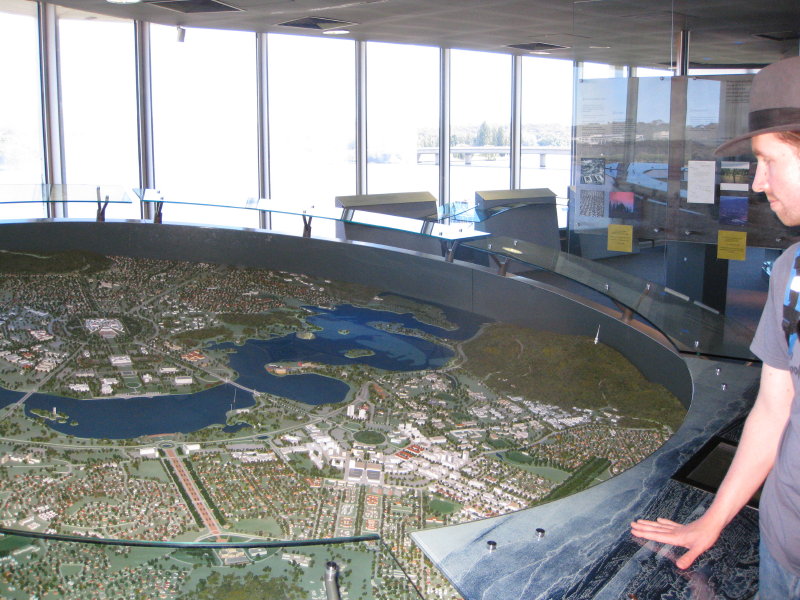
Canberra has several man-made lakes (a kind of apology for being the only Australian capital city without a beach), and dozens of picturesque penninsulas including the tourist-oriented Regatta Point.
I’ve been there several times in my life, and my favourite part within the Canberra exhibit (which is pleasantly compact) is a beautifully made 3D display that talks to you at the press of a button, and lights up the areas of Canberra that it’s talking about. It reminds me very much of certain videos of Walt Disney (or the equivalent 50s-ish videos in Iron Man 2). It’s very well done, and I’ve found it strangely compelling since the first time I saw it as a child.