#306: Enlighten light art
I’m posting this as I eat breakfast, so my Canberra peeps can see this for themselves asap. It’s still running tonight the 19th of March, from dark (about 8pm) until early in the morning.
There’s a whole bunch of stuff on – I will be going to Skyfire (a large free fireworks display set to music) tonight (and blogging about it next week), and a lot of it is free.
So what am I so excited about?
Last night CJ and I went and saw the seriously awesome light sculptures that have been engineered for several of Canberra’s best-known buildings – Old and New Parliament House, The National Gallery, and the National Library.
Each location had giant projectors set up with a series of either moving or still images. Gonna stop explaining now – we were particularly taken with the National Library, which usually looks like this:
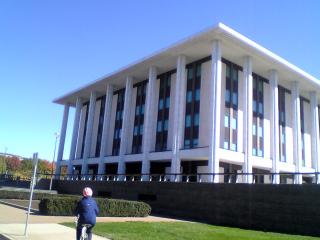
But last night it was all dressed up:
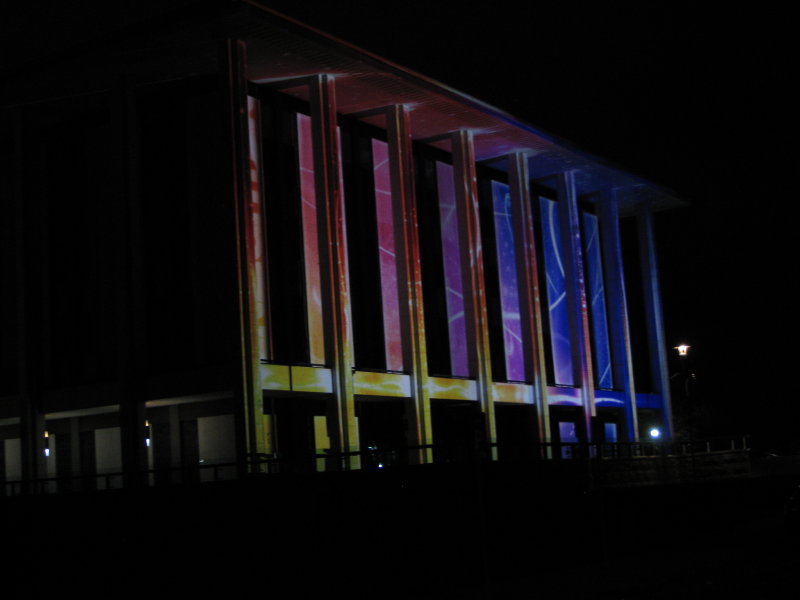

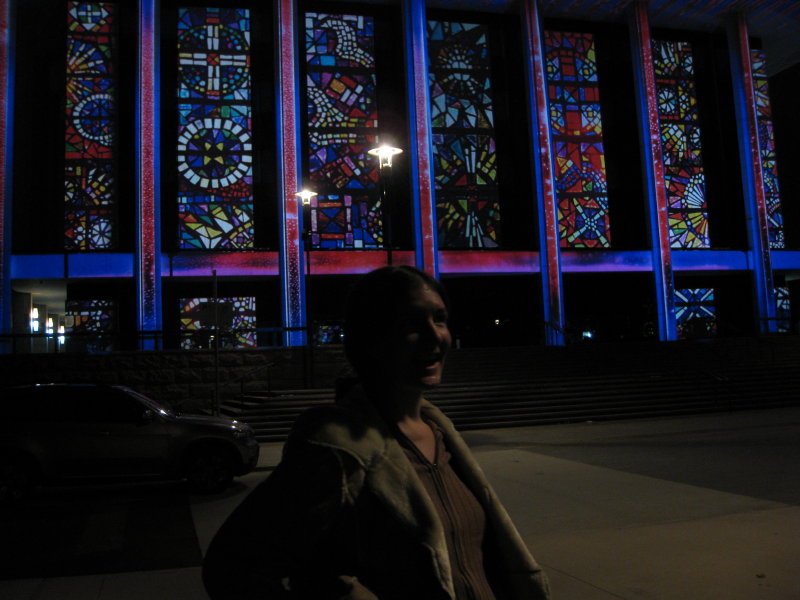


We knew it was going to be good, and it was gasp-worthy. We also watched Old Parliament House for a while (but from farther away).

Play along at home recommendation? DO IT!
#305: Leftovers
When I was a child, “leftovers” meant the unidentifiable frozen sludge freezer-burnt into the permanent ice shelf. One of the things CJ brought into our marriage was a habit of frequent leftovers, and I love it. Because as an adult, what “leftovers” means is super-fast preparation time and barely any dishes.
So here’s CJ’s lasagna – again.
I’m so happy I’m blurry.

And here’s Indah chilling out on CJ’s lap.

SUNDAY: The hot air balloon ride! Aieeee!
PS I just (moments ago) reached 10,000 words in my steampunk book. Emmeline Miller is on board her convict transport (the next chapter takes place in Australia), and has made a lower-class friend and an equally lower-class convict enemy. Having learnt plenty of new words from the former, she just called the latter a “sour-faced rusty-gutted mongrel” – among other things – and successfully beat him up with her Patent Steel-Ribbed Probability Parasol. It went fabulously – right up until the point he revealed that he knew her Terrible Secret.
OH NOSE!! WHAT WILL HAPPEN NEXT?!?!?!
If you could choose
If you were to choose to be above average in one of these three ways, which would you be?
A good person
A talented person
A happy person
I grew up aiming for the first, and I really really wish I could support the hypothesis that I’m the second. The third just seems impossible.
But probably more pleasant than the other two combined.
Which would you choose, if you could have only one?
I think most people require the first or second (or both) to be happy. On the up side, being good is a choice and being talented is generally a matter of how much effort you put in. So maybe we really do have a choice.
S#94: Pay off debt
When I was nineteen I moved out of home, having borrowed the money to buy a motorcycle so I could get around (I had a couple of tutoring jobs, plus casual bookshop work and some babysitting – altogether, I rarely worked more than three hours at a time, so public transport wasn’t an option).
Within two weeks I’d scratched a stranger’s car ($900 – and I do mean scratched, not dented), discovered the wonder of cavities for the first time in my life ($1000) and of course I needed to pay off the bike ($1000). My income after rent (which my parents paid for me) was $145/week. Then I lost two of my three jobs, and suddenly I was earning $10 per week. Within a month I was going hungry, and saving petrol by walking up to two hours to and from work. I still have faint scars on my feet from walking so far one day that my feet bled.
I kept my poverty a secret from my housemates and my parents, but after six months of independence I was forced to move back home (by which time I’d crashed my motorbike a few times, and had to sell it for parts – while still paying it off).
I crawled out of debt over two careful years, and didn’t get back into debt until I became mentally ill, at which point I lost my independence permanently.
CJ and I managed to get married without starting life in debt. We agree that, barring an immediate crisis (a medical emergency, or the sudden lack of something required for work such as the car), the only thing worth getting into debt for is a house.
We made an exception when we started our savings account in 2009, because if we put in enough money by a certain date we get a money bonus. So since (a) it’s not actually spending the money, and (b) it was matching what we’d already put in, and (c) it was creating more money – we borrowed thousands from my parents.
Today, finally, we finished paying it back. This certainly is awesome.
I may not be independent, but I am independent from my parents. That’s worth a lot.
#304: Fall asleep at work
The ability to fall asleep anywhere is the talent that bites back. Because you end up falling asleep everywhere.
I used to work at Questacon (the National Science and Technology Centre, a popular tourist attraction) which gets extremely quiet in February each year as the school term starts. And by “extremely quiet” I mean “post-apocalyptically quiet”. On one day, there was a total of six customers (who emerged rather shaken after entering each gallery only to meet a jibbering attendant who offered them a personalised tour, then begged them not to leave). That time of year, it was often difficult not to fall asleep. I combated it by walking around and around in circles.
But then there’s my other job: tutoring. Now tutoring only goes for an hour at a time, and is very intensive (I can generally teach an entire week’s worth of material in any subject given 1-2 lessons). You’d think that would keep me awake. You’d be wrong. One of my less-than-proud moments was when a student was rehearsing her speech for class and, while supposedly critiquing her, I fell asleep.*
*ahem*
In order to supplement my tutoring income, I sometimes do after-school care, which fundamentally involves picking kids up from school and then either watching TV or reading a book while they amuse themselves (or, sometimes, actually doing something – but not with my current family, who made it very clear the only reason I was there was in case the house spontaneously combusted. It hasn’t yet, so everyone’s happy). Last week, as both children played computer games, I laid my head on the arm of my chair – and slept.
The thing that makes this awesome? Firstly, I was still getting paid. Secondly, when I mentioned it to the parent in question, he was pleased.
Best. Job. Ever.
Also, the kids are nice.
Have you ever fallen asleep somewhere you probably shouldn’t have?
*Arguably, a valid response. Or at least, it was valid the first two times.
#303: Start a novel
As you know, I’ve been researching and planning a steampunk book for most of this year. Now, finally, it has begun, and I’m having a fabulous time.
Here are some of my research notes, and plot and character planning (this scene occured after getting CJ’s permission to take over the kitchen and living room):
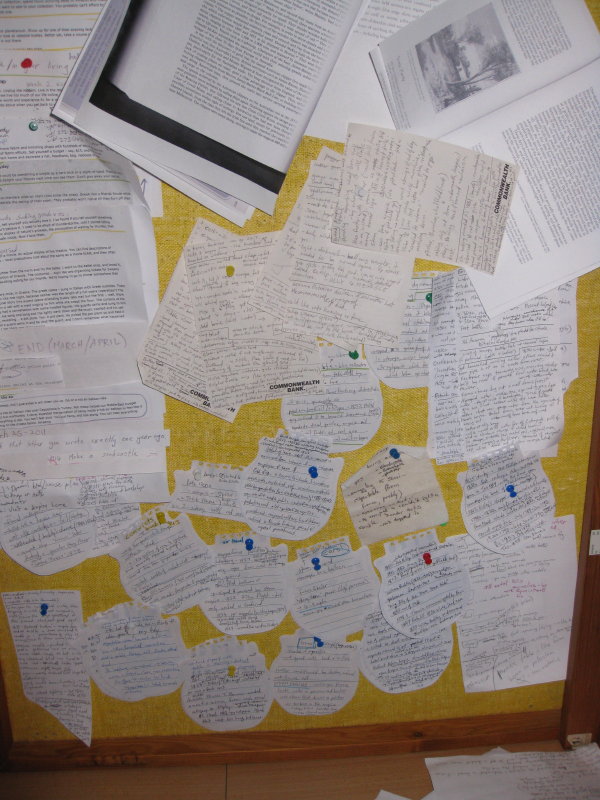
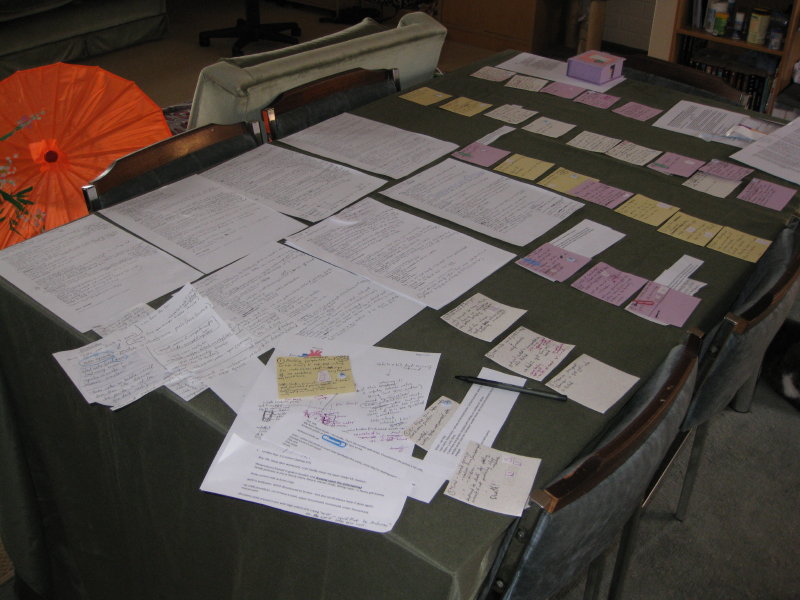
The title is so excellent, so essential to the plot, and so easy to copy that I’m not saying it online (ooh, mysterious!) I will say that the book is about a London girl transported to Australia – and Australia is where most of the action takes place. We were a British colony at the time (1853-4), after all.
The book opens as Miss Miller (aka our hero) is attempting to rescue her family’s faltering riches by marrying well. Her potential suitor, Ambrose Dawes, is about to pay a crucial social call with his mother. Here’s a first-draft sample, taken from when Miss Miller uses magic to eavesdrop on their conversation at her front door:
“One way or another,” said Mrs Dawes, “this family has a reputation for peculiarity.”
“I hope it’s deserved.”
She took several agitated breaths. “Do be serious, Ambrose. And try not to be distracted by Miss Miller’s famous blue eyes. Blue eyes are not at all a suitable reason to marry.”
“I managed to remain calm when I saw them at the royal ball last year. Very distracted blue eyes – until I mentioned my admiration of Hungerford Bridge. Then they were razors.”
“Did you bore her with your engineering talk? You know you mustn’t talk about all that rubbish in proper society.”
“I didn’t have the chance. She danced on. I did, however, notice she possessed a very finely-engineered ankle.”
“Well!” Mrs Dawes cut off further conversation by knocking at our door.
#303: When he cooks
This is what it means when I cook: The food generally costs under $2.50 per serve, and takes less than half an hour to appear.
Here’s what it means when CJ cooks: The focus is on one thing – deliciousness.
Both of us are “good” cooks in our own way, but everything is more epic when CJ cooks*. Last night he made my favourite meal: Lasagna (by request from his parents).
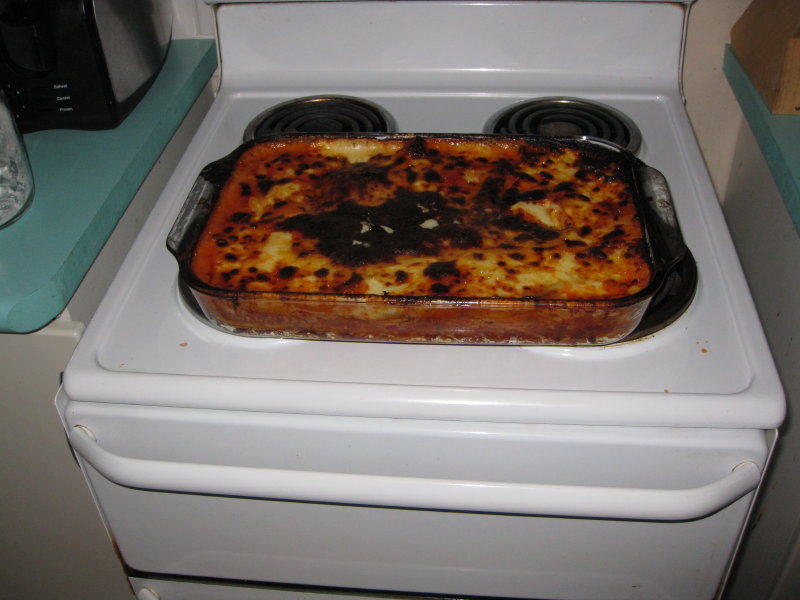
The house still smells delicious. . . and, best of all, we have leftovers.
Today is 14 March, which means *drum roll* there are only TEN official year-of-awesomeness days left. Don’t worry – I won’t suddenly stop being awesome**. I will be making an announcement on Friday 25 March about the blog’s next manifestation. . . and I think you’ll like it.
*Including the dishes
**”Impossible!” from the chorus
#302: Girls’ Day
My Mum is away, so my Dad stole CJ for a boys’ games day.
I responded to the shot across the bow by declaring a rival games day – for girls only.
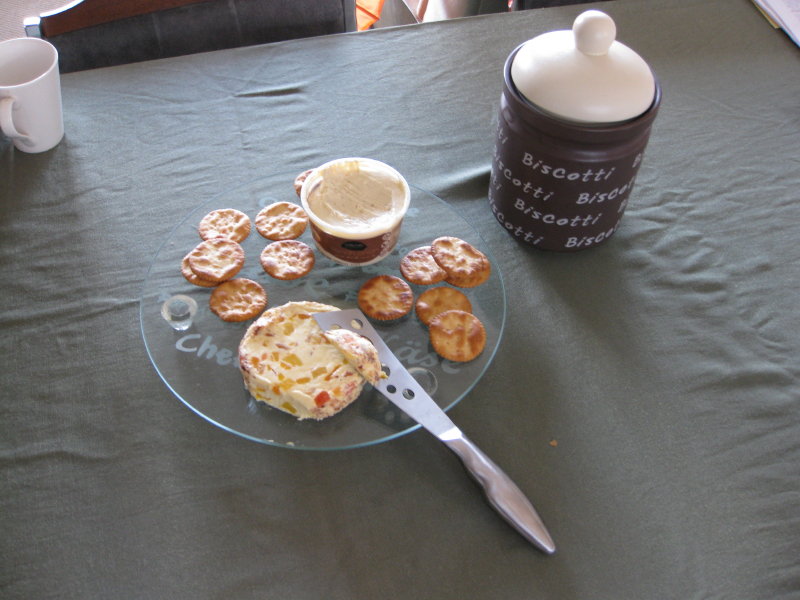

We ate fancy cheese and biscuits, talked about werewolves, and played a one-hour game of Settlers.
Meanwhile, the boys played a six-hour game of civilisation. CJ was pleased that this time he survived to the end – instead of dying partway through and then waiting hours for the game to finish.
Pretty sure the girls won.
Next Sunday I’ll be blogging about a real life hot air balloon ride! Aieeee!
S#86: Starry Night
My mission of awesomeness was to visit an observatory or planetarium. In an odd coincidence, both of Canberra’s star-gazing places (Stromlo and Dickson) have burnt down in unrelated incidents (presumably we’re getting invaded by an army of high-flying yaks who needed to ensure they aren’t seen).
So CJ and I took a picnic rug and went and lay down in a park late last night to ask one another what on earth we were looking at. It was very romantic, even if I did (evidently) forget to take a star map with us.
Plus, since my convict girl and the bushranger do something very similar in my steampunk novel, it totally counts as research.
#301: Detective Dee
Last night I saw “Detective Dee and the Mystery of the Phantom Flame” and BOY was that awesome. . . in every possible sense.
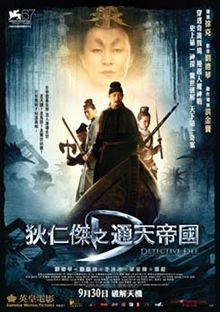
This movie was such a peculiar blend of genius and utter incompetence. Even I know it was wildly inaccurate historically – and while the “rule of cool” says that the giant Buddha statue was fine, it doesn’t speak up when the empress disguises herself with a 1920s hat. The subtitles were very poorly done, which just emphasises the fact that whoever was in charge of this film was just LAZY in so many ways.
The wild leaps of plot and intrigue went way beyond the oriental norm, and the deer high priest was. . . well, whatever. There was plenty of random preachiness, and an oddly flolloping pace. The special effects were unintentionally retro, with no irony whatsoever. The spontaneous human combustions were nice and gory, though – so don’t take your kids.
But the characters were truly interesting – and the resolution was genuinely unique. The acting was often stilted, but it was interesting all the same. I really liked Detective Dee, and the main girl, and the empress. And there was a good range of perfectly adequate eye candy, which is always nice.
The fight scenes were sort of really stupid, but at least it was clear the writers were trying. I liked the scene in which Detective Dee yells out where his blind friend should punch, and the much later scene where he climbs up and around statues while getting attacked by deer.
I saw it at the ANU film group, and all the pain of the movie was worth the roomful of hilarity when Detective Dee went in search of his old friend Donkey Wang. . . the one with scabies.
As an exercise in both very good and very bad film-making, this movie is sublime.
As an actual movie, it’s slightly less good than a punch in the face.