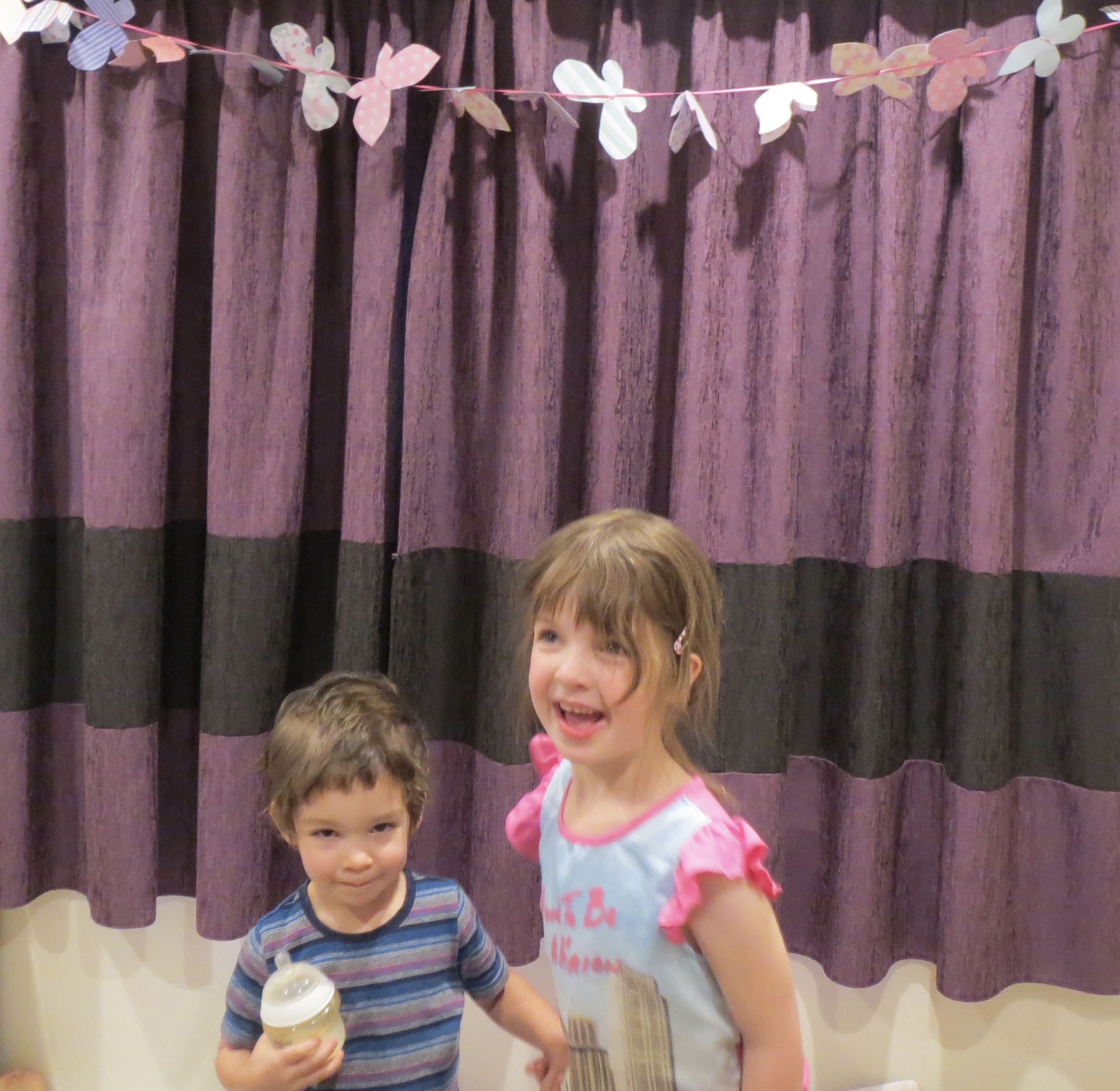
Conflux 13: Day 4
I have only the haziest recollections of today, the shortest day of the conference.
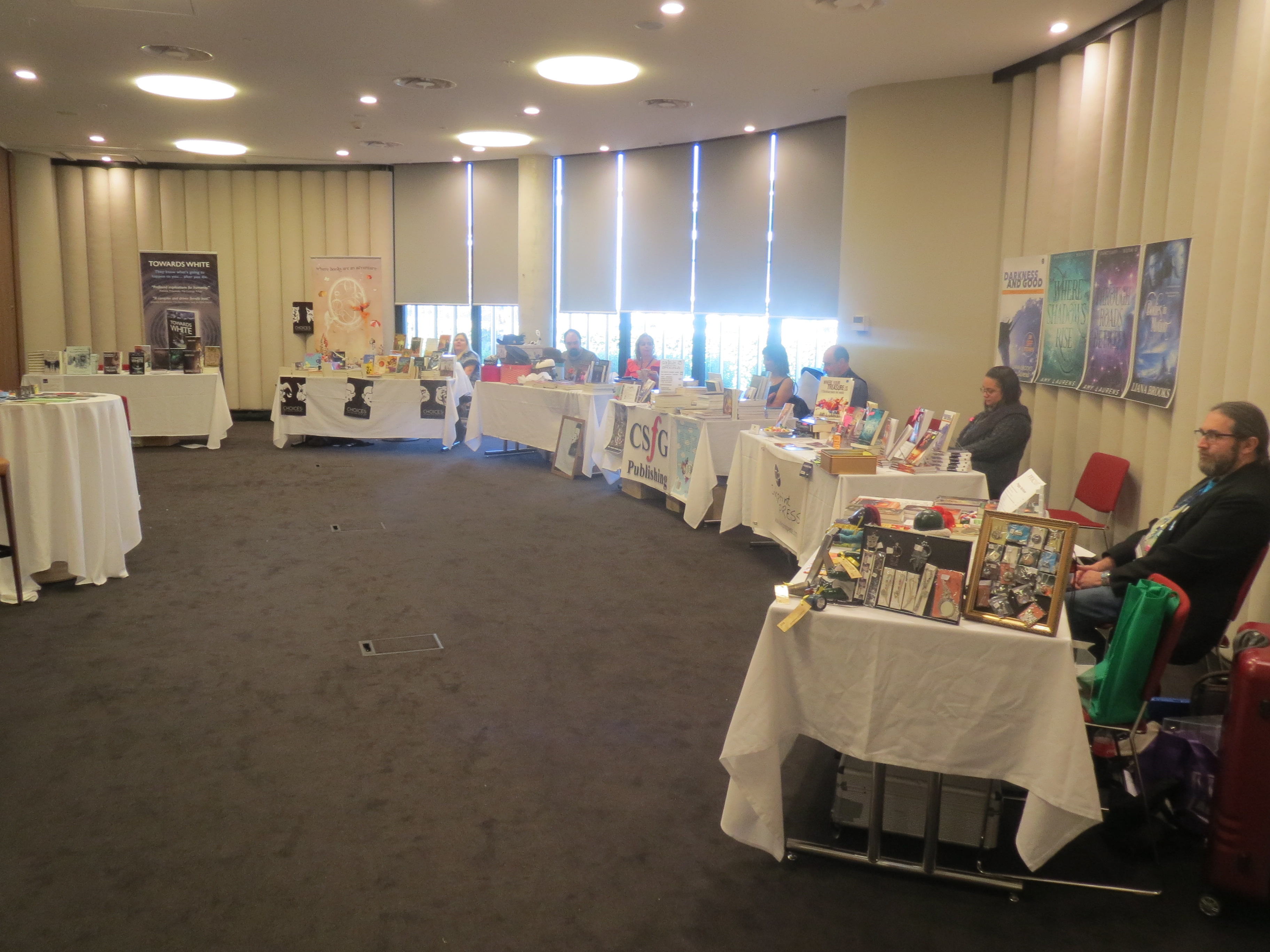
There was the dealer room (taken here in a quiet moment):
There was food (this is the asparagus and avocado salad with optional chicken):
(That’s right. I ate salad, y’all.)

There was much cheering, especially at the launch of the Never Never Book Box:

I should probably mention that (a) The conference was buzzing with the book box love, and (b) I’m friends with the curator (she’s technically a work friend but we have even more than writingness in common). (c) The Never Never Book Box is closely linked to Odyssey through friendship, casual work, and most of all through the fact that both have an enduring love of Australian speculative fiction.
So that’s Conflux done until 2018. I had an absolute blast. I also broke a nail carrying a box of my own books. I feel like that’s some kind of metaphor, but it’s best not to examine it too closely.

Conflux 13: Day 3 (& ChoiceScript)
Today, Sunday, was my Big Day. Not only did I have a Book Launch at 2pm…

…but I also ran a three-hour interactive fiction workshop in the morning.
Which was seriously awesome. (So was the Book Launch. If you haven’t seen the trailer, it’s here.)
The workshop was very biased, naturally, since it is all about my own notions regarding interactive fiction. This article, which I wrote last year, is an excellent summary of the IF scene (as I see it, having stumbled across it very recently).
This article focuses on the different elements of writing interactive novels as opposed to regular novels.
Today’s workshop was brimming with people who’d already written novels, which was quite different to last year. Last year we focused on Twine, the free tool that makes a useful map as you write and is the most user-friendly tool ever. This year we focused on ChoiceScript, which is a lovely elegant engine, also designed for non-programmers, made by Choice of Games. It’s easier to write longer works with ChoiceScript, because it’s set up for that (you can write longer pieces on Twine, but it’s trickier to do anything clever). More on that in a bit. FYI I’m not associated or affiliated with Choice of Games in any way.
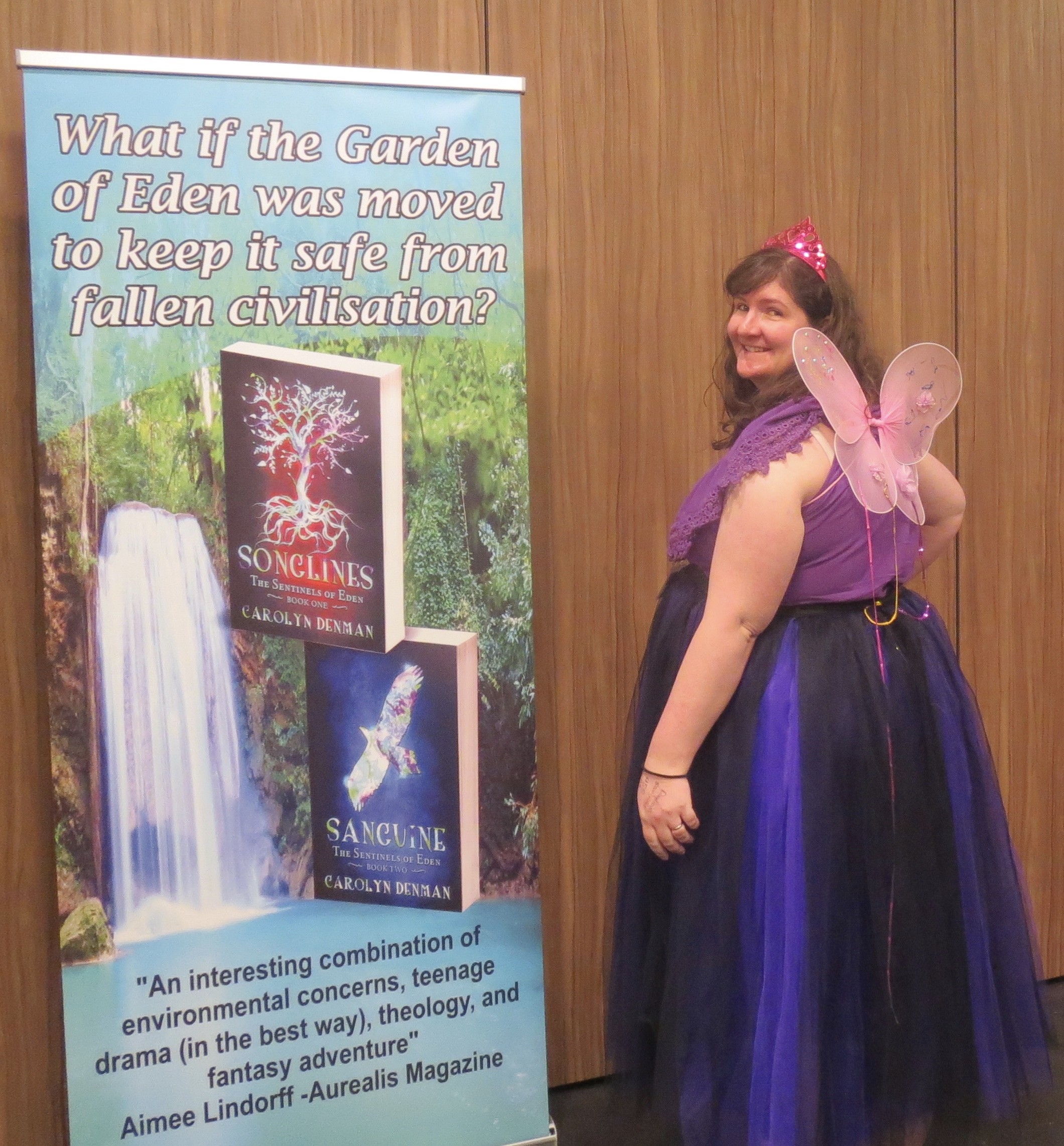
I believe I promised a pic of yesterday’s outfit. Here it is (next to an ad for the excellent “Sentinels of Eden” series which I also mentioned yesterday).
I’ve spent the rest of the day in Conflux mode… that is, hanging around talking to interesting people. My love for the venue is only growing with greater familiarity. Apart from anything else, they DO have special free conference wifi. And SO many power points, just everywhere *swoon*. The staff continue to be absolutely excellent. The food is pretty good but expensive and the menu is fairly limited. Huge portions.
A lot of local people are unhappy Conflux is at the airport, which isn’t great for most Canberrans (especially those who rely on buses—the special shuttle to or from Civic has been helpful). Next year’s venue is TBA. Parking underneath the hotel costs $6 for up to two hours but over $20 for a full day. For people that validated their ticket at reception, a whole day costs $14. There was plenty of space.
People like me (ie with a disability card) can park in a funny little 2-hour carpark that’s on the right as you drive around the hotel on your way to the front door. There are no designated disabled spots but with a card you can use public 2-hour parking for a full day for free. So the key to Conflux parking is to have a disability card but still be able to drive. For me, it was a breeze, and much much nicer than anywhere in civic.
And it’s pretty.
There’s a moment at sunset when everyone in the foyer suddenly has a golden halo. When the moment passes, the brass lamps all come on (not these ones; other ones). It’s quite lovely.

The banquet was suitably glorious, and a very fine evening. Each item on the menu was linked to fairy tales. I ate a Goose’s Golden Egg for dessert (filled with panna cotta).

There’s a Trivia Night tonight, but I shall be going home to sleep.
Thus endeth today’s Conflux Report.
I promised to write out a few very useful bits of code for those who are learning ChoiceScript. This is reinventing the wheel to a large extent, since the official ChoiceScript guides, including a free link to download it, are excellent.
So is the wiki, which has had many years to be refined and expanded. The Twine documents are improving, but they’re newer and trickier, and there are significant changes from Twine1 to Twine2.
When you download ChoiceScript, it has some very basic intro scenes, choices, and statistics set up for you. When you want to start writing, you can just delete a bit and begin.
HOW TO WRITE A CHOICE:
To “play” the example game, follow this path (it works on PC or Mac):

It works best with Firefox, but most browsers are fine (other than, oddly, Google Chrome).
It’s fairly ordinary-looking visually, but it is immediately obvious how to progress the story (Click on a choice, then click on ‘Next’). Your text will be different to this image, because I’ve long since replaced the example with my own.

To see the code behind the story, follow this path (using a text editing program—I recommend Notepad++ for PC and Sublime for Macs):
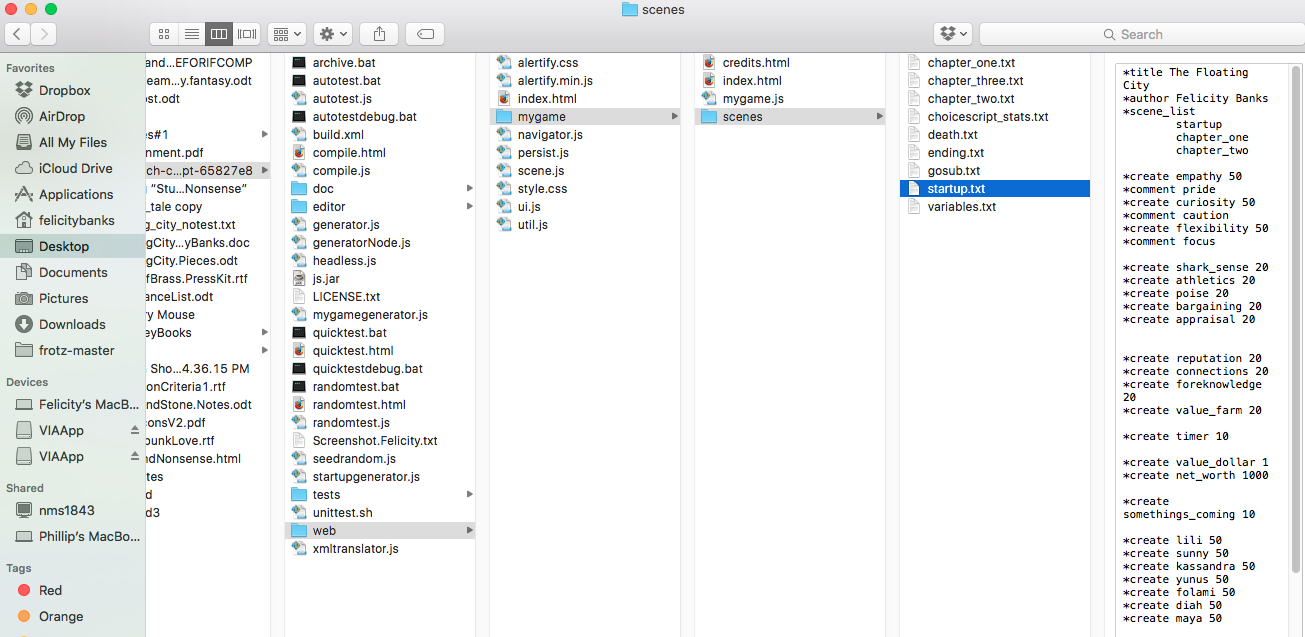
The right-hand column above shows the startup file for the story I’m currently writing (so nobody look, okay?)
Don’t panic when you see a bunch of words and symbols. It will be okay.
NB: Each chapter of your book will be in a separate text file. You can name them whatever you like.
You can switch between the browser and the text file to see how the text file alters the story that you’re reading in the browser. The best thing to do is to just put your own words in, and you’ll be able to see them immediately fit the playable ChoiceScript format.
So if you write exactly this (at the END of the startup file, replacing the kingdom bit):
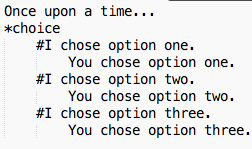
Then you go back to the index.html file, it will look like:
The * and # symbols are vital, and so is the spacing at the beginning of your lines. You can use either tab or spacebar to indent what needs indenting, but you have to pick one and stick to it or the game will break. Those three keys are the heart of your writing from now on.
If the reader picks “I choose option one” above, the line of text will appear, saying, “You chose option one.” Your story works—but so far you haven’t told the program what to do next (thus, the game will break immediately after that line).
Some structural info:
Many stories have a “branch and bottleneck” structure. Choices (often a whole series of nested choices) branch off in different directions, then different directions again… and then there’a a point at which they all come together, and then the choices branch out again from there. Here’s a diagram example using twine:

As a writer, the hard part isn’t branching your story; it’s bringing things back to bottlenecks (so you don’t end up with literally millions of utterly different stories). One handy way is with time, eg:
“The sun is setting. Enough mucking around. It’s time to…”
“Mucking around” is non-specific enough to cover all the possible adventures the character might just have experienced. Or you can leave out that sentence altogether.
Back to your basic ChoiceScript thing:
A lot of choices within a story bottleneck immediately, which is written as:
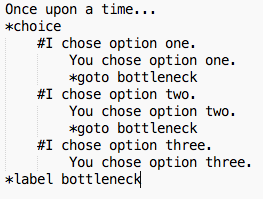
You can name your label whatever you like. Use lower case, avoid special characters, and remember each label must be different.
This is a simple choice structure that works. You don’t actually require the “goto” and “label” stuff unless you’re nesting choices, so a lot of the time it’s even simpler.
Whatever you write after “*label bottleneck” will be seen by all the readers, no matter what choice they made beforehand.
Anything that’s on a line marked with an * will not be seen by the reader.
If you want, you can write an entire story like this. The lines of unique text above (“You chose option one/two/three.”) are only seen by the readers that chose that option. Those lines can be expanded into literally any length, and can have other nested choices inside. ChoiceScript authors don’t have a wall diagram with string going everywhere; they have a ludicrous number of indentations as they write choices within choices within choices.
But you can also just bottleneck after each choice. That’s what smart authors do (for most of the choices, but not all of them—after all, you want your reader to have a unique experience). That’s how authors stay sane.
But how to make the choices matter in a deeper way?
[Tired? Breandead? Stop here and write some scenes. Come back later. This is where I stopped for a day when I was learning ChoiceScript.]
Choices have long-term consequences because of stats. Stats don’t create work; they are a brilliant and cumulative way of making hundreds of choices matter without writing a million-page book.
The two main types of statistics are personality based and skill based. So as your player makes their choices and has their adventures, you’re also noting what kind of character they are creating (think of them as a co-writer who’s in charge of the main character’s personality), as well as building their skill set (for later challenges that can be won or lost).
In ChoiceScript, you make your own unique statistics. The more unique the better!
One of the most distinctive & fun things about the ChoiceScript tool is that it often uses opposed statistics—so for example, you might have ‘Tactfulness’ versus ‘Straight Talker’. If a player chooses to be tactful, their tactfulness stat will go up and their ‘straight talker’ stat will go down.
HOW TO DO STATS:
First, go into the startup file. After the *scene_list but before the story begins, write this:
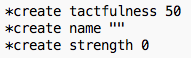
You can set any number of (single, lowercase) words as beginning stats.
Your Tactfulness versus Straight Talker opposed statistic will all be expressed (code-wise) as + or – tactfulness.
Your name stat will be a one-off choice (and the players can enter their own; instructions here).
Your strength starts at 0. It will grow with strength-based choices, and it will be tested at later choices.
The “show stats” button on the browser version of the story (that the players see) appears automatically.
To make the stats page look good, go into the choicescript_stats file (which you already have in the same “scenes” folder as the “startup” file), and write this:
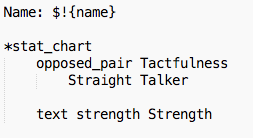
It will look like this to the player:

The numerical values will change as the player makes choices.
The ! makes sure that a word is capitalised (it’s also useful for pronouns—which we’ll talk about next—when they’re at the beginning of a sentence).
Here’s your first-choice example, with stats added:
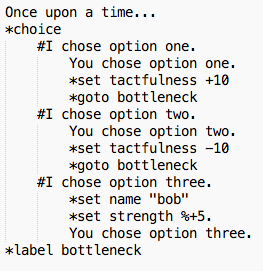
Now players who choose Option One have Tactfulness 60% (and Straight Talking 40%).
Players who choose Option Two have Straight Talking 60% (and Tactfulness 40%).
Behind the scenes, opposed stats are really just recording one stat going up or down, but they’re displayed with a red/blue bar for the player.
If the player chose Option Three, then “Bob” will appear after “Name:” in the player’s stat screen, AND their strength will be 5.
In the line “*set strength %+5” the % symbol is the key to avoiding maths. I have your attention now, don’t I? Long story short, if you use “%+” and “%-” for your stats, you will never get under 0% or over 100%. Is good.
Congratulations! You’ve written a functional choice that doesn’t break the game and that makes a difference to your statistics.
HOW TO DO GENDER:
In your startup file, write:

Then have a choice (early on) like this:
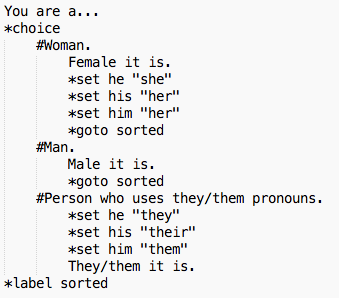
As you may have noticed above, you can put the stats and the text in any order. Since the player doesn’t see the stats (until they click on the button to see the stat page), it doesn’t make a difference. But consistency is a good idea.
Once you’ve done that, you can use pronouns, like so:
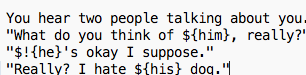
This text will appear normal to the player, but will have the right pronouns, eg:
You hear two people talking about you.
“What do you think of them, really?”
“They’s okay I suppose.”
“Really? I hate their dog.”
There are two important things to note here. (Okay, three.)
-You can write an entire novel without player-character (PC) pronouns if you’re determined (as I’ve done for “Choices That Matter” stories on iOS and Google Play via Tin Man Games).
-‘They’ is grammatically distinct. You probably noticed the painfully incorrect “They’s okay” above. If you include they/them pronouns, you will need to be very careful to avoid a similar grammar fail. But it’s worth it. The IF (Interactive Fiction) community works hard to be inclusive, especially with gender and sexuality.
-Using he/his/him as your “base stat” in the startup file works well because the three forms are distinct (unlike for she/her/her).
Erm, it’s just occurring to me that it might work better to use they/their/them as your base. I’m not smart enough to check the idea is sound without writing a novel to check, but I THINK it’ll help a bunch with both Point #3 and the Point #2.
WELL that was a long blog entry. Are you still here, dear reader? I’m off to eat dinner and have a lie down.
PS Guess what! It’s October! Who knew?
More Conflux tomorrow!
PS Two more super-useful sites for when you’ve finished that brilliant interactive fiction game.
Dashingdon hosts ChoiceScript games, and Philime.la hosts Twine games. Both are free, and both allow you to show your game to a select few (editors) before uploading/publishing a finished version.
Conflux 13: Day 2
It’s 7:05pm as I begin writing, bleary-eyed and rocking a banquet-sized hunger (in related news, the official Conflux 13 banquet begins in twenty-five minutes).
First things first: after a panicked search and paying a suitable bribe to Miss Five, I have the GOOD tiara, and have been wearing it all day.

I’m also wearing an epic purple tutu, and wings. It’s possible glitter and craft glue are involved.
(There are brass lamps and circular patterns in the foyer/bar/restaurant. It is shiny, and the perfect accidentally-steampunky venue for my launch of “Antipodean Queen 2: Silver and Stone” tomorrow at 2pm in the JFK room.)
Note to self: Take pictures. Promise to show them to people who read tomorrow’s blog.
I extremely enjoyed being on the “Beyond the Hunger Games: Best young adult books in the last twelve months” panel. My personal top picks (based on personal taste + genius):
- “Borderline” and “Phantom Pains” (Books 1 and 2 of the Arcadia Project) by Mishell Baker.
- “Goldenhand” by Garth Nix (Book 5 of the Old Kingdom…er… trilogy).
- “Songlines” by Carolyn Denman (Book 1 of the Sentinels of Eden series).
- “Salvage” by Martin Rodereda.
- “Six of Crows” by Leigh Bardugo, which I am reading now (in preparation for the panel…oops).
I adored the panel on Steampunk Martial Arts by Laura E. Goodin, Madeleine D’Este (yes, her again), Aiki Flinthart, and Rik Lagarto. I could listen to any of those people on any topic, but that was just fantastic. I especially enjoyed Laura and Rik’s humour, and Aiki’s knowledge of unusual weapons (hampered only by my knowledge that everyone will know I’ve stolen the ideas from her), such as the flexible sword word as a belt.
I lied about being in the Dealer Room most of the day. There are so many Odyssey authors this year that I wandered off to other places so me and my tutu could stop sweeping over book displays and toppling posters.
Skirts. They’re dangerous.
Photos tomorrow.
Conflux 13: Day 1
Conflux is Canberra’s annual Speculative Fiction conference, run each year by members of the excellent and enormous writing group, the Canberra Speculative Fiction Guild (CSFG). It runs over the October long weekend, which this year and last year has included September. Because life is confusing.
This year for the first time the venue is the Vibe Airport Hotel. It’s very pretty inside and out, and surprisingly easy to get to (whether you’re coming from the airport—it’s about a ten-minute walk) or from Canberra. The best parking option is $10/day at Brindabella Business Park (again, a ten minute walk away). I haven’t checked that for myself since I park in the little 2-hour carpark with my disability permit. There’s also parking underneath the hotel, but I think it’s $23/day or guests only. (Please confirm your plans with someone less vague.)

I really like Vibe’s layout. As soon as you walk in the door you’re in the bar (“Huzzah!” from the chorus), facing the Conflux rego desk, with the hotel reception to the left and all the conference rooms on the right. The restaurant is behind the bar, and the entire hotel foyer is filled with a delicious range and fluidity of chairs and couches and stools and tables.
One of the best things about Vibe is that the conference rooms in particular have excellent sound design (that sounds like a minor thing, but it’s not). The down side is that we don’t get free wifi. We do get free tea and coffee, and all the staff I’ve had contact with were very helpful. I’m pathetically jealous of the people that get to stay there (who I’m sure are pathetically jealous that I can go to my own family and bed to sleep).
Friday is a work day, but we still managed a highly respectable crowd, which bodes very well indeed for the rest of the conference.
This is probably about the point in proceedings that I should mention my flaws as a conference blogger: I almost never go to panels, unless I’m speaking. What I love is hanging out in the dealer room, emerging periodically to eat and drink and hang out some more in the food area, then going to hang out in the dealer room some more.
I could tell you that the panel I was on with Dion Perry, Madeleine D’Este, and Kathryn Gossow was pretty cool, but what would I know? (Also, if you like my books I can pretty much guarantee you’ll like Madeleine’s. Evangeline and the Alchemist is the first one, and I think it’s free all weekend. It’s Aussie steampunk set in Melbourne with a inventive but frequently idiotic heroine.)
So how’s the dealer room? It is nice. The tables include music (Meri Amber, who somewhat corners the market on nerdy singing); the launching-at-Conflux Never Never Book Box subscription series; a range of hats and other gear; and of course many many delicious books.
Speaking of which, guess what I beheld for the first time today??

That’s right. My second published novel. I approved the final edits oh…. about a week ago. So I was a teensy bit worried I’d have no books to sell at the launch on Sunday.
But it’s here, and it looks beautiful, and I think it probably even has my words inside.
(The severed hands belong to my children, who spent much of the day hiding under the Odyssey Books table.)

Is this a face that makes you want to buy books?
Tell me your answers below!
The countdown is on
The second book in the Antipodean Queen trilogy is at the printer and will be ready for the book launch this Sunday (almost definitely). You can pre-order the hard copies through the publisher here, and it’ll be on Amazon, Kobo, B&N, etc etc in a couple of weeks. You can use the ISBN to order it through your local bookshop in case it’s not classy enough to order the book itself.
The launch is at 2pm at Canberra’s Vibe Airport Hotel. It’s part of Conflux, Canberra’s annual speculative fiction conference, but the launch itself is free. So is hanging out in the Vibe bar and/or restaurant after the launch.
There’s no need to RSVP, but the facebook event page is here.
It’ll be short and sweet, but there will still be time for costume prizes (anything steampunk, historical, Aussie, crocodile-like, or fairyish will do).
Here’s the cover, at last!
And click here to watch the trailer. It’s a little inspiring, I think.
Novels Versus Interactive Novels
This is a post written for Games Versus Play.
I write both novels and interactive novels, and I’m fascinated by the style differences between the two.
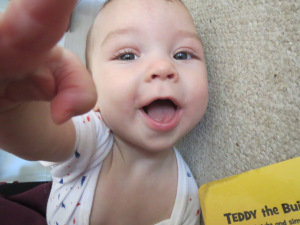
(This is how fascinated I am.)
When I write novels, I often write in first person (“I don’t deliberately make things explode”), and sometimes third person (“She doesn’t deliberately make things explode”). It is extremely rare to find a published novel written in second person (“You don’t deliberately make things explode”). Most people find second person very jarring. The famous exception is “Choose Your Own Adventure” novels, and I’ve seen a couple of modern children’s books written in second person.
The great thing about first person is that it’s easy to use a quirky writing style, and to see inside the main character’s head. In my opinion, it’s particularly good for young adult or crossover writing, when internal thoughts are often an important part of the plot. On the down side, you can’t see the thought processes of other characters, or any information the main character doesn’t know (such as, there is a bushfire coming).
Second person is favoured by a lot of interactive fiction, because it emphasises the reader’s involvement in the story.
It’s also common to have a different style for the text of the choices themselves. For example, Choice of Games uses second person for the main text, and first person for the choices (which is reversed in the Tin Man Games “Choices That Matter” serial story app).

The overwhelming majority of novels use past tense (“Quit it!” said Bob), but quite a few interactive novels use present tense (“Quit it!” says Bob). When I’m writing a first draft, regardless of the form, I tend to switch back and forth between the two, which is always the most obvious thing I have to fix when I edit. It’s never okay to release a story like that.
This blog entry is in present tense. It feels more immediate to the reader—more like a face to face conversation. That’s useful for interactive fiction, which is a more conversational reading experience than novels. Quite a lot of writers fall into present tense in a first draft (whether they mean to or not) because they’re watching their own story as it happens in their head.
A story in its simplest form involves an interesting character with a serious problem who faces obstacles and then either succeeds or fails in solving their problem. The crucial structural elements are:
- How to make a character interesting. Flaws? Features? Quirks? Relate-ability? Pain (physical and/or emotional)? Unusual skills? Danger?
- What is the problem? It needs to be serious to the character, so it can be as simple as being thirsty or as complicated as saving the universe.
- What are the obstacles? They need to appear unsurmountable, and costly. The most difficult part is often having the character attempt to solve the problem in a way that should work (so the character doesn’t come across as an idiot) but instead backfires (raising the tension in the story). It’s a tricky balance.
- An ending must feel satisfying, even if the character fails or the problem has grown worse.
There are plenty of other elements to the story—worldbuilding, themes, scenery, subplots, etc etc—and of course other characters.
The greatest difference between a novel and an interactive novel is #1. The main character of a book is entirely under the writers’ control. They grow and change during the story. A crucial issue for any interactive fiction writer is how to make an interesting main character while also giving the reader control over the story. Often the solution is to make the main character a “Blank Slate”, an effect that works very much like a prototypical “Mary Sue”. That is, the reader can project their own personality onto the character.
Companies like Choice of Games work hard to allow the reader to fill in the blanks—choosing their own gender, sexuality, personality, and even the type of story. A single story with the same general ending can tell multiple stories eg a story ending with a prom can be a romance (the main character gets the girl/guy), horror (Carrie), action (Buffy), or tragedy (the main character doesn’t get the girl/guy) depending largely on the climactic scene. This means the writer needs to be able to think of their own main character and plot in several contradictory ways, and write their scenes accordingly.
A good interactive story writer also needs to think about the tangled fictional ethics of non-player characters. This is especially true in stories with a romance. Most interactive stories offer several romantic options, which immediately begs the question, “How are so many different people all attracted to one person? And is everybody bi?” NPCs really ARE just pieces on a board designed to make the player feel good, but good writing makes them feel like living, breathing individuals.
In the “Dream Daddy Dating Simulator” one of the potential romances is doomed no matter what the player does. This is frustrating to experience, but also makes the game more satisfying, because—as the creators point out—not all romances end well.
Some writers use statistics to block or allow romance, eg Kevin is only attracted to players who have shown high levels of empathy. Others have different sexuality for different NPCs, eg Kevin can only fall for male characters. That can be problematic, because far too much entertainment is pitched to a straight male setting. In my opinion, it’s better to have all bisexual NPCs than to give players less choices based on their gender.
The other tricky style element of interactive fiction is the dreaded “block of text”. In general, interactive fiction writers often aim for less than 300 words between choices. That means long passages of description or dialogue are a no-no. There are always exceptions to the rule, but in general readers want a LOT of choices, and will get bored with lengthy prose (no matter how beautiful or profound). IF can be beautiful and profound, but it needs to use less words to do so (or to use the same number of words, but break up paragraphs with choices).
The experience of reading an interactive novel is both more and less involving than reading a book. As an interactive fiction reader, you can have a huge amount of control over the story—who to love, who to kill, what to learn and how to use your skills—but you are also constantly breaking the fourth wall as you pause to consider your choices along the way. I tend to read non-interactive novels at night, because the decision-making process of reading IF is too stressful.
Whether you’re writing, reading, or playing… good luck!
Books, Food, and the Dangers of Combining the Two
I’ve hurt my back (again) so for the last two days I haven’t been able to do much. I wasn’t even sure I was okay to drive, so yesterday my partner Chris worked from home, and today my father-in-law brought the kids home after school.
Today was a whole lot better than yesterday, pain-wise, and I even did a teensy bit of cautious cleaning (on the level of kicking dirty washing from the hallway into the laundry).
As my father-in-law left, I noticed a book Louisette (5) had brought home from school. One of those kids’ cook books. My heart sank.

Louisette brought it out of her bag (dangit, she remembered she had it) with smiles and requests to read it, and “make everything in it”. I had a look through (approving of the simplicity of the recipes) and said I’d think about maybe making something in it. She wandered off, and I had a look through.
It had ten recipes (not, as the cover proclaims, FIFTY*)
We had too many kiwifruit, which was worrying me (I have many fruit-related anxieties**), so I thought, “Let’s make that kiwifruit smoothie” (but, ya know, in the thermomix and with some frozen raspberries in it too). Kiwifruit is soft enough that I had the kids cutting it up—Louisette cut off the skin (along with two-thirds of each fruit…. well, we DID have too many…) and then TJ cut the remainder into smaller pieces.
This was a grand success, and I rode the high and proclaimed we’d make popcorn too. Louisette has a thing for popcorn and I’d secretly bought some microwavable stuff, so THAT was easy.
I’d already said we could maybe make the tart things for dinner (my own plan was frozen nuggets and chips…. bad back, remember?) since I knew we had a single sheet of ancient puff pastry in the freezer, and I’d also discovered some Chris-made pumpkin soup from a month or so ago, so I thought maybe that’d already count as one of the recipes too. So I took a photo: two happy kids in aprons with smoothie (in a jug to save for Chris), bowls of popcorn, and a freezer container of pumpkin soup.
They’re looking sideways due to watching TV. Mum is boring.
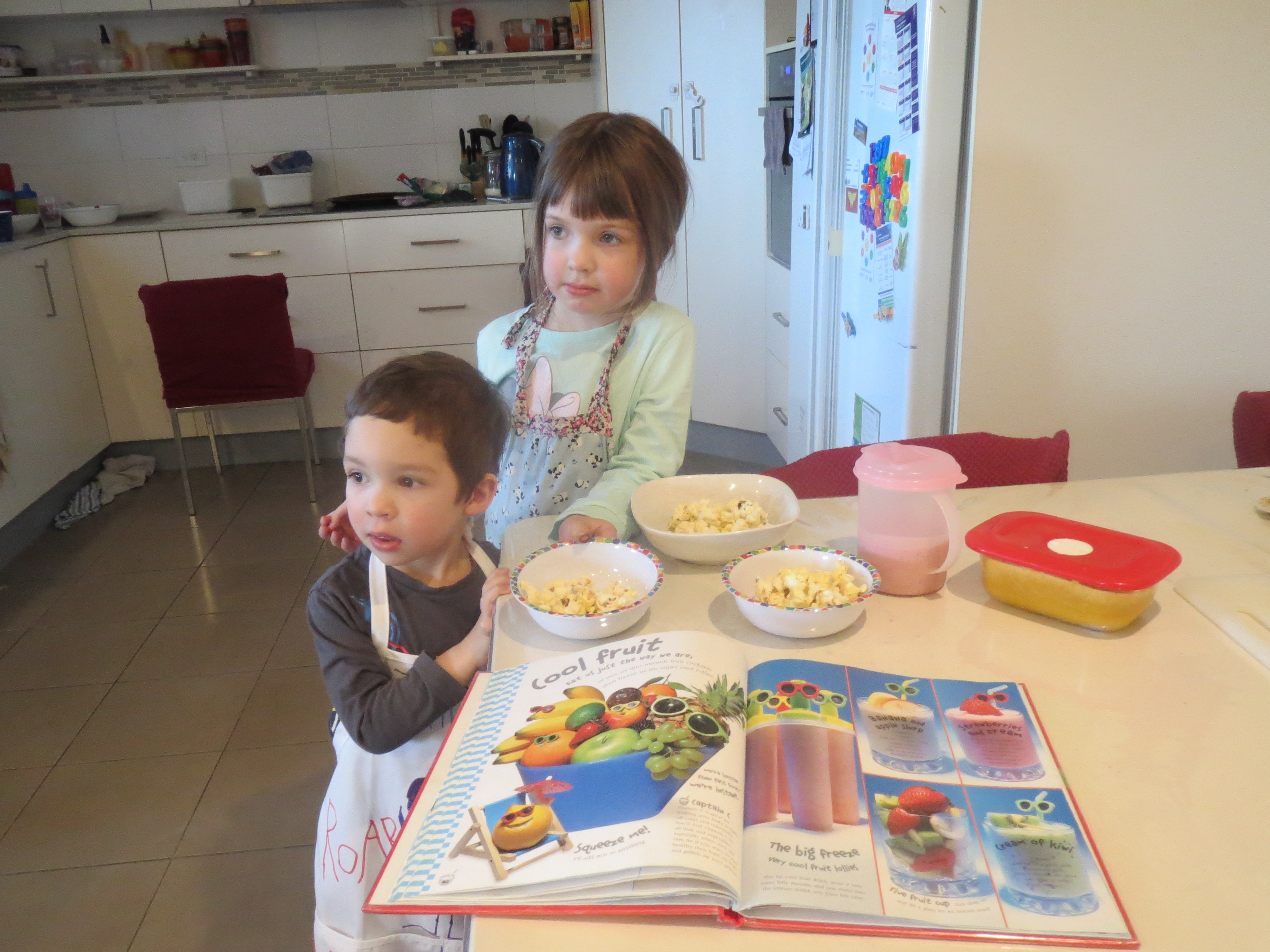
One thing led to another and thoughts happened in my head along the lines of, “Hey, we have to cook dinner anyway!” and “I can re-use trays” and “If I start now, I can…”
So naturally I decided to do all eleven recipes… using healthy versions where available, and using only what was already in the house.
- Smoothie (specifically, kiwi and raspberry, sweetened with maple syrup). Kid involvement: chopping kiwifruit together. Taste: Excellent. Healthiness: Pretty good. Kid response: Delighted. Mum cheat: thermomix.
- Popcorn. Kid involvement: Listening to popping (what else is there?) Taste: Excellent. Healthiness: Pretty good. Kid response: Delighted. Mum cheat: Microwave popcorn.
- Vegetable Art. Kid involvement: chopping various things. Taste: Vegetables and cheese. Healthiness: Excellent. Kid response: Delighted. They even ate most of what they made. Mum cheat: Using only a few ingredients (carrot, cucumber, cheese, mini crackers, and 2-minute noodles). I made a hill at sunrise; Louisette made a racing car (it looks like a train to me), and TJ proudly proclaimed that he had made “A Mess!” This also kept them entertained quite well while I prepped various other things (bread dough a la thermomix, roast vegetables for soup, stuff for “Pasta and Sauce”).


4. Pasta and Sauce. Louisette begged me not to cook this at all (not a fan of tomatoes) but it was far too late for moderation now. Kid involvement: I forced Louisette to stir the sauce for ten seconds so I could take a picture. Taste: Very tomato-y but actually rather nice. Healthiness: Excellent. Kid response: Begging for the sweet release of death. Mum cheat: I reverse cheated on this one: I actually added zucchini (pulverised with butter and onion in the thermomix) and fresh tomato. With grated mozzarella on top (we keep grated mozzarella in the freezer).

5. Bread. Thermomix bread is pretty easy (and we have dried yeast on hand) so I used the thermomix ‘basic bread’ recipe, made a small loaf out of most of it and let the kids make fun shapes from the rest (which I knew would also cook quickly, being smaller). Top tip: Don’t let kids knead bread. They’re terrible at it, and it always ends up really heavy. But they love it.

6. Soup.
At some stage I remembered we had a pumpkin in the fridge and lost my mind completely. I did a fast-and-dirty roast of pumpkin, carrot, sweet potato, onion, zucchini, and potato and then basically shoved it all in the thermomix. The next pic is Louisette modelling for me….. Louisette doesn’t like soup.
Kid involvement: Posing for photo, under protest. Taste: Pumpkin-y. Pretty good, especially considering I forgot to add stock (I added thermomix-and-butter-fried garlic before the rest, and had sprinkled herbs on the roasting vegies along with sprayed oil). Healthiness: Excellent. Kid response: NOOOO WHYYYYYY/Yum (TJ finished his). Mum cheat: Thermomix rather than saucepan (and I know from experience that you should always roast the vegies rather than cooking them any other way – and cover the pumpkin with foil so it doesn’t burn).

7. Tarts/Flans: I made savoury cheese flans plus two jam tarts (both just pastry with stuff inside).
Kid involvement: Louisette broke eggs into the bowl (twice, since the first time she did she added water “because I wanted to make it more healthy”), and both kids helped use the circular pastry cutter, then added scrap bits of pastry to the top of the tarts. Taste: Exquisite. Seriously. I think using the same containers brought in some delicious features from other dishes that did something wonderful to what should have been an omelette with pretensions. Healthiness: Pretty good. Kid response: All the nope, which luckily meant Chris and I got to eat more. Mum cheat: Frozen (and badly freezer-burned) puff pastry instead of shortcrust. I also added ham and avocado because they’re yummy and healthy.
[darn it, I’ve run out of free wordpress image space.]
[picture of muffin tin with tarts/flans because kids were no longer interested in this weird obsession.]
So for dinner we had tarts/flans, fresh bread, fresh home-made pumpkin soup, and pasta with home-made sauce.
Meanwhile, fairy cakes and upside-down puddings were cooking (precisely the same batter, even in the book) were cooking.
8. Upside-down pudding.
Basic cake mixture, in a muffin tin with tinned pineapple, sultanas, and desiccated coconut placed into the pan first. Served upside down (so the fruit is on the top). Kid involvement: Placing pineapple slices inside. Taste: Soap. I have no idea why. Possibly I didn’t clean the tin real well after the tarts. Possibly my body was trying to tell me something. Healthiness: Could be worse. Kid response: Meh. Mum cheat: Cooking fairy cakes at the same time. Genius. Also I’d long since run out of proper flour so I used cornflour. Taste was no longer a factor. The end was nigh.
[Picture of TJ eating his upside-down pudding. I think he actually ate it all, presumably because he was thrown into confusion at this stage of the evening—generally our kids respond to cupcakes with enthusiasm, then eat the top and abandon the rest.]
9. Fairy Cakes.
Same as above, but with paper patty pans instead of fruit. Then flavoured & coloured icing, with all the toppings I could find (desiccated coconut, white choc chips, sprinkles). Kid involvement: Decoration! Much cheering! Also, choosing colour and flavour of the icing (with heavy hints along the lines of “We have lemon flavouring and peppermint flavouring”). Taste: Mmm… artificial flavouring. Healthiness: Nope. Kid response: Delighted with the decorating process, yet strangely unenthusiastic about their ninth course. So this is their dessert-stomach threshold. Good to know. Mum cheat: Dad supervised the brightly-coloured horror of decoration while I did other things (far too hyper myself to panic over the small fingers and food colouring, which would normally be a huge deal).
[Picture of strangely re-invogorated children smeared with chocolate and icing.]
10. Moon rocks (basically lumpy choc chip cookies, but mine turned utterly flat). Kid involvement: Pouring in choc chips. Taste: Cardboard. Healthiness: Fail. Kid response: Glazed. Mum cheat: I had reached a zen-like level of existence where any ingredient vaguely the same colour was a fine substitute, and measuring anything was too hard.
[picture of pancake-like “rocks” melded together.]
11. Chocolate cake.
Yep, for reals. Big finish. Luckily this was a biscuit base with a pure chocolate top. Hello again, thermomix!
Kid involvement: Licking the bowl (Louisette)/showing no interest whatsoever (poor over-fed TJ). Taste: Chocolate. What’s not to like? Okay fine; I haven’t actually eaten any yet. I’m just about to, honest. Healthiness: Hah, lol. Kid response: Too tired to care. Literally zero interest. Mum cheat: THERMOMIX SMASH. Also, Chris does the dishes.
[picture of cake]
I published this post, then went back and tried the chocolate cake. It was excellent. Butter, biscuits, chocolate, then chocolate on top. Rather rich, but easy and fabulous. I shall try to hide it from the kids tomorrow.
Chris came home from work to find me wild-eyed and bustling, with the children poring over vegetable art and things bubbling, roasting, and mixing all over the kitchen. After a little while, he came to me and said, “Hmm… might you be having a manic episode?”
Why yes, I am!
*While writing this post I tried to come up with fifty “interpretations” of the ten recipes. Some were fairly legit (four different types of smoothie, sure), some were moderately legit (you can make jam tarts by putting jam in the pastry, or cheesy tarts by using this egg-and-cheese mixture), and some were literally a list of “foods that can be eaten from a pot”. I managed to nearly reach thirty recipes by including a list of “other types of tarts that also use pastry” but fifty? Not a chance.
**This is actually true. Weird textures and slight variations in flavour cause me much pain. Don’t get me started on under-ripe/over-ripe fruit.
Playing Fast and Loose with History
It’s possible you’ve heard that after ten glorious months, “And Their Souls Were Eaten” is just about to have its final release posted. It’s an interactive serial story that ran for ten months with (roughly) weekly updates.
The total word count is around 370,000 (you get about a quarter of that per read-through) so I’m feeling QUITE pleased with myself right about now. (I’m also apologising to my kids quite a bit and promising that when I’ve finished my next two deadlines it’ll all calm down quite a bit.)
Steampunk never tries to be accurate or even plausible historical writing, although a good steampunk writer will have a solid reason for every change they make (for instance, this story has airships because airships are awesome).
While writing “Souls” I amused myself by adding a bunch of real historical people into the story. For the more famous ones, I disguised them by using their lesser-known names for a while. I happily shifted people around the world for my personal amusement, and fudged their ages a fair bit.
There are therefore very mild spoilers for these characters. Feel free to go and read the entire story first. And don’t think they’re safe from death just because they’re real people. At least two are 100% doomed no matter what. The only question is… which two? You’d have to PM or email me to find out (fellissimo@hotmail.com). Or just read the story a bunch of times, and see who doesn’t survive.
SPOILER SPACE
In (VERY roughly) chronological order:
*Charles Dickens. Because how could I not include the most famous writer of serial stories?
*Genevieve Deringer (yes with one ‘r’) is a fictional member of the real Deringer family (who invented Derringer rifles).
*Thomas Molyneaux was a British Heavyweight boxer (of African descent) and extremely famous and successful. I don’t think I ever named him, but I had Nox rescue him from a soulless man in an isolated forest encounter (and then had far too many characters, so it remained a random encounter).
*The exiled King Charles X of France (yes, he was in Austria for a while, and died of cholera).
*Fairy Fay is fictional, but her name was taken from a woman who may or may not have been killed by Jack the Ripper. (This is also why she calls a character “Jack” at the end. The idea is that “Jack” would have become Jack the Ripper.)
*Ada Lovelace (and the Earl of Lovelace). Because steampunk. She really did try and invent a flying machine as a teenager (and wrote a book about it) and had her first child in 1836.
*Isabella Bird. Was chronically ill and told to travel “for her health”. She was a deeply Christian woman and a suffragette. After attempting to ride side-saddle up a volcano, she rode horses “like a man” forever after.
*Madame Cama. Like Isabella Bird, she was a suffragette (although her main focus was independence for India) who had at least one marriage and seemed to do rather better when it was over. Sadly, she and Isabella never actually met.
*Harriet Tubman, our third suffragette, was certainly not travelling Europe in 1836, not least because she was about 14 at the time. But one of her many awesomenesses was being a suffragette, so I borrowed her—in part to acknowledge all my North American readers (who had to suffer through British English this story, poor dears).
In fact, Michael Bay and I had a chat just last week over tea and cocaine and he apologised for stealing my idea that every work of historical fiction must include Harriet Tubman. (We’re cool now, although he still says the “Choices That Matter” app should be teal and orange instead of black and white.)
*Alexandre Dumas. When I was a teenager one of my best friends lived on “Dumas” street, and although we were aware of the writer we were rather more amused by alternate pronunciations of his name. The more I research the Victorian Era, the more I realise it wasn’t nearly as white-white-white as it is often portrayed. I only discovered last year that Dumas was a black man.
*Adah Isaacs Menken. This fascinating Creole actress and poet was one of Dumas’s many mistresses.
*Selika Lavevski was a very well-known and skilled equestrian circus performer, and drop-dead gorgeous to boot. Yep, I bet you thought I made all that up. I didn’t.

That studio photo was taken from here.
*Gustave Eiffel, long before the Eiffel tower was built.
*The French Fencers: Joseph Bologne and Chevalier d’Eon really were famous late-1700s fencers; an African man and a person who switched genders at least once. They’re only in one very minor (but badass) scene. Yes, Joseph was also a virtuoso violinist!
*Coenraad Van Houten and his father, who were real Dutch chocolate innovators (and who were smart enough to guard their secrets).
*Captain Ching Shih was a real and very successful Chinese pirate with an enormous fleet.
*Princess/Queen Victoria, who took the throne just after her eighteenth birthday in 1836. She was a fan of Charles Dickens.
I’ve probably forgotten some people, so let me know if you think you noticed someone!
I absolutely recommend googling all of these complicated, successful, diverse and talented people. They are well worth getting to know.
News about “Choices That Matter” story app.
Eep, I really haven’t written for a while.
In my defence, I am in a whirlwind of writing as I finish “Choices: And Their Souls Were Eaten”, write the sequel to “Heart of Brass” (it’ll be a trilogy by the end of next year), and research and write [redacted] for [redacted], which is terribly exciting.
First things first, the Tin Man Games story app formerly known as “Choices: And The Sun Went Out” (after the first story, which I also co-wrote) is now known as “Choices That Matter”. It’s still on iOS and Google Play, and the finished tales will eventually show up on Steam.
So, I co-wrote the first story, “And The Sun Went Out” (from arc 4 onwards)
I wrote the second story, “And Their Souls Were Eaten”
I shall be editing the third story, “And Their Heroes Were Lost”.
All in all, KG Tan and I have made sure our fingerprints are all over all three stories. (For those not in the know, KG Tan is the project head of both “Choices That Matter” and “Miss Fisher” and he wrote rather a lot of “And The Sun Went Out”. He’s the last line of defence when it comes to editing, especially coding errors, and he is a spectacularly gifted person as well as a genuine friend.)
Phill Berrie was the first-line editor for “And Their Souls Were Eaten” and he is the writer of “And Their Heroes Were Lost” (which is seriously excellent!)

So let’s talk “And Their Souls Were Eaten”, since it’s my big beautiful baby. It had forty updates over 10 months, and the final update will come out within days. The final word count is around 377,000 (which is impressive until you compare it to the 15-month “And The Sun Went Out”, which came in just over 600,000 words).
YES in case you were wondering, it is connected to my other steampunk stories (they’re all connected). It takes place in 1836 Europe, well before any of the other stories, and the central problem of the story is different to all the rest.
Whenever I write interactive steampunk, I decide one one version of the story that is the “canon” version—the least contradictory version. When it comes to “And Their Souls Were Eaten” the canon version is as follows:
SPOILER SPACE
- The character is male (or appears to be), and after eating the soul of Charles Dickens they ultimately “become” the Charles Dickens that we know from “real” history (minus the horrible behaviour toward women, because I want to like him and it’s my story dammit). He writes all the Dickens stories just as they exist in our real world. The character might just show up in the novels (as “Charles Dickens”). He certainly shows up in “Stuff and Nonsense”.
- The soulless problem is 100% dealt with and although a few people continue to build anti-soulless towers and to keep an eye out in case any soulless escaped, by the time Emmeline Muchamore (hero of the novels) is causing trouble it’s rare to hear “soulless” or “Great Ones” even mentioned. In fact, they don’t come up in the novels at all (conveniently for those who read the novels but not “And Their Souls Were Eaten”.
- Activated gold is discovered during “And Their Souls Were Eaten”, and a few other magical metals are discovered in the 1840s, before the novels begin in 1853.
Storytelling by Mr 2
TJ is almost 3; older now than Louisette was when he was born.
A couple of days ago he said, “I tell stories to you.”
“Oh good,” I said. “I’m listening.”
“This story called: Little-Big!” he said. “I biiiiiiiiiig dinosaur, and Mummy little dinosaur.”
“Oh!” I said. “I like this story. What happens next?”
“I eat you! I eat you all up!”
“Oh!” I said, as he acted out this grisly tale. “And then what happens?”
“You all gone.”
“I’m all gone,” I agreed. “There’s no Mummy here any more. And then what happens?”
“I spit you out, ptuey!” he said. “Now you back here.”
“And then what happens?” I asked.
“That end.”
It’s not his very first story – I think that one was, “Look! I make bridge! People walk across bridge! The end!”
Recorded here for posterity.