She’s five months old
We’re solidly on solids now, and it’s time for another month of photos. All the rest are linked to here.


The madding crowd
Last Friday a friend and I went to a Silk Road exhibit at the National Museum. The exhibit itself consisted of some kind of museum-y thing (we didn’t go in), market-style stalls, and. . . . well, that was pretty much it. My friend and I walked around with expressions of shock and awe, however, because there were PEOPLE. SO MANY PEOPLE. Having lived in Canberra for a good many years, this freaked us right out and was far more interesting than anything else.


Myths of steam
This is what the internet is for:

Also, squeezing into this entry by cool factor & ingenuity rather than pure steampunk, this guy (thank you to blog reader Jolyon for this!):

In answer to the inevitable question: Yes, the bike totally works.
Making money as a writer
Someone on a writing forum said they “need” to finish their novel, both because the story won’t let them go and because they need the money.
This is some of what I said, which clearly not enough people are saying:
First rule of writing is never ever write for money. Here’s some reasons, as briefly and coldly stated as possible:
1. Publishers lose money on most of the books they produce (it’s the few bestsellers that keep them from going bankrupt). The market is just not big enough (think, for example, of how many books YOU have bought in the last year – and as a writer you’re a much more avid reader than 99% of the population). This means the advance is usually all the author gets. Which means (a) small publisher = small advance, so that won’t work for you (nor with print on demand or self-publishing, which despite the much-repeated success stories are MUCH less likely to get any money at all), and (b) your total profit for your book will be between $3000 and $10,000. Keep in mind that most writers tend to average a book a year IF they write full time.
2. You are not special. Major publishers receive literally hundreds of manuscripts each week. I recently went to a conference where there was a higher-up from a major publishing house (I don’t want to name them, but I guarantee you’d recognise the name). She mentioned that they’d just had a five year period where they did not publish a single book from the slush pile. She was excited because they’d changed their slushpile system and had published three whole slushpile books in two years. She was super pleased about that. . . . which works out to a one in 10,000 chance of publication….in a good year.
3. I personally have done okay as a writer. I’ve won or placed in more contests than I can remember without referring to notes (including three or four longer-manuscript contests). Five of my books have been recommended for publication by five different manuscript assessors. Publishers have requested the full manuscript after seeing sample chapters (this happens to about 5% of manuscripts in the slush pile – the rest just aren’t very good) more than twenty times.
Altogether I’ve written thirteen novels over thirteen years. At least one of them has been to an acquisitions meeting at a world famous publisher (ie when the head publishers sit down with books that deserve publication, and decide which ones to publish). Not a single one is published.
So don’t write for money. Third world sweatshops pay better – literally.
You will probably never be published.
If you are, you probably won’t get a career (a publisher probably won’t make money on you, therefore will not publish you again – even though it’s a series).
If you are extremely successful, you’ll probably earn around $5000/year.
I’ve probably given you a pretty bad day – but wouldn’t you rather know now than after thirteen years of trying?

By all means, write. But write for love.
“The Blue Sword” by Robin McKinley
I first read this book – oh, many years ago now – and it stayed in my head all this time. About a month ago I remembered the author’s name and how much I loved the book, and I ordered a bunch of her stuff from the library, which I’ve been voraciously reading ever since. McKinley is the absolute queen of exposition: no-one does it like she does. The rest of this review is here, where I get paid for it.
Life lessons from “This Means War”
Last weekend CJ and I went and saw “This Means War” (starring the girl from “Legally Blonde” as the Ordinary Girl, the guy from the latest “Star Trek” as the Rich Over-Confident Man Who Treats Women Badly, and the guy from various stuff as the Single Father Who Until Five Seconds Ago Was Trying To Get Back With His Incredibly Hot And Polite But Dismissive Ex.
It’s billed as “Spy versus spy” – two guys fall for the same girl and each tries to win her (they’re both spies, and best friends). It was stupid (obviously) but it was a reasonably well-written rom-com with a strong bromance and some action. Most importantly, CJ and I laughed plenty of times, and went home happy.
Also, it was educational. Here’s some of the lessons we learned (mild spoilers shall occur, but if you can’t figure out every detail of the ending from the above, then you’ve probably never seen a film before).
1. The best way to find the perfect guy online is to have your best friend write a wildly fictionalised and frankly bizarre profile for you on a dating site. (Also to look like Cameron Reese-Witherspoon. That might help.)
2. The best way to get back with your utterly uninterested ex-wife is to get blown up a bit on national TV. This is nothing to do with the fact that you hid your real job from her for your entire married life. It’s because you are now cool. Girls like that.
3. Also, the best way to make your son look at you like you’re a man is to beat up someone else’s dad in front of both children. This is what being a good father really means.
4. If you are completely full of yourself, it’s best to let it all out. The woman will tell you clearly in twelve different ways that you are bothering her and she wants you to go away – but at the same time she is secretly telling her best friend that she adores you. If you treat her badly enough, you don’t need anything in common or any attributes whatsoever. The best part is, if you’re lucky enough to have had a family tragedy as a child, you never need to show any kindness, intelligence, respect, or anything – ever. The girl is yours. Guaranteed. This also gives you a free pass to break into her home, film her having sex with other men (having planted bugs in her home when you broke in), record her conversations both at home and elsewhere, track all her movements electronically, record her best friend having sex, and to completely fictionalise everything about yourself including your job, education level, hobbies, likes and dislikes, etc. Girls like that. She is guaranteed to pick you over a sane, attractive man who treats her well and lets her sometimes choose where to go or what to do. But you must remember to ignore everything she says, including, “This is bad. I shouldn’t do this” and, “Get lost. I hate you. I’m going to call the police.”
5. If you can’t choose between two men, you will inevitably have to have sex with both of them. If you don’t have time (or you don’t feel like inadvertently becoming the next home sex video sensation), that’s okay: just pick the one with the most obvious psychological issues. They’re always the best choice.
6. If things aren’t going well with a girl you’re trying to impress, you must show her how good you are at lying. This will solve everything (twice).
7. Finally, never let a major terrorist threat (either national or personal) get in the way of your date. If a major arms dealer follows you to the house of your Completely Normal Girlfriend, at least you don’t have to set up a major network of recording devices in yet another location. (She may get kidnapped and/or blown up: don’t worry, girls totally dig that. Remember to send the terrorist a fruit basket later.)

Rocking the roll
This week Louisette discovered how to roll from her back onto her front (which is harder than front to back, which she’s done once or twice a week since Mothers’ Day). We walked into her room in the morning and found her on her tummy, terribly pleased with herself. Then she did it several more times that day. I predicted it wouldn’t be a good night. . . and it wasn’t. I had to go in and turn her over twice*. Since then she’s got a little better at turning front to back, but we still often hear a particularly strident cry well before she’d normally wake up – and sure enough, she’s on her belly with the same helpless fury as a Christmas beetle waving its legs in the air.
She also had her first projectile vomit this week. She only managed about a foot in distance, but (giving credit where credit is due) that IS almost half her height. It was a reaction to her first taste of protein: tofu.
Now I know what you’re thinking, dear reader: “That’s uncanny! I projectile vomit at the thought of tofu too!” As yet it’s unclear whether it’s truly tofu her body rejected or the whole concept of protein as a food group. We’ll try a different protein once a week has passed, and see what happens.
Because she’s still at the tail end of her cold, she’s wanting more frequent feeds. This means six bottles a day instead of five – in addition to the three solid feeds a day. It’s a little like having a job where one aspect involves getting an electric shock nine times a day, and knowing that the force of the shock is random. It might be little more than an inconvenience, or it might be thoroughly painful. But either way, there’s another on the way first thing in the morning, last thing at night, and averaging every two hours in between.
I don’t know if she’ll cry, scream, spit up, stain her clothes, stain my clothes, pull my hair (yes I tie it up and out of the way, but there’s not much more I can do short of lacquering it to my skull) or all of the above – but I’m pretty much guaranteed to get at least one. Shockingly, I’m not loving the experience.
It could be worse: I could still be breastfeeding (although it’s clear my body is yet to realise I’ve stopped).
It’s worth noting that Louisette remains awfully cute and rather better company than most adults I know.**
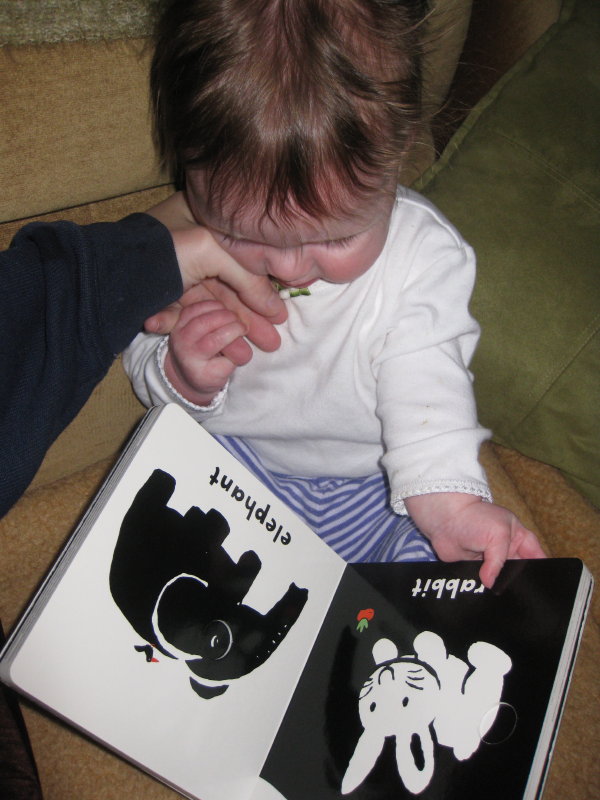
Next week you’ll be seeing another month’s worth of photos, but here’s one or two to tide you over til then. Cross-species interaction has begun (for better or worse):


*For some parents, this would have been their best night since their kid was born. I am so glad not to be one of them.
**Not you. Others.
Invent the solution
Louisette is a long way from actually walking (or crawling for that matter) but we installed our top-of-the-stairs safety gate all the same. Unfortunately, like all removable gates, it is a massive trip hazard – because it must be braced against both walls, and the only place to do so is along the bottom of the gate, where one must step over it constantly. As someone who regularly falls both up and down the stairs, and who is now often carrying a baby up and down stairs, this wasn’t great news.
And so it was that I came up with A Cunning Plan.
It’s simple enough in concept: we can secure the two sides of the gate to two bookshelves placed opposite one another. The space at the top of the stairs is narrower, but regular safety gates have that effect too.
Since it was my design, it relied heavily on gaffa tape (if it cain’t be fixed with gaffa tape it cain’t be fixed by me). This is my “proof of concept” gate from the front and back. The main section is made from the loose back of a dodgy bookshelf (two pieces gaffa taped together), the hinge is gaffa tape, and the latch is two rulers. One is fixed in place (really just to make the gate wider so it can’t be pushed in the wrong direction), and the other sits in a double-sided gaffa tape loop so it can slide back (out of the way) or forward (into a hole I cut in the back of the relevant bookshelf).
I still gotta make the real version….but, for now, I got time.


h





 Felicity Banks