Who do you call good?
The title is a quote from the Bible, when someone calls Jesus “Good Teacher” (or something like that) and Jesus says, “No one is good but God alone.”
Which from him has a multitude of layers. But it’s also interesting, given how much Westerners like to think of ourselves as “a good person”.
I think I may have found one of the conclusions this blog entry will draw: that no one is “good” but God.
However. That doesn’t mean we may as well stop trying.
[Sidebar: The way Christianity fundamentally works is that Jesus died in order to save us unconditionally ie as soon as we accept him we got our ticket to Heaven, no matter if we just ate a delicious orphan lunch five minutes ago. BUT if you believe Jesus is who he says he is, and saved us, and loves us… then there is a side effect on your behaviour. A goodening effect, but it comes from gratitude and love rather than fear of damnation or being caught.]
This blog entry is about white guilt.
I am what I call “Omo white” based on those overdramatic ads of a white SO WHITE that it shines like the sun. That’s me.
The more history I learn, the more I realise that my life is as good as it is because my ancestors did horrible things. So although I’ve never personally attempted genocide, I benefit tremendously from the racist work of others. (And I’m sure I’m plenty racist myself, too. But today I’m concerned with systemic rather than individual racism eg the fact that my name and skin is white enough that I’m more likely to be hired than an equally qualified person with darker skin, or an accent, or a non-European name.)
Guilt is designed to tell us when we have done something wrong. White guilt is trickier, because it’s (mostly) not ME, the individual, who did the bad thing. But it IS me who benefits. So we get several possible reactions:
-Denial. “I didn’t do anything wrong” (or sometimes, “I earned everything I have from my own merit; history/racism has nothing to do with it.”)
-Repression. “I can’t fix this. Better not to think about it.”
-Anger. “How dare you make me feel bad when I didn’t do anything wrong!”
-Despair. “The world is evil; I’m evil. Everything sucks and can’t be fixed.”
-Assuage guilt. This is where I sit, acknowledging that I benefit from awful things done in the past (and present), and others suffer—and that this is not fair, and concluding that I need to do… something.
Some options for action are:
*Loudly acknowledging the facts, especially where people are angry or in denial. (Much social media liking/meme-ing etc ensues.)
*Give to charities, particularly those that are concerned with global problems.
*Join protests.
*Vote for the left, which tends to be less selfish.
*Devote one’s life to aid work.
*Become a vigilante killer (not recommended).
So much of the Western World is obscene or fantastical to poor people in third world nations (or even homeless or otherwise poor people in the West). Here is my daughter and I on a Ferris Wheel. It cost over $30 for a ride that took a few minutes.

$30 is sufficiently alarming that we didn’t go on the Ferris Wheel last year, or the year before. But oh, the look of wonder on my son’s face as our gondola began to rise!
But… thirty dollars. For many people around the world, that is a month’s wages.
Should I sell all I have and give my money to the poor? Knowing what a difference my relatively small amount of cash would make in another country (a country that is poor because my ancestors and my politicians treat the people there as subhuman)?
Is it evil for me to buy gifts for my children, as others go hungry?
In Season Three of “The Good Place” TV show, the main characters discover that, as the world gets more complicated, it’s virtually impossible to do anything truly good. Five hundred years ago, you could gather wildflowers to give to your mother. Aw, how nice—and it doesn’t hurt anyone.
But today, in a city, you can’t gather wildflowers because all the flowers are in someone’s yard, or public property (for everyone to enjoy, so you shouldn’t take them away). So, gathering flowers is stealing. (Sidebar: you can gather certain weed flowers, which my children do for me regularly.) So you can buy flowers… which means either driving to a flower shop (using petrol, which is bad for the environment and has a bunch of other issues) or using your phone (manufactured in a third-world sweatshop?) and having the flower shop drive (using petrol).
So even with the purest heart, it’s impossible to exist in the West without being connected to pollution/Climate Change (which of course is already hitting the poor hardest), sweatshop labour, and so on.
I’ve also been reading a very interesting fantasy series in which magic is literally stealing from the poor. If a person is healed by magic, someone else gets sick. If a beautiful building is made with magic, a building elsewhere falls down. And OF COURSE it’s the pretty pretty Elvish types who use magic to make beautiful clothes, and cities, and art—while the ugly orcish types live in filth and dirt because they are the source of all that magic. And beauty. And art. Eg if an orc has a beautiful singing voice, they sell it to the elves for a few bowls of gruel. They do it willingly, because the system is so crushing that if they don’t sell all they have, they will starve.
Ouch.
See, the thing about sweatshops is that people line up to work in them, because there is no alternative. Or the alternative is to starve. So they work long hours for not-quite-enough. Then they are too tired and hungry to do good work or to work safely, or to find better work.
Welcome to the cycle of poverty.

One of the characters is a teenage white female human. She has grown up loved and secure, so when she discovers how magic works she is devastated and immediately challenges it. When she is standing facing the leader of the Elves, she chooses not to kill him, but to lay down her own life and trust that others will give up all they have, like her, because it’s the right thing to do.
Another character is her boyfriend, a black man. He knows about daily systematic injustice, so when he discovers how magic works he believes the only way to stop it is to utterly destroy the elves. Because even if he kills the evil leader of the elves, the next elf leader will still be in a position of power over the orcs. So even if the next elf leader is “good” they can withdraw their favour at any time. That, of course, is why the White Saviour trope is so insidious. Because it keeps the “other” on the bottom, and the powerful White/Elf type people on the top. (I really hope he’s wrong, because I don’t want the Western World destroyed. And I don’t want it to be subservient to other parts of the world, either. I don’t want to be the “other” that has to rely on the goodness of the more powerful class.)
A third character points out that they are acting as if magic is finite. What they need to do is not to destroy all that has been built, but to use magic in such a way that it doesn’t destroy the orcs, but benefits them.
That has a real-world echo. There IS enough food in the world, already. And we could definitely create more resources ethically.
And isn’t that a nice “out” for people like me? Because I’m not a scientist, or a politician, so what can *I* do?
I’m going to leave it there, for now. Mostly because I’ve written quite a bit. Not because I’ve actually found an answer. But maybe the idea that “helpful must mean I suffer” is innately harmful, causing more guilt and fear rather than usefulness. So that’s something, at least.
IF Comp: Roads Not Taken

I only did one play-through of this story, which took 40 minutes. “Slice of life” is a good description because it feels autobiographical*—both because of the detailed storytelling (good storytelling) and because it has the rambling uncertainty of real life. A lot of hyperlinks add detail, and the writing is good enough that they’re worth clicking on. Other times there is an obvious hub where one can investigate several options and then return to make a branching choice.
I’ve been avoiding realistic stories because… well, ugh. Who wants to read about real life when they’re already living it? (Real life and I are frenemies at best.)
But this is clearly a very well-written story with a vast amount of options. I suspect there are certain choices that lead to a more positive outcome than I got (so people who like the genre will definitely play multiple times), but mine wasn’t terrible or unsatisfying.
So although this didn’t give me the escapism I look for in a story, it is fundamentally perfect (a few spelling errors, but not enough to detract from the overall tale). So it gets 4 stars. In my system, that means a story that is fundamentally perfect.
*I don’t believe it’s actually autobiographical (more than any other story); it’s just so well written it feels real.
Edit: I actually gave it a 9, because the scores are out of 10.
IF Comp: Dull Grey
Okay, so the title is very off-putting. Gonna play it anyway.

I’m enjoying the simple but layered visuals, even if they don’t technically count towards my score (it’s all about the words). But it shows the writer has spent time on making an involving and professional story. Mostly, in my mind, because it means they’ve ironed out a higher number of bugs.
This took me ten minutes to play through once. I could tell it was translated into English because some of the phrasing was just unusual (not quite wrong but not quite right) and some mistakes had gotten through too. Quite a few… but it still felt like a well-written story that just needed one or two more drafts from native English speakers.
It is, as the name suggests, a somewhat depressing story. Which is fine. I made the same choice over and over, and that got me a fairly common ending. I gather than changing one’s mind can change the ending, but I don’t like the story enough to play a second time (only because of personal taste, not because the story is bad).
As I said, the writing is genuinely good throughout. I’m going to give it 4 stars despite the errors, because I respect the effort of translation done well. Some of the errors add to the atmosphere, actually.
IF Comp: Arram’s Tomb

Link to all the games is here.
This looks so perfectly D & D. The cover looks amateurish, but it conveys genre and style perfectly. It is 100% consistent with the writing, which is deliberately cliched.
Heh. It took me five minutes to die on my first go.
Ooh, I think I died even faster on my second go.
On my third try, I lasted SLIGHTLY longer.
This is fundamentally an interactive game, which I know sounds like damning it with faint praise but it’s not I swear! It’s not that easy to make a truly interactive game, and James Beck has done it.
I found the thief creeping on the cleric a bit… well, creepy. But it’s clearly part of his character, and it would only have been truly problematic if he managed to “get” the girl. (It’s possible that he does in some versions, but I’ll give the story the benefit of the doubt and assume that IF they get together it’s because of his positive actions, not because he’s manipulated her into it.)
I have a personal hatred of accents, and I think most readers will find the accent annoying. But I won’t penalise for that.
There were a few minor typos and such, but not enough to penalise.
The formatting was annoying. Most IF engines don’t let you indent paragraphs (like in a novel) so people usually leave a line between paragraphs, exactly like in this blog entry. I think the writer should definitely have done that.
I’m gonna say 3.5 stars for this, because it’s not quite MY cup of tea but it is well written (deliberate stereotypes and all). If the judging form doesn’t allow half stars, I’ll raise it to 4 stars there.
IF Comp: Lucerne
The first pic is not showing up. Possibly because I’m using Safari?
Gorgeous cover. Atmospheric and intriguing. Screams “dark fantasy/adventure” which is right on. You can play it by clicking through to the full list of games here.

And, I know I said I’d skip the 15 minute ones. I just… didn’t find many that suited my criteria, and this one sounded like it wasn’t too dark for me.
This took me about 10 minutes to play, which is about right (I read very quickly). It was a decent story, with a character arc that I found interesting.
But.
I don’t think I made a single choice the whole way through.
And, there were quite a few spelling and grammar mistakes (oddly enough, the visual settings and certain grammar mistakes reminded me of “The Island”, which I just reviewed a moment ago… could they be written by the same person?)
I’m going to give this 2 stars as well, because although the story is better written than “The Island” it still has room for improvement, and the number of spelling and grammar mistakes is still quite high. And the lack of interactivity is quite severe.
But it’s another story that is free of sex and violence, which is actually an achievement in itself.
IF Comp: Valand/The Island
How long it actually took me to play: 15 minutes (the author estimated half an hour but I’m a very fast reader)
The opening of this story was really intriguing: The main character (a child—their gender is never specified) comes to consciousness having washed up on a beach, where they immediately meet a magical creature (who is unhelpful enough to keep the story interesting).
From there, however, there was a lot of dialogue with not much description and not much inner dialogue. It felt quite cursory (very much like my own first drafts, in fact) and wasn’t super involving. A lot of the time no choice at all was offered, and even when there were two or more choices I got the feeling that it barely made any difference (perhaps a line or two; perhaps looking at one part of a room instead of another) or when it did make a difference it wasn’t skill-based (eg finding a crucial object within two tries where there were three equally arbitrary options).
There were a LOT of spelling and grammar issues throughout, so much so that I wonder if the writer speaks English as a second language, or is dyslexic, or very young. My money is on, “Very talented, but very young” in which case the harsh standard of reviews for IF Comp may be discouraging (there are a few shocked and wounded writers every year) BUT if the writer is 16 or less they are definitely someone to watch in future. I feel like even one beta reader would have dramatically improved this story. It’s also possible that the writer is simply a newbie writer (newbie here meaning less than 1000 hours spent writing creatively and learning the basics like grammar). I also feel like there were no beta readers at all, which shows a lack of understanding of the (very generous and helpful) IF Community.
It was really good to see some diversity in the story, which felt natural and showed that the writer has the ability to write interesting stories.
I’m giving it 2 stars, which I feel terrible about, but there are two flaws. First, the writing is fine but not brilliant, and lacks truly interesting choices. Second, the spelling/grammar is quite bad. So if a perfect story gets only 4 stars, this one has to be penalised twice.
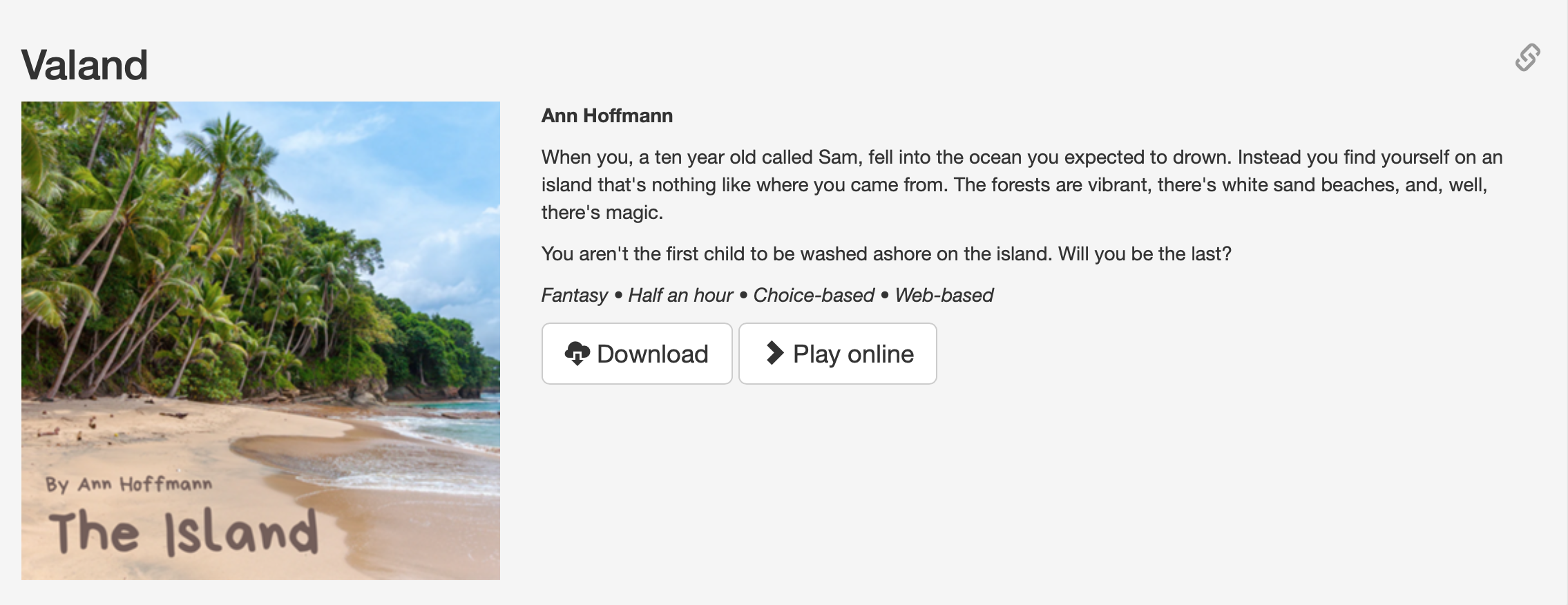
(The above is a screenshot, go here for the full list of IF Comp entries, including this one.)
(Great cover, by the way. I would add half a star except covers aren’t officially part of the judging criteria.)
It’s awesome to find a G-rated story that kids could play safely.
IF Comp
I looked forward to entering IF Comp all of this year, as my reward for finishing an unexpectedly difficult story (due at the end of August). I’d done a bit of research and written the opening. The first week of September I did barely anything. I was utterly exhausted—and besides, I had two months to write this thing. It was gonna be fine.
Then I realised I had the date wrong. The IF Comp deadline is the end of September, not October. And I wrote like a wild thing, often writing 5000 words a day. Then, with 48 hours to go, I went to the web site to do an upload test and… I couldn’t. Because the deadline had passed.
I’d got it wrong twice. It was due 28 September, not 30 September.
The good news is… it doesn’t really matter. It’s going to be a Hosted Game eventually anyway, which will get me more money than the IF Comp anyway. I’m going to take the extra time to write another couple of chapters and of course much more editing. It’s a great game, I think. Here’s the cover:

It’s a prequel to “Choices That Matter: And Their Souls Were Eaten”, which means it’s a prequel to alllll my steampunk tales. It starts in late-1700s France (a rather exciting time) and the player character is a mad scientist who gets off death row by volunteering to be the first person to fly in a hot air balloon. If you want to help edit it (and read it for free), go ahead and email fellissimo@hotmail.com.
But the point of this entry isn’t that. It’s the IF Comp, which I can now judge freely (although I can’t rank anything I beta tested).
So here’s my method for selection: I scrolled past the first ten or so entries, on the basis that most people would start from the top (and a strong minority would start from the bottom), so I should start from the middle (this was unnecessary because the comp automatically shuffles entries for you anyway). I went right past everything parser-based (parser makes me cry, possibly because of the same brain damage that made me get the due date wrong twice). I also skipped anything dealing with suicide, death, or horror. Or experimental (again, brain damage – I’m already confused, and don’t want more confusion on top of that), poetry (which is more or less experimental, isn’t it?). Also anything that’s too close to my real life (making money, raising children), because that’s way too stressful. And I skipped most of the super-short ones on the basis that they should get plenty of readers.
I’m gonna try and do five today. Five is the minimum amount for a judge to do, so if I can do five today then I have room to not do any more (assuming the rest of life overwhelms me, as it usually does).
So here is my opening impression of the comp, based on skimming through less than half of the entries:
People definitely put a lot less time into a lot of these than I did into “Flight”. Some don’t have cover images at all, and a lot of others look terrible. (I confess, I have a weakness for beautiful imagery, which isn’t necessarily a prerequisite for a good cover. Still.) I gather a lot of people joined the competition for the same fundamental reason I did—for fun. But I was aiming for a top ten finish, which meant writing a game that was between 1.5 and 2 hours (the rule is “judge on the first two hours of game play” but games with more content tend to do better), and highly polished.
I’m going to try to be a harsh critic, just so I can differentiate good games from brilliant. So if a game is fundamentally perfect, I’ll give it a 4. If I think it might win outright because it’s so incredibly amazing, I’ll give it a 5. Anything else gets less.
Wish me luck. I’m diving in…
Edited to add: So, games are scored out of 10, not 5. I adjusted my official scores accordingly.
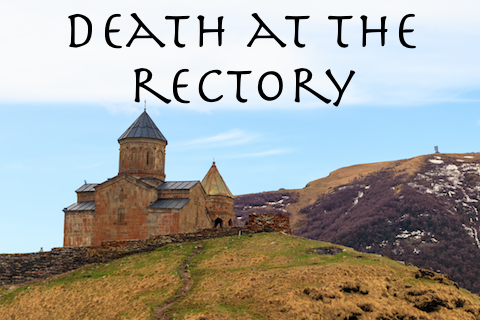
Death at the Rectory
It’s been a long, long time but I finally have another ChoiceScript interactive story.
DEATH AT THE RECTORY (iOS, Google Play, Amazon, etc) is a cozy crime mystery (with magic) which was very much inspired by the real-life rectory of St John’s Anglican in Gundagai. Here are some pics from the actual rectory:
And here’s a bit of the church, made of the same beautiful local slate:

I’m no professional photographer, though, so here’s the real cover (and an unrelated church):
Want those shiny links again? Here they are!

 Felicity Banks