“Heroes of the Valley” by Jonathan Stroud
This book is about Halli, a midwinter’s child who grows up on the epic tales of his ancestors. He is sick of the peaceful political haggling of his village, and longs to be a hero. He runs into Aud, a daughter of another House, who is even more trouble than he is. When a man is killed, Halli seeks vengeance – but heroism isn’t what it’s cracked up to be. When people start telling stories about him, he realises stories have a life of their own. (This paragraph focuses on the theme, which I find fascinating – but probably doesn’t do justice to the book’s many other qualities.)
This book has great characters, great scary action, and it’s very very funny. But the most extraordinary thing is Stroud’s voice. It is clear on every single page that no-one else could have written this book. The unique flavour is fantastic, and I want more.
Like “Larklight” by Philip Reeve, this is a book where I could literally open at any page and give you a brilliant quote. But Katla is one of my favourite characters ever, so I had to include her:
When he was older, Halli’s nurse, Katla, drew his attentions to the date of his arrival in the world. She clucked and whistled through her nose at the sinister implications. “It is a dangerous day, midwinter,” she said as she tucked him tightly into his cot. “Brats born then have an affinity with dark and secret things, with witchcraft and the promptings of the moon. You must be careful not to listen to this side of your nature, else it will lead without fail to your death and the destruction of your loved ones. Aside from that, dear Halli, there is nothing to worry about. Sleep well.”
Gain super powers
Pregnant women often notice a bizarre increase in their sense of smell. When my parents gave CJ and I a lift to the ultrasound on Tuesday, I smelled a dog in their car. Not dog, mind you, *A* dog. A specific dog. A specific dog that has travelled in that car before – but has also been dead for over two years. And no, it’s not the only dog to travel in that car.
Not convinced? Like more measurable results? Okay.
On Monday I went to my optometrist for a routine appointment. She is thorough, and insisted on re-testing my eyesight despite the fact that she tested it only two months ago. It turned out that it’s a good thing she did: my eyesight has improved.
“I’ve heard that pregnancy sometimes changes the shape of the cornea,” she said, “but I’ve never actually seen the effects before.”
I can only assume that I’ll have ninja skills by Summertime.
Who wants to be my sidekick?
Hello, Mini-Me
Before I forget: The “me” in Mini-Me refers to whoever is speaking at the time. It works best with relatives, but all humans are pretty similar when they’re babies, so ultimately there’s a little bit of all of us in Mini-Me. Hence the name.
Today I’ll be calling Mini-Me “he” some of the time, and “she” some of the time. I won’t know which is true until the 20-week scan.
Yesterday, at an estimated 12 weeks and 6 days, CJ and I and every single one of Mini-Me’s future grandparents wheedled our way into an ultrasound room and took a good look through my skin.
Given the amount of medication I’ve been on, I was rather pleased to see that Mini-Me has two arms, two legs, and a perfectly normal spine and face. He wriggled and giggled and kicked and waved. There was rather a lot of butt-waggling, and I had to keep myself from giggling and making things even harder for the technician.
Mini-Me did headstands, and arched her back, and swam around like a little fish (at 13 weeks, she has plenty of room to move). He stretched and turned over and facepalmed. At 7cm from head to bum, she looks basically human – and she is. He even has teeth growing inside his gums, and ears and lungs and eyelids.
After taking various measurements and checking the heartbeat, the technician told us the new, more accurate due date. . . 18 January! Absolutely no change, which means Wednesdays will still mark the end of each passing week. Which also means today marks the beginning of second trimester.
Sorry, what’s that you say? You’d like to see pictures? Oh, if you insist.
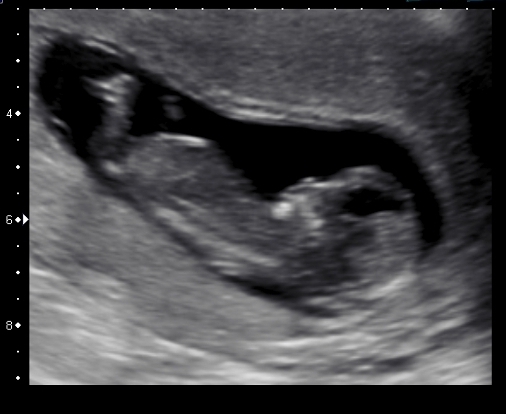

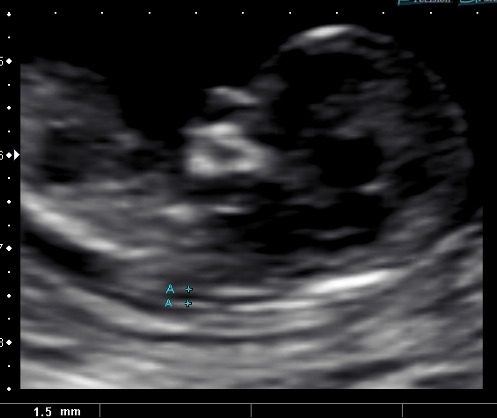
As CJ put it: “There’s a HUMAN BEING in there!”
First snow
Yesterday, for the first time since May, I ran an errand – taking myself to the optometrist.
In my steampunk book (set mainly in Australia), I keep describing various bits of bushland as silvery-green, grey-green, dull green and grey, etc. As I drove along gaping at the foreignness of familiar streets, I realised how very wrong I was. There are trees with oval leaves in pale blue, others with leaves pointed like spears, black trunks bleeding red sap, others peeling away like snakes sloughing their skin, wattle bushes with sprays of soft spheres in brilliant yellow. Altogether, bushland (even by the side of the road here in the city) is red, orange, purple, black, green, silver, gold, pale blue and purple.
I’ll be correcting my error in the book shortly.
Canberra is surrounded by hills that are usually blue with distance. In Winter they become sharper, clearer, and full of detail – including hats of pristine snow. For me, yesterday was the first day this year to see that snow.
Tomorrow: Details of my twelve-week ultrasound.
Jelly beans
I’m not able to eat much yet, but I AM able to eat natural confectionary jelly beans.

That is awesome.
The delicate business of husband-hunting
I’ve said it before and I’ll say it again: If you want to write steampunk, read “Victorian London” by Liza Picard. She is often extremely detailed – and often extremely funny.
Here is some of her section on how a Victorian lady should conduct herself – continued from last week:
With all these hints as to advisable demeanor for every day, the reader may think that nothing remains to suggest for the delicate business of husband-hunting. Alas, in these days when any gentleman belongs to a club where he can find almost every advantage of matrimony, potential husbands are like shy animals, vanishing when most hotly pursued. Do not be tempted to offer, in your own person, those advantages of matrimony which are not available in his club. He is all too likely to obtain these, too, elsewhere than at the domestic hearth. Subtlety is needed, and evasion on your part, never fleeing so swiftly, of course, as to be beyond the reach of the most ponderously slow suitor if he is potentially acceptable. As to your own appearance, I suggest, as with the management of carriage steps and the width of your smile, some consideration in the privacy of your own room. Which is your most advantageous profile? Or is an umbrageous candlelight advisable? An expression of admiring pleasure should be possible to sustain for most of the evening without becoming a rictus. Practise daily, for increasing periods. A conviction that your intended is the most desirable gentleman in every way already resides in his breast. Show him, shyly but unmistakeably, that you share this conviction.
. . . One investigation I must advise, however, before any notable expenditure of time and effort takes place: what is his financial position?. . . Fine whiskers are delightful, but a good income is infinitely more attractive.
Overdone movie tropes
John Scalzi has his own blog, and also writes a film critic column. This one is so funny I had to link to it. Here’s my favourite of his five tropes:
4. The very special youngster. This is more often the domain of fantasy (hello, Harry Potter!) but it was given a science fictional run-through this year with I Am Number Four, and of course Star Wars trotted out Luke, whiny as he was. These run down a checklist. Orphaned? Of course! Having special powers waiting to be unlocked? Yes, indeed! Found and trained (and protected) by a wise mentor? How could it be otherwise? Hunted by the forces of evil? That goes without saying. When this very special youngster shows up, we know where he’s going. Best to leave him in hiding.
Read the whole article here.
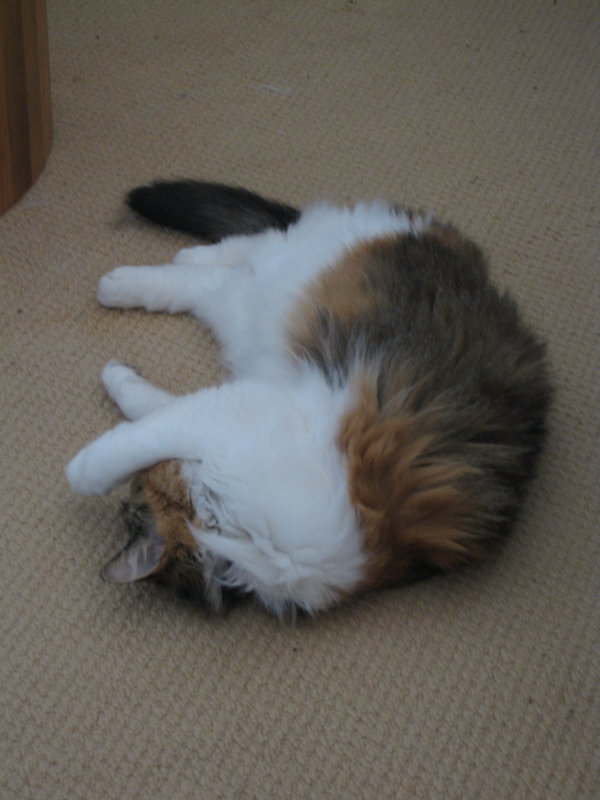
Your kitty pic of the week:
Jane Austen, Dance TV, and the Tour de France
What do they have in common?
Jane Austen and the Tour de France have an intricate web of intrigue and etiquette that only a moron can afford to ignore.
“So You Think You Can Dance” and the Tour de France (other than rhyming) remind me how lucky I am to be a writer rather than an athlete or dancer. I may have to wait years for responses, and get my work dismissed due to a change in market – but I can still write a bestseller when I’m eighty. Dancers and athletes have extremely short, extremely painful, extremely physically risky careers.
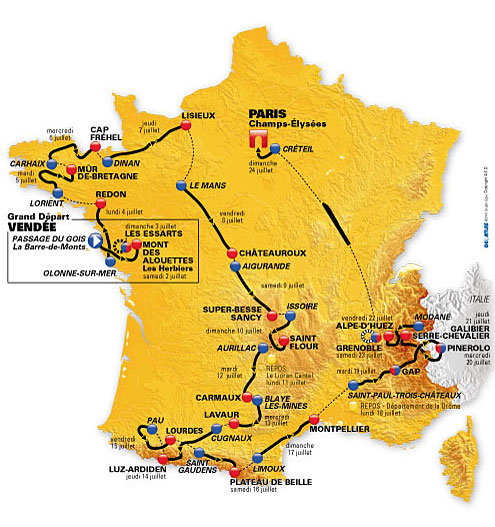
CJ and I view sport in general with cordial contempt. We unmute news breaks on TV, but mute them again as soon as they turn to sports. The Tour de France is the one exception. CJ inherited a fascination with the Tour de France from his Dad, and I saw a few bits here and there as he watched – and then was slowly drawn in.
For me, the first point of appeal was the scenery and architecture of France. Castles, chateux and beaches always feature prominently as the Tour passes by – usually with gorgeous sweeping aerial shots from the helicopter. A large number of passers-by also spice up the viewing experience by building giant sculptures in their fields (often giant bicycles with moving human/mechanical wheels). But it was the etiquette and complexity of the Tour de France that made me an addict.
The three most important categories are:
The winner – aka the yellow jersey – which is based purely on a man’s total time over the three-week race. The race covers thousands of kilometres, but for the last five years there has been less than a minute between first and second place – so the pressure is unrelenting. Whoever has the best time-so-far wears the yellow jersey that day.
The king of the mountain – aka the polka-dotted jersey (seriously – it turns out men who wear skintight lycra professionally don’t mind this kind of thing) – is the most skilled climber, based on how well they do in just the steep parts (including the Pyrenees and the Alps) of the various race stages.
The fastest sprinter – aka the green jersey – is the one who can leave all the rest behind (on average) in designated sprinting sections of the course (there is one in the middle of almost every stage, and the first twenty riders are awarded a decreasing number of points). It’s not so much “going fast all the time” as “putting on a herculean burst of speed when everyone else is already going as fast as they can”.
Climbers and sprinters have completely different body types, and riders always have a specialty one way or another. There are about half a dozen men who are serious contenders for the overall win. Each one is supported by a team of up to nine riders – a mixture of sprinters, climbers and those who are simply consistent riders. Many of the supporting team members are champions in their own right, but they have made the choice to sacrifice their bodies for someone else.
Race etiquette is all about wind – and glory. The wind (particularly from the front) slows riders and saps their energy. In such a long race, energy is the most important currency. So riders are constantly riding behind others in order to be in their slipstream. A team’s job is the protect their leader until the last possible moment – so that he will still have the energy to grab a win. They do most of the work, and he gets the glory.
It’s far more complex than that, however. The usual shape of the race is that there will be an early “breakaway” of perhaps two or half a dozen riders (all from different teams) who will go out ahead of the main pack, and attempt to keep their lead for the whole race. They usually fail – but they will spend a hundred kilometres or more taking it in turns to lead their own small group (which is especially vulnerable to the elements), and bear the brunt of the wind.
The rest of the two hundred riders (20% of whom will not finish the race) ride in a mass called the “pelaton”, mutually protecting one another. Safety demands riding within the first twenty riders – which is of course impossible, so there is a constant gentle shifting among the tightly-packed crowd. Etiquette demands that whichever team currently holds the yellow jersey must form the arrowhead of the pelaton, bearing the wind for the other one hundred and ninety riders.
When a crash happens at the back during the beginning or middle of the race, the pelaton will slow down to let them catch up. Sometimes a single man will race ahead unchallenged – which makes no sense, until he reaches his home town and hops off his bike to kiss his wife. It is one of the many traditions of the Tour de France, and it is universally accepted.
There’s plenty more, but this entry is getting out of control, so I’ll stop here. There are race highlights each day at 7:30am and 6pm on SBS.
At the moment (I haven’t watched Stage Six yet) Thor Hushovd of Norway (team Garmin) is wearing the yellow jersey. Cadel Evans, the Australian leader of American team BMC, is coming second – lagging by one second.
A few days ago, Thor knew he was close enough to the front to keep the yellow jersey, so he sacrificed his stage win for an American team member, Tyler Farrer. Cadel Evans has also won a stage this year, as has the British sprinter Mark Cavendish (and probably others, but I forget their names). Mark Cavendish is from team HTC and is supported by two Australians, Mark Renshaw and Matt Goss.
“Soulless” by Gail Carriger: hilarious steampunk
I promised to review a book that I really liked, and this is it.
It stands alone, but is the first of many Alexia books by the delectable Gail Carriger.
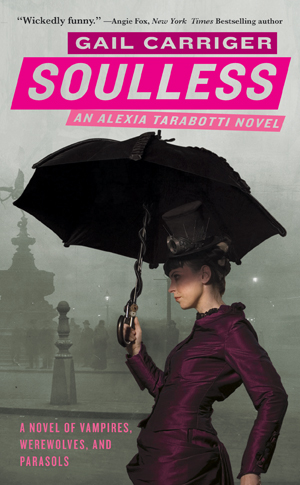
This review has been moved to Comfy Chair, where I get paid for it.
The purpose of parenthood
Last Friday I began eating solid food (including an egg for protein) at lunchtimes. Last Saturday (with CJ on hand) I taught a student for an hour (at home) without incident. Last Sunday (with CJ driving) I actually left the house for non-medical reasons (oooOOOoooh). Yesterday I began reducing my ondaz zydis medication, taking one instead of two, and substituting a maxolon for the other one. It didn’t feel great, but it’s certainly surviveable.
Today marks twelve weeks. I have one week left of first trimester, and this time next week I’ll be blogging about my twelve-week ultrasound (which will likely change the official due date, based on measurements of the baby).
——————————————–
CJ lives very much in the present. I. . . don’t. CJ is happier, calmer and less likely to show up on time (or at all, sometimes). I’m the one who figures out things like, “When we marry, CJ should have a study, at least in the beginning” because I can clearly see the stress that would result if he didn’t (he is messy; I am OCD-ishly tidy). When we think of parenthood, CJ sees visions of playing with children. I ask questions like, “What is parenthood FOR?”
I’ve concluded that the purpose of parenthood is to do our best to create a “good” adult. Here’s the list I’ve come up with for what that means, with my ideas of how to actually teach it.
In no particular order. . .
1. Physical health & Eating.
They need to know how to cook healthy meals and how to exercise. We teach this by modelling (particularly with exercise – which, amazingly, we both actually do – and how much junk food we eat), and by consistently cooking healthy meals (which sets a healthy standard of “normal”, as my parents did for me). Our kids will probably be hilariously uncoordinated, so we’ll need to start early (before they know they suck) at finding sports and exercise that they enjoy.
2. Finances
They need to know how to delay gratification by not buying things immediately or falling into credit card traps. They need to know how to manage household finances, and that you really do have to do your tax return.
We teach this by giving them an increasing allowance and hopefully teaching them to save up when they want a larger item than lollies. We live sensibly ourselves, and slowly involve them in observing how much we spend on groceries, petrol etc as opposed to how much we earn. When they’re earning above a certain amount but still living at home, we start charging rent (ideally we’ll have a bedsitter they can move into at a certain point, so they can learn how to live independently without it all happening at once).
3. Running a household
It’s difficult to coordinate food, bills, cleaning, washing, working, and a social life. So our kids will do plenty of chores – all chores, including the rare ones like cleaning gutters. At certain ages, the chores will be just theirs (eg shopping for their own clothes with their own money, doing their own washing). The bedsit plan comes into play again here.
4. Smart romance (and parenthood)
Mostly this will be us (and our parents) modelling how romantic partners should treat each other, and (hopefully) how parents should treat their children. Hopefully our children will realise that kindness and good conversation are the most important qualities to look for, if you want to live happily ever after. I think pets help teach some of the responsibilites (eg cleaning up after accidents, and training good behaviour with consistent discipline) that are useful in parenthood.
“It’s like having a dog that slowly learns to talk” – Dr Cox on his son, from Scrubs.
5. Human relationships
Our kids need to know how to hold a conversation, how to make friends, how to accept people who are different, when to listen to peer pressure (shower = yes; drugs = no), and how to treat people. Modelling comes into play again, but I also plan to do my best to encourage good friendships in primary school (when I still have some influence) in hopes that kids from various families will continue to teach one another when I’m just a blobby shape that makes food. Several of my friends (friends who I like and respect, and think will produce good kids) have had/will have babies soon, so I’m angling for our kids and theirs to spend plenty of time together. I also plan to have our own two kids sharing a room until they’re about ten – which builds character, but also celebrates their increasing maturity when they get their own room.
6. Self-worth
I’ll do my best, but CJ is going to be much better at teaching this than I am. I can love the kids unconditionally, though. That should help.
7. God/spiritual health
I’ll take them to church and hopefully send them to a Christian primary school, but ultimately the only thing I can teach about spirituality is honesty (and respect for others).
8. Job and/or contributing to society in a healthy way.
I talked about this last week.
9. Contentment/psychological health
Again, CJ shines here. Probably the greatest gift I can give is to teach them resilience – which I’ll teach by letting them fall over in the playground, or make that obvious (but non-fatal) mistake – possibly after warning them it’s not a great idea. Some mistakes harm us permanently, but others teach us that a scraped knee is okay. The second type of mistake is very important, and needs to be made.
10. What do you think? Have I left something out?

 Felicity Banks