IF Comp Review #3: One Does Not Simply Fry
by Stewart C Baker and James Beamon
ChoiceScript comedy. I’m in.
I am suspicious of comedy as a genre, as taste varies so very much. I personally love the “Lord of the Rings” movies with a fiery passion… but I hate puns. So this will be quite a journey!
Now that we’ve established I have massive biases in both directions, let’s jump in!
Also, there will be massive spoilers because this is more of a live blog thingy than a typical review.
The writers have already done something rather clever. ChoiceScript has a specific visual style, designed to be non-distracting. It’s very basic. The games also automatically open directly into the first bit of text when you click ‘Play Online’. Entrants in the IF Comp typically upload an html file with the link to the game (mine is literally just one hyperlink and nothing else). These guys had a nice-looking page of instructions and other details which is not done in ChoiceScript at all (or if it is, they would have had to sort through a bunch of code to shift colours etc)… but then links to the ChoiceScript file.
I shall definitely do that next time I enter. It is much classier, and feels better to the player.
I do love the name “Mount Boom”.
Props for giving vegan and vegetarian options! I am not at all a vegetarian, but when someone actually thinks about minority groups and chooses to bother doing extra bits of code for them, I am impressed. It also makes me instantly feel safe, because a thoughtful game tends to be a kind game (kind to easily-traumatised readers like me, I mean).
I was scared this game would be entirely built on puns, but they seem to be mostly just for names. The style is fun and amusing. I’m on Paragraph 3 of Chapter 1 and I can now fully relax, because it’s clear I’m in good hands. As I’ve said before, if it’s got good writing I will like it. If not, I’ll hate it.
This is good so far.
At the choice of character, having one who can only be accessed on replay is brilliant, especially as it’s clear the writers really want players to go through the game at least twice. Ooh, and only if you WIN the fry-off. These writers are playing hardball!
There are quite long blocks of text between choices. I wonder if that changes when everything’s set up and properly getting started. We’ll see.
What’s with the dice roll? The story basically told me this was my first test, then it appeared to be randomised and not based on anything I’d done. I’m past the first chapter and I’ve made hardly any meaningful choices at all (although to be fair, the two choices I made were significant: character and goal).
It feels weird to play a ChoiceScript game and not choose my gender. I think the writers felt everyone was sick of choosing gender, sexuality, name, etc every time they play a ChoiceScript game. But I like that stuff.
Uh-oh, things are ending badly (which is good for a game very focused on being replayable—it shouldn’t be too easy). It’s a well-written bad ending.
It’s not my favourite game ever, but it’s pretty darn good, and well executed.
Playthrough #2!
Hmm. I bet the Which King? can influence the dice roll and get the super cool kitchen. [Edit: He can’t. Seriously, what is even the point of the dice roll?? Is it merely to make poor innocent completionist players take a fourth play-through in case the one character they didn’t try gets the good kitchen? Well, probably.]
On two different tests I had two viable choices and one obviously poor choice. But my relevant stats were exactly equal for the two choices, so that was unhelpful. The stats are completely static, too—nothing I do makes any difference to my skills. Which is fine, just unusual in ChoiceScript which is specifically designed for delayed branching.
At a couple of stages, a particular choice is correct regardless of what other choices I’ve made along the way. Good for rewarding replayability (and the player’s short term memory), bad for distinguishing one character from another.
I won this time! I was very anxious because I wanted to win this time around, but I knew my onions weren’t perfect. So I feel good about that.
LOL. I’m literally allergic to onions (yet craving them due to this game) so of course I enjoyed having that option (and the torment of wanting to eat onion rings anyway, which is extremely true right now).
Third Playthrough.
I was planning to play the game twice, but they have lured me in. I’m playing as the Which King? next, even though it didn’t entice me at all the first time around.
On this third play-through I saw some things I hadn’t seen before, but it was also very clear that much of the game remains the same. For example, EVERYONE apparently finds Smeagol (you know who I mean right?) slightly attractive, which is statistically very unlikely. There are so many bits of flavour text that could have been different for each character. It’s a shame they didn’t get developed.
I feel like replaying this game was moderately rewarding but not as rewarding as it should have been for a game that is so determined to have players returning for a second (or third or fourth) go.
Still a good game though.
IF Comp Review #2: How Prince Quisborne the Feckless Shook His Title
The author saw my last post and suggested I try his game, since it’s specifically designed to be moron-friendly (that is not actually how he described it).
After installing a TADS er… thingy and downloading it, including going into my security system, I was tired out from problem solving and took a break. I’d been using my brain for almost three minutes!
But I was greeted with a pretty screen and music, which was a nice reward.
The full instructions took about ten minutes to read, and serve as a good intro to parser in general I think. I remembered how much I hate re-reading the same description over and over (a rather essential part of parser games) and opted for the read-through.
Ah! I love the opening paragraph! The exact same humour as was clearly indicated by the title.
Love the whole first page, which starts strong and gets better (and more original) from there.
(In case it wasn’t clear, my main bias is in a highly writer-centric direction. If there ain’t good writing, I will hate it. So far, I love this.)
The author pauses a couple of times to give hints about formatting stuff, which sort of interrupts the story but as a raw beginner I love getting little bits of info juuust when I need them, and in easily-digestible fragments. Ooh, and they develop into gaming hints as well. I’m still allergic to parser (to the extent that I tense up when someone mentions a compass direction) but any moderately sane and intelligent person could easily fall in love with parser because of this game helping them along the way and giving them the option to continue the read-through or put in their own commands.
It does seem to me like a lot of text. I’m not complaining personally, it’s just that my usual experience of IF has the shortest possible bits of text followed by a decision (choice-based IF, of course). Fortunately, fun writing is the author’s strength so why not use it?
There’s some seriously excellent world-building, such as the roads being designed with living creepers to keep them harmonious to the landscape.
Still regularly making me laugh out loud.
I reached an ending (in the sense that the read-through gave it to me), which was delightfully macabre and easily undone. The “undo” button is a wonderful thing.
There’s evidence of thorough programming here, where the scene ‘remembers’ where you dropped things previously.
I just reached the end of the prologue, still enjoying the story (although I thought the paranoid king would believe his rutabagas were somehow sabotaged out of winning first place). It took me less than an hour and a half to get here (it really helps to do the read-through, of course!) so I’ll keep going. I’ve deliberately kept a timer on so I give this game two hours—no more, no less—as per contest rules (we’re meant to judge a game based on the first two hours of play if it’s a monster of a game like this one).
I’m quite delighted that the main focus of the last hour and a half has been some vegetables. I adore low stakes. I also love the prince. And the odder commands in the read-through (eg “Drown Prince”) are delightful. I sometimes find phrases a little clunky, but I think that’s part of the deliberately verbose style rather than actual grammatical clunkiness.
Every so often I know just enough to see the elegance and hard work happening behind the scenes to make the story flow nicely. There are dozens of snippets about what Prince Quisborne is doing as you poke around, and when you leave an area the game very kindly tells you that you leave certain items behind (keeping the inventory to useful items).
I can’t truly comment on the ending, of course, but this seems like a really excellent game that is also very polished and charmingly written.
IF Comp Review #1: Help! I Can’t Find My Glasses!
The Interactive Fiction Comp runs every year, and it is a huge deal among interactive fiction writers and fans. I first entered it in 2015, when I was very new to the whole field of IF, and the entire experience was intense and amazing and lovely. Apart from anything else, part of the forum is a secret Author’s Section where only those who’ve entered the contest that year can talk to each other.
The judging lasts six weeks, and during that time there are HUNDREDS of public reviews.
It is NOT a popularity contest. The community is expected to judge as fairly as they can, and the judges keep an eye out for suspicious trends. But the basis of the contest is community and trust, and I LOVE it.
I am a terrible judge. About half the games each year are parser-based, ie they have puzzles to figure out. Given that I barely know what day it is and live in a permanent state of near-panic, those games are no good for me. I’m also amazingly bad at figuring out even the simplest of computer-y instructions, so a lot of the games are cut off from me for that reason.
So, in sum, I’ll start with games written in the same engine as my own—ChoiceScript. There are three other than my own, so at some point I’ll gird my loins and see what other games are suuuper accessible for my particular neuroses. Because I aim to judge at least 5 games (which is the minimum to take part).
Oh yeah, and I don’t want to give my brain anything too dark, because my depression feeds on that quite badly. That includes any mental illness stuff, so I’ll be avoiding any “this is what it’s like to be mentally ill” games.
Enough rambling! Let us begin!
Help! I Can’t Find My Glasses!
ChoiceScript? Check. Non-Traumatising? Almost certainly. Short? Very.
This game sounds SO easy to play and judge. I’m in.
As a writer, this title is brilliant. It sets tone (tiny, real-world, highly relatable, small-stakes drama), it tells the reader exactly what the driving force of the narrative will be (need glasses), and it immediately makes me sympathetic towards the main character (it gives us a serious problem, as anyone with glasses can tell you, and also gives us a key vulnerability).
The first few choices immediately set name, gender, and sexual orientation, with non-binary options (although no asexual options for those who don’t feel like a fictional romance). This gets some mechanics out of the way very neatly (important in a short game) and allows gender and sexual diversity which immediately makes me feel safe. (Not that I’m in danger from a game, but it means the writer is kind and therefore much less likely to accidentally have casual racism or something else hurtful. The names also had some cultural variety.)
I was immediately let down by the grammar, which is clunky eg “Your hand swipes through…” is saying that your hand passes through solid wood, which would be magical… which is not what the writer intends. Referring to glasses as “it” rather than “them” makes me think English is the writer’s second language. Which makes this an even more impressive achievement. But if this was a longer game, I would quit within three choices. This is what beta testers and editors are for.
The author captures the helplessness of a person without their glasses very well, but the choice to either “beat”, “gut” or “forgive” the person who took them doesn’t allow for any middle ground between violence and forgiveness. Why can’t I report them to a teacher, for example? Or steal something belonging to them?
It’s also odd that someone would fall asleep in a club room. Yes, students will fall asleep anywhere, but it still needs a line of explanation.
My first ending I chose to go and take another nap, and my glasses just appeared back on the table as if nothing happened. It was a little abrupt, but okay (and, no romance happened). My actual theory is that Minh or Jaime knocked the table while being silly and the glasses fell on the floor. Let’s play again and see…
Second ending I discovered Jaime’s dark past (or at least some of it) and asked them on a date, which they agreed to. But I don’t think I found my glasses, so that was a weird ending.
Third ending I wandered around the school a bit, which was quite pleasant, and then I thought I was clicking through familiar endings when I was suddenly at the end. Oops? Or an error?
Fourth ending, I simply ran out of time and the game ended. That’d be the bad ending.
I won’t rate this game very highly, but the writer certainly shows promise. It was smart of them to enter a short game in the IF Comp—a (relatively) small amount of effort for a lot of feedback and community involvement.
Open Garden Fundraiser, 11 November in Canberra
10am-4pm at 15 Cockerill Pl McKellar (different garden to the last two years!)
Entry is $5 with kids under 5 free and a maximum $20 for families.
11:30am Horticultural Talk
1:30pm Refugee Sponsorship Talk
3:00pm Posy-Making Workshop
Plus loads of live music, home-made food (including lunch, tea, and coffee), art, books, our famous plant stall, contests and prizes, and more!

Queen Charlotte: A Bridgerton Story (TW: rape)
I have watched this series over the past several days, and now I need to talk about it.
I enjoyed the first season of Bridgerton and the second was okay. I enjoyed the first Bridgerton book and was increasingly incensed by the books that followed. The TV series is also astonishingly rapey (for example, Daphne rapes her husband in the first season after realising he is using her ignorance about sex to avoid having children).
Queen Charlotte follows the tradition, featuring many sex scenes between a young Lady Danbury and her much older, very oblivious husband who she was betrothed to at the age of three. They are arguably filmed as funny scenes. Fortunately I had advance warning and was braced for them.
At church today, the reading was from Genesis 29. Jacob (a founding father of the nation of Israel) works for his relative, Laban, for seven years as advance payment for marrying his younger daughter Rachel. On the wedding day Laban switches in his older daughter Leah and Jacob sleeps with her and only discovers the deception the following day. Laban says Jacob can have Rachel too, but he has to work another seven years. So Jacob marries Rachel, and then works another seven years. Unsurprisingly, he loves Rachel more than Leah. The first time we hear Leah’s opinion on all this, she is giving birth to four sons, each time thinking that her husband will finally love her. The story continues to be messy as the sisters fight over their husband’s affection and even trade him between themselves.
Did Leah know when she slept with Jacob that she was part of a trick? Was she in on it? Did she want to marry Jacob? Was she happy to marry anyone since she was considered less desirable and/or her father was a liar and/or she wanted children?
The “conclusion” of today’s sermon was that domestic violence is still happening. It wasn’t okay then and it isn’t okay now. There is no happy ending here—no neat moral for us to nod about and promptly forget.
When we read Bible stories like that we tend to blame ancient cultures. But clearly, women have been used as trading pieces in every culture on earth—including, obviously, European nobility.
How much choice did the fictional Lady Danbury have? She looked forward to her husband’s death but didn’t kill him or try to escape. They even had a little bit in common, as they were both dark-skinned and therefore in a socially precarious position despite coming from royalty themselves. She had zero interest in her children until she realised her rank (and entire fortune including her house) was dependent on her four year-old son.
Many cultures have arranged marriage to various degrees. Sometimes the men have choice and the women have none. Sometimes a couple is betrothed but either party can choose to break it off if they want to. Sometimes rituals and celebrations are not enough to hide that women are being sold into sexual slavery, often as children. In the USA, some religious fanatics (Christian ones) force raped children to marry their rapist.
I have met several women in Indonesia who were child brides (in a small village). The custom was to give the woman to the much older husband when she was extremely young, and then the husband would wait until her first period before having sex with her. (Of course there was no accountability whatsoever for even that much kindness.) When I spoke to the women they were middle-aged with children of their own and appeared perfectly content. I didn’t speak enough Indonesian to find out what would happen to their own children. My own Indonesian friends found it all very shocking, so it was clear that cultural change was happening.
I don’t have a problem with arranged marriage itself. When both parties are evenly matched in power and choice, it can be beautiful. In Queen Charlotte there is deception about King George’s madness but they fall in love and are both intelligent, socially progressive people of a similar age. Neither party is particularly willing at first, but they swiftly fall in love. The ideal of arranged marriage is a marriage undertaken for mutual benefit by two open-minded people who are equal in power and who fall in love after their wedding.
Love is a choice.
And for many women throughout history, marriage is a means to an end: It gives them respectable adulthood and a measure of independence; it gives them a career of sorts (running a household); and it gives them children. Not all women want children but a lot of human beings do—our biology pushes us that way—and an extremely small proportion of women have the ability to make children without going the sex-with-a-man route. Given the choice, many women would marry and have sex with a horrid or even violent man if that was the only route to get children. And of course, many people who marry for love end up deeply unhappy or even abused (mostly women, but some men too).
It’s nice—sort of—that King George is also against the idea of marriage at first. There’s a symmetry there which gives their relationship some equality.
However, what marriage is truly equal?
I am a disabled woman married to an able-bodied (but neurodiverse) man. Even if we were both healthy, he would almost certainly earn significantly more than me, have more physical strength, and be free to walk alone at night without danger. Even if we both worked, statistically I would still do the majority of the housework (a discrepancy which grows larger after having kids).
There are many more aspects of being female that are harder to measure. I do not receive the same amount of pain relief as Chris would receive for the same level of pain. I am assumed to be less intelligent. I pay more for mechanics and tradesmen. And so on. This is all magnified a thousand times for women of colour, of course. I’m lucky. But I know I’m a second class citizen inside my own marriage. (Chris is great, totally feminist, blah blah blah. But he still has societal baggage, and so do I.)
If I wanted to divorce Chris, it would be extremely difficult. I would lose at least some access to my children. We would almost certainly lose our home. I would probably have to live in some kind of share house in order to survive financially, which I know from past experience is incredibly stressful. I am currently able to earn up to $300 a week. That would probably no longer be possible. I would be living on a disability pension for the rest of my life.
It is terrifying, to be a disabled woman.
Fortunately we have no plans to divorce, and Chris’s life and income are insured.
But I am, like Lady Danbury, dependent on a man’s goodwill.
There is a great deal of clever writing in the show. Prequels are tricky. We know that Queen Charlotte loves her King George, and that he is destined to get madder over time. We know that Lady Danbury will become the fabulous character we already love.
There is a plotline in the “present” of the Bridgerton TV series in which a much older Queen Charlotte is berating her many children for not producing more heirs. The pattern of royal duty continues, even though she has borne a prodigious quantity of offspring. It is clear she is not the perfect mother, either. Any examination of royal life must show that it is too much: too much wealth, too much responsibility; too little personal freedom or choice; too little connection to the real world; too much power. Too much inbreeding. As a commoner I can sigh over the gorgeous costumes while also being relieved that my life is nothing like that.
I can also stress over Lady Danbury’s considerable dilemma: to use her friendship with the queen to keep her rank, and thus protect the rank of all the recently-elevated non-white half of the ton… or to be a true friend, refusing to either spy on the queen or ask for favours. We know she wins her rank, but how does she do it?
I adore the gay relationship between the queen’s personal assistant and the king’s personal assistant. A gay relationship is always welcome, but the dynamic between the two of them as they attempt to remain loyal to their royal charges is intense and dynamic. It links beautifully into the main plot as well as highlighting the weird relationship between servants and their employers. Not quite family—no, never!—yet often more intimate than family. They are often best friends, or something like best friends, yet with absolutely no power over their own life. While Lady Danbury courts and then rejects a man that her maid would have liked her to marry, she talks about finding her own path and so on. Her maid never gets that option. The gay servants are lucky enough to have a long life together, but only because things happened to fall into place for them. And the absence of one of the pair in the final episode is an absence that can only ever be felt in silence.
I’ve read an article criticising the way the series handled race—as if a dark-skinned queen could solve racism (much like President Obama’s presidency “solved” racism in the US)—but I think it is handled perfectly in the context of a highly fictional and escapist version of the past. It is not 100% realistic but it also doesn’t try to say that a few dark-skinned nobles would make everything okay. And in any fictional story, we always have our protagonists to thank for great acts of heroism and change. Honestly, it is fairly believable that a few high-ranking individuals could cause widespread social change.
This series wasn’t as witty as Bridgerton‘s season one, but it was extremely watchable and surprisingly deep. With lots of extremely attractive people flitting about in amazing dresses and wigs. The quasi-historical wigs and the title character’s natural hair work perfectly together.
And oh, yes of course—the madness. I think it is beautifully handled, including the horrors of misguided medical treatments, the determination to continue with medical treatments, and the desire to protect one’s loved ones from the truth (that always backfires). In many ways, the most tragic part is Queen Charlotte’s insistence that she is herself the cure for him. Because I feel like many people do believe on some level that love can fix mental illness…. and it doesn’t work like that. For once we have a fictional story that shows us that love continues when madness does, side by side.
So I’ll never be able to laugh at a joke about mad King George again. But the journey was worth it.
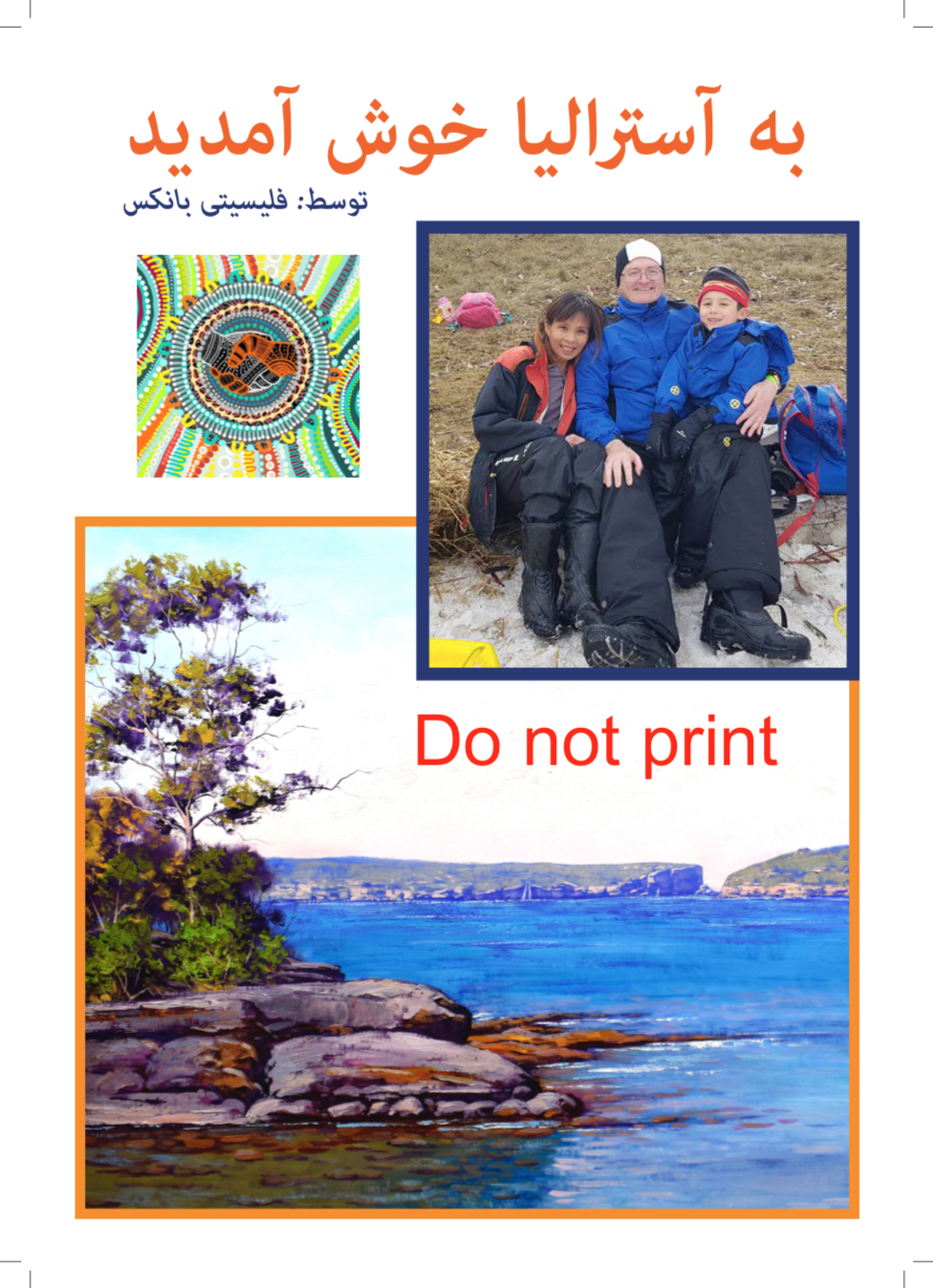
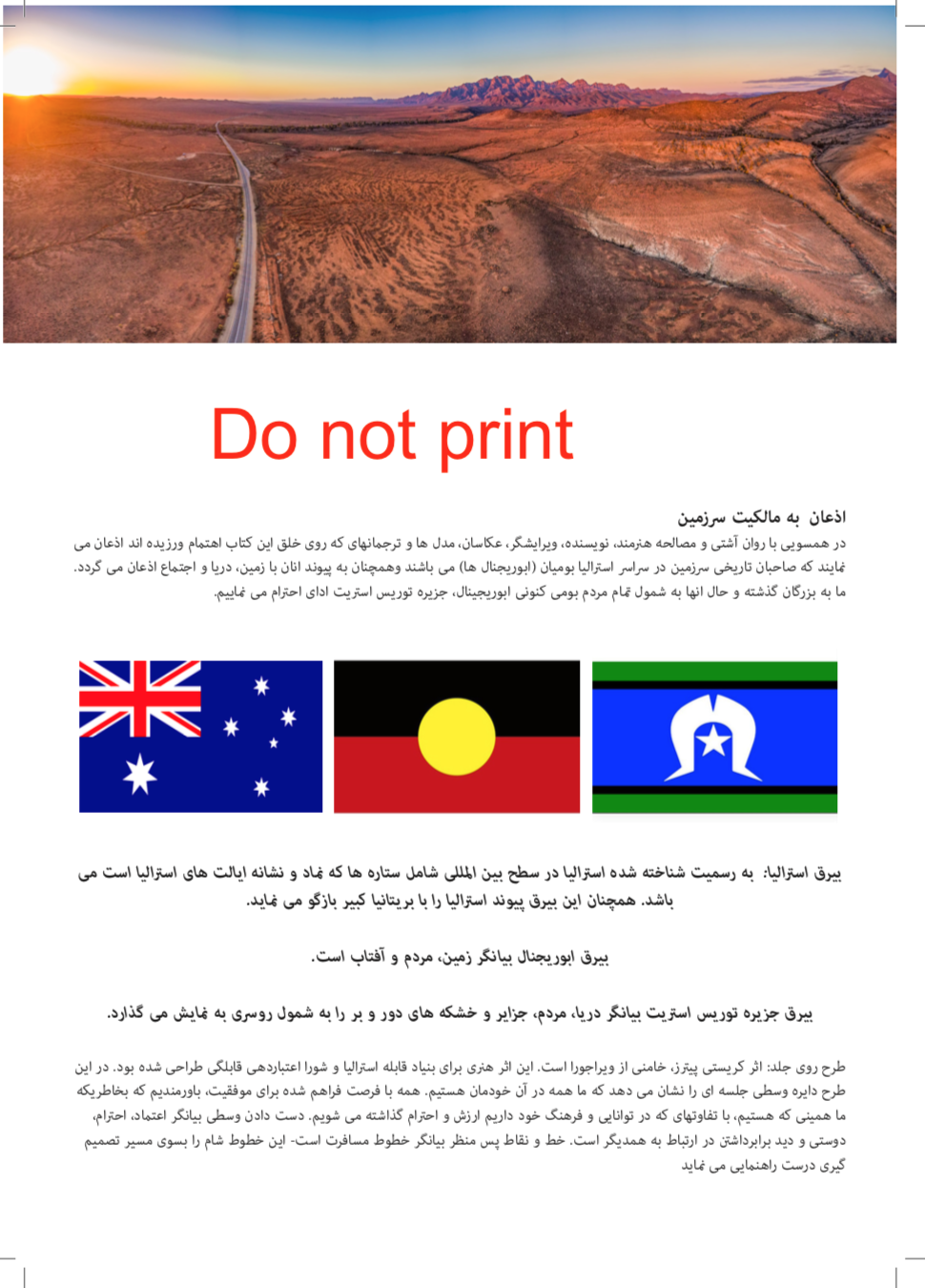
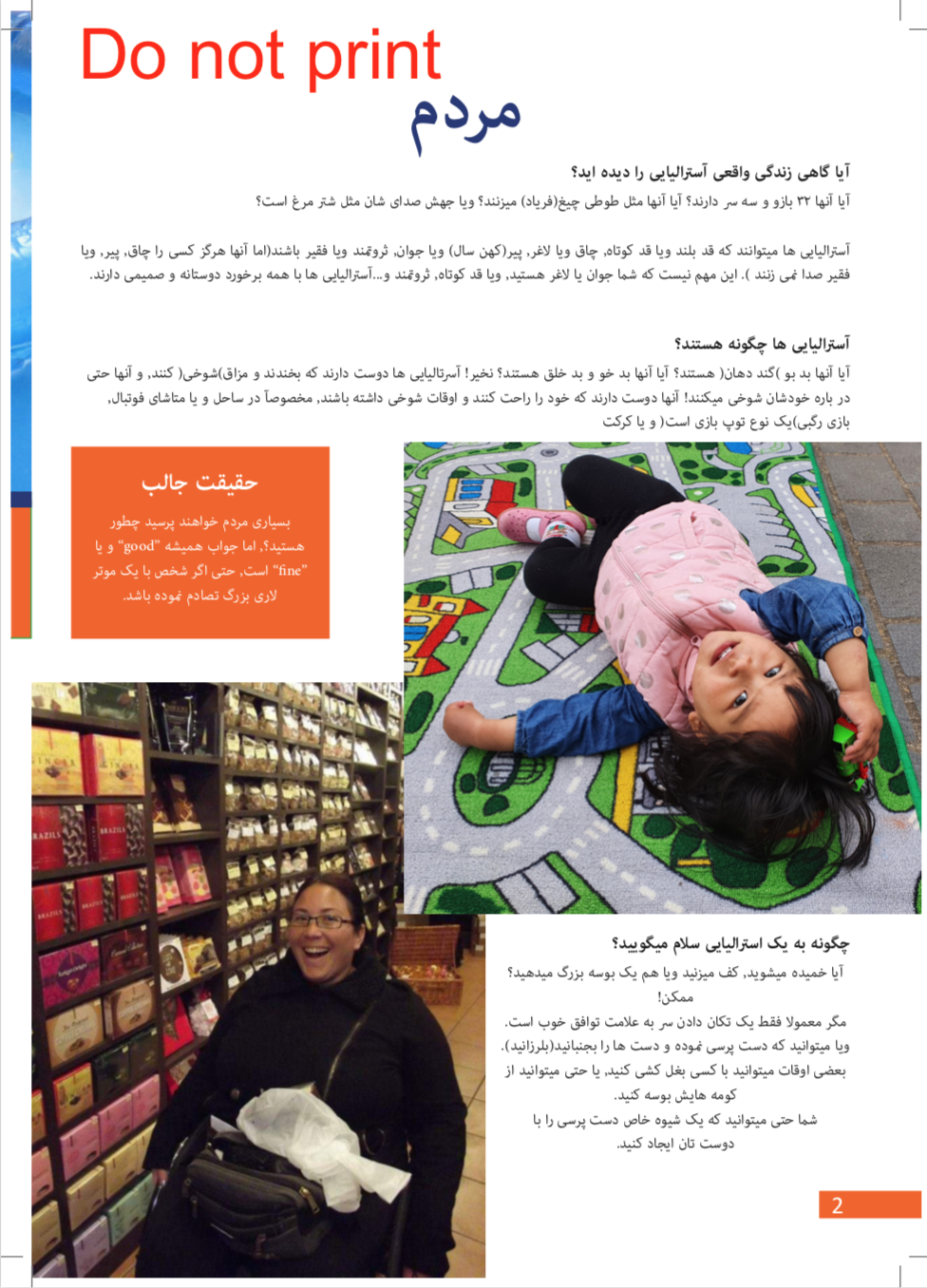
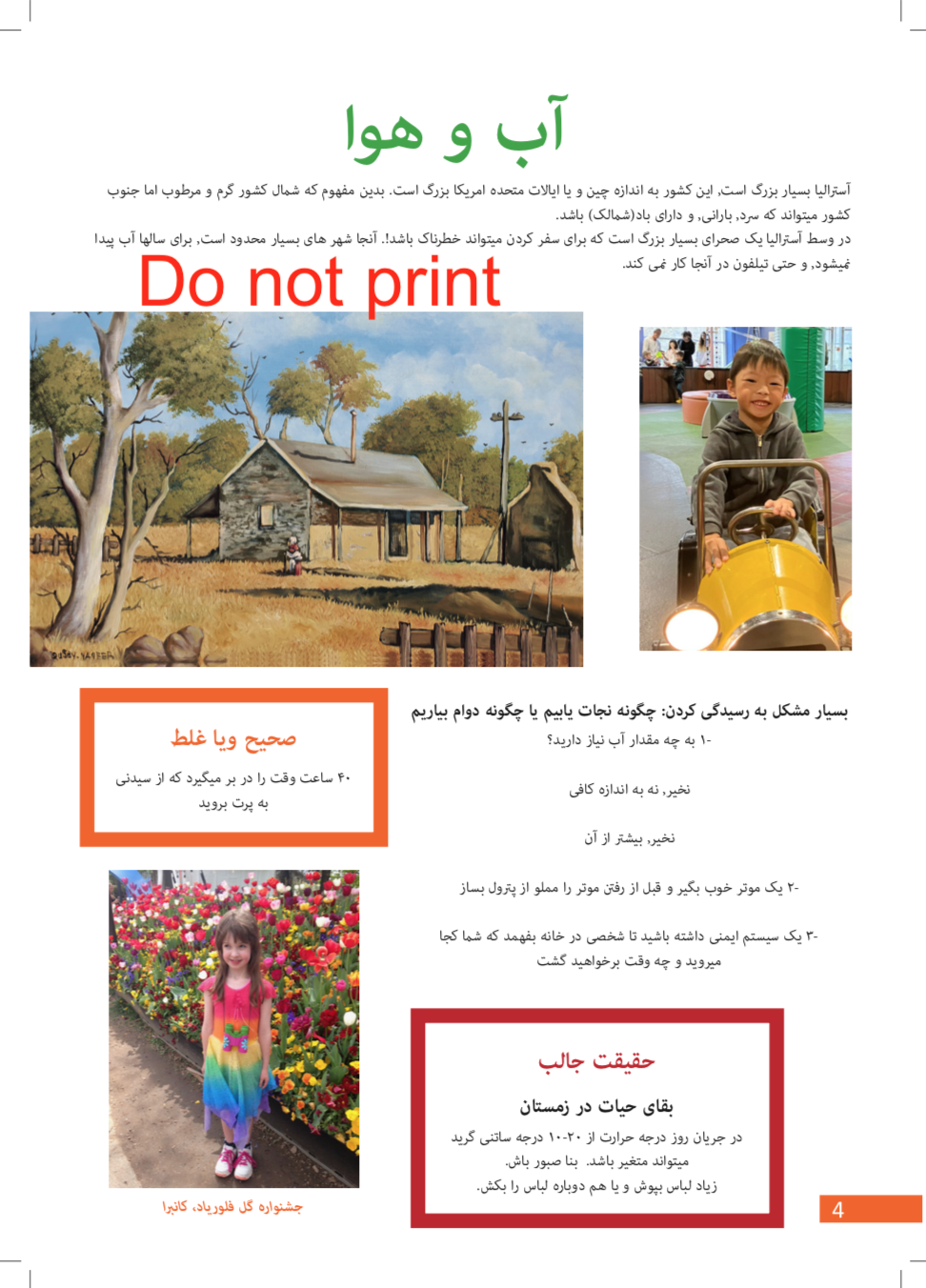
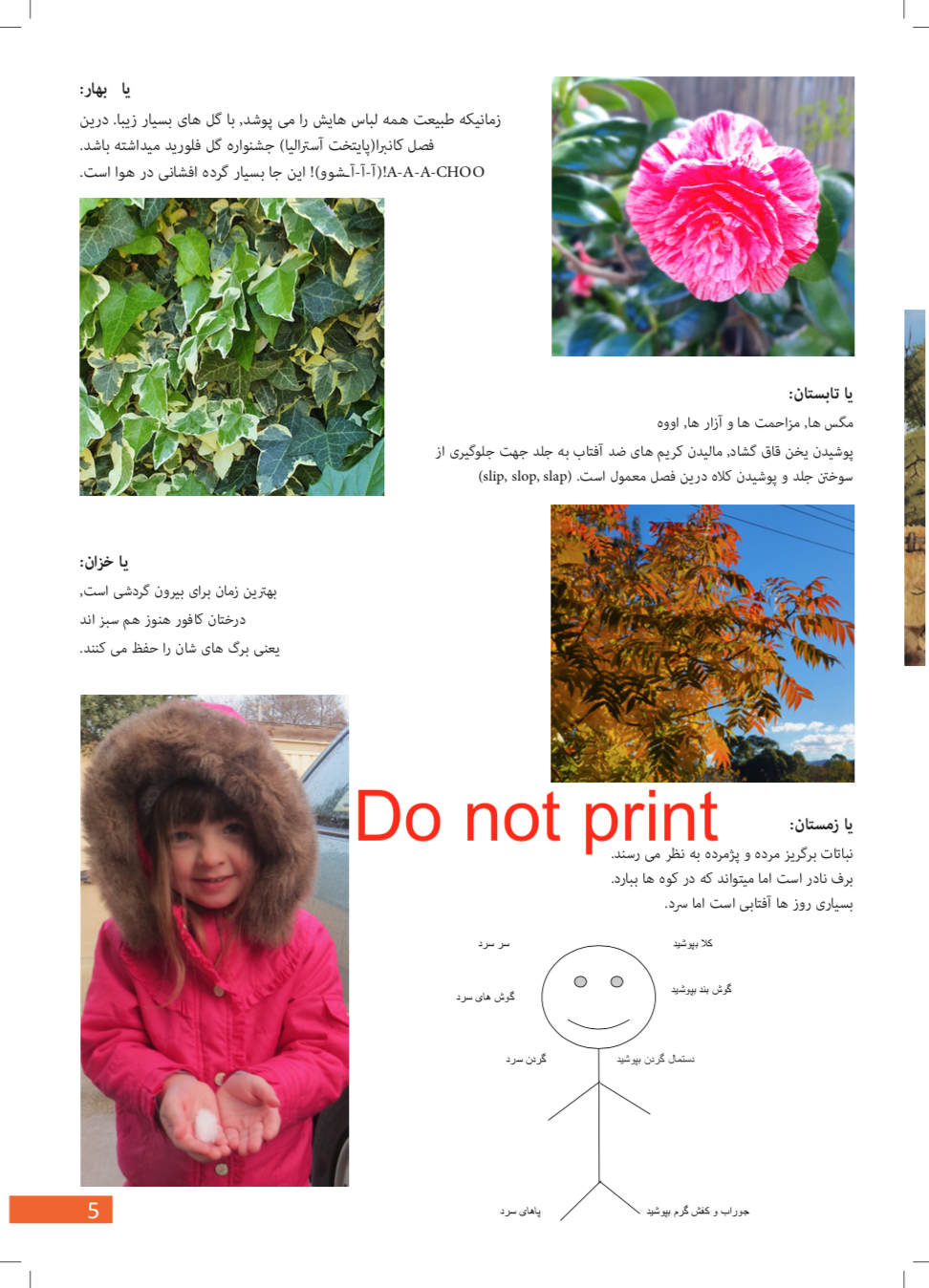
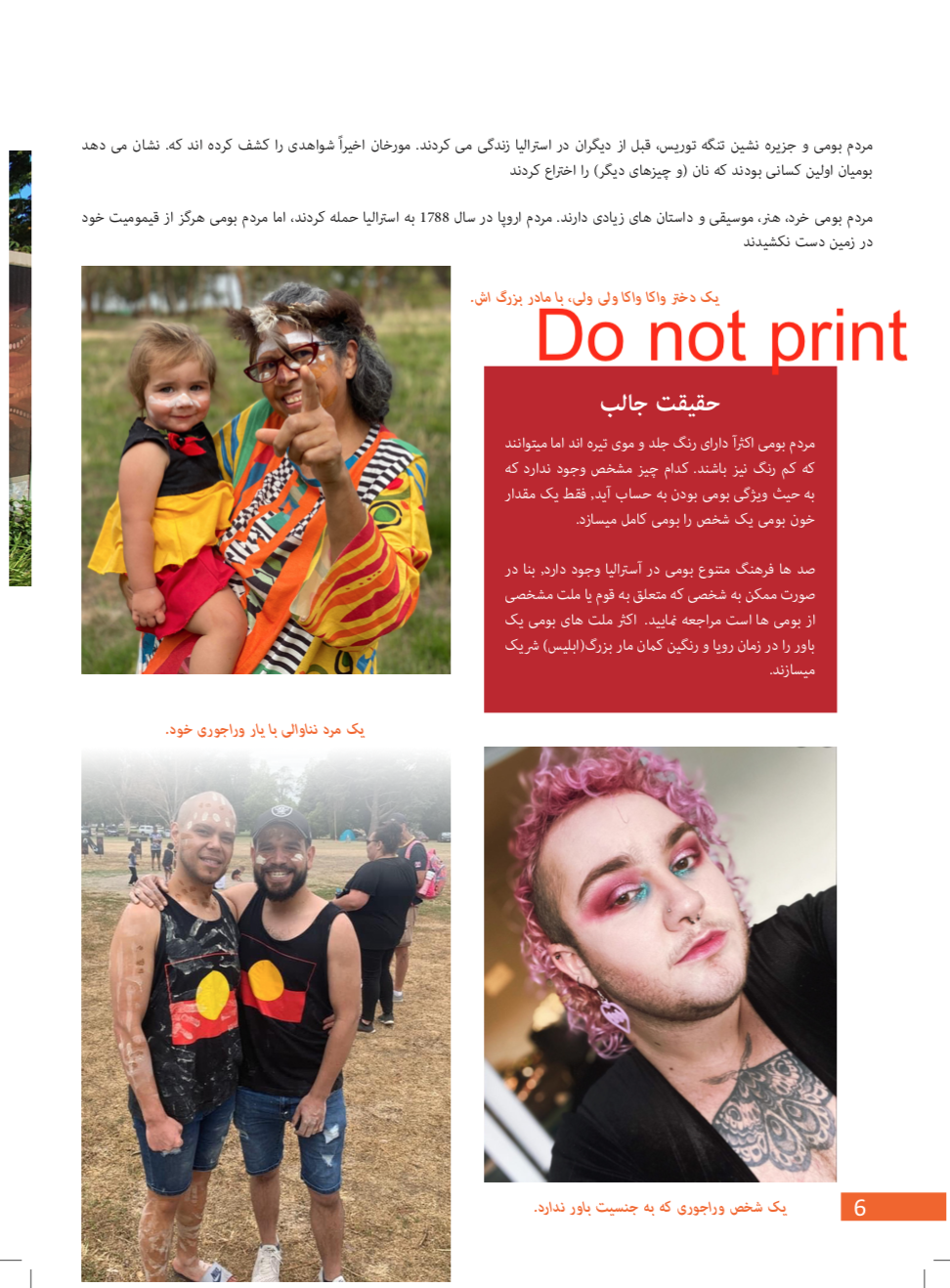
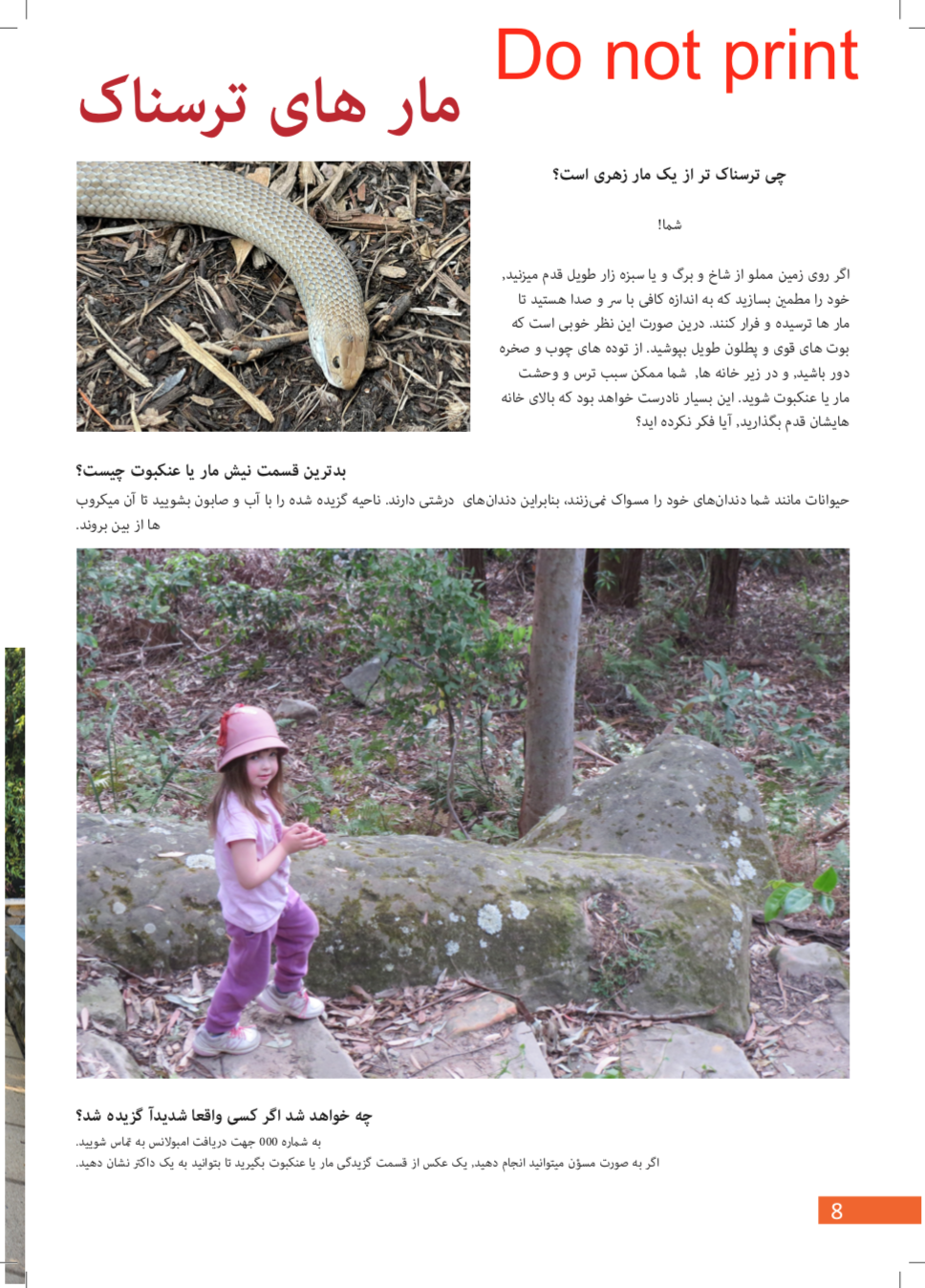
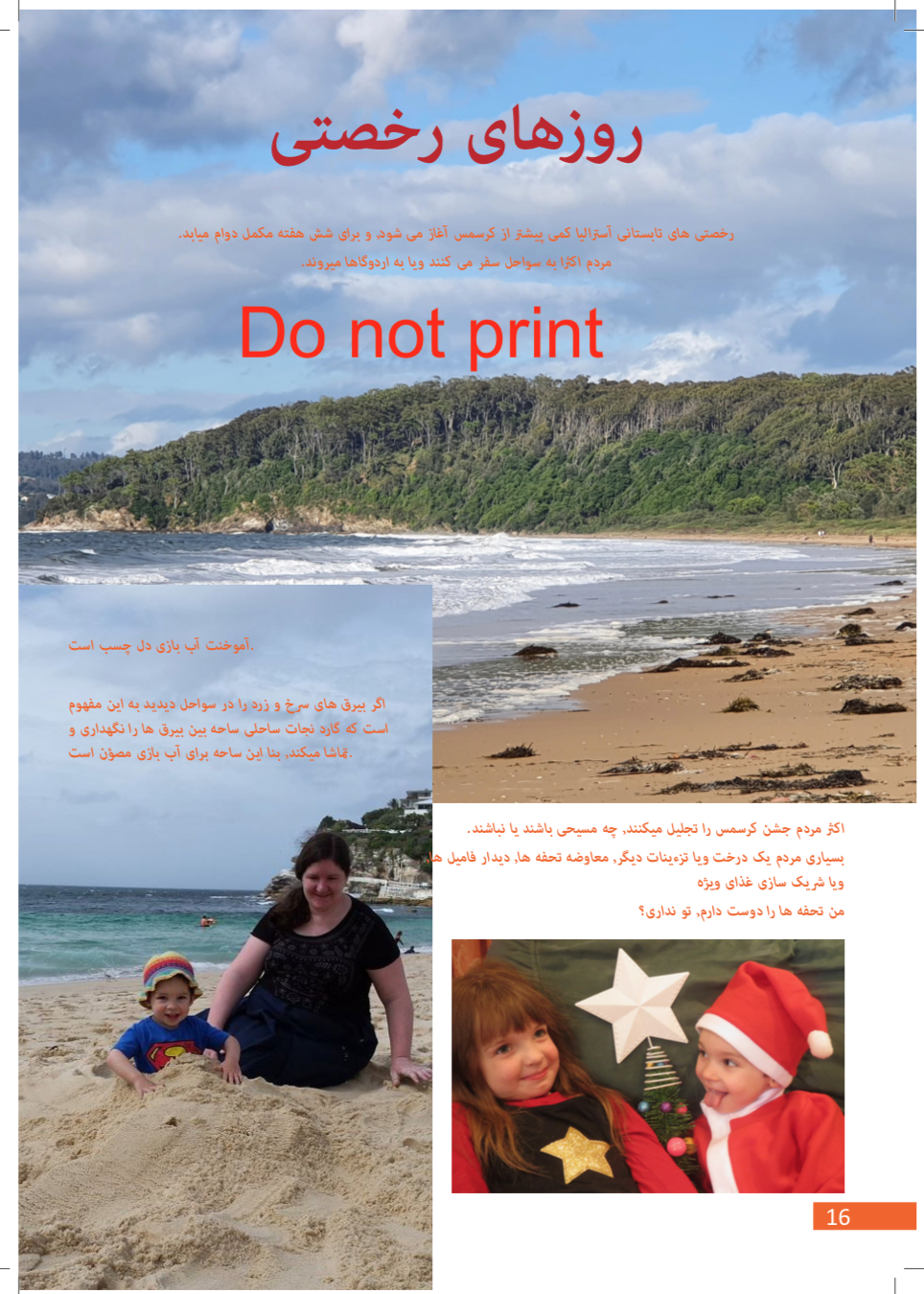
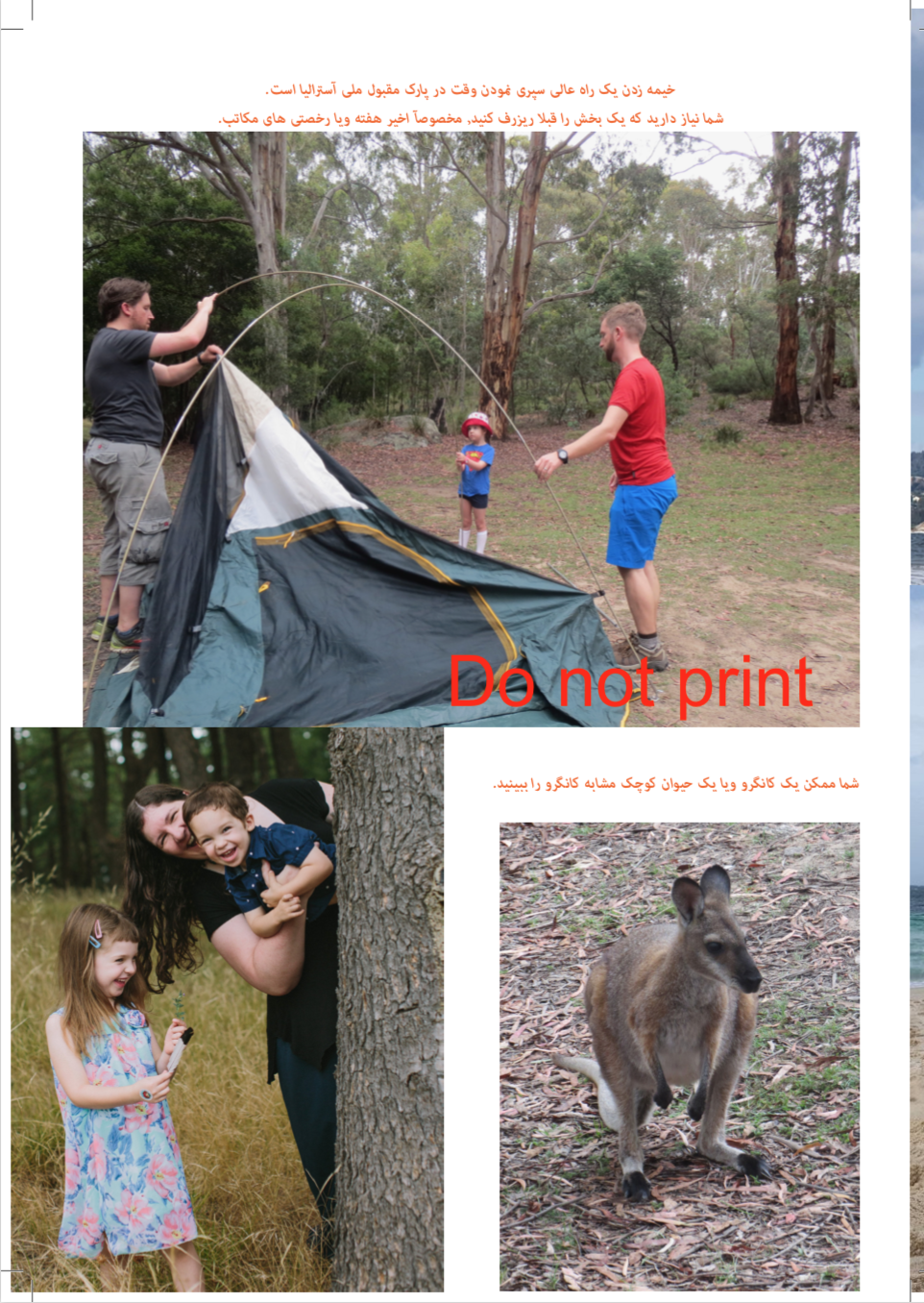
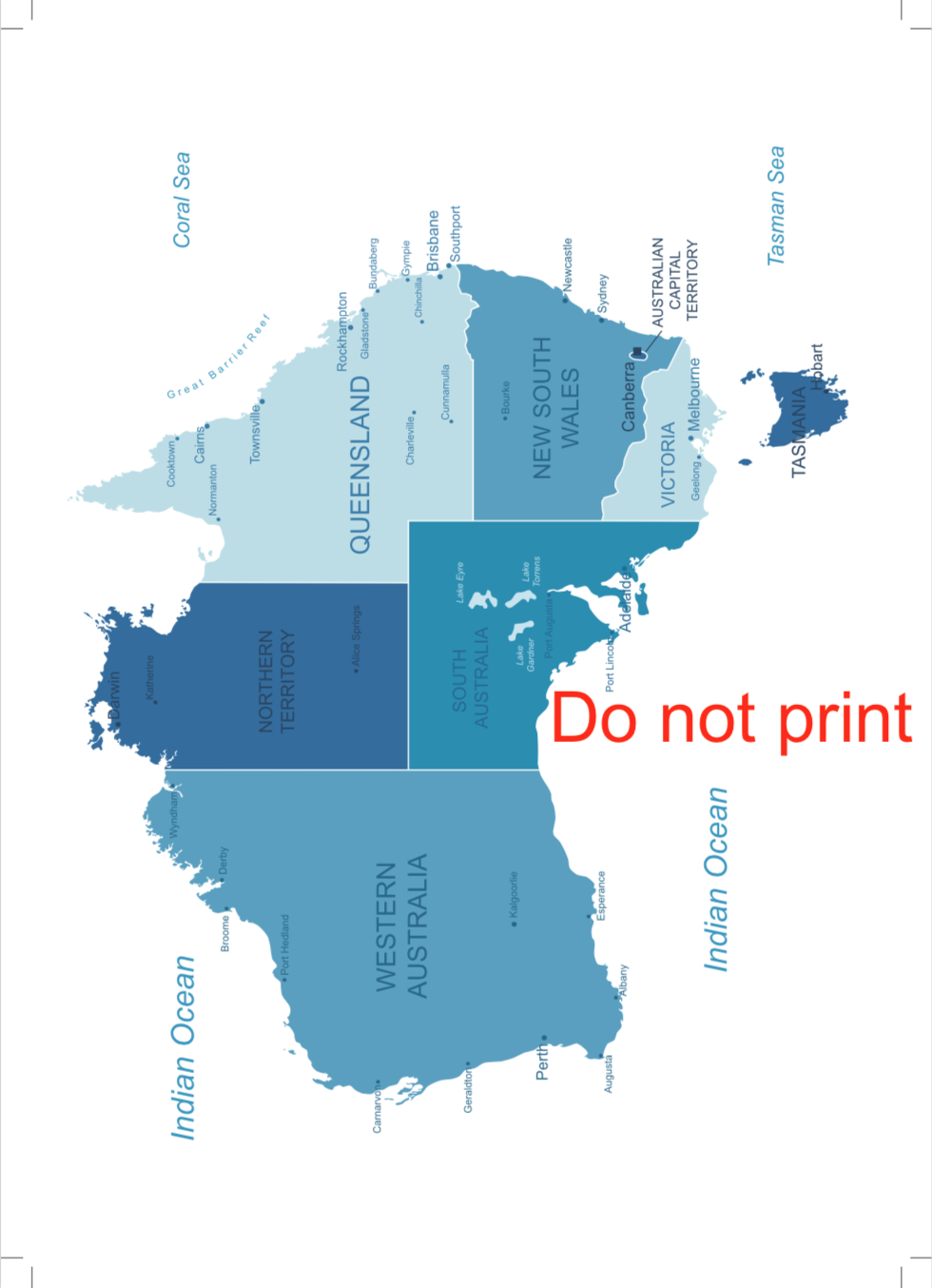
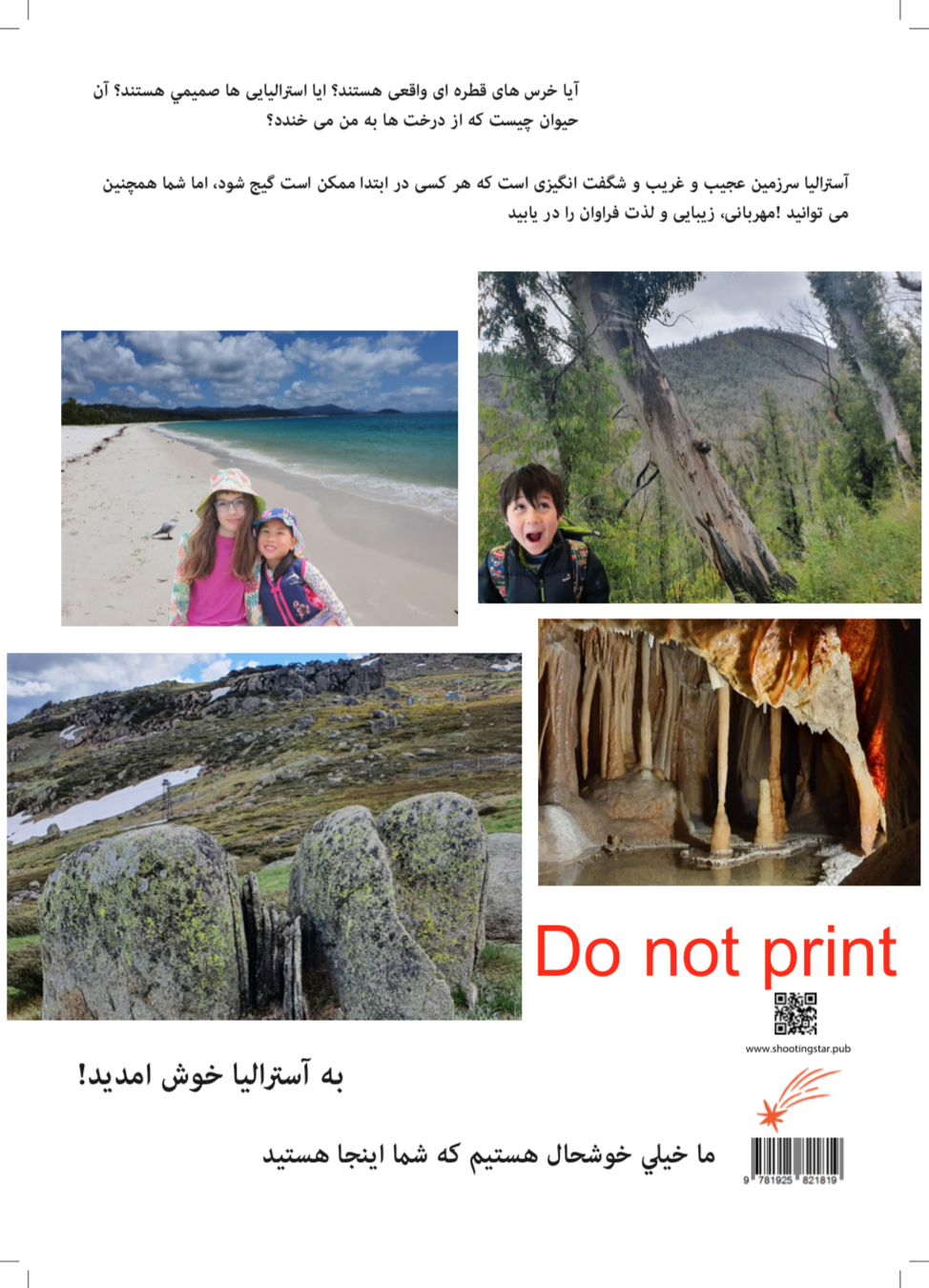
“Welcome to Australia” Dari Persian
Bahasa Indonesia/Bahasa Melayu
Please feel free to share all versions of this book as widely as you like.
All I ask is that you don’t make a profit from any part of it. Dozens of people spent time working on this book, and most were not paid (all Aboriginal people and refugees were paid or had donations made in their name).
You can buy physical copies here in any of the available languages. Yes, the publisher (Shooting Star Press Canberra) plans to sell digital versions of all languages too.





Our refugee family was nearly kidnapped in front of me when they first arrived in Australia: Part 2 of 2
Link to Part 1.
Arrival Day.
At 6am I was at Sydney airport feeling less than fresh but full of a heady mix of anticipation, confidence, and the knowledge that I regularly get lost in shopping malls.
Lesson 4 for CRISP groups: Try not to have the most incompetent, absent-minded, and unhealthy person in the group meet the family at the airport by themselves. But you probably had that one worked out already.
And yeah, I’m smart. And good with plans and organisation. And VERY good at quickly making new plans. And sometimes, I’m kind of brilliant with cross-cultural understanding (other times, I fail to see what everyone else in the fully English and monocultural conversation is talking about… that’s part of the magic of being autistic). But I’m quite bad at negotiating systems that are made by other people. Like, for example, airports. And Sydney.
Due to my fibromyalgia, I’d had Chris drop me at the domestic departures terminal, because I was confident that as soon as I explained to someone that the Afghan family of six had no English and no one to meet them people would leap into action to help.
My phone is dying. It sometimes spontaneously mutes one or both people during a phone call (or just hangs up) and it’s having a lot of difficulty connecting to the internet. But I finally connected to Sydney airport’s free wifi and started live tweeting (except I live-tweeted on FaceBook, because shut up, that’s why. And yeah, I know they want us to call FaceBook something different now, but I’m a rebel).
When we were told the family was coming to Sydney, not Melbourne, they had already left Iran but would be transferring at Dubai. I immediately sent this to the oldest son:

Two blue ticks means they have received the message. We didn’t have two blue ticks yet.
Also, our handy-dandy banner is too big to fly back to Canberra so that was no good.
As soon as I knew about the Canberra flight, which was booked AFTER the family left Dubai, I sent:
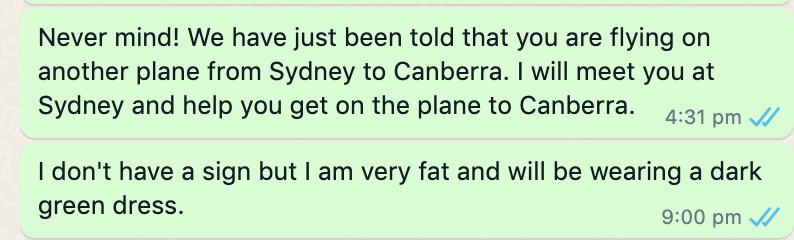
Plus a message for them to show to airport staff to tell staff the whole situation and ask them to call me.
But there was literally no way for them to know that someone in Iran had arranged for them to fly onwards to Canberra. I wasn’t 100% certain they even knew that we (the Castle of Kindness) knew they were coming via Sydney instead of Melbourne (we’d discussed the Melbourne plan with them in detail).
So, tweets:




This is a photo of the same sunrise in Canberra, taken by Suzie Zarew Photography on Thursday 22 June and shared here (and with the family) with her joyful permission.


You’re not allowed to turn phones on in Immigration, as I discovered later.


When I was living in Indonesia (age 18, for six months) my Indonesian friends were terribly offended when I wanted to wear thongs to church rather than socks and sneakers (in the tropics). Hence my concern. (I have loads of knowledge about Indonesia, and sometimes it helps with other nations. A bit.)
A lot of immunocompromised people (very much including me) overheat extremely easily so it was worth the risk of mild offence.
Lesson 5 (or so; I’ve lost count) for CRISP groups: The two hour estimate we were given for a refugee family to get through immigration is more like an average.


Lesson 6ish for CRISP groups: Probably worth finding out if non-flyers are allowed on the transit bus. I forgot I might not be allowed and just walked in with them. I’m sure you can go on the train instead—but you’d have to pay for everyone which is a huge hassle if they don’t speak English, and presumably also massively overpriced.

lol
7:30am


They didn’t get kidnapped at this time.



Lesson 7ish for CRISP Groups: Some of your group will not respond well to a sudden crisis. Some will thrive on it. Try to figure out which is which and plan accordingly (eg make sure a ‘pro-crisis’ person is at least semi-available that day/week as a backup).


Reader, it was not fine. But I’m getting ahead of myself.


Because I had the car seat in my house, ready to pick up the Afghan family at 10pm in Canberra. Remember that plan? It was a good plan. I put it in the backyard so someone else could fetch it while my family was in Sydney.

Actually everyone in the world starts off being bad as distinguishing people of another race. The less people you meet and interact with from another race, the longer it takes to get better at it. Does that make it more or less racist to be bad at recognising people? How big a role does your society and environment play? Do feel free to discuss this matter in the comments.


Having trouble clicking on that link since it’s a screenshot? I got you.


8:35am









It actually wasn’t, at least not in this specific instance. My flight to Canberra cost the exorbitant price of $388 due to being bought within 24 hours of departure, but the Afghan family’s flights were all paid for at the Iran end (perhaps someone at that end received CRSA’s request that they come to Canberra rather than silly old Melbourne and it simply took them fourteen days to make the arrangements). All seven seats were changed to another flight for free.
But we’re also paying bond and the first few weeks of rent for them in Canberra. Now THAT is expensive.
Hah! I just looked and someone really did donate money around 8am. Noice.
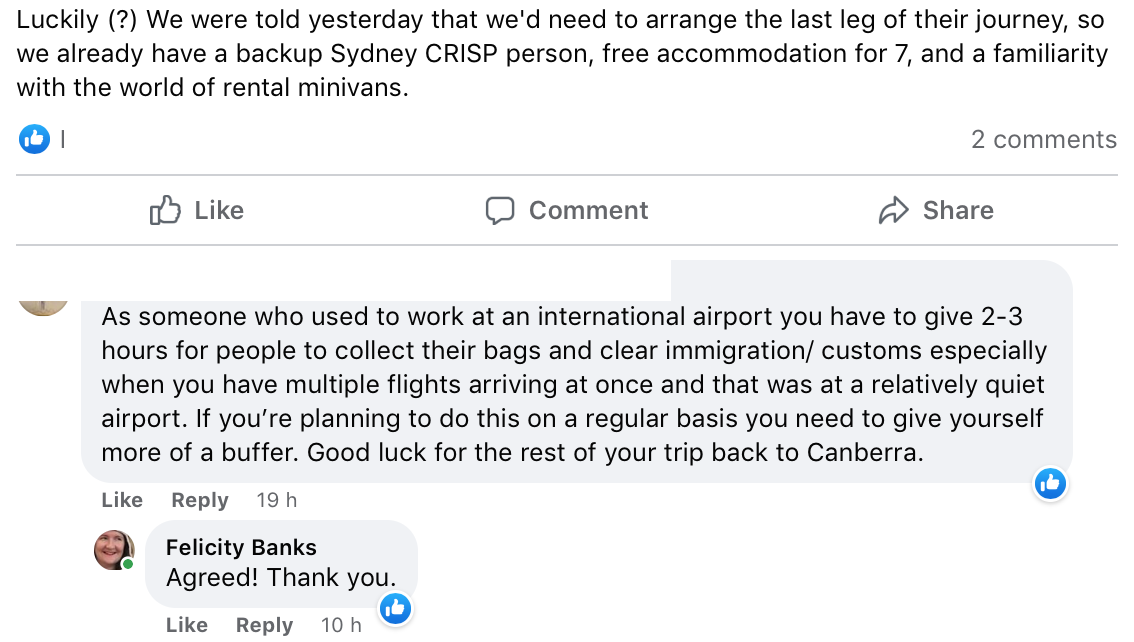
And thank you Chris, who stopped the car at Sutton Forest ready to turn back around.
*
Hey, want to hear about another fun mini-adventure we had on the way?
Carol called a rental company to ask about hiring a minivan and they said it was $160 a day and there was one available in Queanbeyan. They also said that if we rented it for two days and brought it back after one day we’d get a partial refund. And they have a system for paying tolls in Sydney too. Great!
So Chris managed to hitch a lift out to Queanbeyan from his work… where they told him he also needed to deposit a few hundred for a bond, and insurance was much more than they’d told me it was.
Which was all fine except they ALSO absolutely refused to accept payment from Carol (our treasurer) over the phone. And although Carol had already transferred a chunk of money to my account, it hadn’t arrived yet, so we didn’t have enough for the minivan.
So instead of having a vehicle for the airport, we had no vehicle…. and now Chris was stranded in Queanbeyan (which is interstate and generally considered by Canberrans to make the Afghan family’s rental home look like a palace).
BUT that turned out to be a good thing, because we never used a minivan after all that. But as soon as we missed our flight I was calling people about minivan hire rather than having to take a few minutes to sob quietly to myself in utter despair first.
*
Back to the main story…

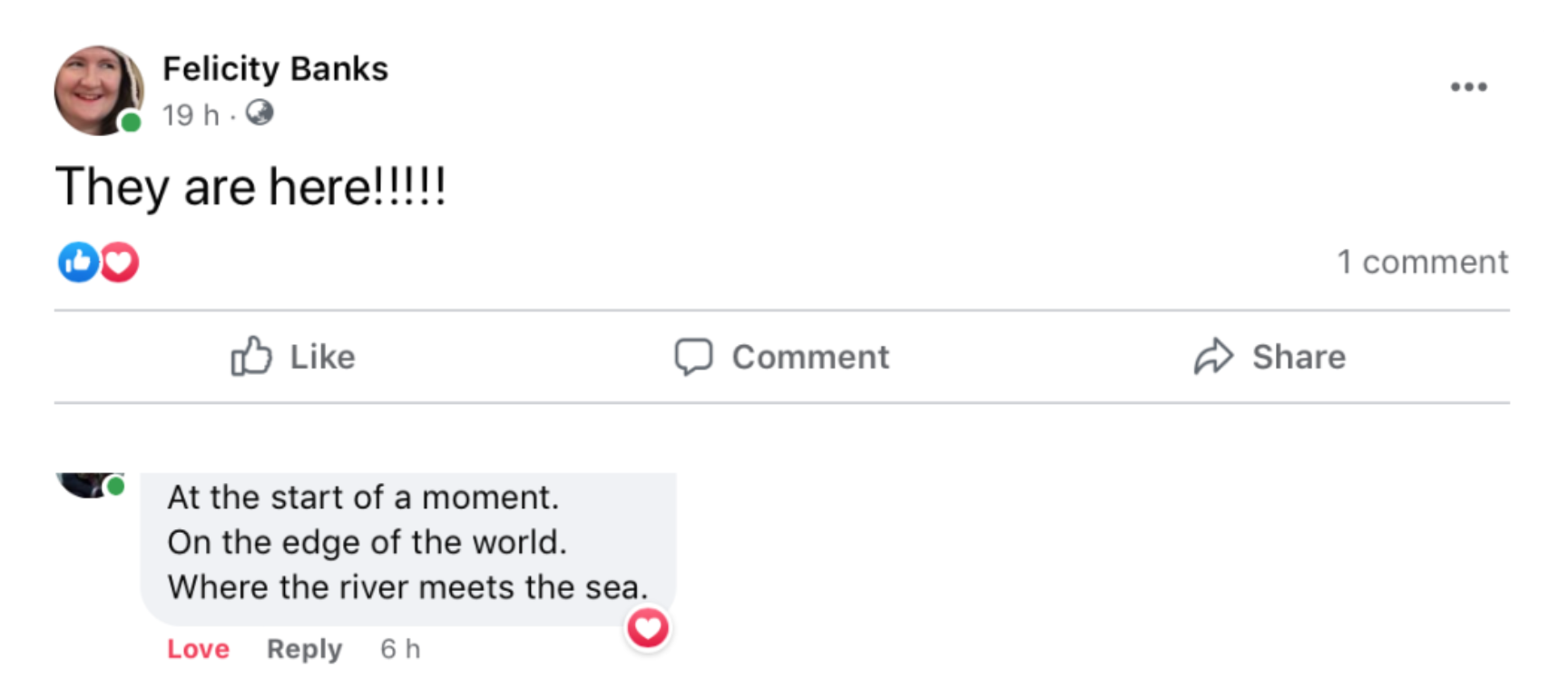
And everything was happy and peaceful forever.
30 minutes until we miss another flight.
The older son recognised me instantly and walked over. He’d already sent me this:

(Huh. Later in the day he referred to a gate as “Gate 1C”. So he was picking up words along the way. He will do so well here!)
We all exclaimed over one another with great love and I used my one phrase of Arabic (which is also the one phrase almost all Muslims know) to greet them, and the little one was greeting me in Arabic and I understood and she understood me and it was so good!
Mindful of the time, I gathered them up with the skill born of many hours of mime work (with other refugees) and indicated that we needed to get going.
But half the family was already dispersed among the crowd. NO WHY!?!?!?!
25 minutes until we miss another flight.
Ali explained that his dad wanted to talk to “a friend” before we left. I went and joined the huddle in the midst of the ongoing arrival chaos, and met a woman whose name I can’t remember. She spoke fluent Farsi and English with a slight accent and skin tone that suggested she was probably from Afghanistan herself (twenty years ago). She asked me who I was and I pulled up the Castle of Kindness web site on my phone (which for some reason didn’t show the link to CRSA, presumably because of my phone being too old and cranky) and started to explain the Castle of Kindness, CRSA, and CRISP. She said she needed to make a phone call but was clearly protective of the family. I was impressed that the family had made such a useful and passionate friend on their plane ride over. There was a girl a similar age to one of refugee family’s kids who clearly knew her, and there was a man around somewhere too.
Someone told me that the Afghan refugee family wanted to settle in Sydney, as they have friends there. I explained calmly that one of the key aspects of the CRISP pilot (and one that’s important to the government) is that most of the CRISP families are settled in regional areas (and yes—embarrassed sigh—Canberra counts as regional). So although the family was welcome to settle in Sydney, they needed to live in Canberra for twelve months first.
It was just a teensy misunderstanding, probably because of the flights changing. Except it wasn’t teensy after all.
20 minutes until we miss another flight.
In the confusion, it took far too long to realise that the friendly girl-child belonged to someone else and the man and woman I spoke to were NOT new friends made on the plane but two staff members of an extremely important refugee advocacy organisation that I’ll call HELP because although they did everything right I don’t want to draw any possible negative attention to them (that would be very bad for everyone). They are the government body that meets refugees at the airport in Sydney, arranges their accommodation and food, and looks after the family for 12 months.
Sound familiar?
Yeah, they’re precisely the same as the Castle of Kindness group… except they have a government contract, hundreds of trained staff including expert translators, and their staff are paid employees who are not permitted to form casual friendships with refugees (much as a teacher cannot form a close friendship with a student—the power imbalance is too hazardous so professional distance is important).
As community supporters, we (the Castle of Kindness) have minimal training, no consistent expertise beyond speaking English and living in Australia, and we are encouraged to be the first true friends of refugees arriving in Australia. The whole point of community sponsorship is to be a community. (And to cost the government little or nothing, so Australia can take more refugees.) During the lead-up to this meeting, the CRISP coordinator told us over and over not to focus on practical details (other than those that are absolutely and immediately vital) but to build a relationship with the family first.
That turned out to be absolutely crucial in a way no one could possibly have predicted.

The Castle of Kindness has been preparing to welcome this family for months. So has HELP. There had been some kind of administrative glitch somewhere and the Afghan family was stuck in the middle while we discussed their fate.
HELP had short-term accommodation prepared (a LOT nicer than ours) in Sydney, with food already there and transport arranged and a twelve-month plan laid out to settle the family in Sydney.
They had already met ‘our’ Afghan refugee family as they stepped off the plane (because they’re an official and well-respected organisation and are allowed to help people through immigration) and been their only support for several exhausting and overwhelming hours in the pit of bureaucracy that is immigration. When the older son had told me his dad was talking to “a friend” it was a simplification but it was also somewhat true. These two HELP people were the first genuinely friendly faces they saw in Australia.
And the family wanted to live in Sydney. Like most immigrants. The dad explained that there is a vibrant community of Afghans in Sydney (while I had been super proud of finding three whole Afghan families interested in meeting the family in Canberra).
And the most important aspect of the CRISP program—more important than being a friend or being helpful—is that we must empower the family at every opportunity short of robbing banks or assassinating certain politicians.
If they wanted to live in Sydney, and had the full support of HELP, that was clearly a better option for them, even if it broke the three week-old kitten that is my heart.
And I might never see them again.
And the rest of the Castle of Kindness—and all the people that donated time and money and cleaning and moving furniture and toys for the toddler and clothes for the adults—would never even get to meet them.
Here is an artist’s impression of my heart, in that vulnerable and slightly furry moment:
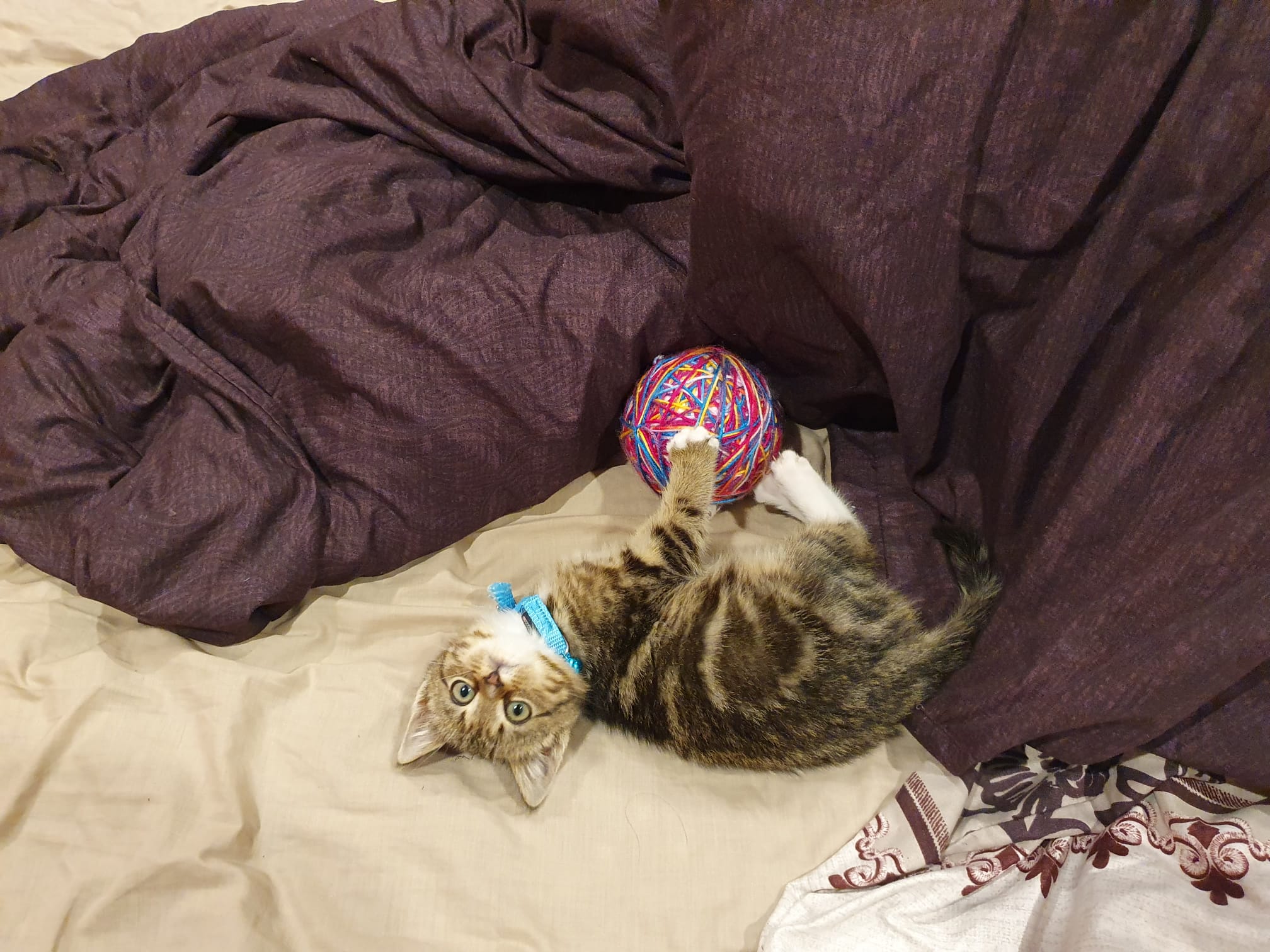
But the right decision was obvious. And suddenly the tables turned. HELP had wanted to check I was legitimate. Now I had to check they were. I still had a duty of care to make sure the Afghan family really was safe and happy… without us. Without me.
And yeah, it was personal.
I don’t remember ever seeing ID from the HELP people. I’m sure they had it, and I’m equally sure I didn’t think to ask for it. But in the confusion they’d probably already shown it to me. I was talking to the woman; the Afghan dad was talking to the man; I was trying to update the mother and older son about what was happening using a translation app on my phone, and so on.
I wanted very badly to sit down.
But now that I’m home I know that at that stage those HELP people could have been part of an international slave ring (all you really need is two bilingual people and a bit of sass—at that stage I didn’t know that they must have been vetted to have gotten into the immigration area. Uh, probably. I think we established earlier that I don’t really know how airports work.)
But by now HELP had had plenty of time to observe me, and the results were… not good.
10 minutes until we miss another flight. But that doesn’t matter any more, does it?
At a writing conference, people can guess my preferred genre just by looking at me. I always wear ankle-length skirts and dresses. (When I was given my beloved recumbent bike I had to buy pants to ride it.) On a good day I’ll wear a corset too. Why YES I write fantasy and steampunk for young adults (and one picture book for refugee kids to read with their parents in various languages, which is in my store here). I am what the Enneagram personality thingy calls an “Individualist”. I prefer to call myself a “delicate flower” which is particularly amusing given that I’m morbidly obese and nearly six feet tall. But it certainly describes my health.
Also, sweaty. Remember how I mentioned that would be important later?
Also, dishevelled.
Also, there is half-erased writing all over my left arm because when I was organising stuff after the flights began to rapidly flicker in and out of existence it was the simplest way to keep things in my head (or near enough) long enough to sort them out. (One bed was broken, could we replace it in time or would the older son have to sleep on a mattress on the floor? Who would transport the new bed if we got one? Did the family have a microwave? Did we ever tell them the unlock code on the phone we bought for them?)
Also, there are several bandaids on my wrist and hand. Enough to make people think, “Why is that grown adult wearing so many bandages? Was it just a funny accident or something more sinister? Are they slightly uncoordinated or is something very seriously wrong with them? Could they be dangerous to others?
And I have a lot of visible injuries from cat scratches that are healed JUST enough to look like permanent scars from self-harm.
And two deep-purple bruises at my elbows from the hospital cannulas. Needle marks, clearly both recently and poorly made.
And with a distinct manic air.
And looking at the floor like I really wished I could just sit down on the concrete.
And moving weirdly, as if there’s something wrong with my muscles.
Well, that’s another flight gone without us on board. But who cares? Nothing matters anymore.
Ultimately HELP decided I was a threat and the family needed to be separated from me for their own safety.
HELP refused to tell me where they were taking the family. They were hesitating to even tell the family where they were being taken because I announced clearly that the Afghans would just tell me themselves where they were living. (Because I am sometimes good at getting past stupid bits of red tape, but I am never good at lying.)
The family, especially the oldest boy, knew and trusted me—so the negotiation wasn’t over even though they definitely wanted to go with HELP. They weren’t going to stick around forever, when there were two people who spoke their language insisting that I was just an error or worse.
HELP had a difficult choice because we all know empowering the family is vital, but I looked sketchy, speak no Farsi, and was making wild claims about the government and a “very new” program for refugees.
I had already called three CRSA people…. and got three answering machines. They had already been told that I’d fixed the latest disaster (missing our flight, for those who have lost count) and we’d just take a later Qantas flight. They had no reason to think anything else would go wrong—or that I couldn’t handle it.
One of them SMSed me back.

See that unredacted naughty word? I’d normally redact or rephrase but this is one of those times that swear words are specifically invented for. Apart from anything else, my contact would know that the emergency was a legitimate emergency because she’s never heard me swear before (unlike—sigh—my kids).

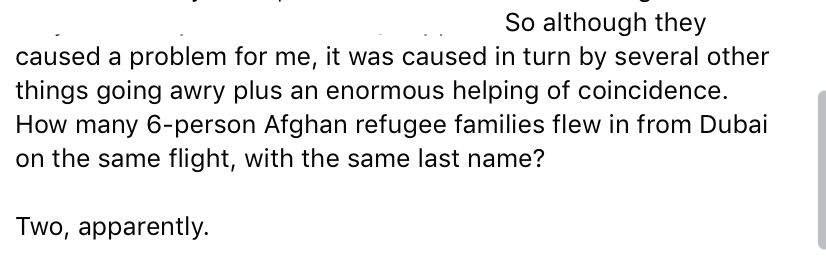
So while MY Afghan refugee family received top-notch translation assistance, another family was not met by the help they had been promised. It took a while, but that other family found someone who called the HELP office and the HELP office called the man and woman who were talking to me.

The HELP translators hurried away to assist the family they’d accidentally abandoned in Sydney airport (pausing only to tell me what happened, and that the mum is an incredibly sweet lady), and the family was mine again. After a brief but slightly plaintive plea from them that, “We want to live in Sydney” (“I’m sorry but legally you have to live in Canberra for at least one year—after that you can move to Sydney”), we began moving.
The family had been through the emotional wringer followed by a very confusing tumble-dry that didn’t end the way they wanted.
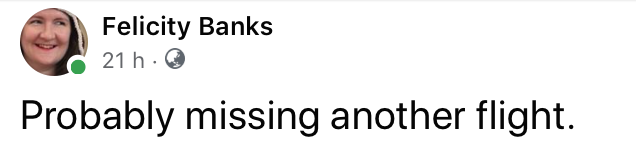
Yup.
And the family was starving. We badly needed to get to the domestic terminal so I tossed them some school snacks I’d grabbed from my own shelf the previous day. It’s not easy to hustle six people through a crowded airport. It was very handy knowing their names.
They asked me only one question: How long is the flight to Canberra?
That broke my heart a little.
The flight is only an hour… but it would be two more hours before we got on it.

The random prissy person was taking up two seats in a crowded bus and was mad at the mum for standing too close as she (the mum) tried to look after her family while prissy missy shoved at her from behind. It’s entirely possible she wasn’t racist but is just an all-purpose jerk.
But random #2 was great. He heard us talking and offered to translate. After all the confusion, it was very worthwhile to explain things a second and third time, because sudden major switches in plans are hard to take in. Ask me how I know.

It turns out we actually HADN’T missed another flight. The next flight with seven seats available for us wasn’t flying out until 12:30. So that was the one we would take. I have no idea if missing two flights in a row would cost money (missing one didn’t cost anything, which was nice). So I guess we’re lucky our replacement flight wasn’t the one I asked for.
We checked in the bags. The Qantas service desk lady was fantastic. Her face actually lit up when I said, “We need help… a lot of help.”
Security was tricky as our phones (and their translation apps—SayHi is best for Farsi aka Persian aka Dari) had to go through the x-ray machine and meanwhile the Afghan mum beeped with just SO MUCH metal all over her body. So she had to be wanded and frisked. She handled it with complete grace but it was extremely difficult for the security lady to mime, “I need consent to frisk you wherever the wand beeps.”
CRISP group tip number eight or so: Have a plan for security if you’re going through security with your refugees. Explain the process if possible. Also warn them that if they have metal (eg valuable jewellery) under their clothes they will get very thoroughly frisked (and honestly may end up strip-searched). Use a handbag instead, as you can keep a handbag with you.

Everyone was way too tired to select their own food (bacon burgers are NOT a great option) so I grabbed the seven most expensive bottles of water on the planet, three fruit salads, and a plate of chips. It seemed like the food least likely to mess with their stomachs and most likely to be recognised, respectively.
The older son told me with great joy that the Turkish flatbread my godparents had provided was as delicious as the bread from their region.
CRISP group tip number nine maybe: Turkish bread and hommus for the win. Probably for a huge swathe of nations. [Edit: I found out later they don’t like hummus at all. Way to buck the stereotypes, you guys.]
The mum made sure I ate.
And now I’m getting misty-eyed again. I actually barely talked to her, focusing on the older son because he’s clearly the closest thing to a translator that we had, and on the toddler because toddlers are both adorable and exhausting.
We took group photos here, but I don’t have consent to share them so I might add them later.


This is Cinnamon, who is 100% a Cinnamon roll even though he is the author of all the minor scratches on my hands (from when I first caught him as a feral… two weeks ago).


I found out Cat was on my flight when I was gazing blearily at the board to see which gate to go to and her husband Mike (also a friend) walked up beside me and said, “I believe you’re going to Gate 1C.” He’d been watching the entire saga unfold on FaceBook.
So yeah, I happened to end up on a flight of fifty people and one of them was a friend of mine. Who was sitting in the same two rows where the Afghan family and I were sitting. I could not have organised it better if I tried.
Speaking of my organisational skills, my bra unzipped at this point. I moved behind a pillar and managed to reach down the front of my dress and zip it back up out of the family’s sight.
Then I looked up and saw Mike with a somewhat confused expression on his face. Oopsy. Well, I didn’t flash the refugees and that’s the main thing.

Another fell asleep as I tweeted that. I woke them all when it was time to go, and one raced off to the toilet—giving me one last thrill before we got on the plane because none of us had any idea where he was. But he knew what he was doing, and was quick. (So yes, I lost two of the six refugees even AFTER I nearly got them kidnapped. Shut up.)
All of them conked out before we left the ground. The toddler slooowly slipped off her mother’s lap onto the floor, and her father picked her up and rearranged her. Cat helped him prop her up against the window so she could be buckled in ready for landing.
CRISP Pro-tip #10: You cannot use the internet on a plane (or in remote nature reserves, as I have had reason to know with other refugees), which means you can’t use translation apps. Make sure you explain beforehand that they need to do up seatbelts (even for a baby, although infant seatbelts help) and lock up tray tables any time the seatbelt sign is on.
One kid utilised the tray table for sleeping and was so exhausted that rather than try and wake him and mime about the tray table (not an easy concept for a child that had never been on a plane before) I physically moved his sleeping self and locked up the tray for him. Interestingly, that is the kind of thing other refugee organisations CAN’T do. They HAVE to have consent, especially with a child. But I am not a government organisation, and if I know for certain the family would rather not be woken, I can use my discretion.
I was also grabbing the female kid’s knee and holding it in place so she didn’t get bashed by the food trolleys. So I manhandled the refugees quite a bit, really.
Carol (from the Castle of Kindness), Terry (a Castle member’s ex-husband!), and an Afghan friend of ours (also a refugee, that we mentored last year) met us at the airport with a car seat and plenty of love. And Farsi.


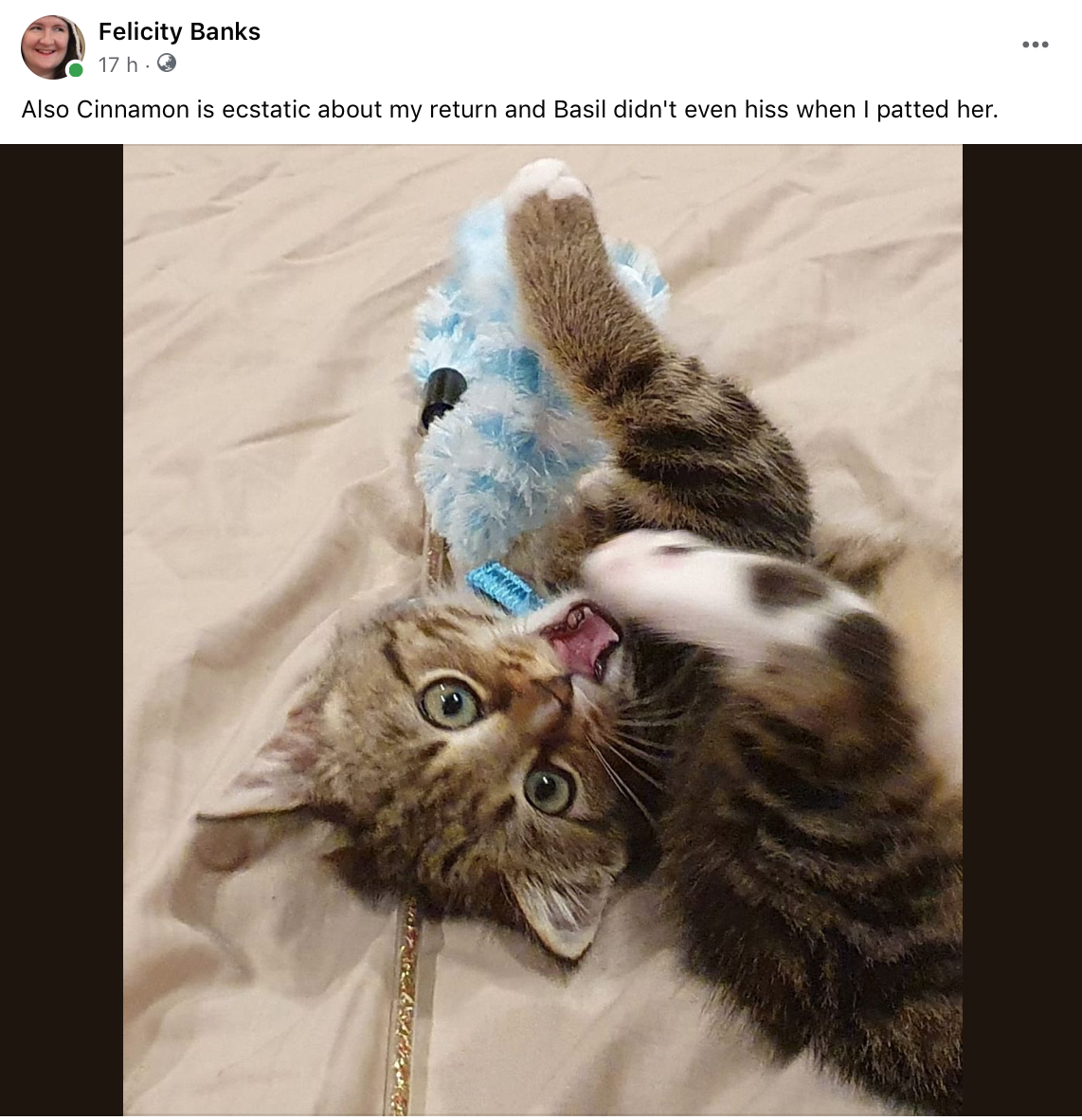
Basil is Cinnamon’s sister but I caught her about a week after Cinnamon so things aren’t going as smoothly with her socialisation (although I HAVE learnt my lesson and not been bitten or scratched since The Biting Incident).
I also have two adult cats.

Here’s a record of one more conversation with the oldest boy. (“You” is of course me. Uh, you get it.)

So! All this was merely the prologue. Our sponsorship journey is barely begun. Terry isn’t actually part of the group but has helped us in the past. The oldest boy has already said how funny Terry is (HOW DOES HE KNOW SO SOON??)
In the car Carol said, “I’m taking you straight home to your house, aren’t I?” and I hesitated and then said yes.
What’s that you say? You would like that GoFundMe link one more time? Sure!

Go here if you’re interested in forming or joining a CRISP group. There are loads of groups, and more all the time. If your life is boring or lacking in meaning, sponsoring refugees is very likely to fix that for you.
Our refugee family was nearly kidnapped in front of me when they first arrived in Australia: Part 1 of 2
Alternate titles:
The black cat that cursed a refugee family’s first day in Australia
The bad hair day that nearly got a refugee family kidnapped
Don’t Look Like A Crackhead and other surprisingly important lessons in refugee sponsorship
A guide on how to avoid accidentally abandoning a refugee family in the wrong city five seconds after they land in their new home country with no English and a toddler with a penchant for running away
Oops, we lost one: what not to do when you have primary responsibility for newly arrived refugees [technically I lost two, but at different times]
—-
I run the Castle of Kindness Refugee Sponsorship Group. We are ordinary people who welcome a refugee family once a year and look after them, including setting up a fully-furnished house for them, teaching them English (sometimes from scratch), and spending fun and silly time with them.
We are trained and guided by Community Refugee Sponsorship Australia, a group that formed in 2018 with the goal of reforming Australia’s extremely awkward and expensive refugee sponsorship system…. and they’re succeeding! They are working with the Federal Government on CRISP: Community Refugee Integration and Settlement Pilot right now, and have helped welcome about a dozen families so far.
We (the Castle of Kindness) have mentored three refugee families so far (families that were under the care of the Red Cross but benefited from having another refugee organisation on the side), but today I was at Sydney airport to welcome an Afghan family of six entering Australia for the first time. This time, the Castle of Kindness had the first and biggest responsibility for the family.
That vital first meeting…. did not go smoothly.
Here’s a few posts I made about the days leading up to their arrival, and what happened next.

We had fifteen days to make final preparations: they would arrive in Canberra at 10pm on Thursday 22nd June, coming via Melbourne. We made plans for Carol to meet them in Melbourne, utilising the airport chaplain and a local translator to help them through immigration.
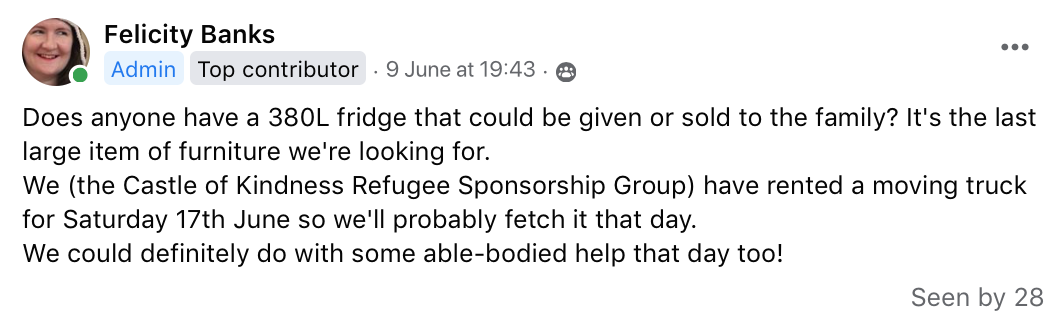
21 June.

(You can see and buy prints by Qusay in the “Marhaba Arts” Etsy shop I run for him. Or just email CastleOfKindness@gmail.com and it will come to me.)
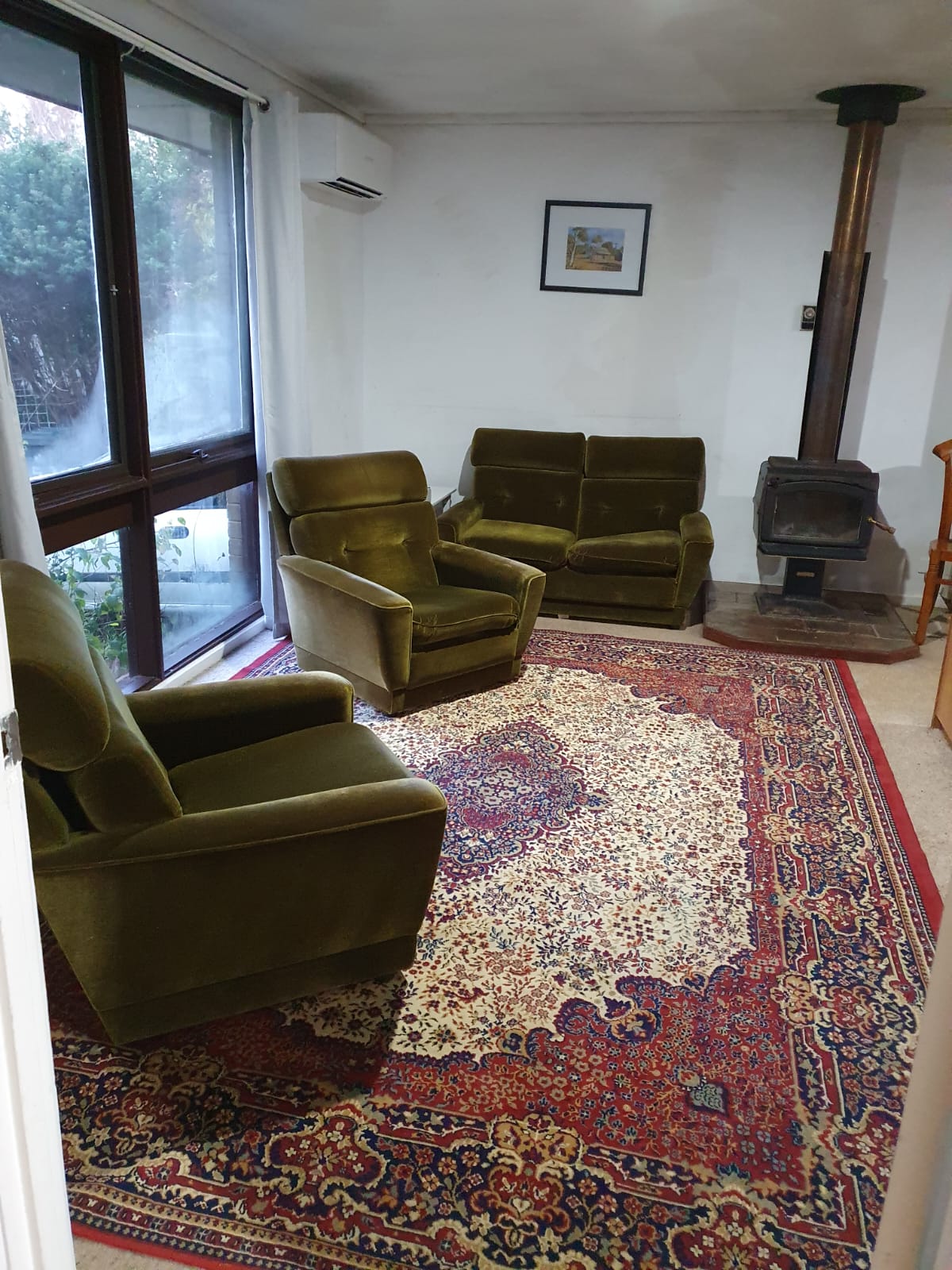
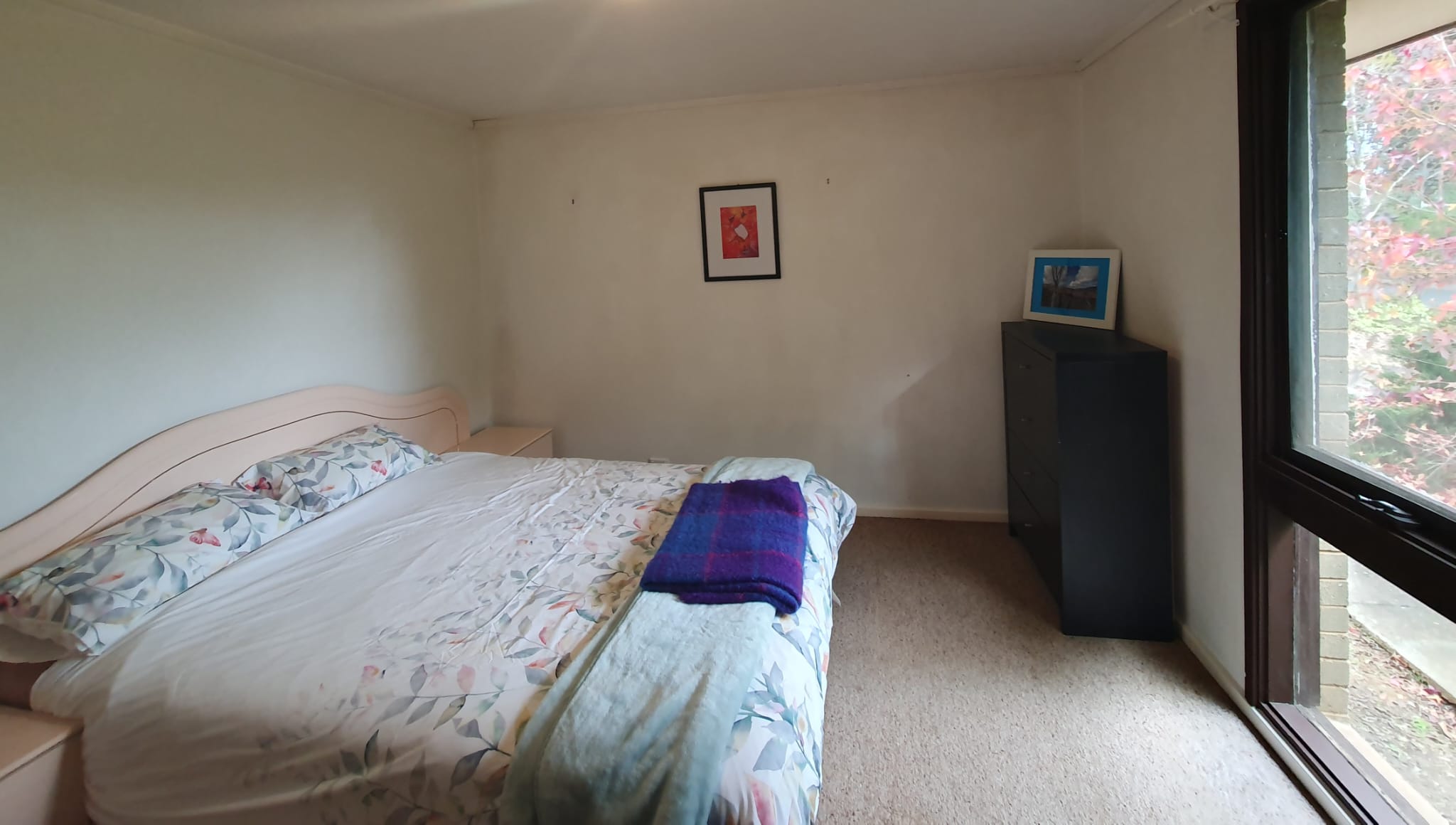
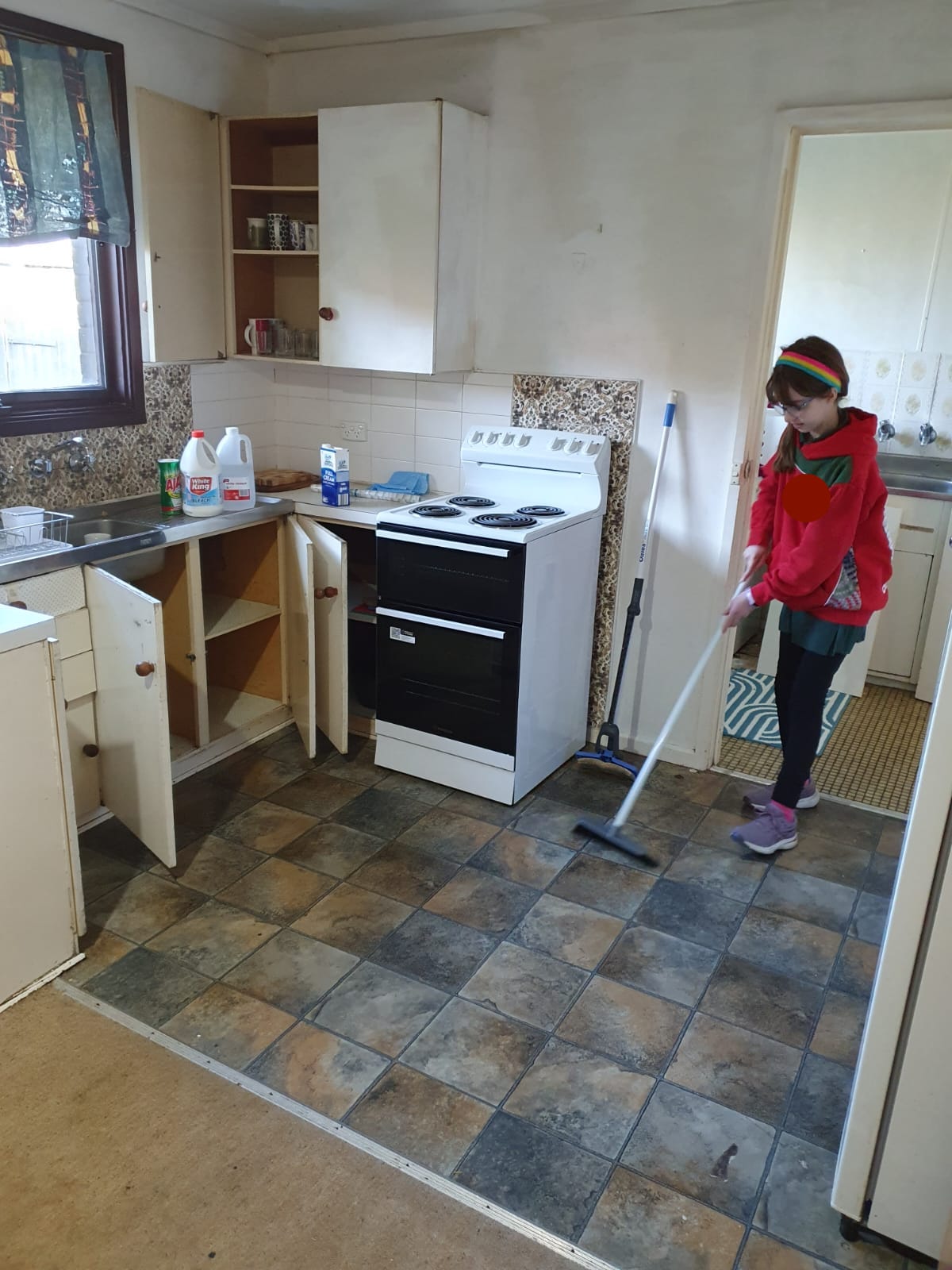
That’s my daughter in the kitchen. And yes, it’s a 1970s ex-government house that has never been updated. There’s a very particular look and feel to ex-guvvy homes that Canberrans know well. It is short term accommodation only, at a brilliant location (walking distance from a shopping centre AND from my house), and extremely cheap by Canberra’s standards. Because it’s only short-term, it gives the family the ability to choose where they want to live (very important for their autonomy).
It wasn’t even cleaned properly for us, but the remaining functional group members and a couple of other brilliant community members spent many hours cleaning it and sorting ALL the furniture, bedding, linen, and food we’ve been organising since we were matched with the family in February this year.
I mentioned that a group member was in hospital? Yeah, that was me. Which also meant a group member (Chris, my husband) had to be a single parent for several days while also running errands and caring for his dear wife in her time of need.
Except of course that he always has to care for me to some extent because I’m disabled by (among other things) fibromyalgia. It’s a chronic, incurable pain condition. It hurts for me to stand or walk and I sleep about ten hours on an average day. Coordinator is a great role for me because I’m a patronising control freak (or as I like to say, “benevolent dictator”—and I work hard to stay benevolent) and I can do almost all of it from my bed.
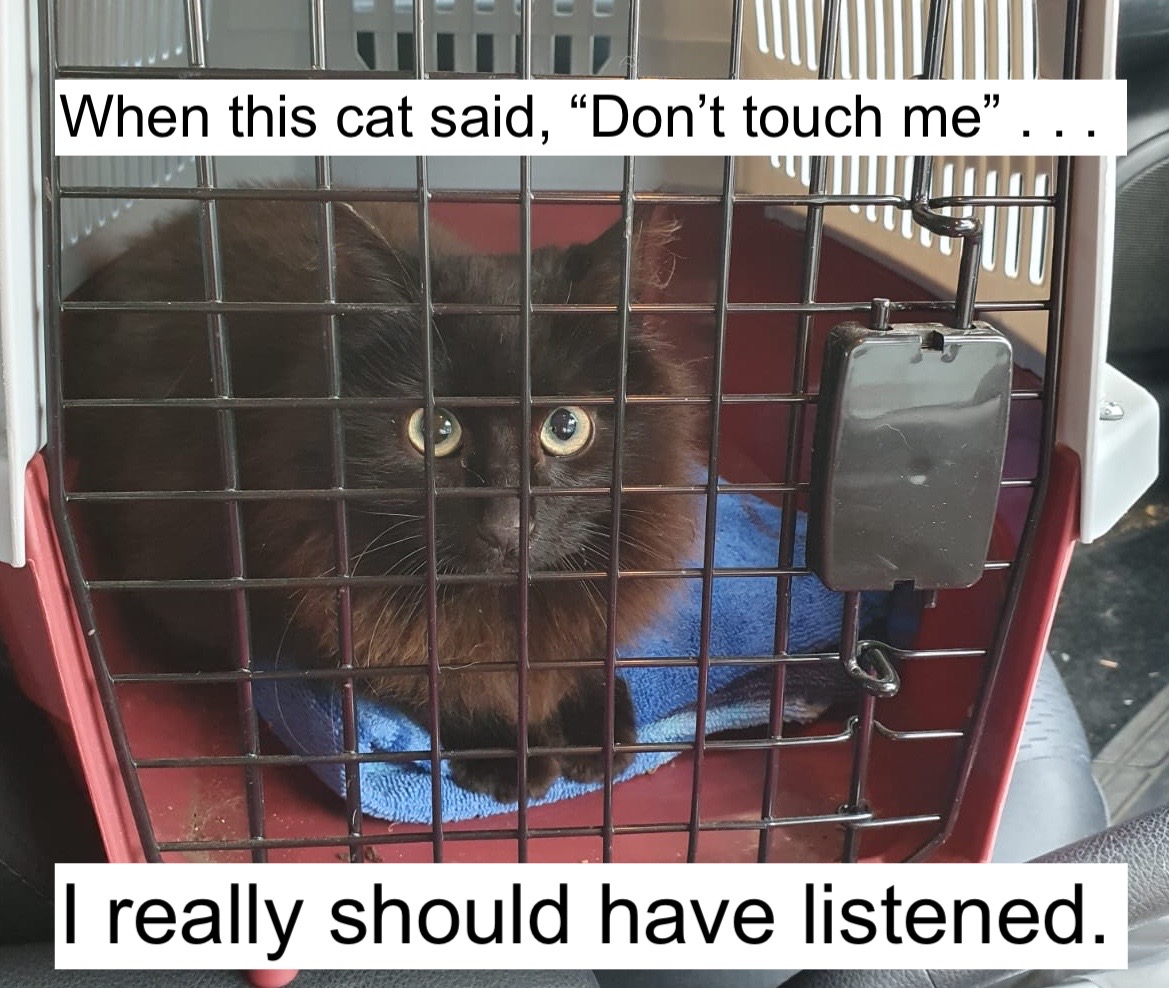
So why was I in hospital? Because when I’m not running a refugee sponsorship group and occasionally throwing chicken nuggets at my two special-needs kids, I foster feral kittens. It’s very new, so I foolishly handled an adult feral cat without donning a full set of armour first. As a result I ended up in hospital with an infection that required IV antibiotics and surgery. My finger is technically still infected and I have to go back to hospital tomorrow (Friday) to see if I need a second surgery. I was discharged last Saturday and told to rest and heal, or face the consequences. And, although I love the drugs they give a girl for most surgeries (which also fix all my fibromyalgia pain for about half an hour after I wake up), this type of hand surgery uses a local anesthetic injected directly into my nerves. It hurt like giving birth (not an exaggeration) and I don’t EVER want to go through that pain again.
Lesson 1 for CRISP groups: If at all possible, make sure every group member has a reasonable amount of free time during the most intense early weeks of the sponsorship journey. And are in the right city. And don’t start any other charities or dangerous jobs immediately before the likely arrival date, like some kind of extremely silly person.
Due to technological and language difficulties at the Iran end, the Afghan family only found out they were coming to Australia fifteen days before they arrived. They speak no English whatsoever. I speak no Farsi, and nor does anyone else in the Castle of Kindness group. The family has been living in Iran as refugees for thirty years and all four children were born there. The oldest is twenty and the youngest is a toddler.
I was able to talk to the oldest on WhatsApp. He was obviously very tech savvy and without prompting was replying to me in English (so now I write to him in English, he translates it into Farsi using Google Translate, writes his response, and translates his response into English… and then pastes the translation into WhatsApp for me). Cool. I sent him photos of the house to give them all an idea of what to expect (without saying something vaguely threatening like, “The house we got you is suuper gross and ugly with an energy rating of minus five stars”). They’re used to four seasons including winter mornings similar to Canberra, so that was reassuring.
I sent pictures of my cats (and kids, and the rest of the Castle of Kindness) and asked a few questions, while trying not to bombard him with pre-arrival interrogation or ask semi-racist questions like if they were living in a tent with a communal pit toilet or something like that (which might mean we needed to teach them “living in a house” type skills like flushing a toilet after use).
It often took eight hours or so for messages to reach him but we did okay.
He is a cat person, so already showing signs of being an intelligent and discerning individual.

Translation apps are incredible, but they’re not perfect.
We got a fridge (free, and the right size) and some help, mainly from a group member’s grandsons who were visiting her that weekend (for only the weekend, so their time was doubly precious). And my uncle, who is over seventy but considerably fitter than most people I know. Chris is literally the only male in our group so of course he was on “Driving the truck to Cooma and fetching large furniture from an upstairs room” duty. Among many other jobs.
Lesson 2 for CRISP groups: Try real hard to have several able-bodied people in your group (or associated with it), and a range of genders (for different areas of expertise and for cultural sensitivity so all arriving genders have someone they feel comfortable talking to).
Wednesday 21 June: the day before arrival day:
My godparents live in Sydney and are two of the nicest people on Planet Earth. Their house is host to a constant stream of visitors including their adult kids, their godkids, and randoms from all walks of life. I called them up around 11am and said, “Can my family and possibly one or two other Castle of Kindness people and/or friendly translators stay with you tonight and possibly tomorrow night as well, and tomorrow night can we also bring another six people who don’t speak any English and will be extremely tired? I have some air beds. We’ll also need to pick them up at the airport at 6am and do you know anyone with Farsi and/or a minivan?”
They laughed with the kind of manic glee that I very much appreciate, and said, “We’d love to have you and anyone else; we’ll be out tomorrow night but you can help yourself to anything in the house; we don’t know any minivan owners but might have a distant connection to a Farsi speaker; and do you need us to come to the airport with you to help pick them up?”
Then they immediately went out and bought Weetbix for Chris to eat, and Turkish flatbread and hommus for the Afghan family.
I am so incredibly lucky to know these people. And so is the world. You’ll never guess why they’re busy Thursday night. . . they’re in the process of forming another CRISP refugee sponsorship group with a bunch of other people. (There are about eighty groups around Australia, and more all the time. You need at least five adults and a little bit of training and paperwork that CRSA helps you to do.)
When we found out that a flight to Canberra had been booked, we altered the plan again. Chris and I and the kids would stay with my godparents and Chris would drop me at the airport on his way home. I’d meet the family at the airport and fly with them back to Canberra. The godparents would never see them… or us, because we’d arrive at 10:30pm and leave at 5:00am. I was very annoyed to not get to bask in the warmth of their love for me but I’d just have to soak it up through the walls this time.
Did I mention they’re recovering from covid and very tired?
They were glad they didn’t have to join the airport run.
But.
They both got up at 4am so they could talk to me. I’m getting misty-eyed just thinking about it.
Everything went more or less smoothly from 4am-6am of arrival day (Thursday 22 June—the winter solstice in this hemisphere) except I was sweaty from frantic packing on Wednesday and didn’t have time to shower. I changed my clothes and hoped the refugees didn’t notice.
It turned out that my sweatiness nearly got the family kidnapped.
Lesson 3 for CRISP groups: Try not to look like a crackhead when meeting the family.
But for the most genuinely terrifying part of this incredible story, you’ll have to wait for Part 2. (You won’t have to wait long; I clearly need to debrief before my body will let me sleep.)

Part 2 is here.
Spicy Kittens (Part 2)
Cinnamon is fond of me and the kids. He (yes I think he’s a boy) views Chris with suspicion, because he hasn’t seen Chris as much. He purrs when we pat him, does adorable stretches, washes himself, and falls asleep.
He is still extremely cautious, barely even playful at all (which I’m starting to worry about). He also has worms, which we treated last night.
He is underweight for his estimated age of 8-9 weeks, but gaining fast. He’s scared by new locations but not particularly scared of our cats. They are terrified of him.
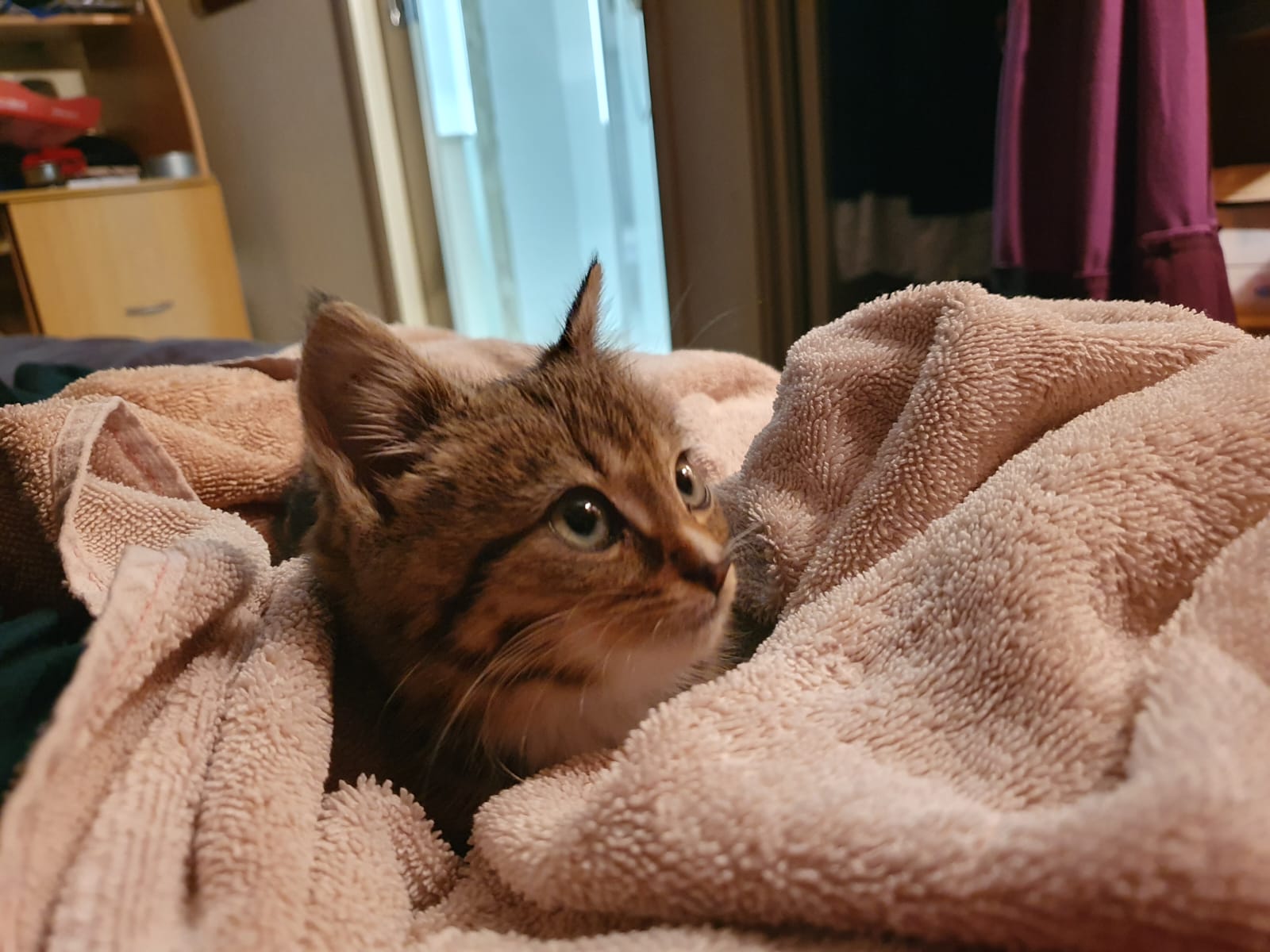
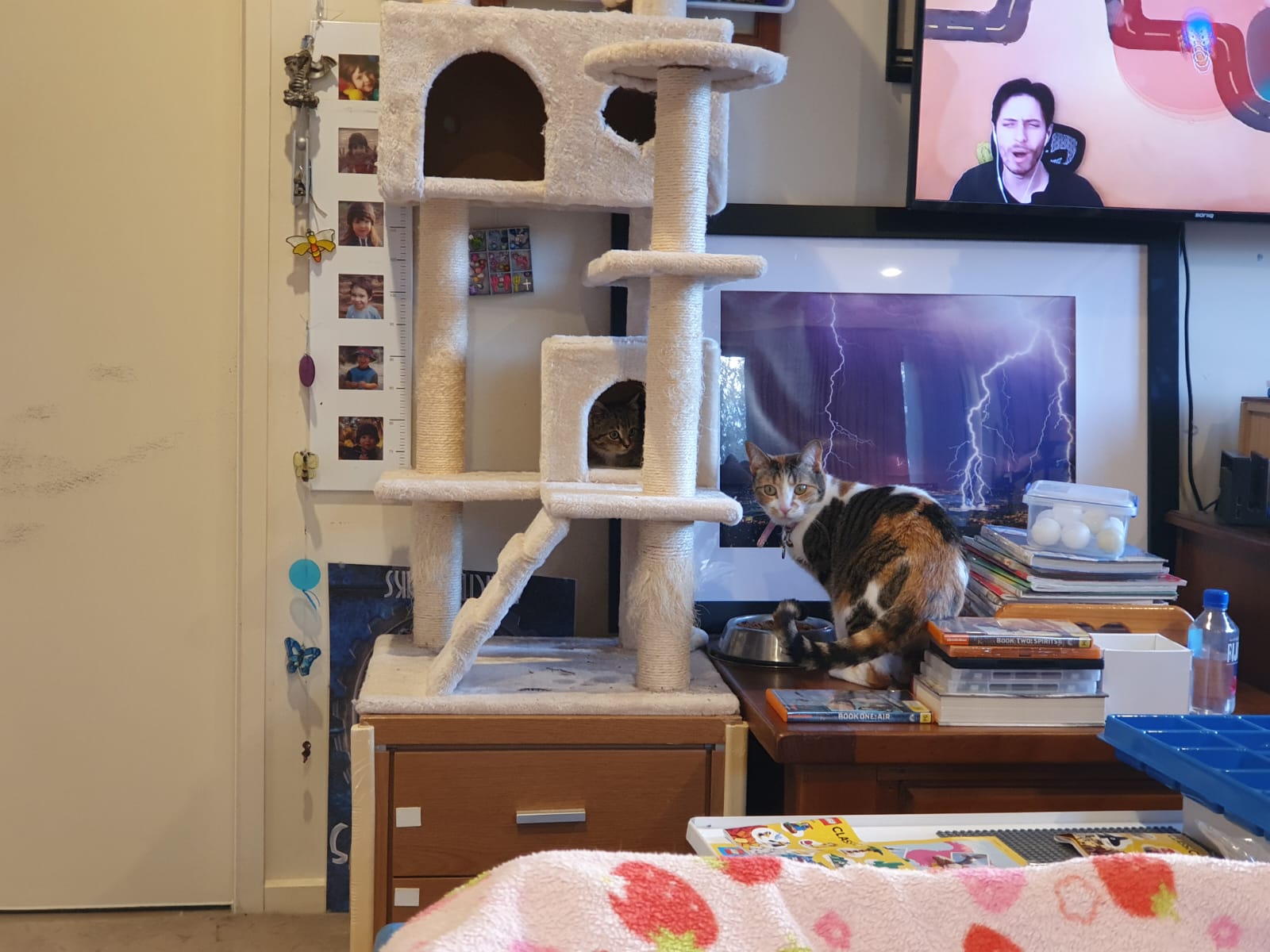
He’s in the cat tower here, where he stayed for a while. Then he meowed at me to take him ‘Home’ to the bathroom/bedroom.
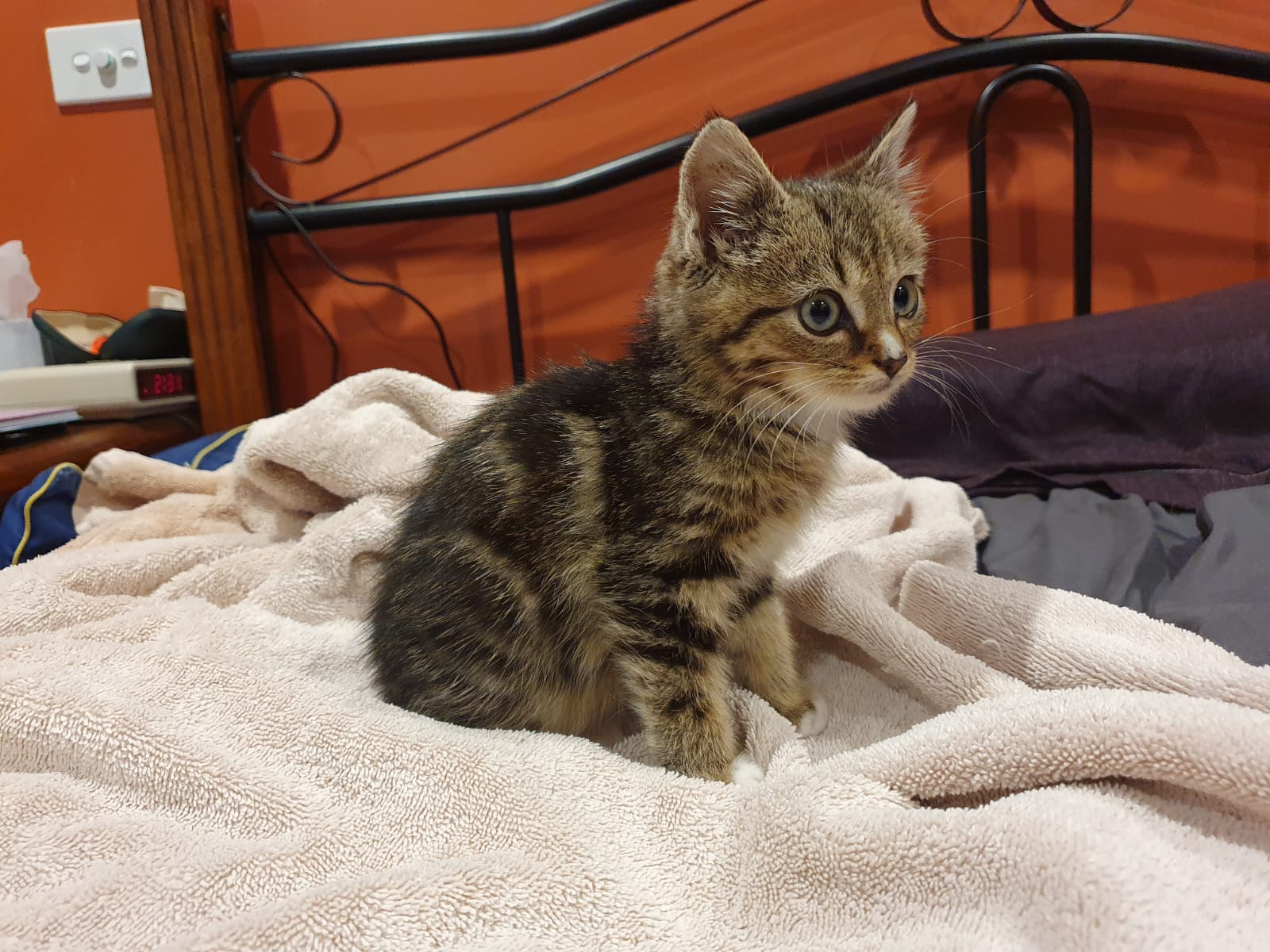
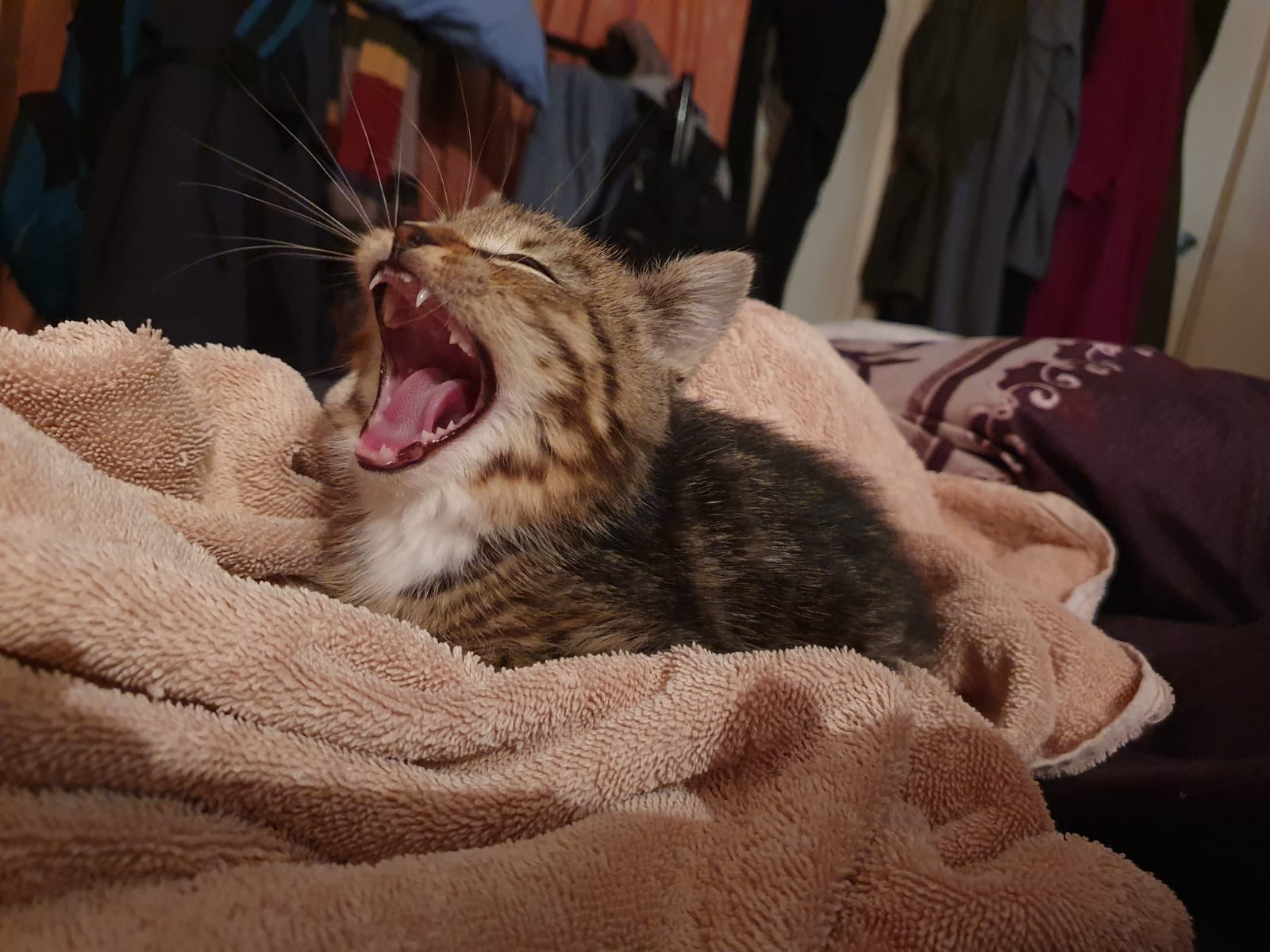
He loves grooming his pet humans.
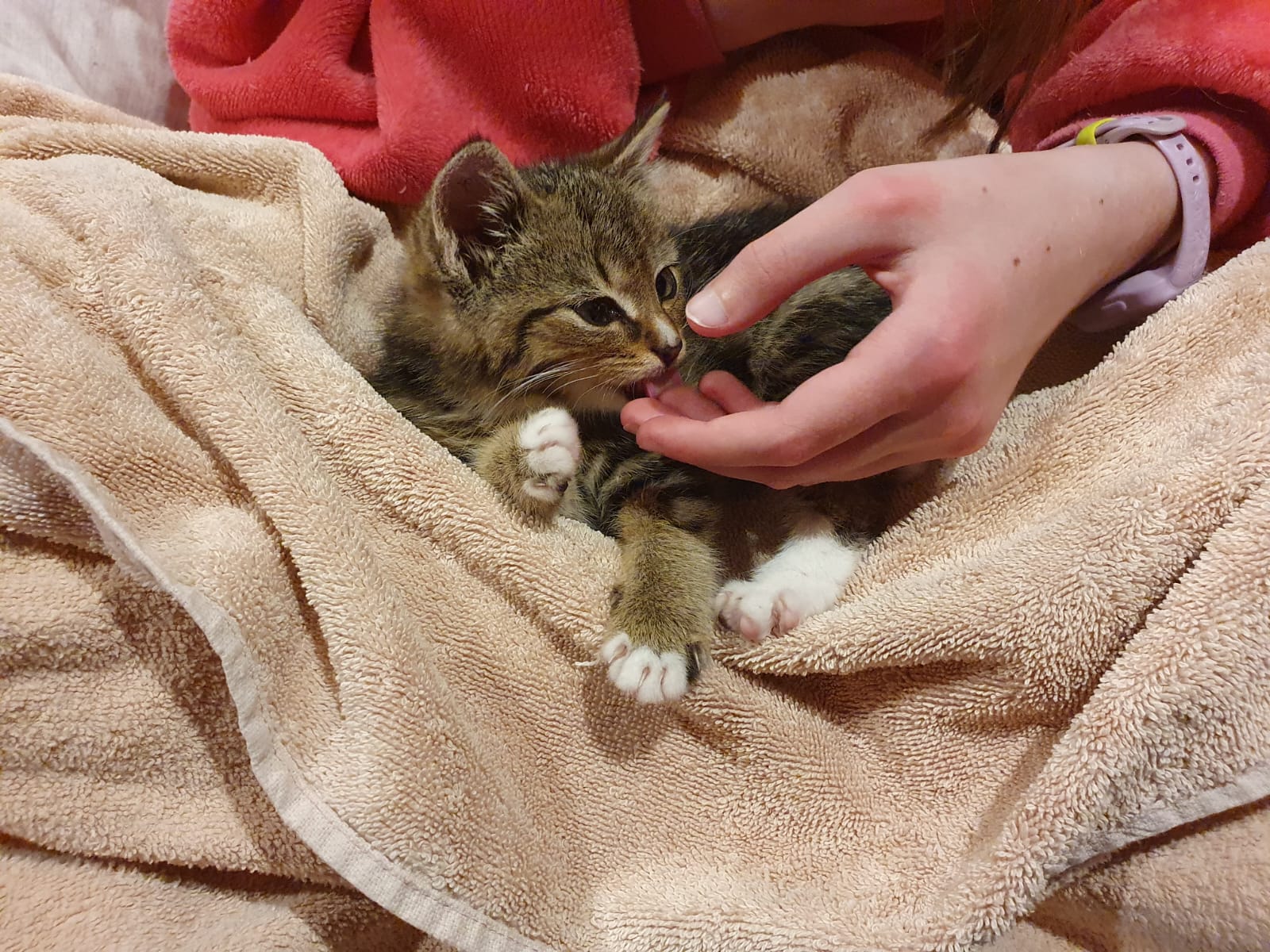

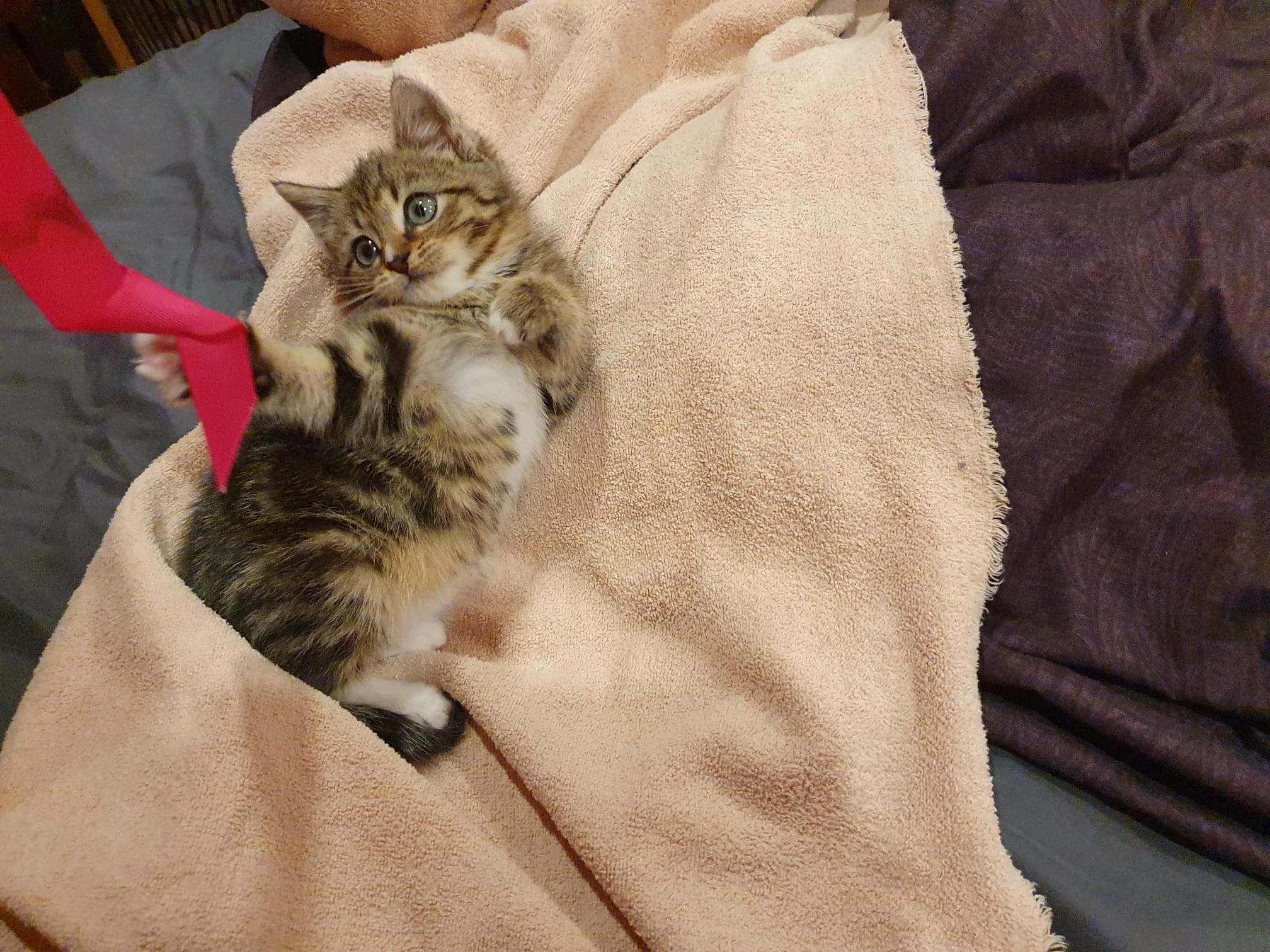
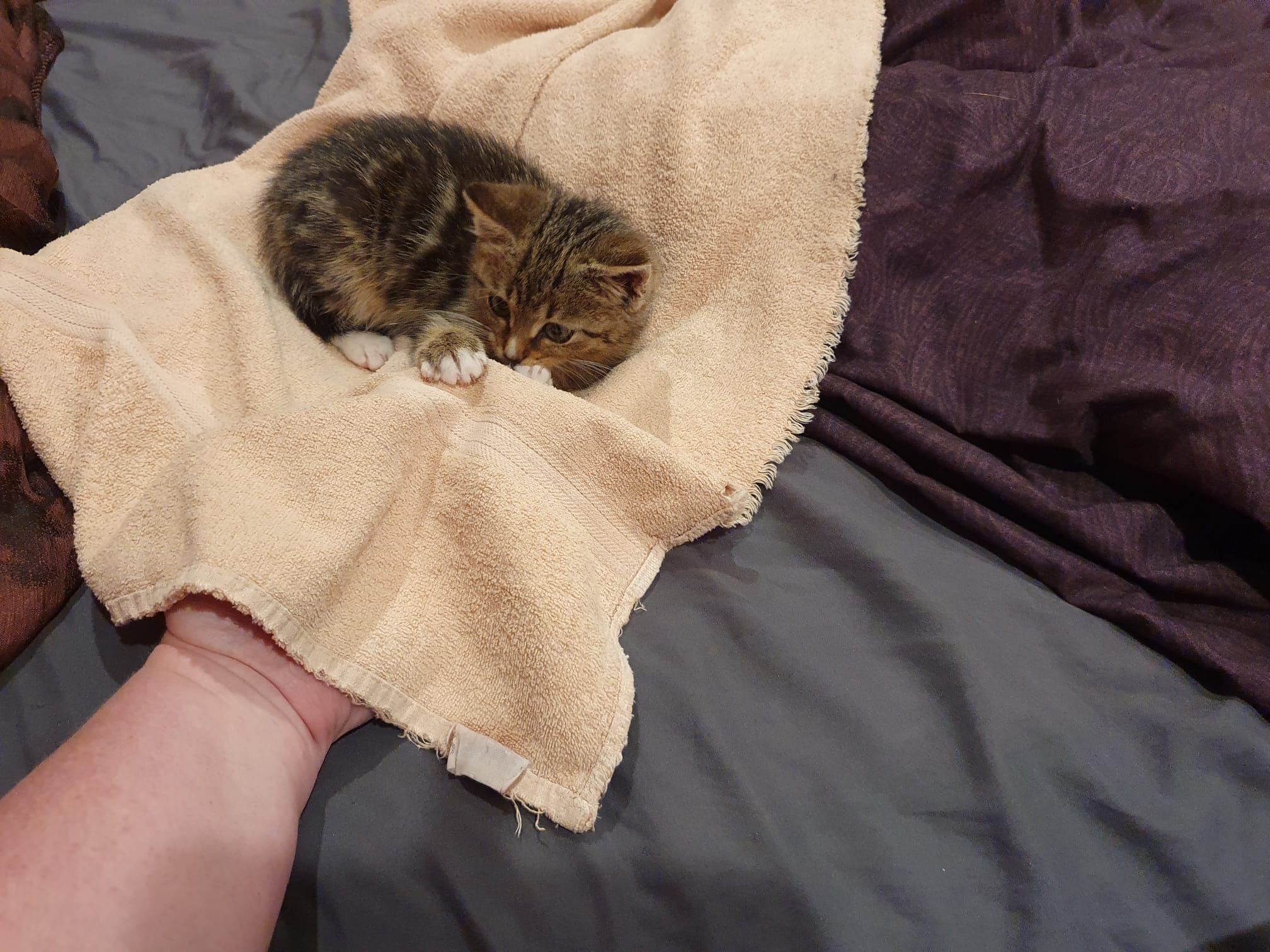
My teenage nephew and I spent over an hour trying to catch more last Wednesday, and failed. (Partly because my nephew is too soft-hearted.) But I reckon I’ll try again on Monday, since it’s a public holiday so my kids will be at home with their dad.
The colony gets fed around 5/5:30 each night, so that’s the only window of opportunity for trapping more. There are at least three more kittens: Pepper (black shorthair), Beardface/Basil (dark and fluffy with a white chest), and another fluffy one.
The RSPCA’s Volunteer Coordinator (and trainer) is on leave for at least another week so I definitely can’t foster them via the RSPCA but two people have donated $100 each so I can at least foster Cinnamon. But of course I really want to foster two together so they don’t get Single Kitten Syndrome.
And I have started looking for work as an editor and/or proofreader—from home, about 10 hours per week. If I can get a job like that, both my health and my family finances will be better off. But there are thousands of novelists (published and unpublished) in Australia who would like to use their writing skills for money, so it won’t be easy.
Or maybe it will be, who knows? I cold called a great company yesterday and they said the CEO would call me back after a meeting. They didn’t… but maybe I’m on a to-do list somewhere.
In big news, the Castle of Kindness Refugee Sponsorship Group was matched with an Afghan refugee family back in February, and we were just given an arrival date later this month. We have signed a lease on a short-term house that is very close to mine, and we’ll be moving in next weekend!
Corsets & Roller Skates: History is Stranger Than You Think
This post was originally written for a guest blog for someone else (I think).
This photo was something I came across while trying to sort out one of my many email accounts. It’s very strange to think that this is really me. THAT TINY WAIST! I was going to post it with a good solid whine about how two of my most important medications also cause massive weight gain and how much that sucks, so… I guess I just did, hey?
Let’s start the post then, which I wrote back in 2015.

Yep, the Victorians were insane… but not in the way you might think.
My interactive novel Attack of the Clockwork Army is steampunk, and features a family of mad scientists. They don’t think of themselves as mad, and by real-life 1850s standards they barely count as eccentric.
As you may have guessed by the title of this blog entry, it was the Victorians who invented roller skates. Casting an eye over patents of the era feels like reading a particularly ludicrous sci-fi novel. The Victorians invented an enormous and noisy device that (allegedly) automatically brushed down your horse. It featured long, spider-like iron arms and an array of cogs, wheels, belts, and counterweights. Any horse worth its meat would have taken one look and kicked it to pieces.
The Victorians also invented the moustache protector, the steam-powered lawnmower (which weighed over a ton and was remarkably difficult to either steer or brake), and (a personal favourite) the anti-garrotte cravat.
I’m fond of the cravat because it’s linked to my particular area of interest: Australia. When Australian residents managed to put a stop to the convict transports to Australia, Londoners feared that all their home-made criminals would be stuck on their own island, and could attack their own people at any moment.
Perhaps now is a good time to admit that I am, in fact, Australian.
I researched 1800s Australia in preparation for inventing my own steampunk version of that history, and to this day the more I read about the era the more incredulous I become.
Cross-dressing, for example. Australia’s early law enforcement was horrifically corrupt, and that corruption was especially blatant on the goldfields. People flocked to Australia from all over the world, and some became fabulously wealthy. Others were so unsuccessful that they couldn’t even afford to pay for a gold-digging licence. The licences were severely overpriced, and the fees for lack of a licence were even worse.
And that, dear reader, is why scores of tough colonial men would greet the local lawmen dressed in full female regalia, and claim that their “brother” or “husband” was elsewhere – “and he has the licence of course, officer.” It is frankly unbelievable that this worked, but it did.
And then we come to the Bentley family. Mr Bentley owned the Eureka Hotel on the Ballarat goldfields. He was good friends with powerful British men (including the magistrate), and was wealthy. One night when a drunken digger yelled to be let into the hotel for a few more drinks, Bentley refused.
From there the story gets murky, and the true events are still being argued over today. One thing is clear: the digger was dead by morning.
According to the small amount of evidence available, Bentley either did the murder or knew who did, but he was not convicted by his powerful friend. It looked like he’d get away with it. Some eyewitnesses said he followed the digger that night and killed him. One eyewitness report actually implies that his pregnant wife did the deed. (Never, ever mess with a pregnant woman.)
The simmering anger on the goldfields soon exploded, and Bentley’s hotel was burned down. For reasons that have never been fully explained, Bentley fled the scene alone on a borrowed horse… wearing a dress.
So if you think steampunk cross-dressing is unlikely, think again. And next time someone on roller skates nearly knocks you over, just be glad they’re not insisting you wear a corset and crinolines every day.
My interactive steampunk novel, Attack of the Clockwork Army is set in Australia. You can choose to be male or female, gay or straight, black or white. You can even choose to fight for the British, or not to fight at all.
The book is available as a Choose Your Own Adventure-style app for your device on Amazon, Apple, Android, and Chrome. You can also buy it directly from the publisher (an easy way to buy and read it on your computer).
The app stores list it as “free, with in-app purchases”. What this actually means is that the beginning is free, and then you pay $5 (once!) to read the rest.
https://itunes.apple.com/us/app/attack-of-the-clockwork-army/id1042824941?mt=8
https://chrome.google.com/webstore/detail/attack-of-the-clockwork-a/oojmcpcnhdedgiegdocaedonlgfhlpgj
If you want to know about ALL my interlinked magical steampunk tales, take a look here.

 Felicity Banks